
When a child's well-being is on the line, the legal terms "guardianship" and "custody" often come up. For Texas families exploring their options, these words might seem interchangeable, but they represent very different legal paths. Understanding this difference is the first, most important step in choosing the right way to protect a child you love.
The core distinction boils down to who is being given responsibility for the child and which court is making the decision. Is it a parent sorting out rights after a divorce, or a grandparent stepping in because the parents are unable to provide care? Each scenario triggers a unique legal process designed to protect the child's best interests.
At The Law Office of Bryan Fagan, PLLC, we have guided countless Texas families through these emotional and complex situations. Whether you are a relative needing to provide a stable home, a hopeful adoptive parent, or a birth parent exploring your options, gaining clarity on these concepts is essential for making an empowered decision.

Quick Comparison: Guardianship vs. Custody (Conservatorship)
To make it simple, let's break down the key differences between guardianship and custody (which Texas law calls conservatorship). This table gives you a quick snapshot before we dive deeper into what each one means for you and the child.
| Legal Aspect | Guardianship (Probate Court) | Custody / Conservatorship (Family Court) |
|---|---|---|
| Who It's For | Usually for a non-parent (like a grandparent or aunt) when parents are unable to care for the child. | Primarily for parents to establish their rights and duties, most often during a divorce or separation. |
| Parental Rights | Parental rights are suspended, not permanently terminated. The parent remains the legal parent, but their ability to act is paused. | Parental rights are divided between the parents, outlining who makes decisions about the child's life. |
| Court Type | Handled in Probate Court, which deals with cases of incapacity and appointing a responsible party. | Handled in Family Court, which always focuses on the "best interest of the child." |
| Common Scenarios | A parent is incarcerated, has passed away, is seriously ill, or has abandoned the child. | Parents are divorcing, separating, or unmarried parents are establishing legal paternity. |
This side-by-side view should give you a good starting point. While the core ideas are similar across the country, Texas has its own specific laws and procedures that make a big difference, particularly those outlined in the Texas Family Code.
For a broader overview, you might find some useful context in this article exploring the fundamental differences between custody and guardianship. Even though it's not specific to Texas, the general principles can help clarify these two distinct legal paths.
Comparing Legal Authority and Parental Rights
When you are trying to protect a child, understanding the true scope of your legal authority is everything. This is where the core difference between guardianship and custody really comes into focus—it all boils down to how they affect parental rights and who gets the final say.
Think of it like this: Guardianship is like temporarily holding the keys to the house for someone who can't be there. Custody, or conservatorship as it's known in Texas, is about officially dividing up ownership and responsibilities for that same house between the parents.
Who Makes the Major Decisions?
One of the biggest distinctions is decision-making power. In a guardianship, the court grants the guardian sweeping authority to make critical choices for the child because the biological parents are unable to do so.
- Medical Care: A guardian can approve everything from a routine check-up to emergency surgery without needing to track down a parent for consent.
- Education: They have the power to enroll the child in school, meet with teachers, and make the day-to-day educational choices that shape a child’s future.
- Daily Life: The guardian is in charge of it all—where the child lives, their daily routine, and their general well-being.
A Texas custody order, on the other hand, almost always splits these rights between the parents under a Joint Managing Conservatorship. The court order details which parent gets the final say on specific issues if they disagree, but the fundamental expectation is co-parenting. The goal is for parents to work together, whereas guardianship is about a non-parent taking over when parents cannot.
The most crucial takeaway is this: Guardianship is established because parents cannot fulfill their duties, while a custody order defines how parents will fulfill their duties separately.
The Impact on Parental Rights
This is where the real emotional and legal weight of the decision hits home. Both guardianship and custody redefine the legal relationship between a parent and child, but they do so in fundamentally different ways.
A guardianship suspends parental rights. The parents don't stop being the legal parents, but the probate court essentially puts their ability to exercise their rights on hold. This is a protective measure, often with the hope that the parent can one day get back on their feet and resume their role. The legal parent-child bond remains intact, which is a key principle in Texas family law.
In sharp contrast, a custody order doesn't suspend rights; it allocates them. A family court judge meticulously decides which parent has which specific rights and duties. Even a parent named the "possessory conservator" (the non-primary parent) still holds significant parental rights, like accessing their child's school and medical records.
It’s critical to understand that neither guardianship nor custody automatically severs the legal ties between a parent and child. That requires a completely separate and far more permanent legal action. You can learn more about what it means to terminate parental rights in our detailed guide on the subject. Knowing this difference is vital, as it protects that sacred legal bond unless a court determines it's in the child's best interest to end it for good.
Ultimately, choosing the right path depends entirely on your family's unique circumstances—whether you're a relative stepping in during a crisis or a parent navigating a new family structure after a split.
When Guardianship Is the Right Choice for a Child
In some of the most challenging family situations, guardianship isn't just a legal option—it's a lifeline for a child. It's a powerful tool designed for those moments when a parent simply cannot provide the care their child needs. This isn't about judging a parent; it’s about ensuring a child stays safe, stable, and loved through a crisis.
Imagine a grandparent getting a call that their grandchild’s single parent has been hospitalized with a long-term illness. Or think about an aunt who must step in because a parent is facing incarceration. In these real-world scenarios, a loving relative becomes the child's primary caregiver overnight. But love alone isn't enough to handle the legal and practical realities of raising a child.

Providing Stability When It Matters Most
Without any legal authority, a caregiver—even a very close relative—will hit major roadblocks. They might be blocked from enrolling the child in a new school, giving consent for necessary medical care, or even signing a permission slip for a field trip. This is exactly where guardianship provides the essential framework for stability.
A probate court can grant a guardian the legal power to:
- Make Healthcare Decisions: This covers everything from routine vaccinations to consenting to emergency surgical procedures.
- Handle Educational Needs: A guardian can legally enroll the child in school, show up at parent-teacher conferences, and access academic records.
- Manage Daily Life: This authority extends to all the day-to-day decisions, like where the child lives and who supervises them, ensuring their life continues with as little disruption as possible.
Guardianship formalizes the caregiver's role. It gives them the legal standing they need to protect and provide for the child effectively, transforming them from a temporary helper into a recognized, empowered advocate for the child’s best interests.
Preserving the Parent-Child Bond
One of the most compassionate features of guardianship is that it suspends parental rights rather than terminating them completely. This distinction is critical. The goal isn’t to erase the parent from the child's life but to create a safe harbor until the parent is able to resume their responsibilities.
Guardianship is a protective measure, not a permanent one. It prioritizes the child's immediate safety while holding space for the possibility of family reunification down the road.
This approach acknowledges the deep-rooted importance of the parent-child relationship. It allows for visitation and contact when appropriate, fostering connection and hope for the future. For many families, just knowing that the door to reunification can remain open provides immense emotional relief during an otherwise difficult time.
Why Guardianship Offers Unique Protections
The distinction between guardianship and custody represents a fundamental divide in family law. While the overwhelming majority of kinship caregivers are granted custody, very few receive the additional legal protections of formal guardianship. Guardians can consent to medical treatment and ensure private health insurance coverage for children, authorities that custodial parents often lack. This gap highlights why choosing guardianship can provide crucial protections when a relative becomes responsible for a child due to parental illness, incarceration, or substance abuse. Discover more about the statistics that shape these family law decisions.
Ultimately, guardianship is the right choice when a child needs a legally recognized caregiver to step into the shoes of a parent who is temporarily unable to fulfill their role. It’s a solution born of necessity and rooted in the unwavering commitment to a child’s well-being and security.
How Texas Child Custody (Conservatorship) Orders Work
While guardianship is a solution for when parents can't care for a child, a custody order is all about how parents will care for their child after splitting up. In Texas, we don't officially use the word "custody." Instead, the law refers to it as conservatorship. This legal framework is built around a single, powerful principle: doing what is in the best interest of the child.
These orders are handled in family court, typically as part of a divorce or a Suit Affecting the Parent-Child Relationship (SAPCR) for unmarried parents. A conservatorship order isn't a temporary patch for a crisis; it's a long-term roadmap that spells out the specific rights and duties for each parent. The goal is to create a predictable, stable structure that helps children thrive by minimizing conflict and keeping both parents in their lives.
Joint vs. Sole Managing Conservatorship
Texas law begins with a strong preference for Joint Managing Conservatorship (JMC). The court presumes this is what's best for the child, making it the most common arrangement by far. In a JMC, parents share the rights and responsibilities of raising their child.
Now, "joint" doesn't automatically mean a 50/50 time split. The focus is more on shared decision-making for the big stuff, like:
- Medical and Dental Care: Both parents usually have the right to consent to routine medical treatments.
- Education: Parents work together on decisions about their child's schooling.
- Moral and Religious Upbringing: Both parents have a say in these aspects of the child's life.
Even in a JMC, one parent is typically named the "primary" conservator. This parent has the exclusive right to decide where the child lives, though it's often restricted to a certain geographic area.
On the other hand, in rare cases where co-parenting would actively harm a child—think situations involving family violence, substance abuse, or extreme conflict—a judge can order a Sole Managing Conservatorship (SMC). This gives one parent the exclusive right to make most major decisions, creating a vital layer of protection in high-risk family situations.
The Best Interest of the Child Standard
Every single decision a Texas family court judge makes about conservatorship boils down to the "best interest of the child." This isn't just a sentimental phrase; it's a specific legal standard defined by factors in the Texas Family Code.
A judge’s goal is to create an environment that will foster a child's emotional and physical well-being. They will look at the complete picture of a family's life to determine what arrangement best supports the child's growth and happiness.
While the list isn't exhaustive, here are some of the key things a judge will weigh:
- The child’s current and future physical and emotional needs.
- Any physical or emotional danger the child might be in.
- The parenting abilities of each person seeking custody.
- The stability of the home (or proposed homes).
- Any actions or failures to act by a parent that suggest an improper parent-child relationship.
Custody outcomes can look very different from family to family. In the U.S., where only about 60% of children live in intact families, custody arrangements reflect these evolving dynamics. While shared parenting is on the rise, older data showed that custodial mothers were more likely to have child support agreements (52.3%) than custodial fathers (31.4%). This points to historical trends that courts are now moving away from in favor of more balanced, shared responsibility. You can learn more about evolving child custody frameworks and how they are changing.
Ultimately, a Texas custody order is a detailed, enforceable roadmap for co-parenting. It’s designed to provide clarity and, above all, give a child the best possible shot at a secure and happy future.
Navigating the Different Court Processes
Understanding the legal road ahead is one of the best ways to reduce anxiety and feel in control of your family’s future. When you're weighing guardianship against custody, it's not just the final outcome that's different—the entire court process is, too. Each path takes you into a different type of Texas court, each with its own focus, rules, and key players.
This is a fundamental difference. Guardianship cases are heard in probate courts, while custody matters are handled in family courts. Just knowing which courtroom you'll be walking into helps set the right expectations from day one.
The World of Probate Court in Guardianship Cases
Probate courts in Texas are all about handling matters of legal incapacity. That’s exactly why guardianship falls under their jurisdiction—these cases arise because a parent is considered legally unable to care for their child. The court’s primary job is to determine if a parent is incapacitated and, if so, to appoint a responsible adult—the guardian—to step in and protect the child.
The focus here isn't on the relationship between the parents. Instead, the judge zeroes in on two critical questions:
- Parental Incapacity: Is there clear, convincing evidence that the parent cannot adequately provide for the child’s physical and emotional needs? The court needs solid proof, not just opinions.
- Guardian Fitness: Is the person asking for guardianship suitable and ready for the job? The court will conduct a thorough review of their background and ability to provide a safe, stable home.
The Role of Family Court in Custody Cases
Family courts, on the other hand, start from a completely different place. Their entire focus is on spelling out the rights and duties between parents in a way that serves the child's best interest. When parents divorce or separate, the family court steps in to create a formal parenting plan, which in Texas is legally called a conservatorship order.
Instead of questioning a parent's fundamental ability to care for a child, the court is simply allocating responsibilities. The judge’s goal is to build a predictable, stable routine that allows the child to maintain a strong relationship with both parents whenever possible.
The core difference is this: Probate court steps in because parental care has broken down. Family court steps in to structure how parental care will continue after a separation.
Key Figures and Necessary Evidence
In either courtroom, an attorney ad litem might be appointed. This is an attorney whose only client is the child. Their job is to represent the child’s best interests, acting as the court's eyes and ears to understand the child's needs, circumstances, and wishes.
The type of evidence you'll need is also completely different. For a guardianship, you have to present proof of the parent's inability to provide care—think medical records, evidence of incarceration, or testimony about severe substance abuse. If you're heading down this road, our guide on how to become a legal guardian in Texas breaks down the requirements step-by-step.
For custody cases, the evidence is all about each parent's ability to provide a stable environment, their history of involvement in the child's life, and anything else that might impact the child's well-being.
Every year, family and probate courts across the United States handle a staggering volume of cases, including an estimated 290,000 guardianship cases and millions of custody-related filings. But there's good news: a remarkable 90% of custody cases are settled without a full-blown court trial, which shows just how effective negotiation and mediation can be. You can learn more about the volume and nature of these family law statistics. Understanding which path your case will take is the first step toward finding the right resolution for your family.
Choosing the Best Path for Your Family
Deciding between guardianship and custody can feel overwhelming, like standing at a crossroads without a map. But it becomes much clearer when you focus on one thing: the reason you need to step in. Think of guardianship as a legal shield, put in place to protect a child when their parents simply can't. Custody (or conservatorship), on the other hand, is a roadmap for parents who are separating but will continue to share responsibility for their child.
The right path always comes down to what will give the child the most stability, safety, and support.
To get to that answer, ask yourself a few key questions. Is this situation likely temporary, or does it feel permanent? How important is it to protect the biological parents' rights while ensuring the child's daily needs are met right now? What kind of legal power do you actually need to enroll them in school or get them medical care without hitting a wall of red tape?
Making an Informed Decision
Mulling over these questions is your first real step toward clarity. The way forward usually becomes obvious once you figure out if you're dealing with a crisis that needs a temporary fix (guardianship) or a long-term plan for co-parenting (custody).
This flowchart helps visualize that initial decision point, depending on whether the parents are disagreeing over their roles or are unable to fulfill them.
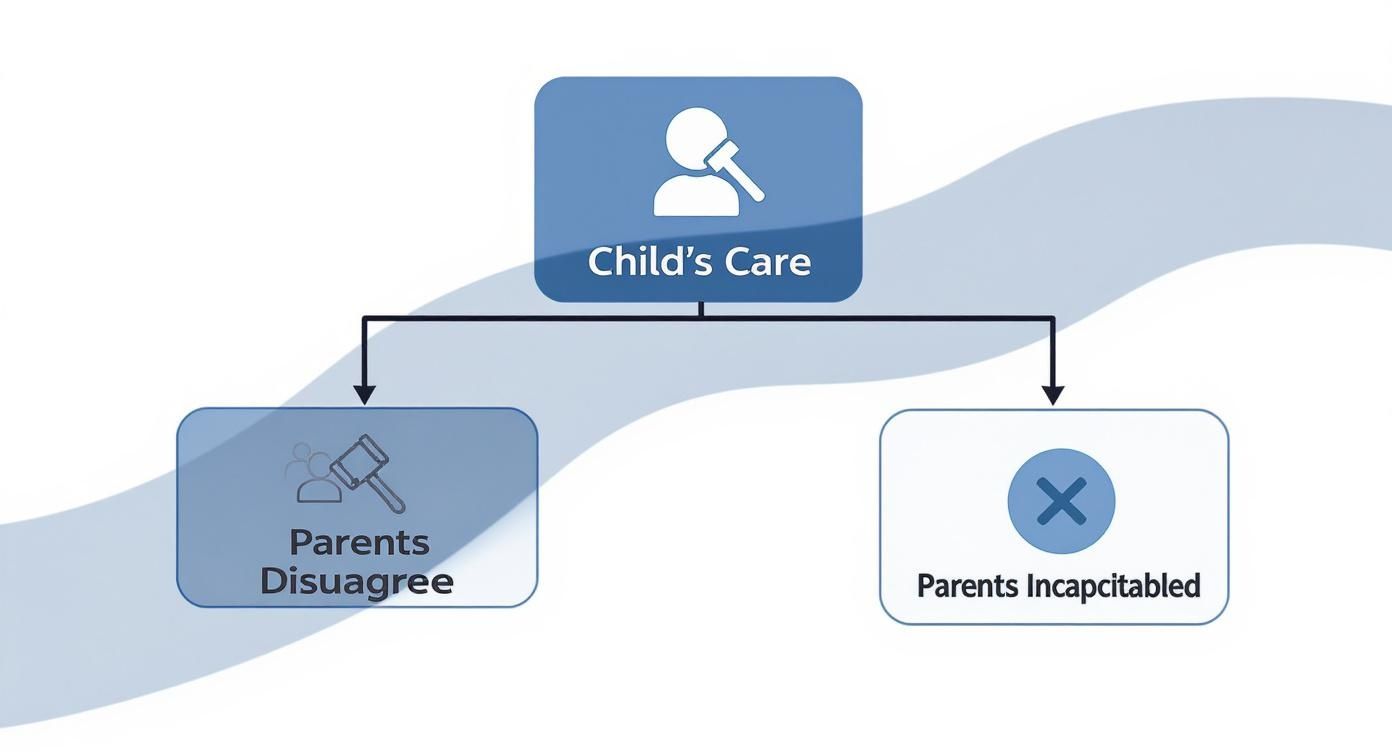
As you can see, the parents' own circumstances are what typically funnel a case toward either family court for a custody matter or probate court to establish a guardianship.
While this guide is meant to arm you with knowledge, it’s not a substitute for legal advice. Every family's situation is unique, and the small details can make a huge difference. For those looking for more in-depth support, you can often find additional guidance on family legal matters through dedicated legal resource centers.
Choosing between guardianship and custody is one of the most significant decisions you can make for a child. Your choice will shape their future, provide stability, and define their family structure for years to come.
Your family deserves peace of mind. At The Law Office of Bryan Fagan, PLLC, we are here to provide the compassionate legal counsel you need to protect the child you love. Schedule a free, confidential consultation with us today to discuss your situation and secure a safe future for your family.
Frequently Asked Questions
When you're trying to figure out family law, it’s easy to get bogged down in the details. Here are some clear, straightforward answers to the questions we hear most often from Texas families weighing guardianship against custody.
Can a Guardian Receive Child Support in Texas?
This is a huge point of confusion for many people. Child support is a specific legal tool used in family court, usually as part of a custody case (known as a SAPCR). Guardianship, however, is a different process handled in probate court, which doesn't issue standard child support orders.
But that doesn't leave a guardian without options. A probate court judge absolutely has the power to order a parent to financially support their child, even when that child is under a guardianship. While it accomplishes the same goal as child support, the legal path to get there is different than a typical case between two parents.
Can a Parent Visit Their Child if Someone Has Guardianship?
Yes, absolutely. This is one of the most critical differences to remember: guardianship suspends parental rights, it doesn’t terminate them. The legal bond between parent and child is still there.
A probate court judge will almost always include visitation in the guardianship order. The specifics—how often, where, and if visits need to be supervised—are decided based on one thing: what is safe and in the child's best interest. The goal is often to keep that parent-child connection alive, leaving the door open for reunification if the parent's situation improves.
Is It Easier to Change a Guardianship or a Custody Order?
Both of these legal setups can be changed, but the proof you need to provide the court is very different. To modify a Texas custody order, you have to show that there's been a “material and substantial change” in the family’s situation since the last order was signed.
Getting a guardianship modified or ended is a much higher hurdle. You must prove to the probate court that the circumstances that created the need for the guardianship in the first place are completely gone. For instance, a parent would have to bring solid evidence showing they are now stable, healthy, and fully capable of taking back their parental duties. Because guardianship is put in place due to a parent’s inability to care for their child, reversing it means proving that ability has been fully restored.
The legal standard for ending a guardianship is tied directly to the parent's fitness. Modifying custody, on the other hand, is about how the family's overall circumstances have evolved. This key distinction highlights the very different jobs these two legal tools are designed to do.
Choosing the right path forward will have a profound impact on a child’s life and your family’s future. The details are complex, and the stakes couldn't be higher.
Every family's story is different, and you shouldn't have to navigate this alone. The compassionate team at The Law Office of Bryan Fagan, PLLC is here to bring clarity and provide the legal guidance you need to protect the child you love. We empower families to take the next step toward a stable, loving future.
Schedule a free, confidential consultation with us today to talk about your situation and take the first step toward securing a stable, loving future for your family.
