
At its core, the difference between adoption and fostering boils down to one powerful concept: permanence. Adoption is a permanent, legal process that creates a lifelong parent-child relationship. In contrast, fostering is a temporary, supportive arrangement designed to give a child a safe home while their birth family works toward reunification. Your choice will depend on whether you feel called to build your forever family or provide temporary, critical care for a child in crisis.
Comparing Your Journey: Adoption vs. Fostering
When you are considering welcoming a child into your home, understanding the difference between adoption and fostering is the most important first step. Both paths come from a place of love and a desire to provide stability, but they are guided by very different legal frameworks in Texas and lead to vastly different outcomes for everyone involved. Making the right decision for your family starts with a clear, compassionate look at what each journey truly asks of you.

Core Differences: Adoption vs. Fostering at a Glance
For families in Texas, these two paths offer distinct ways to support a child. To help you see the contrasts clearly, let's break down the essential aspects of each in a simple side-by-side comparison.
| Aspect | Adoption | Fostering |
|---|---|---|
| Goal & Permanency | To create a permanent, legally recognized family. This is a lifelong commitment. | To provide a temporary, safe home. The primary goal is reunification with the birth family. |
| Legal Status | You gain full, permanent parental rights, just as if the child were born to you. | You are a temporary caregiver. The state (DFPS) or a child-placing agency retains legal custody. |
| Parental Rights | Birth parents' rights are legally and permanently terminated. | Birth parents often retain their rights and work on a service plan to regain custody. |
| Financial Support | Families are financially responsible. Subsidies are available for adoptions from foster care. | Foster parents receive a monthly stipend from the state to cover the child's expenses. |
| Duration | Lifelong and permanent. | Temporary, lasting from a few days to several years, depending on the case. |
This table gives you a high-level view, but the emotional and practical weight of these differences is felt in the day-to-day journey. Each path requires a unique mindset and set of expectations.
The Heart of the Matter: Permanence
The most profound distinction lies in the legal outcome and the promise of a forever home. Adoption is a legal process governed by the Texas Family Code (Chapter 162) that transfers all parental rights and responsibilities from the birth parents to the adoptive parents, legally creating a new family. Fostering, however, is a temporary placement where children stay with licensed families while their birth parents work toward reunification or until another permanent option, like adoption, is found.
While both paths are profound acts of love, adoption answers the question, "Who will be my family forever?" Fostering answers the question, "Who will keep me safe right now?"
Nationally, about 50,193 children were adopted from foster care in 2023. While that number is significant, it represents just 27% of all exits from the system that year. This statistic is critical because it shows that while foster-to-adopt pathways are a reality for many, the primary mission of foster care is temporary support and, whenever possible, reunification.
You can learn more about these national trends through the latest foster care and adoption statistics. Understanding this core difference in purpose helps set realistic expectations from the very beginning of your journey.
Navigating Legal Status and Parental Rights
The single biggest difference between adoption and fostering boils down to one critical question: who holds parental rights? This isn't just legal terminology—it defines your entire relationship with the child, from everyday choices to their long-term future. Understanding these legal frameworks in Texas is the first step in figuring out which path is right for you.

When you adopt a child, you are building a new, permanent family, legally and completely. The process is guided by the Texas Family Code (Chapters 162-166), which lays out a clear path to becoming a legal parent.
Fostering, on the other hand, is a temporary service you provide for the state. You are a licensed, essential caregiver, but legal custody remains with the Texas Department of Family and Protective Services (DFPS).
Adoption: The Transfer of Permanent Parental Rights
Adoption is a final legal act. It concludes with a judge signing a court order that makes you the child's parent, full stop. A non-negotiable step in this journey is the termination of the birth parents' rights.
This legal action permanently severs the biological parents' rights and responsibilities, clearing the way for you to step in and assume them. Once the adoption is finalized, you have the full authority to make every decision for your child.
In the eyes of the law, an adopted child is your child, period. You hold the same rights, duties, and privileges as if they were born to you.
As a legal parent, you have the sole authority to:
- Make all medical and healthcare decisions.
- Enroll your child in the school you choose.
- Consent to travel, sports, or other activities.
- Decide on their religious upbringing.
This legal finality gives both the child and your family the ultimate security and stability. The road to get there can be complex, and it is vital to understand the legal steps. To learn more about this crucial stage, you can explore our guide on the Texas termination of parental rights.
Fostering: The Role of a Temporary Caregiver
Foster parents work within a completely different legal structure. You provide the day-to-day love, care, and support a child desperately needs, but your decision-making power is limited because you do not have legal custody. The state, through DFPS and the child’s caseworker, holds the final say.
This means you must consult with and get approval from the caseworker or the court for major decisions. This is because the primary goal in foster care is almost always reunification with the birth family, whose parental rights are usually still intact.
Here’s a real-life scenario to illustrate the difference:
Scenario: Medical Decisions
- Adoption: Imagine your adopted son, Leo, falls and breaks his arm at the park. You immediately take him to the hospital, consent to treatment, and make every decision about his care. No outside permission is needed.
- Fostering: Now, imagine a child in your foster care, Maya, breaks her arm. You provide immediate care and comfort, but you must notify her caseworker right away. Any major medical procedures would require consent from DFPS or, in some cases, Maya's birth parents.
This example gets to the heart of the legal distinction: adoption gives you total parental autonomy. Fostering makes you a key member of a professional team, working under the state's supervision to do what's best for the child. Both roles are incredibly important, but they are built on fundamentally different legal ground.
The Journey Toward Permanency for a Child
When you are thinking about opening your heart and home to a child, it is crucial to understand the end goal of each path. The entire emotional and practical journey of adoption versus fostering is defined by one core concept: permanency. One path is built to be temporary, while the other is designed to last a lifetime.

This fundamental difference in purpose shapes two very distinct experiences for the families and children involved. Understanding these timelines and goals will help you align your own hopes with the realities of each system in Texas.
Fostering: The Goal of Reunification
The primary mission of the Texas foster care system is to provide a safe, temporary haven for a child while their birth parents work to resolve the issues that led to state intervention. This means the central goal is almost always reunification.
As a foster parent, your role is incredibly complex and requires deep compassion. You are asked to love and care for a child as your own, all while actively supporting the state's efforts to return that child to their biological family. This can involve facilitating visits with birth parents and celebrating their progress toward regaining custody.
This creates an emotional journey filled with uncertainty. A placement can last for days, months, or sometimes years, and the timeline is often unpredictable, shifting with the progress of the birth parents' service plan.
A foster parent must hold two opposing ideas in their heart at once: the hope for the child to heal and thrive in their care, and the hope for the child's birth family to heal and be reunited.
This unique role demands immense emotional resilience and a solid commitment to the child's immediate well-being, even when their future is uncertain.
Adoption: The Promise of a Forever Family
In stark contrast, adoption has one clear and singular goal: to create a permanent, legally secure family. The entire process, as outlined in the Texas Family Code, is structured to move toward a definitive and final resolution that is in the best interests of the child.
Once a child is legally free for adoption—meaning the birth parents' rights have been terminated—the journey shifts from uncertainty to finality. The process is no longer about "if" the child will have a permanent family, but about formalizing that family through the courts.
This provides a powerful sense of stability for both the child and the adoptive parents. The timeline, while still involving legal steps like a home study and post-placement supervision, is structured and moves toward a known conclusion: the finalization hearing where the child legally becomes a member of your family, forever. Many families find this path appealing, and you can learn more about the specifics in our guide on how to foster to adopt in Texas.
Long-Term Outcomes for Children
The different goals of adoption and fostering lead to substantially different long-term outcomes for children. Adoption provides a permanent family solution, giving adopted children the same legal rights, emotional security, and stability as biological children.
In 2023, 27% of children exiting U.S. foster care were adopted, while 45% were reunified with their families. Sadly, about 15,590 youth aged out of foster care that year, leaving the system without a permanent family. This often leads to difficult futures, with higher rates of homelessness and unemployment.
These statistics underscore the critical importance of permanency, which adoption provides. You can discover more insights about child welfare statistics and see why creating forever families is so vital.
Whether you feel called to provide a temporary, healing home or to build a permanent family, both paths are profound acts of love. Knowing the end goal from the start helps you prepare your heart and your home for the unique and rewarding journey ahead.
Understanding the Financial Commitments
Let's talk about the practical side of things. The financial realities of growing your family are a significant factor for most people, and the costs involved in adoption versus fostering are very different. Understanding the numbers and the support available in Texas is key to making a confident decision that fits your family’s budget.
This is one of the biggest distinctions between the two paths. One involves minimal personal cost, while the other can be a major investment. The good news is that both are often more accessible than many people assume.
Fostering Costs and State Support
When you become a foster parent in Texas, you are stepping up to provide a critical service for the state. Because of this, the financial burden on your family is minimal. You are not expected to cover the costs of caring for a child out of your own pocket.
Instead, the Texas Department of Family and Protective Services (DFPS) provides a monthly financial stipend. This payment is specifically designed to cover the child’s essential needs, such as:
- Food and clothing
- Daily living expenses
- School supplies and activity fees
Additionally, children in foster care are covered by Medicaid, which handles all their medical, dental, and therapeutic needs. The state’s goal is to let you focus on what truly matters—providing a safe, nurturing home—without the financial strain.
The Costs Associated with Adoption
The financial landscape for adoption is a different story, and it depends on which route you take. Private adoptions, like a domestic infant adoption, can involve significant costs. These expenses often include legal fees, agency fees, birth mother expenses, and home study costs, which can range from $30,000 to $60,000 or more.
However, adopting a child from the Texas foster care system is a much more affordable path to building your family. While there might be some minor costs for legal services, the state provides substantial financial assistance to make it possible for loving families from all economic backgrounds to adopt.
The most important thing to remember is that you don't need to be wealthy to adopt a child from foster care. Texas provides significant financial support to ensure children find permanent, loving homes.
Before we dive into the details, let's look at a side-by-side comparison to make the financial differences crystal clear.
Financial Comparison: Fostering vs. Adoption in Texas
This table breaks down the typical costs and financial supports you can expect with each path. It’s a great starting point for seeing how the numbers stack up.
| Financial Aspect | Fostering | Adoption (from Foster Care) | Adoption (Private) |
|---|---|---|---|
| Upfront Costs | Minimal to none. | Minimal. Often reimbursed by the state. | Substantial. ($30,000 – $60,000+) |
| Legal Fees | None. Covered by the state. | Low. Often reimbursed up to $1,200. | Significant. Can be thousands of dollars. |
| Home Study Fees | Free. Provided by the state/agency. | Free. Usually covered by the state. | $1,500 – $4,000+ |
| Agency Fees | None. | None. | Varies widely. Often $20,000 – $40,000+. |
| Monthly Support | Yes. Monthly stipend from DFPS. | Yes. Adoption Assistance (subsidy) until age 18. | No. |
| Medical Coverage | Medicaid. Fully covered. | Medicaid. Usually continues until age 18. | Private insurance. Covered by adoptive parents. |
| Tax Credits | No. | Yes. Federal Adoption Tax Credit available. | Yes. Federal Adoption Tax Credit available. |
| College Support | Yes. Tuition waiver for Texas state schools. | Yes. Tuition waiver for Texas state schools. | No. |
As you can see, the state's investment in children from foster care creates a financially viable path for many families who might otherwise be unable to adopt.
For children adopted from foster care, Texas offers several key financial supports that make a huge difference:
- Adoption Assistance (Subsidies): A monthly payment to help with the child’s ongoing needs, which often continues until the child turns 18.
- Medicaid Coverage: The child typically remains eligible for Medicaid until age 18, covering medical and therapeutic costs.
- College Tuition Waiver: Children adopted from Texas foster care can attend state colleges and universities tuition-free.
These programs are game-changers. They remove financial barriers and ensure you have the resources needed to support your child long-term. You can find a more detailed breakdown by reading our guide to the cost of adopting from foster care in Texas. This robust support system truly reflects the state's commitment to finding permanent, loving families for children who need them most.
The Children Who Need a Family
Behind every conversation about adoption and fostering are the children themselves. Each one has a unique story and an urgent need for safety, love, and a stable home. Understanding who these children are is the first step in figuring out which path—fostering or adoption—best aligns with what your family can offer. While both systems serve children who have experienced trauma, their circumstances, ages, and needs often look very different.
A child’s journey into foster care almost always starts with a crisis. Children enter the system not because of anything they have done, but because their family is facing overwhelming challenges like neglect, abuse, or instability. These are children from our own Texas communities, from newborns to teenagers, who just need a safe place to land while their parents work toward getting back on their feet.
The Urgent Need for Homes in Texas
Here in Texas, there is a profound and constant need for families willing to open their hearts to the children who often wait the longest for a permanent home. Many hopeful parents dream of adopting an infant, but the reality of the foster care system is different. The greatest need is for families who can provide a loving, structured environment for:
- Older Children and Teenagers: These young people are at a critical point. They need guidance, stability, and a committed family to help them navigate the leap into adulthood.
- Sibling Groups: Keeping brothers and sisters together is a top priority for DFPS. Adopting a sibling group ensures these vital family bonds are not broken.
- Children with Unique Needs: This includes children with medical, physical, or emotional challenges who require extra patience, resources, and unconditional love.
Choosing to foster or adopt one of these children can completely change the trajectory of their life, offering them the permanency and support every child deserves.
"At the heart of the Texas child welfare system is a commitment to kinship care. When a child cannot remain with their parents, the first and best option is to place them with relatives who can provide a familiar, loving environment."
This focus on kinship care, laid out in the Texas Family Code, means that grandparents, aunts, uncles, or other relatives are the first people called upon to step in. It’s a powerful way to maintain crucial family connections and cultural identity for a child in crisis.
A Look at the Children in Each System
The profiles of children in adoption versus foster care show some clear differences. In the U.S., the average age of a child adopted from foster care is six years old, with 28% of adopted children being nine or older. This is different from the broader foster care population, where infants and toddlers make up the largest group of new entries. For example, 28% of children who entered foster care in 2023 were between ages 1 and 5, and infants under one had the highest rate of entry.
It is also important to know that children adopted from foster care often have complex needs due to past trauma. In fact, 94% of adoptive parents rely on adoption subsidies or post-adoption services to support their children. You can dig deeper into the numbers and find more foster care facts and insights to get a clearer picture.
Whether you feel called to offer temporary shelter through fostering or provide a forever home through adoption, you are answering a critical need. By understanding the children at the center of this journey, you can make an informed, compassionate decision that will change a life—and your own—forever.
Choosing the Right Path for Your Family
Deciding between adoption and fostering is a deeply personal choice. Both paths come from a place of love and a desire to give a child a safe, nurturing home. The best choice for you boils down to your family's goals, emotional capacity, and whether you are seeking a permanent addition or feel called to offer temporary support.
This is not about which path is better; it is about which path is a better fit for you. Understanding the fundamental difference is the first step toward making a confident decision that truly aligns with your heart.
Reflecting on Your Goals and Readiness
To find clarity, it helps to ask yourself some honest questions about your motivations and what you are emotionally prepared to handle.
Consider these points:
- What is my primary motivation? Am I hoping to build my permanent, forever family, or do I feel called to provide temporary safety and healing for a child in crisis?
- How do I handle uncertainty? The main goal of fostering is often reunification with the birth family. This means you have to be prepared for the possibility of saying goodbye. Can your heart handle loving a child fully, knowing they might leave?
- What does permanency mean to me? Do I have a deep desire to be a child’s legal parent forever, making all the big decisions and providing a lifelong home?
Your answers will start to show whether the temporary, supportive role of a foster parent or the permanent, lifelong commitment of an adoptive parent is the right fit. Both roles are absolutely vital to the well-being of children in Texas.
The most important part of this journey is self-reflection. Adoption offers the beautiful certainty of building a permanent family, while fostering provides the incredible gift of stability to a child during the most uncertain time in their life.
This decision tree can help you visualize how your primary goal—offering a permanent or temporary home—guides you toward either adoption or fostering.
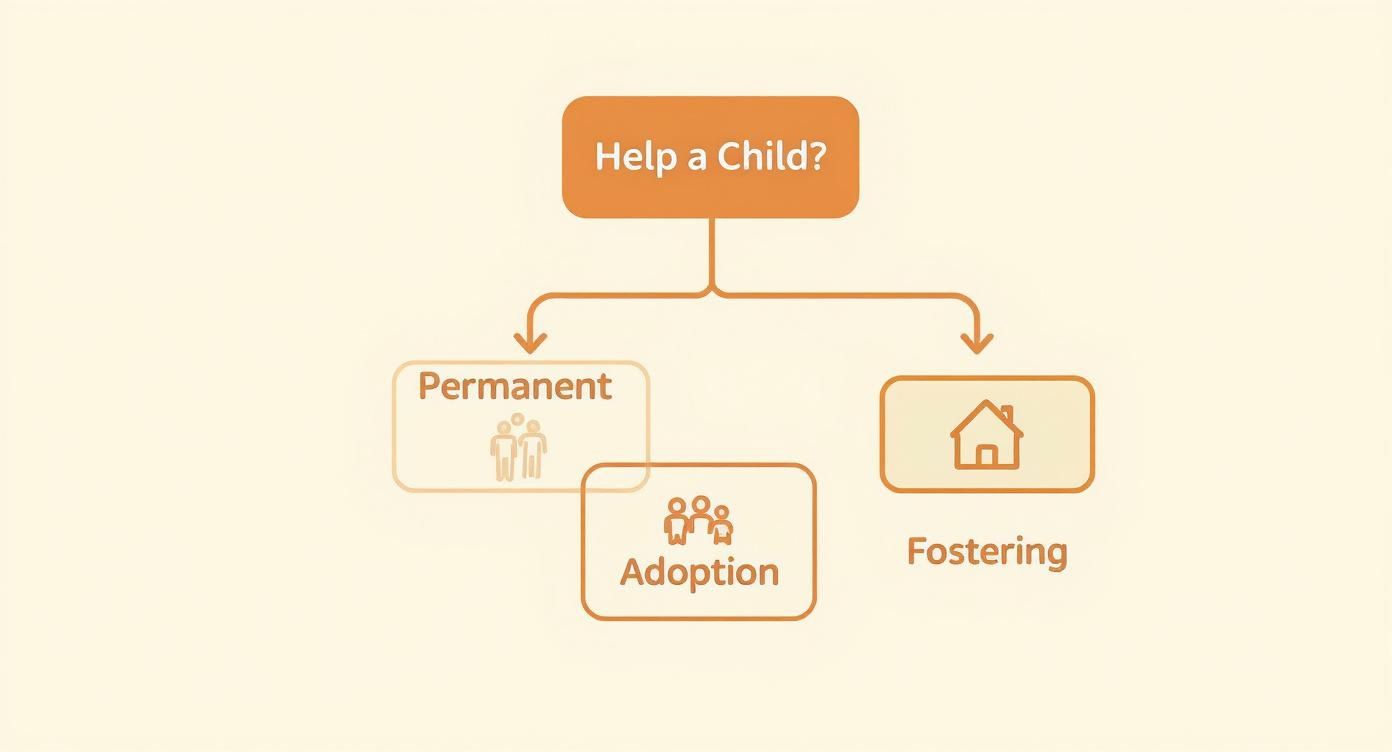
This visual guide simplifies the core difference, showing that your long-term goal is the key factor. Beyond the legalities, a huge part of both journeys involves strengthening the parent-child connection to build a secure and loving attachment.
Taking the Next Confident Step
You do not have to make this decision alone. Navigating the complexities of the Texas Family Code can feel overwhelming, but professional guidance can provide the clarity you need. An experienced adoption attorney can listen to your story, answer your questions, and help you explore the legal realities of each path.
At The Law Office of Bryan Fagan, PLLC, our compassionate team is here to support you with clear, knowledgeable advice tailored to your unique situation. We are committed to empowering you with the information you need to take the next step toward building or supporting a family with confidence.
If you are ready to explore your options, we invite you to schedule a free, no-obligation consultation with us. Let's talk about your hopes and how we can help you achieve them.
Frequently Asked Questions
When you're exploring adoption and fostering in Texas, it’s natural to have a lot of questions. We’ve answered some of the most common ones here to give you the clear, straightforward information your family needs to move forward.
Can You Foster a Child With the Intention to Adopt?
Absolutely. This is a very common path in Texas, often called foster-to-adopt. Many families get their foster care license with the ultimate goal of adopting a child who becomes legally available for adoption.
However, it’s critical to go in with your eyes open. The primary goal of the foster care system is almost always reunification with the birth family. That means you must be prepared to support that outcome, even while hoping to adopt. It’s a challenging emotional balance, but a necessary one.
What is Foster-to-Adopt and How Does it Work?
Foster-to-adopt is where you become a licensed foster parent for a child who might become eligible for adoption. If the court decides the child cannot be safely returned to their biological parents, their parental rights may be terminated.
Once that happens, the child needs a permanent home. As their foster parent, you have already built a relationship and provided a loving, stable environment. This naturally positions you as a strong candidate to adopt, giving the child the consistency they desperately need.
Do Foster Parents Get Priority for Adoption?
While there’s no automatic legal “priority” written in the law, Texas foster parents are almost always given strong consideration when a child in their care becomes available for adoption. The Texas Department of Family and Protective Services (DFPS) wants what's best for the child, and that usually means placing them with caregivers they already know and trust.
The court’s guiding principle, as laid out in the Texas Family Code, is the best interest of the child. Keeping a child with a loving foster family they have bonded with is typically seen as the least disruptive and most beneficial path forward.
How Long Does a Child Typically Stay in Foster Care?
There is no single answer to this question. A child’s time in foster care can vary dramatically from one case to the next—it could be a few days, several months, or even years. The timeline depends almost entirely on the birth parents’ progress on their court-ordered service plan.
If the family is reunified, a child might return home within a year. If parental rights are terminated, the road to adoption opens up, but the entire journey demands patience and emotional strength from everyone involved.
Beyond the legal and financial aspects, it’s also important for all parents to be prepared for everyday emergencies by acquiring essential paediatric first aid skills.
The journey to build or grow your family is unique, and you don’t have to walk it alone. At The Law Office of Bryan Fagan, PLLC, our compassionate legal team is here to provide the clarity and guidance you need. Schedule a free consultation with us today to discuss your personal situation and take the next confident step.
