
Yes, a single man can absolutely adopt a child in Texas. The law is not focused on your marital status; it’s centered entirely on your ability to provide a stable, loving, and permanent home. If you dream of becoming a father, that dream is very much within reach.
Your Path to Fatherhood Starts Here
If you’ve found yourself asking, "Can a single man adopt a child?" you're not alone. It’s a common misconception that being single puts you at a disadvantage, but that simply isn’t true in Texas. The entire adoption process is guided by one core principle: the best interest of the child.
What does this mean for you? It means that your character, your stability, and your capacity to love are what truly matter—not whether you have a partner.

The legal foundation for adoption in Texas is the Texas Family Code, specifically Chapters 162-166. You will not find any language in these statutes that requires an adoptive parent to be married. Courts and adoption agencies are looking for dedicated individuals who can create a safe, nurturing environment where a child can thrive. Your desire to be a parent is not just valid; it is valued and needed.
Key Pathways to Adoption for Single Men
As a single man ready to build your family, you have several different roads you can take. Each one is a unique journey, allowing you to find the path that feels right for you and your future family.
- Adopting from Foster Care (CPS Adoption): This is a powerful way to provide a permanent family for one of the thousands of Texas children waiting in the foster care system. It is often the most affordable path and meets a critical need right here in our communities.
- Private Infant Adoption: This route involves working with a licensed agency to connect with a birth mother who has made the courageous and loving decision to create an adoption plan for her newborn. It offers the opportunity to be there from the very beginning of a child's life.
- Kinship Adoption: Are you hoping to adopt a relative, like a nephew or a grandchild you are already raising? This process, also known as a relative adoption, formalizes your role as their legal parent, providing the child with the security and stability they deserve.
Adoption Eligibility at a Glance for Single Men in Texas
To help you understand what the process entails, here is a simple overview of what Texas courts and agencies look for in a prospective parent. Remember, every requirement is designed to ensure a placement is in the child's best interest.
| Requirement Category | What Texas Law and Agencies Look For |
|---|---|
| Age | You must be at least 21 years old. |
| Financial Stability | You must demonstrate the ability to manage your finances and provide for a child's needs. You do not need to be wealthy, just responsible. |
| Home Environment | Your home must be a safe, stable, and nurturing place for a child to live and grow. |
| Background Checks | You will need to pass comprehensive criminal history and child abuse background checks, as outlined in the Texas Family Code. |
| Personal Character | Agencies look for emotional maturity, a strong support system, and a genuine, unwavering commitment to parenting. |
| Health | You must be physically and mentally healthy enough to care for a child. |
| Parenting Training | You will need to complete state-required training designed to prepare you for the unique journey of adoptive parenthood. |
This table isn't meant to be intimidating—it's a checklist to show that the focus is on your ability to be a wonderful, prepared parent.
Ultimately, this journey is about showing that you are the right father for a child who needs one. A great next step is to explore the specific single parent adoption requirements in Texas. This guide will walk you through every stage, giving you the clarity and confidence to move forward. Your ability to provide a loving home is what opens the door.
The Unique Strengths Single Fathers Bring to Adoption
Meeting the legal requirements is just the first step. The real story, the one that matters most, is about the incredible value you bring as a single adoptive father. Your decision to pursue this path speaks volumes about your commitment and readiness to give a child unconditional love and stability.
Many men we speak with initially worry they are at a disadvantage. But the reality is often the opposite. As a single man, you offer a unique set of strengths that are desperately needed in the adoption community, especially for children who have been waiting the longest for a family to call their own.
Meeting a Critical Need for Older Children
One of the most significant impacts single adoptive fathers make is their willingness to open their homes and hearts to children who are so often overlooked. This isn’t just an anecdotal feeling; it’s a well-documented trend that highlights just how vital your role can be.
Imagine, for a moment, a teenage boy who has moved between foster homes and desperately needs a positive male role model to guide him into adulthood. Or think of a group of siblings who are terrified of being separated, and you have the space and focused energy to keep them together. These are the children who often wait years for a permanent home, and time and again, it is single men who step forward for them.
The numbers are compelling. Research shows that single men are exceptionally open to adopting older children. A study revealed that a stunning 60% of single men who adopted through foster care chose children over six years old. That figure is significantly higher than the 23% of single women and a mere 9% of married couples who did the same. You can explore the full study about adoption trends on PMC for more insight.
This is a powerful truth. It proves that as a single man, you aren't just an "alternative" to a two-parent family. For a specific child out there, you are often the ideal family—the one who needs exactly what you have to offer.
The Power of Focused Parenting
Another incredible strength is your ability to provide focused, one-on-one attention. In a single-parent household, the bond between a father and his child can become exceptionally strong and secure. You become the consistent, stable presence in their life, which is profoundly healing for a child who may have only known instability or trauma.
Your journey as a single adoptive father isn't about filling a void in a child's life. It's about building a new future, grounded in your unique strengths, unwavering commitment, and the powerful presence of a dedicated dad.
This focused environment often helps a child build trust and attach more easily. Your home becomes their safe harbor, a place where they know, without a doubt, that they are the priority. That undivided attention can be a tremendous asset in helping a child heal, grow, and truly thrive.
Finally, by choosing this path, you help redefine what "family" looks like. You show the world that families are built on love and commitment, not a specific structure. You model strength, resilience, and compassion—qualities that will shape your child's life in the most profound ways. Your path to fatherhood isn't just about building your family; it's about changing a child's world for the better.
Your Step-By-Step Texas Adoption Journey
The road to becoming a father through adoption is a journey with several key milestones. While it can seem like a mountain of paperwork and legal hurdles, when broken down into clear, manageable steps, the path becomes much clearer. For a single man in Texas, the process is about methodically showing you’re ready to be a great dad. Let’s walk through each stage, referencing key parts of the Texas Family Code (Chapter 162), which governs adoption in our state.
Step 1: Choosing the Right Adoption Agency
Your first major decision is finding an adoption agency that understands and supports your goals. Not all agencies are the same. Some focus on foster care adoptions, while others specialize in private infant adoptions. As a single man, it’s vital to partner with an agency that has experience with—and a genuine enthusiasm for—working with single-parent households.
When you begin your research, don't hesitate to ask direct questions:
- "What is your track record with placing children with single fathers?"
- "What kind of pre-adoption training and post-adoption support do you offer specifically for single parents?"
- "Could you connect me with other single dads who have adopted through your agency?"
Their answers will reveal their commitment. A truly supportive agency will see you as a strong, capable candidate, not an exception to the rule, and will become your most important partner on this journey.
Step 2: The Initial Application and Training
Once you’ve found the right agency, it’s time for the official paperwork. The initial application provides a comprehensive look into your life, covering everything from your personal history and financial health to your motivations for adopting. This is the administrative foundation for the process, so be prepared with documents like your birth certificate, financial statements, and personal references.
Alongside the application, Texas law requires all prospective adoptive parents to complete mandatory training. This is far more than just checking a box; it’s an invaluable preparation course for parenthood. You’ll learn about trauma-informed parenting, understand the challenges adopted children might face, and discover resources available to help you succeed. For a single dad, this training is also a fantastic way to connect with other hopeful parents and start building your support network.
This infographic highlights some of the key areas where single adoptive fathers often find their greatest strengths and make the biggest impact.
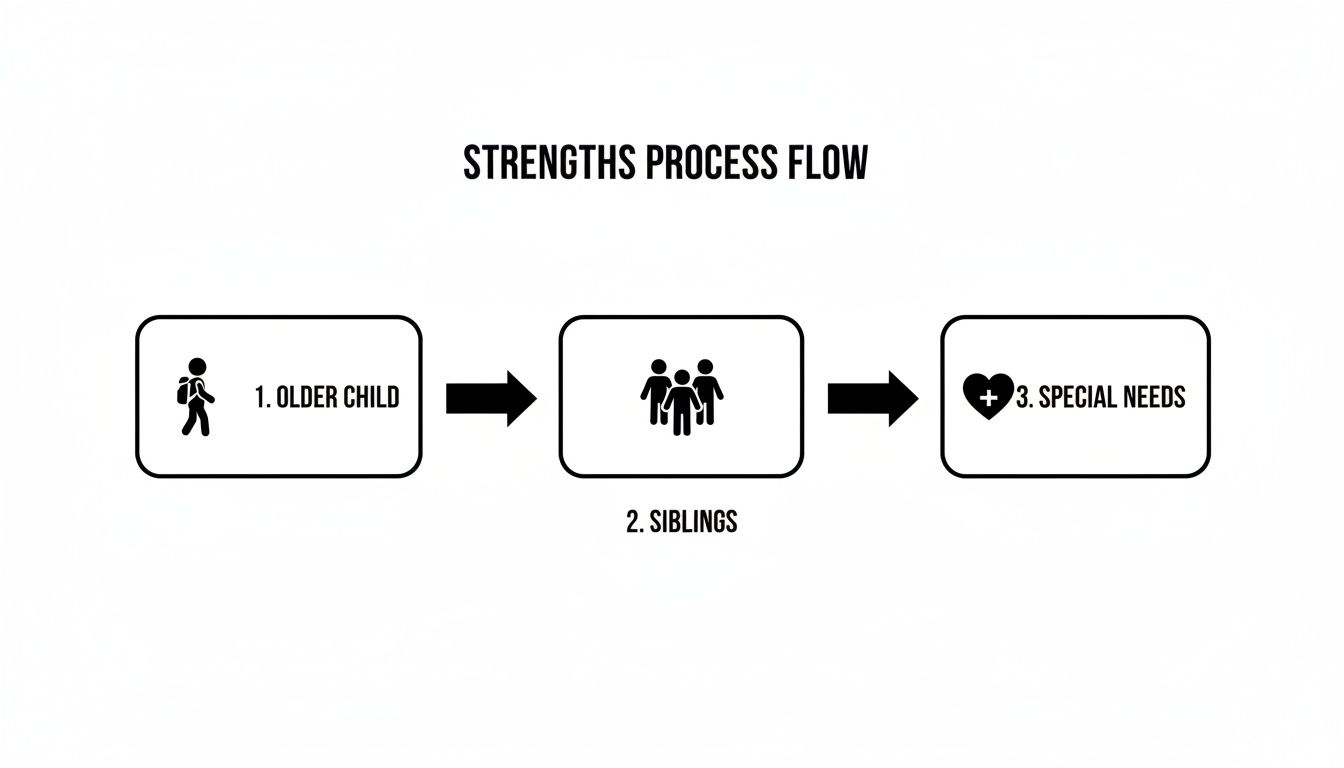
This illustrates that single men are often uniquely positioned to provide stable, loving homes for children who might otherwise wait longer for a family.
Step 3: Preparing for the Home Study
The home study is often the most anticipated—and sometimes nerve-wracking—part of the process. In Texas, a licensed social worker will conduct a series of interviews and a home visit to ensure you can provide a safe, nurturing environment. Think of it not as an inspection, but as your opportunity to share your story and show them the wonderful home you’ve prepared.
The social worker is not looking for a perfect house; they are looking for a safe, loving home. For a single man, they will pay close attention to a few specific areas:
- Your Support System: They want to see that you have a "village"—friends, family, and neighbors who will be there to support you and your child.
- Financial Stability: You’ll need to show that you can comfortably provide for a child's needs on your income. A detailed budget is often part of this.
- Childcare Plan: Having a solid plan for childcare, especially if you work full-time, is essential.
The home study is less of an inspection and more of a conversation. It's an opportunity for you to articulate your commitment, showcase your support network, and prove that your home is ready for the love and laughter of a child.
Step 4: The Matching Process
Once your home study is approved, you are officially eligible to be matched with a child. How this stage unfolds depends on the type of adoption you are pursuing. In a foster care adoption, your caseworker will present profiles of children whose needs you are well-equipped to meet. For a private adoption, your profile will be shared with expectant mothers who are choosing an adoptive family for their child.
Patience is key here. The goal isn’t just to find a child, but the right child for your family. For many single men, this is where their willingness to consider older children or sibling groups becomes a tremendous asset, often shortening the wait time.
Step 5: Placement and Finalization
The day a child is placed in your home is a day you will never forget. This begins a post-placement supervision period, which typically lasts about six months. During this time, the social worker will visit your home periodically to see how everyone is adjusting and to offer support and resources as you settle into your new life as a family.
After this period is successfully completed, your attorney will file a petition to adopt with the court. The final step is the finalization hearing. This is a joyful, celebratory court proceeding where a judge reviews your case, signs the final adoption decree, and legally declares you the parent of your child. On that day, you officially and forever become a family. To get a closer look at the legal details, you can explore the full process of adopting a child in Texas in our detailed guide.
Each of these steps brings you closer to building your family. It requires dedication, but remember, you are not doing this alone. The team at The Law Office of Bryan Fagan, PLLC is here to provide compassionate legal guidance at every turn, transforming a complex process into a clear path to fatherhood.
Choosing Your Path to Fatherhood in Texas
Once you’ve made the incredible decision to pursue adoption, the next question is: which path is right for you? For a single man in Texas, there are a few distinct routes to becoming a dad, each with its own timeline, costs, and emotional journey.
Understanding these options is key to making a choice that fits not just your circumstances, but your heart. The three primary avenues are adopting from foster care, private domestic infant adoption, and kinship adoption. Let’s break down what each path looks like.

Adopting from Foster Care
Adopting through the Texas Department of Family and Protective Services (DFPS)—often called a CPS adoption—is one of the most powerful ways to build a family. Right now, thousands of children in Texas foster care are legally free for adoption and waiting for a permanent, loving home because their birth parents' rights have already been terminated.
This path often means adopting older children, sibling groups, or children with unique medical or emotional needs. For many single men, this is where they truly find their calling. As we've seen, single dads are often uniquely equipped to provide the stable, focused environment these children need to finally feel safe and begin to heal.
For example, a single man named Mark felt called to adopt an 11-year-old boy who had been in the system for years. Mark's quiet, stable home and one-on-one attention were exactly what this child needed to build trust after years of uncertainty. Their story is a beautiful testament to the power of this path.
Here’s a quick look at the process:
- You will first become a licensed foster-to-adopt parent through a Child Placing Agency (CPA).
- You will then complete state-required training designed to prepare you for both the challenges and rewards of parenting a child who has experienced trauma.
- Once a child is placed in your home, there’s a waiting period of at least six months before you can go to court to finalize the adoption.
Financially, this is often the most accessible route. Most costs are minimal, and families who adopt from foster care frequently qualify for financial assistance and medical support to help meet the child’s needs.
Private Domestic Infant Adoption
If your dream has always been to raise a child from birth, private domestic infant adoption may be the journey for you. This path involves working with a licensed adoption agency to be matched with an expectant mother who is creating an adoption plan for her baby.
The process here is very different from a foster care adoption. A significant part of the journey is creating a compelling parent profile—a book or online portfolio that shares your story and gives a birth mother a genuine sense of who you are. As a single man, this is your chance to highlight your strengths, your support system, and your deep desire to be a father.
It’s important to understand that in a private adoption, the birth mother chooses the family. While some may prefer a two-parent household, many are simply searching for the most loving, stable, and committed parent for their child. Your authenticity is your greatest asset.
Private adoptions also come with varying levels of openness, from semi-open relationships managed by the agency to fully open communication with the birth family. Learning to navigate these relationships with compassion and respect is a vital part of the journey.
Kinship and Relative Adoptions
Sometimes, the child you’re meant to parent is already a part of your life. A kinship adoption is the legal process that allows a relative—like an uncle, older brother, or grandparent—or even a close family friend to become the legal parent of a child they are already raising.
This situation often arises when a child's biological parents are unable to care for them. Formalizing the relationship through adoption provides the child with an incredible sense of legal and emotional security. It solidifies that they have a permanent home with someone they already know, love, and trust.
The legal steps for a kinship adoption are often more streamlined than other types, especially if the biological parents consent. The court’s main focus remains on what is in the best interest of the child—and strengthening an existing, loving bond is almost always the answer. This path provides stability and honors the family structure that is already in place.
No matter which path you feel drawn to, the goal is the same: to provide a safe, loving, and permanent home for a child. At The Law Office of Bryan Fagan, PLLC, we are here to provide the compassionate legal guidance you need to explore these options. We invite you to schedule a free consultation to discuss your unique situation and take the first step toward building your family.
Overcoming the Hurdles for Single Adoptive Fathers
While Texas law is clear that single men can adopt, it's helpful to be prepared for some societal stereotypes or outdated ideas you may encounter. Knowing this isn't meant to discourage you—it’s about empowering you to face every question with confidence and turn any doubt into an opportunity to showcase your readiness to be an incredible dad.
The simple fact is that single men are still a minority among adoptive parents. In 2021, single men adopted just over 2,000 children from foster care in the U.S. While this number is growing, it highlights that you may encounter more questions than other applicants. This isn't about your ability; it’s about navigating biases you can—and will—overcome.
Building Your Village and Proving Your Strength
One of the first and most important questions you will be asked, especially during the home study, is about your support system. A caseworker's role is to ensure that any child placed in your home will be surrounded by a network of caring, reliable people. For a single dad, demonstrating this "village" is non-negotiable.
So, who is in your corner? Start thinking about:
- Family Members: Are your parents, siblings, or cousins ready to offer emotional support or help with babysitting?
- Close Friends: Who are the friends you can rely on for advice or a listening ear?
- Community Connections: Think about neighbors, community groups, or local parent organizations that can offer a sense of belonging and practical help.
When it's time for your home study, don't just say you have support; paint a clear picture. Explaining that, "My sister lives ten minutes away and has already offered to be my go-to for childcare," is much more powerful than a general statement like, "My family will help."
Addressing Practical Concerns with a Solid Plan
Beyond your emotional support network, you need to show you’ve thought through the daily logistics of parenting alone. Caseworkers want to see that you are grounded in the reality of what it takes.
Your preparedness is your greatest asset. By having clear, thoughtful answers to the tough questions, you replace any doubt with undeniable evidence of your commitment and capability.
Develop a detailed plan for key areas. A social worker will feel much more confident when you can discuss your strategy for work-life balance or how you'll handle childcare. Having already researched local daycares or after-school programs proves you’re not just dreaming—you’re planning. The same applies to your finances. A solid budget demonstrating you can provide for a child on a single income offers concrete proof of your stability. Before you get too deep into planning, it’s also wise to understand what disqualifies you from adopting to ensure there are no surprises.
Finally, showing your readiness extends beyond the practical. It helps to be prepared for the emotional side of adoption, too. Taking the time for things like understanding attachment disorders symptoms that some children may face demonstrates a deeper level of commitment. By facing these potential hurdles head-on with honesty and a solid plan, you turn them from obstacles into proof that you are ready to provide a stable, loving, and permanent home.
Take the Next Step on Your Adoption Journey
The dream you hold of becoming a father is not a distant hope. It is a real, achievable, and beautiful reality. If there's one thing to take away from this guide, it's that the answer to "can a single man adopt a child in Texas?" is a firm and resounding yes. What truly matters isn't your marital status—it's your ability to provide a child with love, stability, and a permanent home.
Do not underestimate the unique strengths you bring to this journey. As a single dad, your focused attention, resilience, and unwavering commitment are precisely what so many children need to feel safe and begin to heal, especially those who have been waiting the longest. The road ahead requires dedication, but every step—from the first home study visit to the finalization hearing—brings you closer to building your family.
Your Journey from Wondering to Planning
The adoption process may look complex, but it is a manageable journey with the right support. You now have a clearer picture of the steps involved and the different paths you can take, whether through foster care, a private agency, or a kinship adoption. The key takeaways are simple but profound:
- Fatherhood is possible. Texas law doesn't just allow single parents to adopt; it welcomes them.
- Your strengths are needed. Your unique ability to parent could be the perfect match for a child waiting for their forever family.
- Support is available. You do not have to walk this path alone.
This is your invitation to shift from wondering if you can adopt to planning how you will. The most important step you can take is often the very first one: reaching out for clear, compassionate guidance tailored to your specific situation.
You have everything it takes to be an incredible father. The love, commitment, and desire to provide a safe home are the only qualifications that truly matter. Now is the time to turn that desire into action.
At The Law Office of Bryan Fagan, PLLC, we have proudly guided countless Texas families through this life-changing process. We understand the specific questions and concerns single adoptive parents face, and we are here to offer the legal expertise and empathetic support you deserve.
We warmly encourage you to schedule a free, confidential consultation with our team. Let's talk about your dreams of fatherhood and map out a clear, actionable plan to help you build your family.
Frequently Asked Questions About Single Man Adoptions
The road to adoption is paved with questions, and that’s perfectly normal. To give you some quick, clear answers, we've pulled together a few of the most common things single men ask when they start thinking about fatherhood here in Texas.
Do I Need a High Income to Adopt as a Single Man in Texas?
Not at all. You do not need to be wealthy to adopt. What the Texas Family Code and adoption agencies truly care about is financial stability, not a specific income level. You simply need to show that you can comfortably manage your household expenses and provide for a child’s needs.
This is typically assessed during the home study, where you will share documents like pay stubs and a household budget. The focus is not on how much you make, but on whether you can provide a secure, stable home.
Will My Sexual Orientation Affect My Ability to Adopt?
Absolutely not. In Texas and across the United States, your sexual orientation cannot be used as a barrier to adoption. The law is clear: what matters is your ability to provide a safe, loving, and stable home for a child.
Every prospective parent is evaluated using the same standard, with the guiding principle always being what is in the best interest of the child.
What Is the Most Important Part of the Home Study for a Single Applicant?
While every part of the home study is important, for a single applicant, demonstrating a strong support system is crucial. The caseworker wants to see that you have a "village"—a reliable circle of family and friends who will be there for both practical help and emotional support.
Be prepared to talk about who these people are, how they fit into your life, and the specific ways they will be there for you and your future child.
The home study isn't about having a perfect life; it's about showing you have a real, supportive community ready to welcome a child alongside you.
Can I Adopt a Newborn as a Single Man?
Yes, single men can and do adopt newborns through private adoption agencies. It is helpful to know that in private adoption, birth mothers choose the family they feel is best for their child, which can sometimes mean a longer wait for a single parent.
However, many agencies are strong advocates for all types of qualified parents. The best thing you can do is create an authentic, open, and honest parent profile. Your story and your genuine commitment are what will ultimately connect you with the right situation.
The journey to fatherhood is one of the most rewarding experiences a person can have. If you are ready to take the next step, The Law Office of Bryan Fagan, PLLC is here to provide the compassionate legal guidance you need. We invite you to schedule a confidential, no-obligation consultation to discuss your unique situation and get the clear legal advice you need to begin. Visit us at https://texasfamilyadoption.com to learn more.
