 Skip to content
Deciding to adopt your stepchild is a powerful act of love, one that gives them lifelong security and solidifies your family's bond. This journey is about making the parent-child relationship you've already built official, offering both legal recognition and incredible peace of mind. It’s the final step in legally uniting your family and confirming your role as a parent in every sense of the word.
At The Law Office of Bryan Fagan, PLLC, we understand that this is more than just a legal process; it's a profound step toward strengthening your family's foundation. We are here to guide hopeful adoptive parents through the Texas adoption process with empathy and clarity.
Why Formally Adopting Your Stepchild Matters
Making the decision to adopt your stepchild goes far beyond legal paperwork; it's a profound commitment that strengthens the very foundation of your family. While you may already feel like a parent in every way that counts, a legal adoption provides tangible security and recognition that will benefit both you and the child for a lifetime.

This step ensures you have the undisputed right to make crucial decisions for your child's well-being. It cements your family unit in the eyes of the law, bringing clarity and permanence to your relationship and placing the best interests of the child at the heart of your family's structure.
The Legal and Emotional Benefits
Once you legally adopt your stepchild, you gain full parental rights. This is a game-changer. Suddenly, you can:
- Make medical and educational decisions without hitting legal roadblocks.
- Easily list the child on your health insurance and other benefits.
- Guarantee the child has inheritance rights as your legal heir.
- Change the child’s last name to reflect your united family, if you choose.
This legal finality provides immense emotional security for a child. It erases any question or ambiguity about their place in the family, confirming that your bond is permanent and unconditional.
Stepparent adoptions are a common and beautiful way for families to grow. In fact, estimates suggest that roughly one in four adoptions in the U.S. each year involves a stepparent, which shows just how many blended families take this meaningful step toward family unity.
Of course, building a cohesive family unit emotionally is just as important as the legal side, which often means navigating and strengthening all the relationships within the home. For blended families with older kids, fostering positive connections is critical, and that includes understanding adult sibling relationships.
Ultimately, adopting your stepchild is an act that protects their future while celebrating the love that already defines your family. It's about making your bond official, ensuring that no matter what life throws your way, your legal connection is just as strong as your emotional one. At The Law Office of Bryan Fagan, PLLC, we are honored to help Texas families complete this journey with the compassion and clarity they deserve.
Meeting the Texas Stepparent Adoption Requirements
Before you can start the official journey of adopting your stepchild, Texas law has a few foundational requirements you'll need to meet. These aren't just legal hoops to jump through; they’re designed to make sure every adoption is in the child's best interest by confirming a stable, secure home life is already in place. Think of these as the green lights for your adoption process.

Knowing what these criteria are from the start helps you move forward with confidence. The core requirements really boil down to your marriage, how long you've lived in Texas, and the established relationship you already have with your stepchild.
Establishing Your Eligibility
The Texas Family Code is very specific about who can file for a stepparent adoption. The main requirements paint a clear picture of a consistent, established family unit.
To be eligible to adopt your stepchild, you must:
- Be legally married to one of the child’s biological or legal parents. This is the absolute cornerstone of a stepparent adoption.
- Have lived in Texas for at least six months before you file the petition.
- Make sure the child has lived with you and your spouse for at least six months.
These rules help show the court that your family has already been functioning as a blended unit for a while. It frames the legal adoption as what it truly is—the natural next step, not a sudden change for the child.
The Child's Voice in the Process
As children get older, Texas law rightly gives their wishes a lot of weight. If your stepchild is 12 years of age or older, they will need to provide their written consent to the adoption. This is often a really powerful moment in the process, as it lets them formally agree to making your relationship legally permanent.
A judge will want to be sure the child truly understands what adoption means and is genuinely on board. It’s not meant to be an intimidating interrogation but a compassionate conversation to confirm their feelings.
For example, think about a 14-year-old whose stepfather has been in their life since they were five. Giving written consent empowers them, allowing them to formally acknowledge the parental bond they've shared for nearly a decade.
This step gives the child a real voice, making them an active participant in creating their new legal family. It’s a wonderful recognition of their maturity and their central role in the family.
The Home Study: A Common Question
One of the first questions we always get is about the home study. In many adoptions, a social worker performs a detailed investigation of the adoptive parent's home and life. But for stepparent adoptions in Texas, this requirement is usually waived.
Why? Because you and the child have already been living together as a family, the court often sees a formal home study as redundant. A judge can grant an exemption, which simplifies the whole process and keeps costs down. While background checks are still mandatory to ensure the child’s safety, skipping the full home study makes the path much smoother for most stepparents.
As you start pulling your paperwork together, knowing what's required is half the battle. For a deeper dive, you can look over our guide on the essential required documents for a Texas adoption home study.
Once you've confirmed you meet these initial requirements, you've hit the first major milestone. The next step involves addressing the legal rights of the other biological parent—a topic we'll explore with the care and sensitivity it deserves.
Navigating the Other Biological Parent's Rights
One of the most delicate parts of a stepparent adoption is handling the legal rights of the other biological parent. For your adoption to move forward, Texas law is crystal clear: a child can only have two legal parents. This means the other parent’s rights must be legally resolved, either through their cooperation or a court order.
This stage of the process calls for empathy, patience, and a steady focus on what's truly best for the child. It’s all about creating legal and emotional clarity so the child’s new family structure is secure for the long haul. There are two main ways to get this done, and the right one depends entirely on your family's circumstances.
The Compassionate Path of Voluntary Consent
The smoothest, most harmonious way forward is with the voluntary consent of the other biological parent. This is what happens when the parent agrees that the adoption is in their child's best interest and is willing to sign a legal document to make it official.
In Texas, this document is called an Affidavit of Relinquishment of Parental Rights. It's a powerful, sworn statement where the parent formally and permanently gives up their legal rights and responsibilities to the child. This is a profound decision, and it’s often made out of deep love—a parent recognizing that the stepparent can provide the stability and day-to-day care they cannot.
Think about a situation where the other parent lives in another state, has remarried, and has very little contact. They might see that their child views the stepparent as a primary caregiver and feel that making it legal through adoption gives the child the most security. In these cases, open and respectful communication can lead to a cooperative outcome that honors everyone and keeps the child's emotional well-being front and center.
This infographic breaks down the two main pathways for addressing the other biological parent's rights in a Texas stepparent adoption.
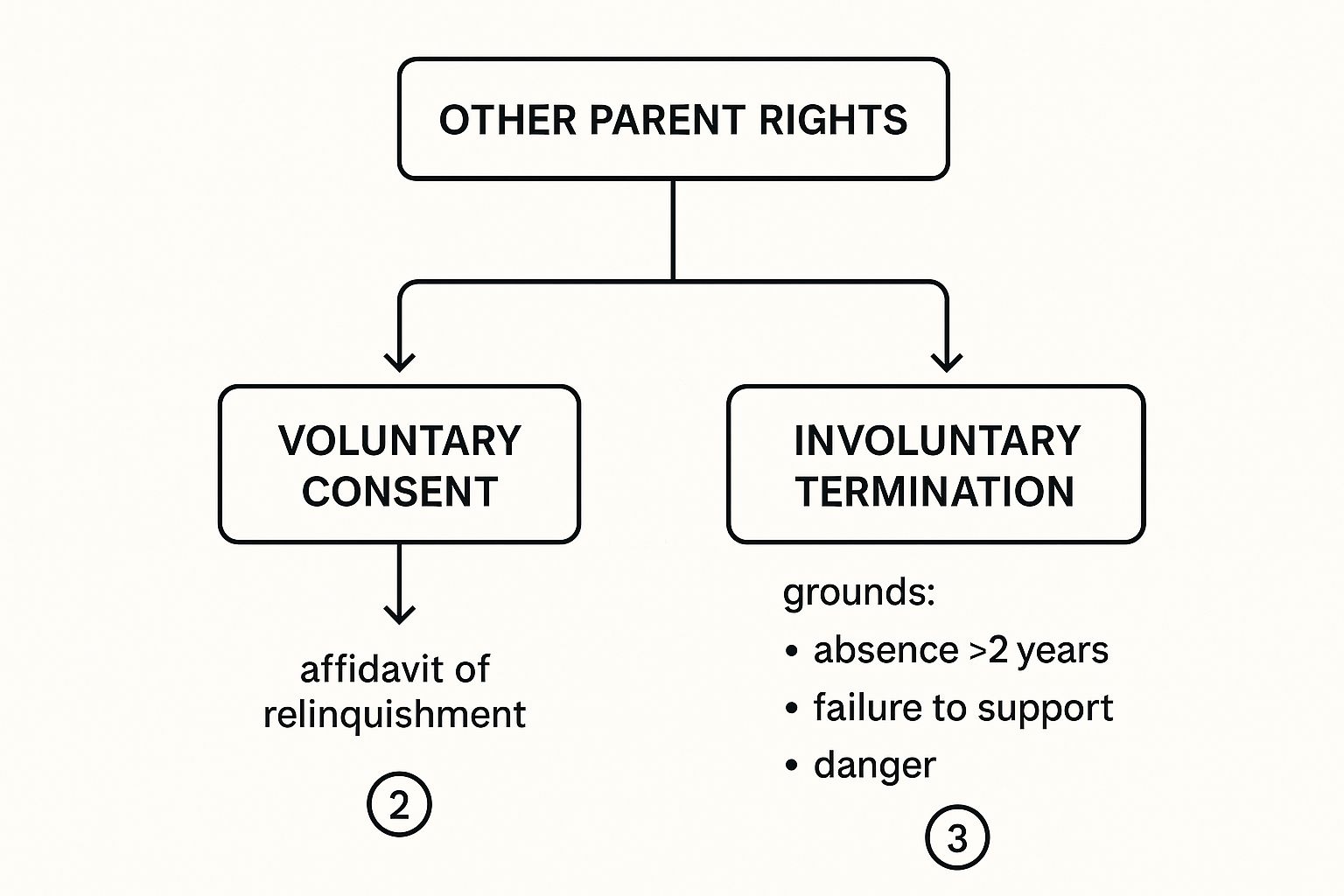
As you can see, the process branches into either a cooperative, consent-based approach or a court-ordered termination. The child's best interest is the ultimate goal, no matter which route you take.
When Consent Isn't an Option: Involuntary Termination
Unfortunately, getting voluntary consent isn't always possible. Sometimes, the other parent is completely absent, can't be found, or simply refuses to agree to the adoption even though they have no real relationship with the child. In these tough situations, the law provides a path forward through the involuntary termination of their parental rights.
This is a serious legal action that asks a judge to end the parent-child relationship without that parent's agreement. To succeed, you must prove to the court that specific grounds for termination exist, as laid out in the Texas Family Code (specifically Chapter 161).
Common grounds for involuntary termination include:
- Abandonment: The parent has essentially walked away, leaving the child without support and failing to maintain any kind of significant relationship. If a parent hasn't seen or spoken to the child in years, a court may view this as abandonment.
- Failure to Support: The parent has consistently failed to provide financial support for the child, despite being able to do so.
- Endangerment: The parent has engaged in conduct that puts the child's physical or emotional well-being at risk. This could involve substance abuse, neglect, or a history of abuse.
A court will only terminate a parent's rights if it finds clear and convincing evidence that it is in the child’s best interest. This is the highest standard of proof in civil law, which really highlights the gravity of the decision.
For example, imagine a stepparent who has raised a child since they were a toddler. The other biological parent has been out of the picture for over five years, has never paid child support, and has made zero effort to contact the child. In a case like this, a court would likely find that terminating that parent's rights is necessary to give the child the legal permanence and stability they deserve with the stepparent who has been their true parent figure all along.
This can be a complex and emotionally draining process. It's crucial to understand the legal hurdles, especially when you're trying to figure out what happens if the other parent digs in their heels. You can learn more in our detailed article on what to do if the other parent won't consent to a stepchild adoption in Texas.
Whether you're hoping for voluntary consent or facing the possibility of involuntary termination, getting legal guidance is essential. At The Law Office of Bryan Fagan, PLLC, we handle these sensitive matters with the utmost care, making sure your family is supported and the child's needs always come first. If you are facing this part of the journey, we invite you to schedule a free consultation with our team to discuss your family’s unique situation with compassion and legal clarity.
Preparing and Filing Your Adoption Paperwork
Once the rights of the other biological parent are resolved, you can dive into the heart of the legal process: preparing and filing the adoption petition. This is where you officially ask the court to recognize your family, and it’s all about careful organization and clear communication.
Think of it as building the legal foundation for your family’s future. Every document you gather and every form you fill out tells the story of your family and shows the judge exactly why this adoption is in your child's best interest.
Assembling Your Essential Documents
The first move is to gather all the necessary paperwork. Being meticulous here will save you headaches and delays down the road. You’ll need a collection of official records that verify everyone's identity and legal status.
While every case is a bit different, here's what most Texas stepparent adoptions require:
- The Child’s Birth Certificate: You'll need a certified copy of the original.
- Your Marriage License: A certified copy proves you're legally married to your spouse (the child's parent).
- Criminal Background Check Results: Both you and your spouse will need to complete and pass these checks to confirm a safe home environment.
- Proof of Name Changes (if any): If you or your spouse have ever legally changed your names, you'll need the court orders to prove it.
Our advice? Get a dedicated folder—physical or digital—and keep everything organized from the very beginning. It makes the process feel much more manageable.
To help you stay on track, we've put together a table of the documents you'll need to collect. Think of this as your personal checklist for building a strong adoption case.
Essential Documents for Your Adoption Petition
| Document Type | Purpose | Where to Obtain |
|---|---|---|
| Child's Birth Certificate | Verifies the child's identity, age, and original parentage. | The vital statistics office in the state or county of birth. |
| Your Marriage License | Confirms your legal marriage to the child's biological parent. | The county clerk's office where your license was issued. |
| Criminal Background Checks | Ensures a safe home environment for the child, as required by law. | Usually initiated through your attorney or a court-approved service. |
| Proof of Name Change | Documents any legal name changes for you or your spouse. | The court that granted the name change. |
| Termination Order | If the other parent's rights were previously terminated, this is the court order. | The court that handled the termination case. |
Having these documents ready to go before you file your petition will streamline the entire process and show the court you’re well-prepared.
The Original Petition for Adoption of a Stepchild
The centerpiece of your filing is the Original Petition for Adoption of a Stepchild. This is the formal legal document that kicks everything off. It officially tells the court who you are, who your stepchild is, and why you are asking for the adoption.
Filling this out accurately is absolutely critical. The petition asks for key details like names, dates of birth, and residency information. It also clearly states the grounds for the adoption and affirms that it is in the child's best interest. Some families consider taking a DIY approach, but getting legal guidance here can be priceless. For anyone weighing their options, our article offers more insight on a do-it-yourself stepparent adoption in Texas.
The petition is more than just a form—it's your official request to the court to legally recognize the parent-child relationship you've already built. It sets the entire legal process in motion.
Once you file it with the correct Texas family court, your case is officially opened, and you'll get a case number.
The Role of the Ad Litem Attorney
In many Texas adoptions, the court will appoint an ad litem attorney. Don't let the legal term intimidate you. This is simply a neutral attorney whose only job is to represent the best interests of the child. They are the child's voice in the legal process.
The ad litem will usually meet with you, your spouse, and the child to get a feel for your family dynamic. They'll review your case file and then make a formal recommendation to the judge about whether the adoption should be granted. Their report carries a lot of weight, so it's important to be open, honest, and cooperative during your conversations.
This step provides an extra layer of protection for the child, ensuring an objective expert has reviewed the situation and agrees that the adoption serves the child's emotional and physical well-being.
What About the Home Study?
One of the first questions we get from stepparents is about the social study, often called a home study. The good news here is that under the Texas Family Code, the home study requirement is often waived in stepparent adoptions.
Why? Because the child has already been living with you and your spouse for at least six months, the court generally presumes the home is a stable and suitable environment. A judge can grant an exemption, which simplifies the process and cuts down on costs. While background checks are still mandatory, avoiding a full-blown home study is a major benefit of the stepparent adoption process.
With your paperwork filed and any required ad litem appointed, you're one huge step closer to the final hearing—the day you officially and legally become a parent.
The Final Hearing and Celebrating Your Family
After all the paperwork, waiting, and legal steps, the final adoption hearing is the beautiful, long-awaited day it all becomes real. This is the moment the law officially recognizes the loving parent-child bond you’ve already built. Think of it less as a trial and more as a celebration of your family.

Many people get nervous just thinking about a courtroom, but adoption finalization hearings are famously happy occasions. Judges often say these are their favorite days in court, and the atmosphere is usually relaxed and genuinely joyful. It’s a day to focus on what this moment means for your family, not to sweat the legal formalities.
What to Expect in the Courtroom
When your day arrives, you, your spouse, and your child will be brought before the judge. It’s a good idea to dress up a bit, like you would for any other significant family event. The judge’s main job here is simply to confirm that every legal box has been checked and that the adoption is truly in your child's best interest.
The judge will probably ask you and your spouse a few straightforward questions, such as:
- Confirming who you are and your relationship to the child.
- Asking you to state your intention to adopt and provide a loving, permanent home.
- Making sure you understand the legal rights and responsibilities you’re taking on.
If your child is old enough, the judge might ask them a few gentle questions to make sure they understand what's happening and are happy about it. The tone is always supportive and is meant to make your child feel comfortable and included in this incredible milestone.
The Moment the Decree is Signed
After a few brief questions, the judge will sign the Final Decree of Adoption. This is it. This is the powerful moment you've been working toward. With the stroke of a pen, you become your child's legal parent in every sense of the word, with all the rights, duties, and incredible joys that come with it.
Hearing the judge declare the adoption final is an incredibly emotional experience for most families. It’s the legal system's way of saying, "We see you, we recognize this family, and we protect this bond." It provides a profound sense of permanence and peace of mind.
Don't be shy about bringing a camera. Many families capture the moment with the judge, who is often more than happy to pose for a picture with the newly official family. This isn't just another court proceeding; it's a memory you will cherish forever. As you plan for this joyous day, you might also want to explore some meaningful adoption gift ideas to commemorate it.
After the Hearing: Next Steps for Your Family
Once the decree is signed, your attorney will guide you through the last few administrative tasks. The most important of these is applying for an amended birth certificate for your child.
The Texas Bureau of Vital Statistics will issue a new birth certificate that lists you as the child's parent, officially replacing the original document. If you chose to change your child's last name, that will be reflected here, too. This new birth certificate becomes their official legal record from this day forward.
With that final document in hand, your family's new beginning is legally complete. You can now confidently make medical decisions, enroll them in school, and add them to your insurance without any legal gray areas. It’s the final piece of the puzzle, cementing the legal security that perfectly matches the emotional reality of your family.
Frequently Asked Questions About Stepparent Adoption
Deciding to adopt your stepchild is a huge, wonderful step, but it's natural to have a lot of questions pop up along the way. To help you feel more confident, we've put together some straightforward answers to the questions we hear most often from Texas families just like yours.
How Long Does a Stepparent Adoption Usually Take in Texas?
The timeline can really vary, but most stepparent adoptions in Texas wrap up within three to six months. The biggest variable is almost always the other biological parent.
If that parent is cooperative and voluntarily signs the paperwork to relinquish their rights, things move pretty quickly. But if you must pursue an involuntary termination, the process will naturally take longer. That involves more legal filings, serving official notices, and additional court hearings. Our job is to move your case forward as efficiently as possible while making sure every single legal requirement is met.
Will We Absolutely Need a Home Study?
This is one of the best pieces of news for most families. In the vast majority of Texas stepparent adoptions, a formal home study (also called a social study) is waived by the court.
The Texas Family Code makes a special exception because the child is already living with you and your spouse. The court operates on the common-sense assumption that since you've all been living together for at least six months, your home is already a stable and safe place. You'll still need to complete criminal background checks, but skipping the intensive home study makes the entire process simpler and more affordable.
The home study waiver is a key reason stepparent adoptions are often more straightforward than other adoptions. It recognizes that the family bond is already there; the legal process is just making it official.
Can We Change Our Child's Last Name During the Adoption?
Yes, absolutely. The adoption process is the perfect time to do it. You can request to change your child's last name to match yours or create a hyphenated name—whatever feels right for your family. This request is simply included in the Original Petition for Adoption of a Stepchild.
When the judge signs the Final Decree of Adoption, it will include an order that legally changes the child's name. Later, the amended birth certificate will reflect this new name, creating the unified family identity so many parents are looking for. It's a personal choice, but for many, it's a powerful symbol of their new legal bond.
What Is the Total Cost of a Stepparent Adoption?
The cost depends on the complexity of your situation. An uncontested adoption—where the other biological parent gives their consent—is by far the most affordable path. In those cases, the costs are mainly comprised of attorney's fees, court filing fees, and smaller expenses for things like background checks and obtaining a new birth certificate.
Costs will increase if the adoption becomes contested. Involuntary termination of the other parent's rights involves more legal work, like hiring a process server and spending more time in court. At our firm, we believe in complete transparency, so we lay out all the potential costs for you right from the start.
What Happens to Child Support After the Adoption?
This is a critical point to understand. Once the adoption is finalized, the legal relationship between your child and the other biological parent is severed for good. This means their obligation to pay any future child support ends the moment the judge signs the order. As the adoptive parent, you now have full financial responsibility.
However, the adoption does not wipe out any past-due child support, also known as arrears. The other parent is still legally responsible for any support payments they owed up until the day their parental rights were terminated.
Navigating a stepparent adoption is a journey of love, and you shouldn't have to walk it alone. The compassionate attorneys at The Law Office of Bryan Fagan, PLLC are here to provide the legal clarity and heartfelt support your family deserves. To discuss your unique situation and take the next step toward legally uniting your family, schedule a free, no-obligation consultation with our team today. We are ready to help you build your forever family.
Schedule Your Free Consultation with The Law Office of Bryan Fagan, PLLC

