 Skip to content
When you begin your adoption journey in Texas, the choice between an open adoption vs closed adoption is one of the most significant and personal decisions you will make for your family. Think of open adoption as an ongoing conversation between birth and adoptive families, filled with shared milestones and updates. A closed adoption, in contrast, creates a private space where records are sealed and no future contact is planned.
There is no single "right" answer. The best path is the one that serves the child’s best interests and feels right for the unique needs of everyone involved. This is a choice made from the heart, guided by love and a desire to create a stable, nurturing home.
Defining Your Family's Future Communication
This decision goes beyond legal paperwork; it shapes the future for the child, the birth parents, and you as adoptive parents. Understanding the fundamental differences is the first step toward making a confident, informed choice that honors everyone’s journey. This decision will influence how your child understands their own story, connects with their heritage, and builds their sense of self.
The landscape of adoption has changed dramatically over the last few decades. Today, the vast majority of domestic infant adoptions embrace some level of openness. In fact, around 95% of domestic infant adoptions now have open arrangements, reflecting a cultural shift toward transparency and connection. You can find more details on these adoption statistics and trends on AdoptionNetwork.com.
Open vs Closed Adoption At a Glance
To clearly understand the core differences, it helps to see these two paths side by side. This table provides a quick snapshot of what each approach means for communication, information sharing, and the relationships that will form.
| Key Aspect | Open Adoption | Closed Adoption |
|---|---|---|
| Communication | Direct or mediated contact between birth and adoptive families (e.g., calls, visits, emails). | No contact or communication between the birth and adoptive families after finalization. |
| Information | Identifying information (names, locations) is often shared, and ongoing updates are exchanged. | All identifying information is kept confidential, and records are sealed by the court. |
| Relationships | The child grows up knowing their birth family, fostering an extended family connection. | The child is raised without direct knowledge of or relationship with their birth family. |
| Medical History | Direct access to updated family medical history, which is crucial for the child's health. | Medical history is typically limited to non-identifying information provided at the time of adoption. |
Whether you lean toward an open or closed adoption, the goal is always the same: creating a stable, loving, and permanent home for a child. Each path offers a different way to achieve that goal, with its own unique emotional and practical considerations.
Here at The Law Office of Bryan Fagan, PLLC, our compassionate team is here to provide the legal guidance you need to navigate this deeply personal choice with clarity and confidence.
The Emotional Impact of Open Adoption
Open adoption is more than just a legal agreement; it is a living, breathing family dynamic built on communication and a shared love for a child. This path is less about drawing lines and more about building connections. It redefines the concept of family into a wider, more supportive circle where a child feels loved by many.

For a child, this approach provides something they naturally crave: answers. Instead of a future filled with questions about their origins, an open adoption provides a direct link to their story, heritage, and identity.
For the Adoptee: A Stronger Sense of Self
Knowing their birth family can be incredibly affirming for an adopted child. It helps them piece together a complete sense of who they are and can help prevent feelings of abandonment that sometimes arise in closed adoptions.
Having access to their heritage, family stories, and critical medical history isn't just about data—it's about understanding their identity. This connection helps them feel whole and grounded. The benefits are clear; one study showed that adolescent adoptees with in-person contact reported much higher satisfaction and well-being than those without. You can read the full research about these adoption satisfaction findings to see the data for yourself.
For Birth Parents: Reassurance and Healing
For birth parents, the decision to place a child for adoption is one of the most profound acts of love imaginable. An open adoption can be a tremendous source of comfort on their healing journey.
Rather than facing a lifetime of wondering, they can receive updates, see pictures, and even share in major milestones. This tangible proof that their child is happy, healthy, and deeply loved can bring incredible peace and help ease the grief that accompanies such a selfless choice.
It transforms a painful goodbye into a different kind of relationship—one built on a mutual desire to see the child thrive. This continued connection honors their love and sacrifice in a beautiful, ongoing way.
For Adoptive Parents: A Partnership in Parenting
Adoptive parents often discover that an open relationship with the birth family enriches their own lives as well. It removes the mystery from the adoption story, allowing it to be a normal, celebrated part of their family's history.
For example, a simple question about where a child gets their artistic talent can be answered with a story about their birth father, the painter. This direct line of communication is invaluable, whether for sharing medical history or understanding a personality trait. It creates a partnership focused entirely on the child’s well-being.
Navigating these relationships requires care, honest communication, and clear boundaries. It’s a journey of evolving connections, and finding the right balance is key. Support is available; our guide on the top adoptee support groups can be a great resource for finding community and guidance.
As everyone grows more comfortable, what starts as scheduled calls might evolve into casual texts or shared holiday celebrations. The key is to always keep the child at the center of every decision, ensuring every interaction serves their best interests.
Understanding Closed Adoption Privacy and Closure
While open adoptions have become more common, closed adoption remains a necessary and valid choice for families facing unique circumstances. This decision isn't about secrecy; it's about creating a quiet space—a sense of privacy, closure, and emotional safety for everyone involved, especially when it is in the child’s best interests. It is a deeply personal choice, always made with great care.
For some birth parents, ongoing contact can be emotionally painful. A closed adoption provides the space they need to heal and build a new chapter in their life, giving them peace of mind that their child is in a loving, permanent home without the constant reminder of their loss. This choice can be a powerful act of self-preservation.

For adoptive parents, a closed adoption may offer the best opportunity to form a secure, unbreakable bond with their child, free from outside complexities. In situations involving a birth parent's safety, instability, or a traumatic background, creating a firm boundary is essential for the child's stability and well-being.
The Legal Finality in Texas
In Texas, a closed adoption provides legal and permanent finality. As outlined in the Texas Family Code (Chapter 162), once the adoption is finalized, the court seals the original birth certificate and all related records. This process is called termination of parental rights, which legally ends the birth parents' connection to the child.
This legal firewall guarantees complete confidentiality. No identifying information, like names or addresses, is shared between the birth and adoptive families.
The court then issues a new, amended birth certificate that lists the adoptive parents as the child's legal parents from birth, cementing their role and creating a clear, legally recognized family unit.
Key Aspects of a Closed Adoption
A closed adoption is defined by its structure of privacy and finality. Here are the core components:
- No Ongoing Contact: After the final adoption decree is signed, there is no planned communication—no calls, emails, or visits between the birth and adoptive families.
- Sealed Records: All identifying court and agency records are sealed by law to ensure total privacy for everyone.
- Non-Identifying Information: Adoptive parents are provided with a non-identifying social and medical history of the birth family. This gives the child crucial health information without compromising anyone's privacy.
For many, the clear boundaries of a closed adoption offer a sense of security. It removes uncertainty about future interactions and allows the adoptive family to bond and grow without managing external relationships.
Scenarios Where Closed Adoption Is a Protective Choice
Imagine a young birth mother escaping an abusive relationship. For her, the privacy of a closed adoption isn't just a preference—it's a critical safety measure for both herself and her child. This arrangement allows her to rebuild her life without fear, knowing her child is safe.
Or consider adoptive parents welcoming a child who has experienced early trauma. A closed adoption can provide the quiet, stable environment that child needs to heal and form a strong, secure attachment to their new parents, free from potential disruptions.
Although records are sealed, it's natural for children to become curious about their origins. Our firm can help you understand the process, and you can learn more about how to unseal adoption records in Texas under specific circumstances—which usually requires the adoptee to be an adult. Choosing a closed adoption is about doing what’s best for today, knowing that paths to information may open in the future.
How Texas Law Shapes Your Adoption Agreement
When you formalize an adoption plan in Texas, the legal system provides the structure to make it official. Whether you choose an open or closed adoption, understanding how Texas law works is crucial for making decisions that protect your child’s future.
For an open adoption, the key document is often a Post-Adoption Contact Agreement (PACA). This is a roadmap for future communication, outlining the hopes and expectations of both the birth and adoptive families. It is a cornerstone of the open adoption vs closed adoption decision.
A closed adoption, on the other hand, is defined by legal finality. The court’s decree permanently terminates the birth parents' rights and seals the original records, creating a firm and legally protected boundary.
The Role of Post-Adoption Contact Agreements (PACAs)
A PACA is a written plan, agreed upon by both birth parents and adoptive parents. It outlines the specifics of future contact.
This agreement might detail things like:
- How often photos and letters will be exchanged (e.g., twice a year).
- The number of scheduled phone calls or video chats.
- Plans for in-person visits, including where they will happen and who will be present.
It is critical to understand that under Texas law, PACAs are considered "good faith" agreements. This means they are not legally enforceable in court like a custody order. A judge cannot compel either party to follow the agreement if someone has a change of heart.
Even though they are not enforceable, PACAs are incredibly valuable. They encourage honest conversations, set clear expectations from the start, and serve as a powerful written promise to honor the relationship for the child's sake.
Having an experienced adoption attorney help draft this document ensures the language is clear and that everyone fully understands their roles and the spirit of the agreement. To learn more, you can explore our article on understanding Texas Post-Adoption Contact Agreements.
The Legal Finality of a Closed Adoption Decree
In a closed adoption, the legal process is designed to create absolute permanence and privacy. Once a Texas judge finalizes the adoption, the legal relationship between the child and their birth parents is permanently severed.
The court orders the original birth certificate to be sealed. A new birth certificate is then issued that lists the adoptive parents as the child's legal parents. For all legal purposes, this becomes the child's official birth record.
These sealed records can only be opened under very specific and rare circumstances, usually requiring a court order or mutual consent through a state registry once the adoptee is an adult. For some families, this legal finality provides the security and closure they need to move forward.
This chart helps visualize the key legal differences between open and closed adoption agreements in Texas.
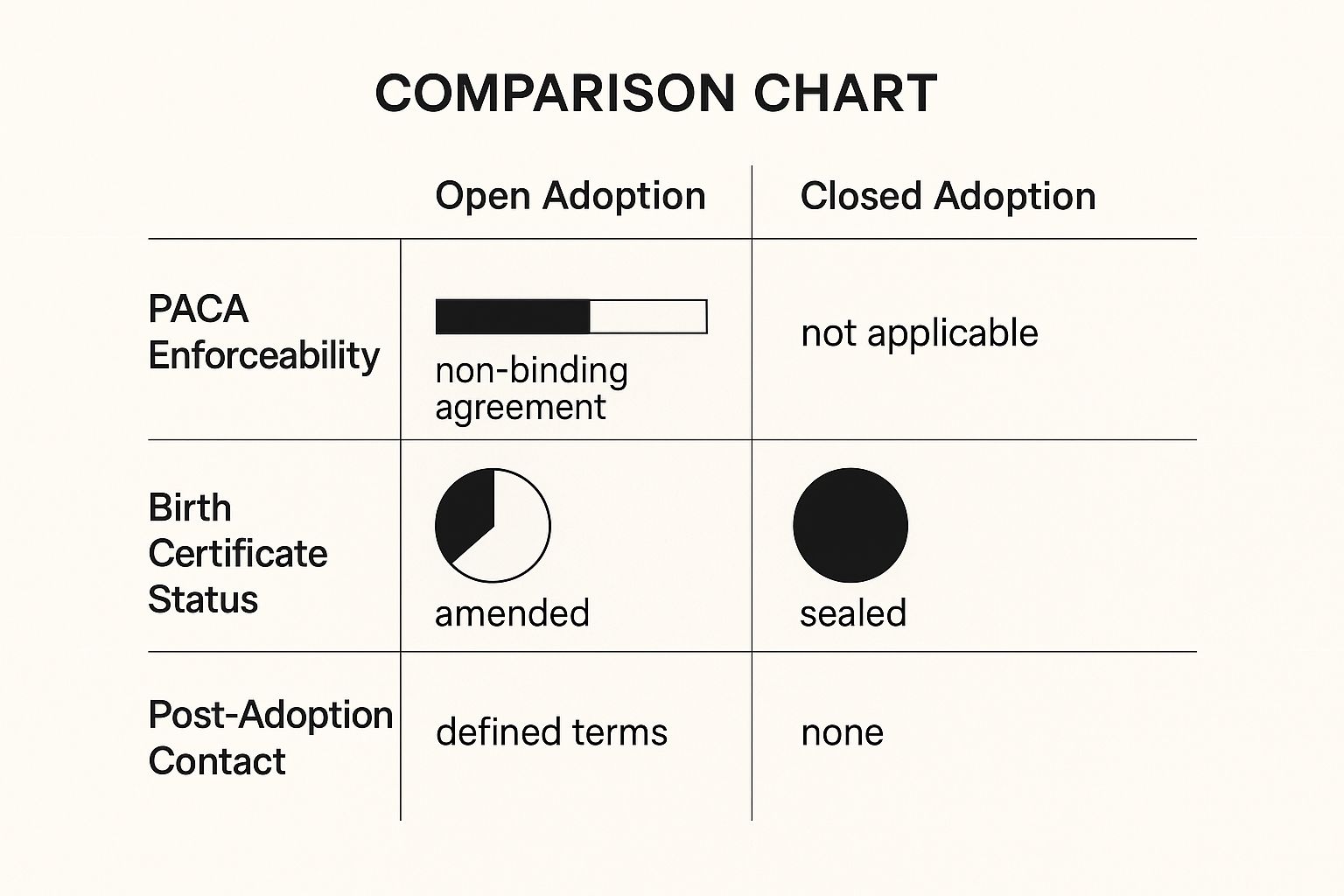
As the infographic shows, an open adoption is built on a non-binding agreement for contact, while a closed adoption creates a legal wall with no contact and sealed records. Understanding these legal distinctions is the first step to choosing the path that fits your family’s needs and best protects your child’s future.
Comparing Long-Term Realities for Your Family
Choosing between an open or closed adoption is a decision that will resonate throughout your family’s life for years to come. What an adoption plan looks like on paper can be very different from how it feels on a quiet Tuesday, ten or twenty years down the road.
Both paths create unique family stories, and understanding the practical, day-to-day differences is key. It’s about looking beyond the final court date and picturing the small moments that build a lifetime.
The Evolving Nature of Open Adoption
An open adoption relationship is like a living thing—it breathes, changes, and grows alongside your child. What might begin as a formal agreement to exchange letters twice a year can evolve into a more natural and integrated connection.
For example, when your child is young, you might manage all communication through scheduled video calls with their birth family. Years later, that same connection might shift to spontaneous texts or a shared social media group. The key is flexibility—a shared promise to adapt as your child’s needs and comfort levels change.
However, all relationships take work. A landmark US study that followed families for 14 years found that the initial frequency of contact can sometimes decrease over time. Contact rates dropped from 60.2% to 39.2% during the study, a reminder that keeping the connection alive often depends on the effort and comfort of the adults involved. You can learn more by seeing what the research says about adoption openness.
Navigating Life in a Closed Adoption
In a closed adoption, the long-term reality is built around privacy and the strength of your independent family unit. Here, the responsibility for sharing your child’s origin story rests entirely on your shoulders. This is not about secrecy; it is about framing a beautiful story of family formation in a positive, age-appropriate way.
As your child’s curiosity about their roots naturally grows, you’ll need to be prepared to answer their questions with honesty and grace, using the non-identifying information you were given.
The challenge—and the profound opportunity—is to help your child forge a rock-solid identity based on the family they know and love, while respectfully acknowledging the parts of their story that remain unknown. It’s about validating every question and feeling, even when you don’t have all the answers.
Long-Term Considerations in Daily Life
To grasp how these choices play out, it helps to compare them in real-world situations. Think about the unexpected questions and milestones that arise over the years.
This table breaks down a few common scenarios, showing how different the day-to-day experience can be.
| Consideration | Open Adoption Scenario | Closed Adoption Scenario |
|---|---|---|
| Medical Questions | A new hereditary health issue appears. You can contact the birth family directly for an updated medical history, giving your child's doctors immediate, accurate information. | You rely on the non-identifying medical history provided at birth. If new concerns arise, you have no direct line for updates, which may mean more extensive medical testing for your child. |
| Child's Identity Questions | Your child asks, "Who do I get my curly hair from?" You can pull up a recent photo of their birth mother or even schedule a video call, giving them a tangible link to their roots. | You might discuss physical traits mentioned in the background report. The conversation centers on celebrating their unique identity while acknowledging that some questions about physical resemblance don't have answers. |
| Major Life Events | A birth grandparent sends a graduation card. A birth sibling is invited to a milestone birthday party. These big moments can be shared, expanding your child’s circle of support. | Your family celebrates milestones privately. On your child's birthday, you might light a candle or share a story about their birth family, honoring them as a cherished part of their history without any direct contact. |
Ultimately, both paths demand an incredible amount of love, patience, and dedication to honoring your child's unique story. The "right" choice is the one that fits your family's heart—the one that aligns with your capacity for communication, your need for privacy, and the environment you feel will best help your child flourish.
How to Make the Right Choice for Your Family
Choosing between an open, semi-open, or closed adoption isn't about finding a "correct" answer—it's about finding the answer that is right for your family. This is a deeply personal decision that should align with your heart, your unique situation, and, above all, the best interests of the child. It is a choice that requires honest, soul-searching conversations from everyone involved.
By asking the tough questions now, both birth parents and hopeful adoptive parents can find a path that feels loving, secure, and built to last.
Questions for Hopeful Adoptive Parents
Before building your family through adoption, it’s important to understand your own emotional landscape. Take time to reflect on these points as you look toward the future:
- Your Comfort with Connection: How do you genuinely feel about your child having a relationship with their birth family? Are you prepared to nurture that connection with consistency and respect, even when it becomes complex?
- Managing Uncertainty: Open adoption relationships are not static; they grow and change. Are you comfortable with a dynamic that might shift as your child's needs and questions evolve?
- Telling the Story: How will you talk about adoption with your child? Are you prepared to frame their birth family as a positive, important part of who they are, regardless of the level of contact?
Questions for Expectant Parents Considering Adoption
This decision is yours alone, and it should be guided by what brings you the most peace, both now and in the years to come. Think about what you need to feel secure in your choice:
- Your Need for Closure: Do you feel you will need privacy and space to heal and move forward? Or would seeing your child happy and thriving bring you a sense of comfort and reassurance?
- Your Hopes for the Future: What kind of connection, if any, do you imagine having with your child as they grow? Would receiving photos and letters be enough, or does the idea of in-person contact feel important to you?
- Trust and Communication: What do you need to feel confident in your decision? What information or assurances from the adoptive family would help you feel secure in the path you've chosen for your child?
A great middle ground for many is the semi-open adoption. In this arrangement, an agency or an attorney acts as an intermediary, passing along letters and photos without sharing identifying details. It allows for a meaningful connection while maintaining a layer of privacy for both families.
This is about finding a balance that honors everyone involved. If you are struggling to weigh your options, exploring different decision making frameworks can provide structure for this significant choice.
No matter where you are in this journey, you do not have to figure it out alone. The compassionate team at The Law Office of Bryan Fagan, PLLC is here to listen and provide the legal guidance you need. We invite you to schedule a free, no-obligation consultation to talk through your unique situation and find the path that feels right for your family.
Texas Adoption Questions Answered
Deciding between open and closed adoption naturally brings up many questions. As you determine what feels right for your family, getting clear, straightforward answers is essential. Here are some of the most common questions we hear from Texas families.
Can a Closed Adoption Become Open Later in Texas?
Yes, it is possible for a closed adoption to become open later, but it requires mutual consent. While a finalized adoption is legally permanent, the door is not always closed forever. Reconnection often happens when an adoptee becomes an adult and both the birth family and the adoptee agree to make contact.
The Texas Voluntary Adoption Registry is a resource that can help facilitate this process. However, it is crucial to understand that a court cannot force a legally closed adoption to be “reopened.” Any future contact depends entirely on the voluntary consent of everyone involved.
What Is a Semi-Open Adoption?
A semi-open adoption is a middle ground that blends the privacy of a closed adoption with the connection of an open one. In this arrangement, a neutral third party—typically an adoption agency or an attorney—acts as the intermediary for all communication.
This structure allows families to share letters, photos, and important updates without exchanging identifying information like last names or home addresses. It is an excellent option for those who want to maintain a connection while preserving a comfortable level of privacy.
This mediated approach provides a structured way to share meaningful milestones. It creates a sense of connection that can be incredibly reassuring while keeping personal boundaries clear and respected.
Are Post-Adoption Contact Agreements Enforceable in Texas?
In Texas, Post-Adoption Contact Agreements (PACAs) are considered “good faith” agreements and are not legally enforceable by a court. A judge cannot step in and compel someone to follow the agreement if circumstances change or one person decides to withdraw.
Even so, these agreements are incredibly valuable. They create a written roadmap, set clear expectations from the start, and foster a mutual commitment to honor the relationship for the child’s sake. A well-drafted PACA is a powerful tool for building a foundation of trust.
Navigating the legal and emotional landscape of adoption can feel overwhelming, but you don’t have to do it alone. The compassionate attorneys at The Law Office of Bryan Fagan, PLLC are here to offer the clarity and support you need. Schedule your free, confidential consultation with us today to discuss your family’s future.

