
Starting the journey to build your family through adoption is one of the most profound and hopeful steps you will ever take. The first move is understanding the legal world you're stepping into. Texas adoption laws, found mainly in the Texas Family Code (Chapters 162-166), are all built around one single goal: protecting the best interests of the child while creating strong, permanent families.
This guide is here to offer a clear, step-by-step path, making the process feel less like a mountain and more like a journey you can navigate with confidence.
Your Journey to Understanding Texas Adoption Laws
Whether you’re a hopeful parent dreaming of welcoming a child home, a birth parent weighing your options with incredible courage, or a relative stepping up to care for a child you already love, the way forward is paved with legal steps. It can feel intimidating, but we encourage you to think of the law not as a barrier, but as a supportive framework ensuring every child finds a safe, stable, and loving home.
At The Law Office of Bryan Fagan, PLLC, we believe that with compassionate guidance, you can navigate this journey with clarity and peace of mind.

Different Paths to Building Your Family
Adoption in Texas isn't a one-size-fits-all process. The law recognizes several different avenues, each tailored to unique family situations. Understanding which route aligns with your circumstances is a crucial first step that shapes everything that follows.
For many people, the path isn't immediately obvious. To help clarify your options, here’s a look at the most common types of adoption in Texas.
Quick Guide to Adoption Paths in Texas
This table summarizes the most common types of adoption in Texas, helping you understand which path might be right for your family's unique situation.
| Type of Adoption | Best For | Key Consideration |
|---|---|---|
| Private Adoption | Hopeful parents looking to connect directly with birth parents, often through an agency or attorney. | The process is highly personal and often involves building a relationship with the birth family. |
| Foster Care (CPS) Adoption | Families open to adopting children whose biological parents' rights were terminated due to abuse or neglect. | These children have often experienced trauma and may require specialized care and support. |
| Stepparent Adoption | Stepparents who want to legally formalize their parental role for their spouse's child. | Creates a unified legal family structure and requires consent or termination of the other parent's rights. |
| Kinship (Relative) Adoption | Grandparents, aunts, uncles, or other relatives stepping in to provide a permanent home for a family member. | Texas law prioritizes these placements to maintain family bonds and a child's sense of identity. |
Each of these paths leads to the same destination—a legally recognized, permanent family—but the journey to get there can look very different.
The Heart of Texas Law: The Child's Best Interest
Every rule, from background checks to home studies, is guided by a single legal principle: the "best interest of the child." This is the legal standard Texas courts use to make every decision. In plain English, it means that every choice must prioritize the child's emotional, physical, and developmental well-being above all else.
This focus is especially clear in the state's preference for keeping children with family. In fact, while there were 4,586 children adopted in Texas in fiscal year 2021, relatives stepped up to adopt more than half of all children and teens from foster care. This isn't a coincidence; it highlights a cornerstone of Texas law that favors kinship placements to preserve those vital family ties whenever possible.
At its core, Texas adoption law is about creating permanence and stability for a child. The legal process confirms that a child belongs, fully and forever, to their new family.
Getting a handle on these fundamental concepts can empower you to move forward. You can learn more about the legal foundation by reading our essential guide on Texas adoption and the Family Code.
No matter which path you're considering, you are not alone. Each year, thousands of Texas families are built through adoption, each with its own unique story. Our role is to provide the legal support that turns your hope into a reality. If you are ready to explore your options and understand how the law applies to your specific situation, we invite you to reach out.
Qualifying to Adopt a Child in Texas
The dream of bringing a child into your life is a powerful one, and it’s completely natural to ask, "Am I qualified?" The good news is that Texas adoption laws are less about a rigid checklist and more about your ability to provide a safe, loving home. The state isn't looking for a perfect family; it's looking for committed ones. That means single individuals, LGBTQ+ couples, and families from all walks of life are welcome to start this journey.
So, where do you begin? Texas law sets a few basic requirements. You need to be at least 21 years old and financially stable. This doesn't mean you have to be wealthy—it just means you have the resources to meet a child’s day-to-day needs.
Beyond that, the state is focused on one thing: the child's safety. This means you and any other adult in your home will go through a comprehensive background check to ensure every child is placed in a secure environment.
Ensuring a Safe Home Environment
In every single adoption, the child's safety is the absolute top priority. It's why Texas requires every prospective adoptive parent to complete thorough background checks. These are a standard, non-negotiable part of the process designed to protect children.
The screening process includes two main components:
- A criminal history check: This looks for any past offenses that could put a child at risk. While a minor mistake from your youth likely won't be a dealbreaker, a history of violent crime or offenses involving children will unfortunately disqualify you.
- A child abuse and neglect registry check: This is a search to confirm you don’t have a verified history of child maltreatment.
It's common to feel a little anxious about this part, but remember its purpose: to create a circle of safety around a vulnerable child. The best approach is always honesty. If you have any concerns, talk them over with your attorney beforehand so you can be prepared.
The Home Study: A Partnership, Not an Inspection
The home study is probably the most misunderstood step in the entire adoption process. Many families imagine someone with a white glove and a clipboard inspecting their house, but that couldn't be further from the truth.
Think of the home study as a partnership—a collaborative process designed to prepare you for this life-changing journey. It’s not a test you can pass or fail.
A licensed social worker will meet with you over several sessions to get to know you and your family. Their job is to support you, answer your questions, and make sure you’re ready for both the joys and challenges of adoption. For a more detailed look at what's involved, you can explore the complete requirements for adoption in Texas in our in-depth guide.
The home study is fundamentally an educational tool. It helps you explore your parenting motivations, identify your strengths, and build a support system before a child is placed with you.
Of course, the social worker will check for basic safety—things like working smoke detectors and ensuring medications are stored securely. But more importantly, they want to understand your emotional readiness, the stability of your relationships, and the strength of your support network. By the time it's over, you won't just feel "approved"—you'll feel more prepared and confident to start your new chapter as a parent.
A Step-By-Step Walkthrough of the Legal Process
Once you meet the qualifications to adopt, the legal journey begins. This is where your dream starts taking shape on paper, moving from a heartfelt wish to a courtroom reality. While the steps can feel a bit intimidating, every single one is designed to build a secure, permanent, and loving foundation for a child.
Think of it like building a house. First, you pour a solid foundation—that’s the termination of parental rights. Then, you put up the frame by filing the adoption petition. Finally, you get to have the housewarming party, which is the final hearing where your family is officially and legally recognized.
The Critical First Step: Termination of Parental Rights
Before a child can be legally welcomed into a new family, the legal ties to their biological parents must be permanently severed. This is called the Termination of Parental Rights (TPR), and it's one of the most serious and emotionally significant steps in the process. Its purpose is to give the child the legal and emotional freedom to fully belong to their new family.
TPR generally happens in one of two ways:
- Voluntary Relinquishment: In this scenario, a birth parent makes the courageous and loving choice to sign legal documents—an "affidavit of relinquishment"—to voluntarily give up their parental rights. It's a profound decision made with the child's best interests at heart.
- Involuntary Termination: In other situations, a court may terminate a parent's rights without their consent. This only happens when a judge finds clear and convincing evidence of serious issues like abandonment, neglect, or abuse, and determines termination is the only way to ensure the child's safety and well-being.
Whether voluntary or involuntary, TPR is the legal bedrock upon which every adoption is built.
Filing the Petition and Protecting the Child
With parental rights addressed, the next major move is to file a Petition to Adopt with the court. This is the formal document that officially tells the court of your intent to adopt and gets the legal ball rolling on your case.
Soon after you file, the court will appoint an ad litem attorney for the child. This is a special lawyer whose one and only job is to represent the child's best interests. They'll meet with the child, talk to you and others involved, and then give the judge their professional opinion on whether the adoption is a safe and positive plan for the child.
This diagram gives you a simplified look at the key milestones you'll hit during the qualification process.
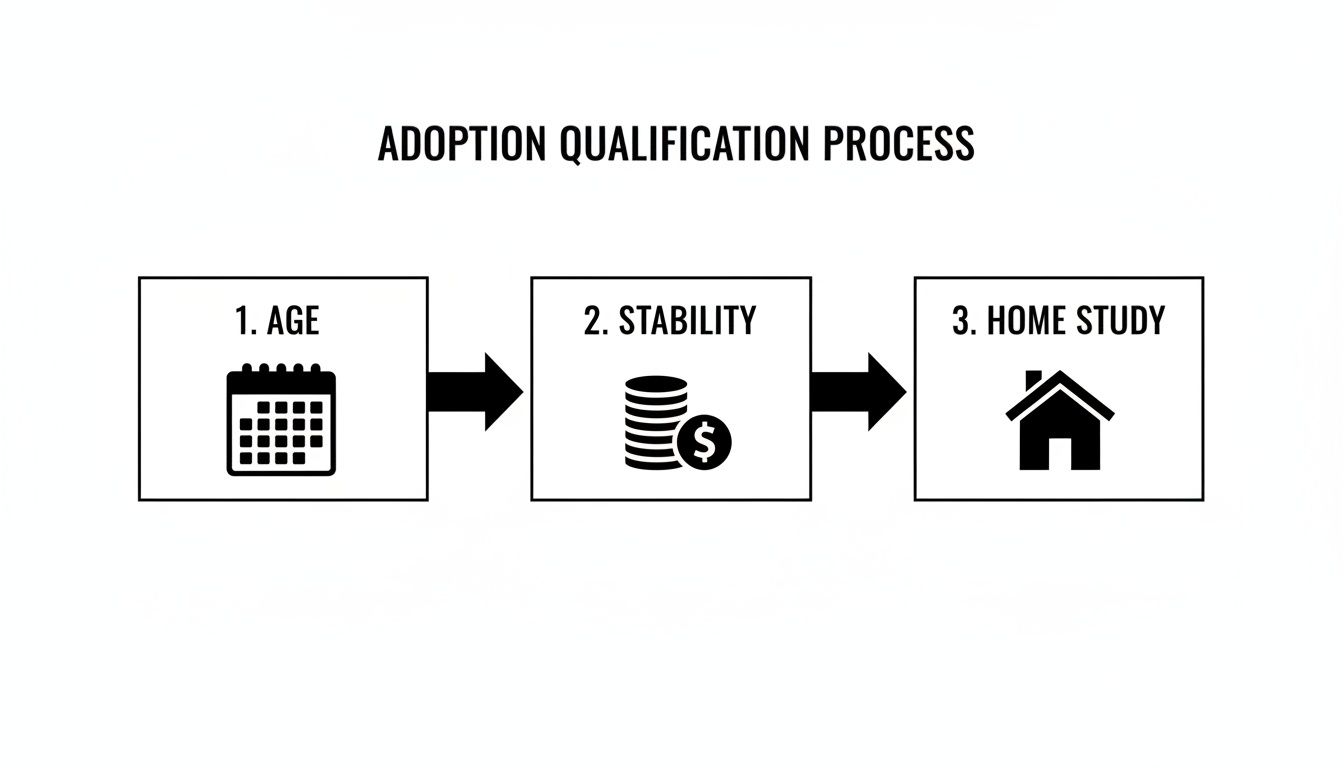
As you can see, proving your age, financial stability, and completing the home study are the foundational pieces you need in place before you can even begin the legal phases of adoption.
The Observation Period and A Real-Life Example
After the child is placed in your home, Texas law requires a mandatory waiting period—typically at least six months. This is known as the post-placement observation period. During this time, a social worker will visit to see how everyone is adjusting and to offer support. It’s a crucial time for bonding, learning, and making sure the placement is a wonderful fit for both you and the child.
Let’s look at a common example: a stepparent adoption. Imagine Maria has a 10-year-old son, Leo, from a previous relationship. She marries Mark, who has been a devoted father figure to Leo for years. They decide it's time for Mark to legally adopt Leo.
First, they’d need to address the rights of Leo’s biological father. If he’s supportive, he can sign a voluntary relinquishment. If not, they might have to ask the court to terminate his rights based on specific grounds, like a long history of no contact or support. Once that's settled, Mark files his Petition to Adopt. An ad litem attorney is appointed for Leo, and after the observation period, the whole family goes to court for the final hearing.
This example shows how adoption texas laws play out in a real family's life. We break down the entire journey in our article on the process of adopting a child in Texas.
The Finalization Hearing: A Day of Celebration
The last step is the adoption finalization hearing. Forget any ideas of a scary courtroom battle; this is a joyful celebration. You, your child, and your attorney will go before a judge who will look over all the paperwork, ask a few simple questions, and then sign the final decree of adoption.
In that moment, with the strike of a pen, your family is legally complete. Your child is, in the eyes of the law, fully and forever yours.
This is the day you've been working toward—a day filled with smiles, photos, and that deep feeling of permanence. This commitment to finding forever homes is a growing trend in our state. Between fiscal years 2010 and 2019, Texas saw an incredible 27.2% increase in adoptions from its child welfare system, with 53,412 children finding permanent families.
Navigating Special Adoption Scenarios in Texas
Every family’s journey to adoption is its own unique story. Because of this, Texas law provides different routes designed for specific family situations. The end goal is always the same—giving a child a stable, loving home—but the legal path to get there can look very different depending on the circumstances.
Understanding these special scenarios is the first step toward moving forward with confidence. Whether it's a grandparent stepping up to raise a grandchild or a foster parent making a bond permanent, each situation has its own set of legal rules. At The Law Office of Bryan Fagan, PLLC, we’re here to offer clear, compassionate guidance through whatever specialized process your family needs.

The Priority of Kinship and Relative Adoptions
When a child’s birth parents can't care for them, Texas law is crystal clear about what should happen next: keep them with family. This is the whole idea behind kinship adoption, where a relative—like a grandparent, aunt, uncle, or even an adult sibling—steps in to adopt. The state's preference for this path comes from a simple, powerful belief: keeping family ties intact is almost always in a child's best interest.
For a child, a kinship adoption can be a lifeline of stability during a difficult time. They get to stay surrounded by people they know and trust, which can help soften the trauma of being separated from their parents.
From a legal standpoint, kinship adoptions can sometimes be more straightforward. While a home study is still part of the process, the standards might be adjusted to reflect the existing family relationship. The focus is still on safety and stability, but there’s an understanding that a loving bond is already in place.
Adopting from the Foster Care System
Choosing to adopt a child from foster care, often called a CPS adoption, is a profound act of love and healing. These are children who have been placed in the state’s care because their biological parents’ rights were terminated, usually due to neglect or abuse. They are waiting for a family to give them the security and permanence every child deserves.
The process often starts with you becoming a licensed foster parent. If a child placed in your care becomes eligible for adoption, you, as their current caregiver, are usually the first person considered to adopt them. It’s an incredibly rewarding path, but it also requires a commitment to understanding the needs of children who have experienced trauma.
Thankfully, Texas provides significant support for families who choose this route:
- Financial Assistance: Many children adopted from foster care qualify for monthly financial support and Medicaid coverage until they turn 18.
- Therapeutic Resources: The state offers access to specialized counseling and other support services to help both children and families heal and thrive.
- Legal Support: In many cases, the state helps cover a large portion of the legal fees needed to finalize a CPS adoption.
Open vs. Closed Adoptions: A Heartfelt Decision
One of the most personal choices in the adoption process is deciding on the level of future contact between the birth family and the adoptive family. The decision between an open adoption and a closed adoption is a deeply emotional one with lifelong effects for everyone involved—especially the child.
In a closed adoption, no identifying information is exchanged between the birth parents and the adoptive family. After the adoption is finalized, the child’s original birth certificate is sealed. For a long time, this was the standard, offering privacy and a clean break.
On the other hand, an open adoption allows for some form of ongoing contact. This can range from sharing letters and photos through an agency to direct communication and even in-person visits. The terms are always agreed upon by both sides with a focus on what will best support the child’s emotional health. Today, more and more adoptions lean toward openness, as it can help a child better understand their own story and identity.
The choice between open and closed adoption isn't about right or wrong; it's about what feels right for your family and what honors the child's story. It is a decision that requires empathy, respect, and careful consideration.
Understanding these different paths can help you see where your own story might fit. Here's a quick side-by-side look at some of the key differences between common adoption types.
Comparing Key Adoption Types in Texas
Each adoption path has its own legal, financial, and emotional landscape. This table breaks down the core elements of stepparent, kinship, and foster care adoptions to help you see the distinctions more clearly.
| Feature | Stepparent Adoption | Kinship/Relative Adoption | Foster Care (CPS) Adoption |
|---|---|---|---|
| Primary Goal | Legally formalize the parent-child bond within a blended family. | Maintain family connections and provide stability for a relative. | Provide a permanent, loving home for a child in state custody. |
| Parental Rights | Requires termination of the other biological parent's rights. | Requires termination of both biological parents' rights. | Parental rights have typically already been terminated by the court. |
| Financial Considerations | Generally funded privately by the family. | Families may be eligible for some state financial assistance. | Often subsidized by the state, including financial and medical aid. |
As you can see, the requirements and support systems vary quite a bit. Thinking through these factors can help you and your family prepare for the journey ahead.
Every adoption is a life-changing event. If you are considering one of these paths or just want to learn more about adoption texas laws, our team is here to help. We invite you to schedule a free, compassionate consultation to discuss your unique situation and explore the best next steps for building your family.
Understanding the Costs and Timelines of Adoption
When you start getting serious about adoption, two very real questions usually pop up right away: "How much is this going to cost?" and "How long is this going to take?" These are completely normal and incredibly important questions. Getting clear answers can reduce anxiety and let you plan for the future.
Every adoption story is one of a kind, but we can give you a realistic picture of the financial and time commitments you're looking at. When you understand these factors, you can prepare for the road ahead and focus on what really matters: getting ready to welcome a child into your family.
A Realistic Look at Adoption Expenses
The cost of an adoption can vary widely depending on the path you take. A private infant adoption, for instance, has a completely different financial breakdown than an adoption from the foster care system. It helps to see the cost not as a lump sum but as a series of professional services that protect everyone involved—you, the child, and the birth parents.
Here are some of the common expenses you can expect to see:
- Attorney and Legal Fees: This covers all the critical legal work, from filing the initial adoption petition to representing you at the finalization hearing.
- Court Filing Fees: Every legal case comes with administrative costs for using the court system.
- Home Study Costs: This fee pays for the time and expertise of the licensed social worker who conducts your mandatory home study.
- Agency Fees: If you're working with a private adoption agency, their fees usually cover everything from matching you with birth parents to providing counseling and support.
It's easy to feel overwhelmed looking at these numbers, but it’s so important to know that financial help is available.
Financial Resources to Help You Adopt
Thankfully, there are powerful resources designed to make adoption much more affordable. One of the biggest is the Federal Adoption Tax Credit, which can put thousands of dollars back in your pocket by offsetting adoption-related expenses.
Families adopting children from foster care in Texas often receive even more significant financial support. The state provides subsidies, which can include a monthly payment and Medicaid coverage for the child, ensuring you have what you need to meet their needs. These programs are a cornerstone of adoption texas laws, showing the state's commitment to finding forever homes for kids in its care.
Planning for the costs of adoption is a lot like planning for any other major life event. When you break it down and look at all the resources available, you can build a financial plan that works for your family.
Understanding Adoption Timelines
Just like costs, timelines are not one-size-fits-all. The length of the journey depends heavily on the type of adoption and the unique details of your case. For example, a stepparent or kinship adoption where everyone is on the same page can often be finalized relatively quickly, sometimes in under a year.
On the other hand, a private infant adoption might take longer because the timeline hinges on the matching process. A major factor that can stretch out any adoption timeline is a contested termination of parental rights. If a biological parent fights the termination, the legal dispute will naturally take more time to work through the courts. While it's impossible to circle a date on the calendar, being prepared for a process that can take anywhere from one to two years is a reasonable expectation for many families.
So, Where Do You Go From Here?
Taking that first step toward adoption is a huge moment, filled with hope and maybe a little uncertainty. We've walked through the legal side of things, from the specific adoption Texas laws you'll encounter to the different paths your journey might take. The key takeaway is this: the legal process, while detailed, is there to build strong, permanent families with the child's absolute best interests at heart. It’s a journey, but you don’t have to walk it alone.
Building your family through adoption is one of the most beautiful, life-changing things you can do. Every year, thousands of Texas families become part of this incredible story. In 2021 alone, 81,839 children across the country were adopted, with a huge number coming from the foster care system—a trend that reflects Texas's own deep commitment to finding kids their forever families. You can discover more insights about adoption statistics and see the impact for yourself.
Your Next Step Starts with a Conversation
At The Law Office of Bryan Fagan, PLLC, our purpose is to guide you through every legal detail with clarity, compassion, and genuine care. We understand the emotional weight of this process. We’re here to offer the reassurance and rock-solid legal support you need to move forward with confidence.
Your dream of building a family is worth pursuing. With the right legal partner, you can navigate the complexities of Texas law and focus on what truly matters—preparing to welcome a child into your home.
You’re ready to take the next step. Every question you have is valid, and every concern deserves to be heard. We invite you to schedule a free, no-obligation consultation with our team. Let's sit down and talk about your unique situation, answer your questions, and map out a clear plan to help you build the family you've always imagined.
Frequently Asked Questions About Texas Adoption
The road to adoption is naturally paved with questions. Getting clear answers is the best way to move forward with confidence instead of uncertainty. To help you, we’ve put together some of the most common questions we hear from families just starting to explore their options.
Understanding these key parts of adoption texas laws can bring a lot of clarity as you think about what’s next for your family.
Can a Single Person Adopt in Texas?
Absolutely. Texas law is focused on one thing above all else: a child's best interest. The court's main concern is your ability to provide a stable, loving, and safe home for a child. Your marital status is not a barrier.
In fact, many wonderful, successful adoptions involve single parents who create nurturing and supportive homes. The home study process will look at your support system and overall readiness, just as it does for couples.
What Is the Difference Between Adoption and Guardianship?
This is a critical legal distinction. Think of it like this: adoption is about building a permanent family foundation, while guardianship is more like putting up a temporary, protective arrangement.
Adoption creates a brand-new, legally permanent parent-child relationship. It completely and forever severs the rights of the biological parents. For all legal purposes, that child becomes your child.
Guardianship, on the other hand, is a temporary legal arrangement. A court gives someone the authority to care for a child and make decisions for them, but it doesn't terminate the biological parents' rights. That means the arrangement can be changed or even ended by the court down the road.
Do Both Birth Parents Have to Agree to the Adoption?
For an adoption to be legally sound and emotionally secure for everyone involved, the parental rights of both biological parents must be legally terminated. This isn't just a piece of paperwork; it's a non-negotiable step that protects the child and their new family from any future legal challenges.
This termination can happen in one of two ways:
- Voluntary Relinquishment: This is when a birth parent makes the conscious, difficult choice to sign legal documents that end their parental rights.
- Involuntary Termination: In heartbreaking situations involving abandonment, neglect, or abuse, a court may step in and terminate a parent’s rights without their consent to protect the child from harm.
Securing this termination is what gives an adoption its finality. It’s the legal act that allows a child to truly and permanently belong to their new family.
The journey to build a family through adoption is one of the most incredible paths a person can take. At The Law Office of Bryan Fagan, PLLC, we are here to provide the compassionate legal guidance you need every step of the way. If you have more questions or are ready to begin, we invite you to schedule a free consultation with our dedicated team today at https://texasfamilyadoption.com.
