
For hopeful parents considering adoption, one of the first and most heartfelt questions is, "How long will this take?" It’s a question that comes from a place of pure excitement and the deep desire to finally bring your child home. At The Law Office of Bryan Fagan, PLLC, we understand that waiting can be the hardest part of the journey.
The truth is, there’s no single answer. A realistic estimate for an adoption in Texas is anywhere from three months to two years. The biggest factor shaping your personal timeline is the path you choose—whether it’s a stepparent, private infant, or foster care adoption. Each journey is unique, guided by the Texas Family Code and centered on the best interests of the child.
A Visual Guide to Texas Adoption Timelines
Think of these timeframes less as rigid deadlines and more as a general roadmap for the journey ahead. Every family's story is different, shaped by unique circumstances, legal requirements, and the specific needs of the child.
To give you a clearer picture, here’s a simple breakdown of what to expect for the most common adoption types in Texas.
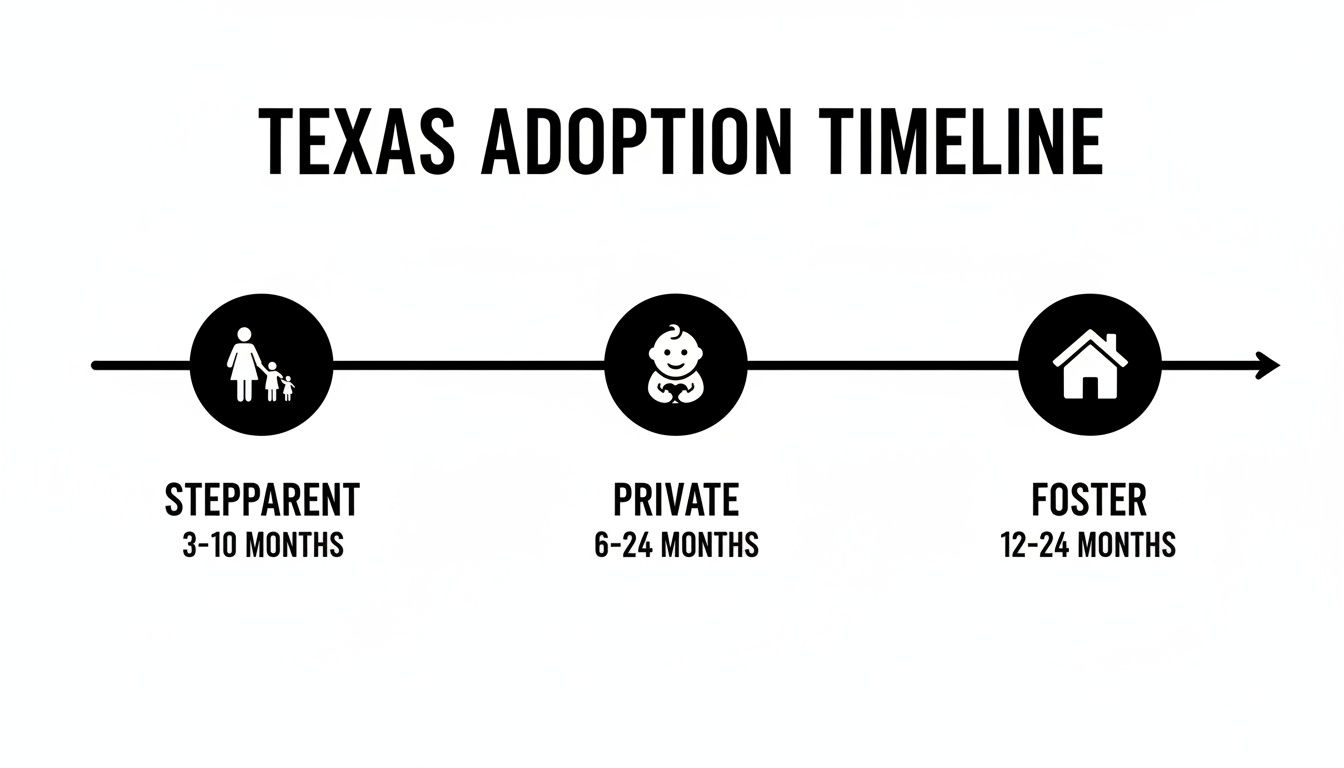
As you can see, stepparent adoptions tend to be the quickest, as they formalize an existing family bond. On the other hand, private and foster care adoptions involve a much longer and more complex series of steps before you celebrate finalization day.
Texas Adoption Timelines at a Glance
To help set clear expectations, this table offers a quick summary of the estimated timeframes for the most common types of adoption in Texas.
| Type of Adoption | Average Time to Finalization |
|---|---|
| Stepparent Adoption | 3 to 6 months |
| Private Infant Adoption | 6 months to 2 years |
| Foster Care Adoption | 9 months to 2 years |
| Relative/Kinship Adoption | 6 to 12 months |
Remember, these are just averages. Your journey might be shorter or longer depending on the specifics of your case, but this gives you a solid starting point for planning.
Why Do Timelines Vary So Much?
So, what causes such a wide range in timelines? Several key factors come into play, each unique to your situation. Here are the main variables that can speed up or slow down the process:
- The Type of Adoption: As the infographic shows, a stepparent adoption formalizes an existing family bond and is naturally faster than a private infant adoption, which requires matching with an expectant mother.
- Termination of Parental Rights: Things move much more quickly if the biological parents voluntarily and legally consent to the adoption. If their rights need to be terminated by a court due to abandonment or other issues, as outlined in the Texas Family Code, this can add significant time and legal complexity.
- The Home Study and Paperwork: Completing your home study—a thorough assessment required by the Texas Family Code—typically takes two to four months. Staying organized and responding promptly to your social worker can keep this critical step on track.
- Legal Procedures and Court Schedules: Every stage, from filing the initial petition to the finalization hearing in front of a judge, has its own timeline. These are often dictated by packed court dockets and mandatory waiting periods.
Navigating these steps requires patience and preparation. By understanding what to expect, you can feel more in control and less anxious about the road ahead.
For a complete breakdown of each stage, you can explore our guide on what the adoption process in Texas looks like. Knowing what’s coming is the first step toward building your family with confidence.
The Stepparent and Relative Adoption Journey
When you’re adopting a stepchild or a close relative, you’re not starting from scratch. You're giving legal recognition to a family bond that has been growing for years. That’s why these adoptions are often the most straightforward—and emotionally rewarding—paths to making a family official.
The deep, existing relationship you have with the child is the key. Unlike adoptions involving an unknown child, Texas courts recognize this built-in connection, which can significantly streamline the process. A judge might even waive certain requirements, like a full home study, making the journey feel less like an inspection and more like a celebration of family unity.
Key Milestones in a Family Adoption
While the path is shorter, a stepparent or relative adoption still follows a clear legal roadmap to protect the child’s best interests. The process is designed to be thorough yet efficient, reflecting the stability that’s already in place.
Here’s a look at the typical steps you'll take:
- Filing the Original Petition for Adoption: This is the first official move, where you file legal documents with the court to formally begin the process.
- Terminating the Other Biological Parent's Rights: This is a crucial milestone. If the other parent consents and signs a voluntary relinquishment, it’s a simple step. If not, it can become a more complex legal hurdle that requires compassionate and skilled legal guidance.
- Conducting a Background Check and Social Study: Even if a full home study is waived, the court will still require a social study and criminal background checks. This is a non-negotiable step to ensure a safe environment for the child.
- The Finalization Hearing: This is the day you’ve been waiting for. It’s a joyful court appearance where the judge reviews your case, signs the final adoption decree, and legally declares you the child’s parent, cementing your family forever.
How Long Does It Realistically Take?
The good news is that stepparent and relative adoptions move much faster than other types. Most families can expect the entire process to take between 3 to 12 months. These adoptions are incredibly common; in fact, stepparent adoptions made up about 25% of all adoptions in the U.S. in 2022. You can explore the national adoption data to see just how many blended families take this step.
The single biggest factor dictating your timeline is the termination of parental rights. Thankfully, over 90% of these cases are consensual. When the other biological parent agrees, the process moves smoothly, often leading to finalization within just four to six months of filing.
But what if the other parent contests the adoption or simply can't be found? That’s when the timeline stretches. Additional legal steps become necessary, adding time and complexity. For a complete breakdown of the legal ins and outs, take a look at our detailed guide on stepparent adoption in Texas.
Having an experienced adoption attorney on your side can make all the difference, especially when navigating delicate conversations around parental rights. Our team at The Law Office of Bryan Fagan, PLLC, helps you manage these moments with both compassion and legal clarity, keeping the child’s well-being front and center.
Navigating the Private Infant Adoption Path
Choosing to adopt an infant through a private agency is a journey of the heart, one filled with anticipation, patience, and an incredible desire to grow your family. For so many hopeful parents we work with, including LGBTQ+ couples and individuals, this path has its own unique emotional rhythm. Understanding the timeline from the start helps you prepare for what’s ahead with reassurance and hope.

Unlike a stepparent adoption, which makes an existing bond legal, private infant adoption is about creating a brand-new family. It’s a process that unfolds in careful, deliberate stages, each with its own timeline, all leading to that incredible moment you finally bring your child home.
The First Steps: Choosing an Agency and Completing the Home Study
Your journey begins by finding a licensed adoption agency or an attorney you trust to guide you. This isn’t a decision to rush. Expect to spend one to two months researching, conducting interviews, and finding a team that feels like the right fit for your family’s vision and values.
Once you have your professional partners in place, you’ll dive into the home study. This is a mandatory step required by the Texas Family Code, and it’s a thorough look into your life, your home, and your readiness to be a parent. It typically takes about two to four months to complete and involves background checks, financial reviews, personal interviews, and a home safety check. The purpose is to ensure a child will be welcomed into a safe, stable, and loving home.
Creating Your Profile and Waiting for a Match
After your home study is approved, it’s time to create your prospective parent profile. Think of this as more than just a document—it's your family’s story in written form. It's a heartfelt introduction that shares who you are, your hopes for a child, and the life you want to build. This profile is what expectant birth parents review when they make the brave and loving choice of an adoption plan.
The waiting period that comes next is often the most emotionally challenging part. The question of how long the adoption process will take is most uncertain here. Finding a match depends entirely on a birth parent choosing your family, and this phase can last anywhere from six to over 18 months.
Your profile is your chance to connect on a human level. It’s a story of your life, your values, and your dreams for a child. A compassionate and authentic profile can make all the difference in connecting with an expectant mother.
A few key things can influence how long you wait for a match:
- Your Openness: Families who are open to different situations—such as various racial backgrounds or potential health considerations—often find their wait time is shorter.
- The Birth Parent's Journey: Every birth parent's situation is unique. Their timeline for making such a personal and loving decision is entirely their own.
- Your Agency’s Caseload: The number of other hopeful families your agency is currently working with can also be a factor.
From Placement to Finalization
Once you're matched and the baby is born, Texas law provides critical protections for the birth parent. A birth mother cannot legally sign the documents to relinquish her parental rights until at least 48 hours after the birth. This is a vital safeguard under the Texas Family Code (Chapter 162), giving her time to make this monumental decision without pressure.
If the adoption crosses state lines (for instance, you live in Texas but the baby is born elsewhere), you'll also have to navigate the Interstate Compact on the Placement of Children (ICPC). Getting this legal clearance can add a few extra weeks to your timeline.
After you bring your baby home, a social worker will conduct a series of post-placement visits over the next six months. The final step is the finalization hearing, where a judge signs the official decree that makes your family legally and forever complete. All told, the timeline for a private infant adoption usually lands somewhere between 6 and 24 months, with most families completing the process in about 9-15 months from start to finish. You can discover more about national adoption statistics to see how these timelines compare across the country.
The Foster to Adopt Timeline in Texas
Choosing to adopt a child from the foster care system is one of the most incredible ways to build a family. You’re offering a child the life-changing gifts of stability, a permanent home, and unconditional love. The foster-to-adopt timeline can be the most unpredictable of all adoption paths, requiring a deep well of patience and compassion.

This journey doesn’t usually start with an adoption petition. It starts with you becoming a licensed foster parent. That’s because the primary goal of the Texas Department of Family and Protective Services (DFPS) is always family reunification, whenever safely possible.
This means that even when a child is placed in your home, the state is legally required to give the biological parents a chance to address the issues that led to the child’s removal. This core principle, centered on the child's best interest, shapes the entire timeline from start to finish.
Becoming a Licensed Foster Parent
Before you can be considered as an adoptive family, you must become licensed to provide foster care in Texas. It's a multi-step process designed to ensure you're fully prepared to care for a child who has likely experienced trauma.
This initial stage typically takes four to eight months and involves:
- Attending informational meetings and in-depth training.
- Completing a detailed home study and passing background checks.
- Sharing personal, financial, and medical information.
Once you’re licensed, a child might be placed in your home. It’s crucial to remember that at this point, you are their temporary caregiver while the state works on its reunification plan with their birth family.
The Waiting Period for Legal Clearance
This is the most significant and unpredictable part of the foster-to-adopt journey: waiting for the child to become “legally free” for adoption. This can only happen after a court terminates the parental rights of the biological parents.
This legal process can take anywhere from six to 18 months, and sometimes much longer. A judge will create a service plan for the biological parents, giving them a specific amount of time to demonstrate they can provide a safe home. If they are unable to meet those requirements, the state moves to terminate their rights—a complex legal process that can be lengthy and emotionally challenging for everyone involved.
The heart of the foster-to-adopt journey is patience. It means loving and caring for a child completely, while accepting the uncertainty of their legal case. This period requires immense strength, but it’s all in service of the child’s best interests.
From Placement to Finalization
Once a judge terminates parental rights, the path to adoption becomes much clearer. The child is now legally available for adoption, and as their foster parent, you are almost always given the first opportunity to become their adoptive family.
Under Texas law, the child must live in your home for at least six months after parental rights are terminated before the adoption can be finalized. This post-placement period gives social workers time for supervisory visits to ensure everything is stable and going well. After that, you’ll head to court for a finalization hearing, where a judge signs the decree that officially makes the child a permanent member of your family.
When you add up all these overlapping stages, the entire foster-to-adopt process—from getting licensed to the final handshake with the judge—usually takes between 12 and 24 months. To get a better handle on those first steps, you can explore our guide on how to foster to adopt in Texas. The timeline can feel long, but the reward of giving a child a forever home is immeasurable.
Factors That Shape Your Adoption Timeline
While no one can give you a crystal ball with the exact date your adoption will be final, understanding the key variables can provide a sense of control and empowerment. It helps you move through the process with more confidence and less anxiety. Think of it like building with blocks; certain pieces need to be perfectly in place before you can add the next layer. How long your adoption takes really boils down to how smoothly those foundational pieces come together.

Some of these factors are within your control—like being organized with your paperwork. Others, like court backlogs or a birth parent's personal journey, are simply out of your hands. The key is to focus on what you can influence while giving yourself the grace to accept the parts you can't.
Speeding Up or Slowing Down the Process
Certain milestones have a much bigger impact on your timeline than others. For instance, a consensual and voluntary termination of parental rights can shave months off the journey. On the other hand, a contested case can easily add a year or more. Pinpointing where potential delays might arise helps you and your attorney prepare a solid game plan.
Below is a quick look at the most common things that can speed up or slow down your adoption. Understanding these elements helps you proactively manage your journey instead of just reacting to it.
Key Factors Influencing Your Adoption Timeline
| Factor | Potential to Expedite Process | Potential to Delay Process |
|---|---|---|
| Completeness of Paperwork | Submitting a thorough, accurate application package right from the start. | Missing documents, incorrect information, or slow responses to requests. |
| Home Study Preparation | Working closely with your social worker and having a safe, prepared home. | Unresolved safety issues, background check flags, or scheduling conflicts. |
| Parental Rights Termination | Voluntary and consensual relinquishment by biological parents. | A contested termination or major difficulty locating a biological parent. |
| Legal Representation | An experienced attorney who anticipates and resolves legal hurdles quickly. | Navigating complex legal requirements without professional guidance. |
By keeping these factors in mind, you can take a more active role in shaping your own timeline.
Taking an Active Role in Your Timeline
It's easy to feel like you're just waiting, but there are absolutely concrete steps you can take to keep things moving. Being proactive doesn't just prevent unnecessary delays; it also gives you a sense of empowerment during what can be a very emotional time. It shifts your mindset from waiting for things to happen to making them happen.
Here are a few actionable tips:
- Gather Documents Early: As soon as you decide to adopt, start collecting essential documents like birth certificates, marriage licenses, and financial records. Don't wait to be asked.
- Prepare for Your Home Study: Read up on the requirements and begin making any necessary safety adjustments to your home ahead of time.
- Maintain Open Communication: Stay in regular contact with your adoption agency and your legal team. Quick replies to emails and phone calls can stop small delays from becoming major ones.
- Trust Your Attorney: Lean on your adoption attorney's expertise. They live and breathe the intricacies of the Texas Family Code and can spot potential roadblocks long before they become serious issues.
Your journey is unique, but the path is well-traveled. By preparing for these key steps, you are not just waiting—you are actively building the foundation for your family’s future.
By focusing on preparation and teaming up with a skilled legal team, you can navigate the adoption process—however long it takes—with purpose and peace of mind. The journey demands patience, but every step forward is a step closer to bringing your child home for good.
Your Questions About Adoption Timelines Answered
When you’re thinking about adoption, the questions can feel endless. The waiting and the unknowns are often the hardest parts of the journey, but getting clear answers can make everything feel more manageable. We've put together some of the most common questions we hear from Texas families to give you the practical insights you need to move forward with confidence.
How Long Does the Adoption Home Study Take in Texas?
In Texas, you can generally expect the home study process to take somewhere between two and four months. This window covers everything from the initial interviews and background checks to the home safety inspections and gathering all your personal documents.
How quickly you provide the required paperwork and the schedule of your social worker are the two biggest variables. The best way to keep things moving is to stay organized and be as responsive as possible—that alone can shave weeks off the timeline.
Will a Contested Adoption Lengthen the Process?
Absolutely. A contested adoption is one of the most significant reasons an adoption timeline can stretch out. When a biological parent objects to the termination of their parental rights, the matter must go before a judge.
This introduces a new level of legal complexity that can easily add a year or more to your wait. In these situations, having a seasoned adoption attorney isn't just helpful; it's essential for navigating the court system and advocating for the child’s best interests.
Is It Faster to Adopt an Older Child from Foster Care?
Not always. The real question isn't the child's age but their legal status. If a child is already “legally free” for adoption—meaning a court has already terminated parental rights—then yes, the matching and finalization process can move fairly quickly.
But if the biological parents’ rights are still intact, you're back to waiting for that legal process to play out, which can be a long and unpredictable road. While there is a great need for families willing to adopt older children, the timeline hinges entirely on the child's specific legal situation.
How Can an Attorney Help Make My Adoption Faster?
Think of an experienced adoption attorney as your guide and advocate, spotting and preventing common delays before they ever happen. They know exactly how to file the legal paperwork correctly, manage the intricate process of terminating parental rights, and keep communication flowing between all the different parties.
By anticipating legal hurdles and navigating the Texas Family Code efficiently, an attorney helps ensure your journey to finalization is as smooth and swift as possible, letting you focus on what matters most—your family.
The adoption journey is filled with unique legal and emotional milestones, but you don't have to walk it alone. The compassionate attorneys at The Law Office of Bryan Fagan, PLLC are here to provide the clarity and support you need at every step. If you're ready to take the next step toward building your family, schedule a free, no-obligation consultation with us today. Let us help you bring your child home.
