
A lot of Houston families begin in the same quiet place. Maybe you're sitting at the kitchen table after bedtime, talking about the child you've already been raising, the baby you hope to welcome, or the grandchild who already feels like your own. You feel hopeful. You also feel the weight of questions that don't have easy answers.
You may be wondering whether you need an adoption attorney in Houston, how Harris County courts handle these cases, what the process looks like, or whether your family situation fits Texas law at all. Those questions are normal. Adoption is both very personal and highly legal.
For some people, adoption means making an everyday parent-child bond official. For others, it means helping a child stay connected to family after a crisis. Birth parents may be asking different questions, but the heart of the matter is the same. Everyone wants to know what comes next and what protects the child.
Texas adoption law gives families a path forward, but it also asks for careful steps. Chapters 162 through 166 of the Texas Family Code shape much of that path, including who may adopt, how parental rights are handled, what the court reviews, and when an adoption can become final. In Houston, the local court experience can add practical details that broad statewide guides often leave out.
Starting Your Houston Adoption Journey
At 9:30 on a Tuesday morning, a Harris County courtroom can hold several very different families with the same quiet hope. A stepparent may be waiting to make an everyday parent-child bond official. A grandmother may be asking the court to recognize the child she has already been raising. A foster parent may be standing at the edge of a long-awaited final hearing. On paper, each case has forms, signatures, and deadlines. In real life, each case carries years of love, worry, and unanswered questions.
That mix of emotion is common in Houston adoption matters. Families often arrive asking a simple question that has a layered answer. How do we make this legal, and how do we do it the right way in Harris County?

What Texas asks from adoptive parents
Texas courts want a clear picture of the adults asking to adopt and the home the child will enter. In many cases, that means the prospective adoptive parent must be an adult, complete background screening, show the ability to provide a stable home, and take part in a home study or other required evaluation, depending on the type of case.
If that sounds formal, it may help to picture the court as checking three basics. Who is stepping into the legal role of parent? Is the home safe and steady? Does this adoption serve the child's best interests?
Some families worry that the process is a test of perfection. It is not. Judges are not looking for a flawless household. They are looking for consistency, honesty, and evidence that a child will be cared for day after day.
Practical rule: Adoption is about showing the court that a child will have a safe, steady, loving home.
If you are still sorting out which kind of adoption fits your family, this overview of common types of adoption in Texas can help you get oriented before you start gathering documents.
Why Houston families often want local guidance
State law sets the framework, but Houston families often feel the pressure in the local details. Harris County procedures, court scheduling, required paperwork, and the way contested issues are handled can affect how a case unfolds in practice. Two families may both be pursuing adoption under Texas law and still have very different experiences depending on the court, the history of the case, and whether another parent must be notified or have rights addressed first.
A local adoption attorney can help make those steps feel manageable. That matters in Houston, where timing, courthouse procedures, and case-specific filings can shape how quickly a family gets from "we're ready" to a final hearing. Good legal help also gives families a steady point of contact during an emotional process. One parent may be excited while the other is anxious about paperwork, delays, or a hearing date. Clear guidance helps both.
For many hopeful parents, adoption feels like building a home while learning the city's permit rules at the same time. The love may already be there. The legal process makes the structure secure so no one is left wondering later whether the parent-child relationship is fully protected.
The Different Ways to Build Your Family Through Adoption
Adoption in Texas isn't one single road. It's more like several roads leading toward the same goal, which is a secure legal parent-child relationship that serves the child's best interests. If you're still figuring out which path sounds most like your story, it helps to separate the options in plain terms.
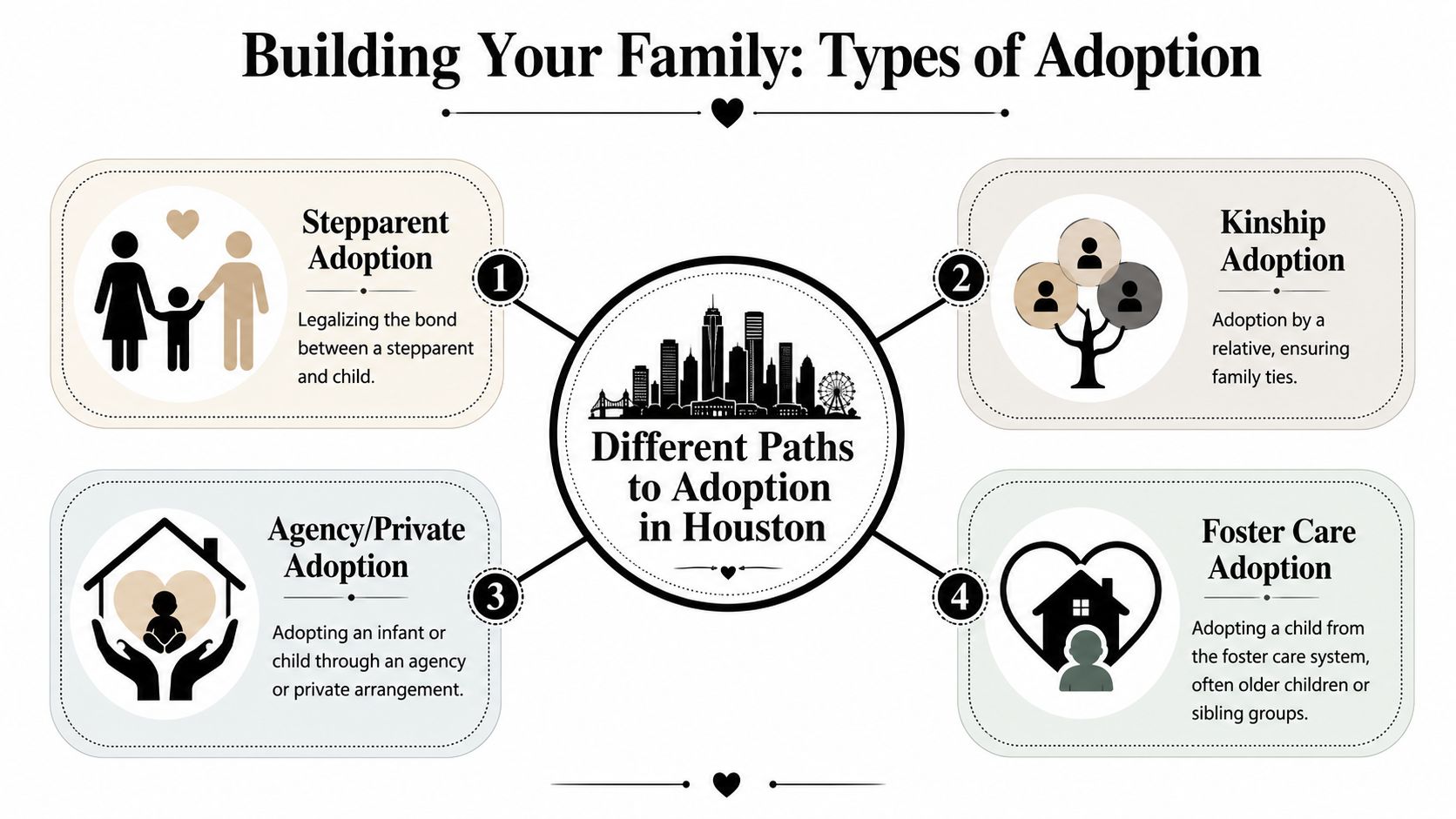
Four common adoption paths
Here's a simple way to think about the main types many Houston families consider. The firm's guide to types of adoption in Texas gives a broader overview, but these basics help most readers get oriented quickly.
Stepparent adoption
This is often the legal version of a bond that already exists. A stepparent has been doing the daily work of parenting and wants the law to recognize that relationship. Stepparent Adoption in Texas is the most common Texas adoption and explains how that process works.Kinship adoption
This happens when a relative, such as a grandparent, aunt, uncle, or adult sibling, adopts a child. Families often choose this path when they want to keep the child connected to familiar people, routines, and family history.Agency or private adoption
Some families adopt an infant or child through a licensed agency or a private arrangement handled under Texas law. This path usually includes more planning on the front end and often involves careful work around consents, placement, and court review.Foster care or CPS adoption
This path usually grows from the child welfare system. A foster parent or approved caregiver may move toward adoption when reunification is no longer the plan and the court decides permanency through adoption is in the child's best interests.
How families decide which path fits
A simple question often helps. Are you legalizing an existing family bond, or are you creating a new placement through a formal process?
If you've already been raising the child, stepparent or kinship adoption may fit. If you're starting with a placement process, agency, private, or CPS adoption may be the better match.
The right path isn't the one that looks easiest online. It's the one that matches your family's actual legal situation.
That distinction matters because each route can involve different paperwork, different people whose rights must be addressed, and different court concerns. The emotional side matters too. A grandparent adopting a grandchild may be carrying grief alongside love. A stepparent may worry about hurting a child's connection to the past. A birth parent may want reassurance that the child will remain safe and cherished.
Navigating the Adoption Process Step by Step
Most adoptions share a basic structure, even when the facts are very different. Once families understand the sequence, the process usually feels less mysterious and more manageable.
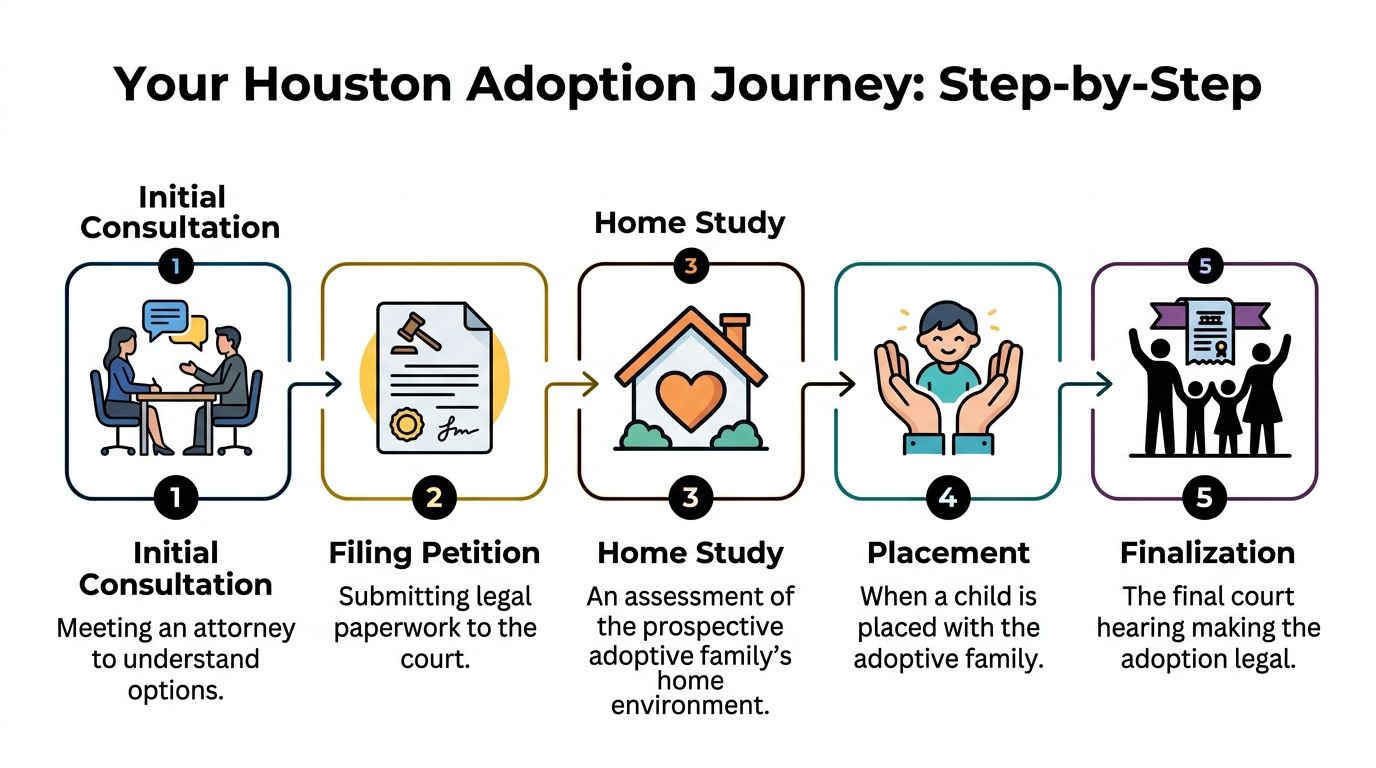
A quick visual can help before you dive into the details.
The legal path from first meeting to final hearing
The full guide to the Texas adoption process step by step goes deeper, but the main stages usually look like this:
Initial consultation and case review
You and your attorney identify the adoption type, the child's current legal status, and whether another parent's rights must be terminated or addressed first.Filing the petition
The case begins with formal court paperwork in the proper county. In Houston-area cases, filing in the right court and presenting the facts clearly can prevent avoidable delays.Home study and background review
This is the court's chance to evaluate the home, the caregivers, and the overall stability of the proposed placement. Families often worry this step is a test they can fail for small reasons. In reality, the reviewer is looking for safety, honesty, and readiness.Placement and parental rights issues
In some cases, the child is already living with the petitioner. In others, placement happens during the process. If another legal parent still has rights, the case may require consent, relinquishment, or litigation over termination.Post-placement supervision and finalization
Before the judge signs the final decree, the court usually expects a period of supervision and updated information showing that the placement is stable.
The six-month rule that surprises many families
One of the most important Texas rules appears near the end of the process, not the beginning. Under Texas Family Code § 162.009, a court cannot grant an adoption decree until the child has resided with the petitioner for a minimum of six months post-placement. This residence requirement is designed to allow the court to assess the stability of the adoptive home, though a judicial waiver is possible if it's in the child's best interest, a key factor in many kinship or stepparent adoptions, as explained in this discussion of Texas Family Code § 162.009.
That rule confuses many families because they assume the case can finish as soon as everyone agrees. Often, it can't. The court wants a meaningful period to see that the placement is working in real life.
A smooth placement doesn't always mean an immediate final hearing. Texas law often requires the family to live the arrangement before the court makes it permanent.
Where people get stuck
The hardest step is often termination of parental rights, sometimes called TPR. People often believe that if a biological parent has been absent, the court will quickly end that parent's rights. That's not always true. The court requires proof, proper notice, and careful procedure.
For example, a stepparent may have raised a child for years, yet the other parent's legal rights still must be resolved before adoption can move forward. A relative caregiver may believe everyone in the family agrees, only to learn that one parent later contests the case. Those issues don't mean adoption is impossible. They mean the process has to be handled with care.
Understanding Adoption Timelines and Financial Investment
A Houston parent may walk out of the courthouse feeling hopeful one week, then feel discouraged the next because a hearing date moved or one more document is needed. That swing is normal. Adoption usually moves in stages, and in Harris County, each stage can have its own pace depending on the court's calendar, the type of adoption, and whether every required signature and notice is in place.
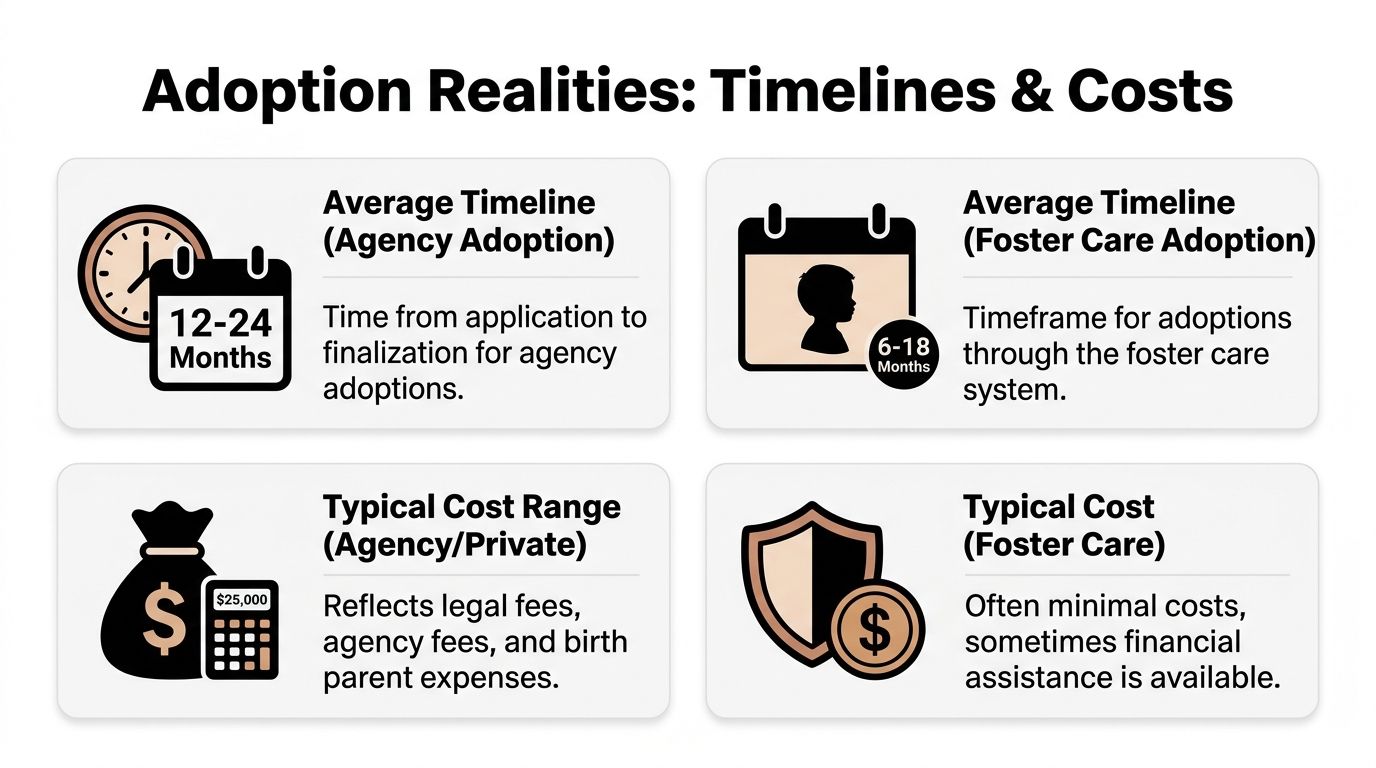
What affects the financial side
Adoption costs in Texas can vary a great deal. A stepparent adoption in Houston often involves a very different level of legal work than a private infant adoption, an agency matter, or a CPS case with disputed facts.
Families usually spend more or less based on three practical questions. What kind of adoption is this? Is anyone likely to object or be hard to locate? What extra steps will the court require before finalization?
Here are the cost drivers families usually see:
Type of adoption
Stepparent and kinship cases are often more limited in scope than private or agency adoptions, which may include matching, placement coordination, and additional paperwork.Level of agreement
Cases tend to move more efficiently if the necessary parties consent and can be served without difficulty. Costs often rise if a parent contests the case, cannot be found, or requires formal notice through alternative methods.Required evaluations and records
Home studies, background checks, medical records, certified copies, and post-placement reports can all add time and expense.
A helpful way to view legal fees is to compare them to building plans for a house. If the design is straightforward and everyone agrees on the layout, the project is easier to price. If a wall has to be moved halfway through, the budget changes. Adoption cases work much the same way.
How to think about timing in Harris County
The question is usually not just "How many months?" A better question is "Which phase are we in, and what has to happen before the next one?"
In Houston-area cases, families often move through these phases: preparation, filing, notice to all required parties, any home study or post-placement supervision, and then finalization. A delay in one phase can hold up the next, even if the child is already thriving in the home.
That can feel frustrating. It does not always mean something is wrong.
Harris County courts are handling crowded dockets, and adoption cases still require careful review because the judge is creating a permanent legal parent-child relationship. For hopeful parents, it helps to expect progress in steps rather than in one straight line.
| Phase | What Houston families should expect |
|---|---|
| Preparation | Gathering records, confirming who must be notified, and preparing accurate filings can take time at the start |
| Court process | Service, consent documents, home study requirements, and hearing availability may move on different schedules |
| Finalization | Even after placement feels settled, the case may need additional time before a judge can sign the final order |
A real-life example helps. A stepparent in Harris County may assume the adoption can be finished quickly because the child has lived with the family for years. Then the case pauses because the other legal parent must still receive proper notice, or the court needs a clean set of certified documents before setting a final hearing. The delay feels personal, but often it is procedural.
That is why planning matters so much. Families who understand the likely phases usually handle the waiting period with less stress and fewer expensive surprises. For a fuller breakdown, see our guide to understanding the financial investment in adoption.
Special Considerations for Houston Adoptions
A Houston adoption can feel settled at home long before it is settled in court. A child may already know who tucks them in, helps with homework, and shows up for doctor visits. In Harris County, though, the court still has to answer a separate legal question. Can this adoption go forward under Texas law, with the right notices, findings, and court orders in place?
That gap between family reality and legal reality is where many Houston families get surprised.
Why contested termination cases can slow a Houston adoption
If another legal parent will not sign, the case often becomes more demanding. The court may need proof of proper service, evidence supporting termination, appointed counsel in some situations, and one or more hearings before an adoption can be finalized. In Harris County, that process can take far longer than hopeful parents expect, especially when a parent appears and contests the case.
For a foster parent, the experience can feel like living in two timelines at once. Daily life may already look like permanent family life. The court file may still be focused on whether parental rights can legally be terminated.
A simple way to understand it is this. Adoption is the final chapter, but the court cannot turn that page until the earlier chapter about parental rights is fully resolved.
In many Harris County cases, the hardest part is not proving that a child is loved and cared for. It is meeting the legal requirements that must come before a judge can approve adoption.
CPS cases carry their own emotional weight
CPS adoptions often bring a kind of uncertainty that private or stepparent adoptions do not. The case usually begins with child safety concerns and a strong effort toward reunification when reunification is possible. If that effort fails, the case may move toward termination and adoption. Even then, the court does not skip steps.
Families sometimes ask whether a parent's absence, broken promises, or limited contact should be enough by itself. The law usually asks for more careful proof. Judges look at statutory grounds for termination and whether termination and adoption serve the child's best interests. In a Harris County courtroom, that means details matter. Records matter. Testimony matters.
That can be frustrating for caregivers who have been doing the hard work for months or years. It still helps to know what the court is measuring, because the legal standard is narrower and more specific than the emotional story of the case.
Houston families often need county-specific planning
Statewide guides usually explain the rules. They do not always explain how those rules play out in Harris County.
Local practice matters in practical ways. A case may require close attention to service issues, certified records, court settings, or the way related child welfare orders affect the adoption filing. Two families may both have strong adoption cases on paper, yet one moves more smoothly because the filings were prepared with Harris County procedure in mind from the start.
A stepparent adoption shows this clearly. A family may assume the child's long, stable relationship with the stepparent will carry the day. It certainly matters. But if the other parent has not signed, cannot be located, or suddenly objects, the case shifts from a straightforward family transition to a more formal court process with higher stakes.
LGBTQ+ parents, single parents, and relative caregivers
Many hopeful parents still carry outdated fears about who is "allowed" to adopt. In Texas, the essential questions are much more grounded. Can you meet the legal requirements? Can you provide a safe, stable home? Does the adoption serve the child's best interests?
That applies to same-sex couples, single adults, relatives, foster parents, and stepparents.
Harris County courts are not looking for one narrow version of family. They are looking for permanence, safety, and a result that protects the child. For many parents, hearing that clearly brings real relief. The court process may still be detailed, but your family structure by itself is not the problem.
When a case has extra layers, such as a CPS history, a missing parent, a contested termination, or unusual paperwork issues, local Houston experience can make the process easier to understand and easier to prepare for.
Questions to Ask Your Prospective Adoption Attorney
Choosing a lawyer for an adoption case isn't just about hiring someone to file papers. You're trusting that person with one of the most important transitions in your family's life. The questions you ask early can tell you a lot.
Questions worth asking in the first meeting
Bring a written list. Stress makes people forget what they meant to ask.
Ask about Harris County experience
How often do you handle adoption matters in Houston and Harris County courts?Ask how the lawyer evaluates your exact case type
A stepparent case, kinship case, private adoption, and CPS adoption don't raise the same issues.Ask who handles communication
Will updates come from the attorney, a paralegal, or both? How will you learn about hearings, missing documents, or delays?Ask about parental rights issues early
If another parent hasn't signed, what legal path do you expect? What problems usually appear in these cases?Ask what you need to gather now
A good lawyer should be able to tell you what records, references, or court documents matter first.
Red flags families shouldn't ignore
Some warning signs show up fast.
Guaranteed outcomes
No careful attorney should promise that a judge will grant an adoption or terminate rights without complication.Vague answers about process
If the lawyer can't explain the next steps in plain English, communication may stay frustrating throughout the case.No clear system for updates
Adoption already carries enough anxiety. You shouldn't have to guess whether anyone is working on your case.
Ask yourself one simple question after the consultation. Did this person make the process clearer, or more confusing?
Families who are still deciding when legal help becomes necessary often benefit from reading about when to hire an adoption attorney. Even if you aren't ready to file yet, a focused consultation can help you avoid mistakes at the beginning.
How Our Firm Can Help Build Your Family
A Houston parent may walk into the courthouse feeling equal parts hopeful and nervous. The child already feels like family. The legal system still needs proof, signatures, correct filings, and a judge's approval before that bond is fully recognized.
That gap between what your heart knows and what the court requires is where careful legal help matters.
The Law Office of Bryan Fagan, PLLC assists Texas families with adoption and guardianship matters, including stepparent, kinship, domestic, LGBTQIA+, and CPS-related cases. In practical terms, that can mean preparing petitions, organizing supporting records, explaining what Harris County courts are likely to expect, addressing parental rights questions, and getting a family ready for finalization.
For many Houston families, the hardest part is not just paperwork. It is uncertainty. A stepparent may wonder whether the other biological parent will cooperate. A grandparent caring for a child may worry that a missing document or old court order will slow everything down. A foster parent may ask whether the case is really ready for adoption or whether one more hearing is still ahead.
Good legal guidance brings those questions into the open early.
An experienced adoption lawyer should help you see the road ahead the way a clear map helps on unfamiliar streets. You still have to make the trip, but you are less likely to miss a turn, file the wrong document, or arrive at a hearing unprepared. In Harris County, where local procedures, scheduling realities, and court expectations can affect timing, that kind of preparation can relieve a great deal of stress.
Families often want someone who can do two things at once. Explain the law in plain English and keep the process centered on the child.
If that is what you need, a thoughtful consultation can help you sort out where your case stands, what legal issues need attention first, and what the next step should be. Even when the path feels emotionally heavy, it usually becomes more manageable once you can break it into clear, workable pieces.
If you are considering adoption, guardianship, or a stepparent, relative, private, or CPS-related case, a free consultation may help you understand your options with more confidence. The attorneys at Law Office of Bryan Fagan, PLLC work with Texas families who want practical guidance, compassionate support, and advice shaped by the realities families often face in Houston-area courts. Reach out to schedule a free, confidential consultation and talk through your situation in plain English.
