
Some families arrive at adoption after years of hoping. Others get there after a sudden life change, a difficult pregnancy decision, or a relative stepping in to care for a child. No matter how you got here, it's normal to feel excited one minute and overwhelmed the next.
You may be staring at agency websites, reading legal terms that feel unfamiliar, and wondering who does what. An adoption agency can help with the human side of the journey, but a lawyer handles the legal side that makes the adoption secure and permanent. That difference matters.
If you're trying to understand how an Adoption Agency Texas families work with fits into the larger process, this guide can help you slow it down into manageable pieces. The goal isn't to make adoption sound easy. It's to make it understandable, so you can move forward with clearer expectations and more peace of mind.
Starting Your Adoption Journey in Texas
A hopeful parent often starts in a very ordinary moment. Maybe you're at your kitchen table after bedtime, reading about agencies while wondering whether you're already behind. Maybe you're a grandparent caring for a child and trying to figure out whether adoption, guardianship, or kinship care makes the most sense. Maybe you're an expectant parent looking for a safe, thoughtful plan.
Those moments can feel lonely, but they aren't unusual. Individuals often begin adoption with a mix of love, uncertainty, and a long list of questions.
A Texas adoption journey usually includes both emotional choices and legal steps. You may need to choose an agency, complete a home study, decide what kind of adoption fits your family, and prepare for court requirements under Texas Family Code Chapters 162 through 166. That's a lot to hold at once.
Adoption works best when families understand both the heart of the process and the structure behind it.
One couple may want to adopt a newborn through a licensed agency. A stepparent may want to make an existing parent-child bond legally permanent. A relative may need to step in after a child is removed from a parent's care. Each path looks different, but all of them center on the same question. What arrangement serves the child's best interests?
If you're still sorting through agency options, this guide to best adoption agencies in Texas can help you start comparing providers in a more informed way.
What many families need first
Before families need forms, they often need clarity.
- A plain-English roadmap: Legal terms can sound intimidating until someone explains them clearly.
- A realistic picture: Adoption includes waiting, paperwork, interviews, and court approval.
- The right team: An agency may support matching, education, and placement, while an attorney protects your legal rights and handles the court process.
That combination often helps people breathe again. You don't have to understand everything today. You just need to take the next step with good information.
What an Adoption Agency Does for Your Family
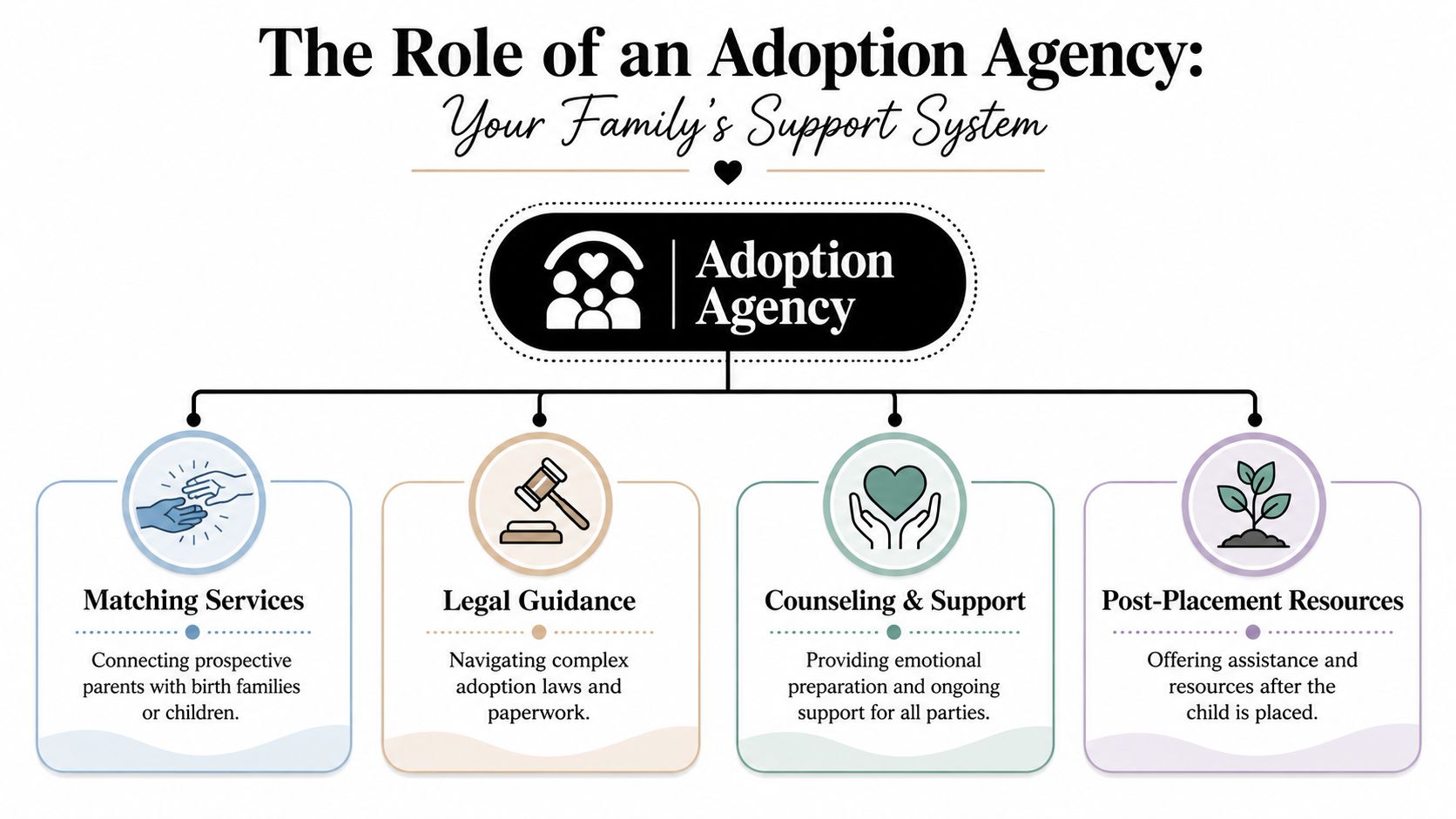
An adoption agency is often part matchmaker, part project manager, and part support system. Agencies help organize the adoption process and support the people involved, but they don't replace legal counsel.
The practical role of an agency
A licensed agency may help your family with several core tasks:
- Home study coordination: The agency or a licensed professional completes the adoption evaluation required before placement.
- Matching support: In some adoptions, the agency helps connect adoptive families with expectant parents or with children eligible for placement.
- Education and counseling: Agencies often prepare adoptive parents for placement and may also provide counseling support to birth parents.
- Paperwork management: They help gather documents, track deadlines, and keep the process moving.
That matters because adoption has many moving parts. Families often feel calmer when one professional is helping coordinate the day-to-day process.
Where the agency's role ends
An agency can guide and facilitate, but court filings and legal orders require legal representation. In most Texas adoptions, the parent-child relationship with each living parent must be terminated unless the adoption is a stepparent adoption where the non-terminated parent is the petitioner's spouse, under Texas Family Code Section 162.001.
That's why many families also need to understand Termination of Parental Rights Before Adoption. It's the legal first step in most adoptions, not just a formality.
Practical rule: An agency helps you move through the process. An attorney makes sure the legal foundation is complete and enforceable.
Agency support and legal counsel aren't the same thing
Think of it this way. If adoption were a long road trip, the agency would help plan the route, gather supplies, and stay in touch during the drive. The attorney would make sure the title, registration, and legal paperwork are valid before you arrive.
That distinction becomes especially important in situations involving consent, termination of parental rights, interstate issues, contested cases, or final court approval. Families often assume the agency "handles everything," then discover later that legal work requires separate attention.
When you're comparing an adoption agency Texas families might choose, ask not only what services the agency provides, but also what legal services it does not provide. That question alone can prevent confusion and stress later.
The Different Paths to Adoption in Texas
A couple in Texas may start in the same hopeful place and still end up on very different adoption paths. One family may want the steady guidance of a licensed agency. Another may already know the expectant parent. A third may be caring for a relative's child and want to make that bond permanent. The right path depends on your family's story, the child's needs, and the professionals who will support you along the way.
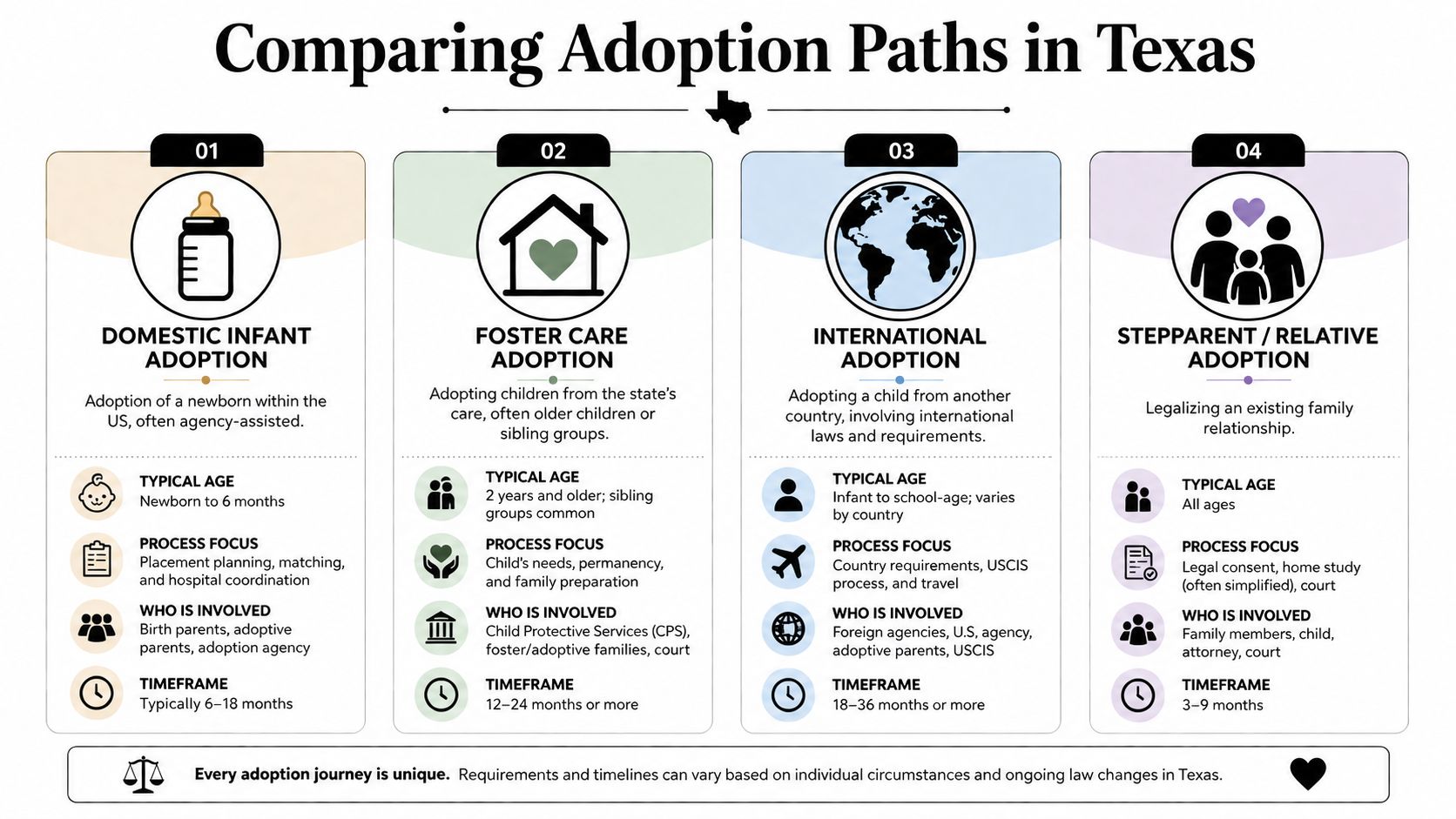
Four common paths
| Path | What it often involves | Emotional focus |
|---|---|---|
| Licensed agency adoption | Structured support, matching, education, home study, placement help | Preparing for a new parent-child relationship from the start |
| Private or independent adoption | Usually more directly coordinated between parties, often with attorney involvement | More individualized planning and communication |
| Foster care adoption | Adoption of a child from state care, often after reunification efforts end | Supporting a child who may have experienced loss or trauma |
| Stepparent or kinship adoption | Legalizing an existing family bond | Creating stability and permanency in a relationship already formed |
If you are comparing agency help with a more independent route, this guide on private adoption vs agency adoption which is better can help you sort out the differences.
Licensed agency adoption
This is the path many hopeful parents picture first. A licensed agency often helps with education, the home study process, matching, communication, and support before and after placement. For many families, that kind of structure feels like having a steady travel companion during a long trip. You still need legal counsel for the court side of the case, but the agency often carries much of the emotional and practical load.
That human support matters. Adoption involves paperwork, yes, but it also involves waiting, uncertainty, and big feelings. A good agency often helps families prepare for all three.
Private or independent adoption
In a private adoption, the connection between adoptive parents and an expectant parent may happen more directly. Attorneys and licensed professionals still play major roles, especially for legal documents, consents, and court filings.
This route can feel more personal because communication is often less filtered. It can also place more responsibility on the adults involved to understand who is handling each step. An agency may act like a guide and support system. An attorney protects the legal framework. Families considering private adoption should make sure both roles are clearly covered.
Foster care adoption
Foster care adoption usually begins with a child who is already in state care. In Texas, 4,586 children were adopted in fiscal year 2021, and relatives adopted more than half of them (Law Office of Bryan Fagan, Texas adoption statistics and requirements). That shows how often adoption grows out of an existing relationship, not only a new match.
Families who adopt from foster care often need patience, flexibility, and trauma-informed support. The child may be carrying grief, confusion, or fear along with hope. In that setting, the right team matters even more. An agency or state program may help with preparation and services. An attorney handles the legal steps that turn placement into a final adoption.
Stepparent and kinship adoption
This path often starts with love already doing the daily work of parenting. A stepparent may have been helping with homework, school pickups, and doctor visits for years. A grandparent, aunt, or older sibling may already be providing the child's stable home.
Texas law says a child age 12 or older must consent to the adoption unless the court waives that requirement in the child's best interest (Texas Family Code, Section 162.010). That rule reflects a simple idea. Older children should usually have a voice in a decision that changes their legal family ties.
These cases can look simpler from the outside because the relationship is already there. Legally, they still require care and accuracy. The emotional side is also tender. A child may feel relieved about permanence and still have mixed feelings about the parent whose rights are being addressed.
Some adoptions begin with a match. Others begin with years of bedtime routines, rides to school, and showing up every day.
A note about adult adoption
Texas also allows adult adoption. Under Texas law, an adult may be adopted if the adult consents to the adoption in writing (Texas Family Code, Section 162.501). Because this process does not involve the same home study and parental-rights issues that apply to minor-child adoptions, it is usually more straightforward.
Adult adoption often serves a very human purpose. It may formalize a parent-child relationship that has existed emotionally for years, even if the legal paperwork never caught up.
Navigating the Texas Adoption Process Step by Step
Most agency adoptions don't feel like one big event. They feel like a series of checkpoints. One family might begin with excitement, slow down during paperwork, feel anxious during the wait, and then experience both joy and nerves when placement finally happens.
A visual overview can make the journey easier to follow.
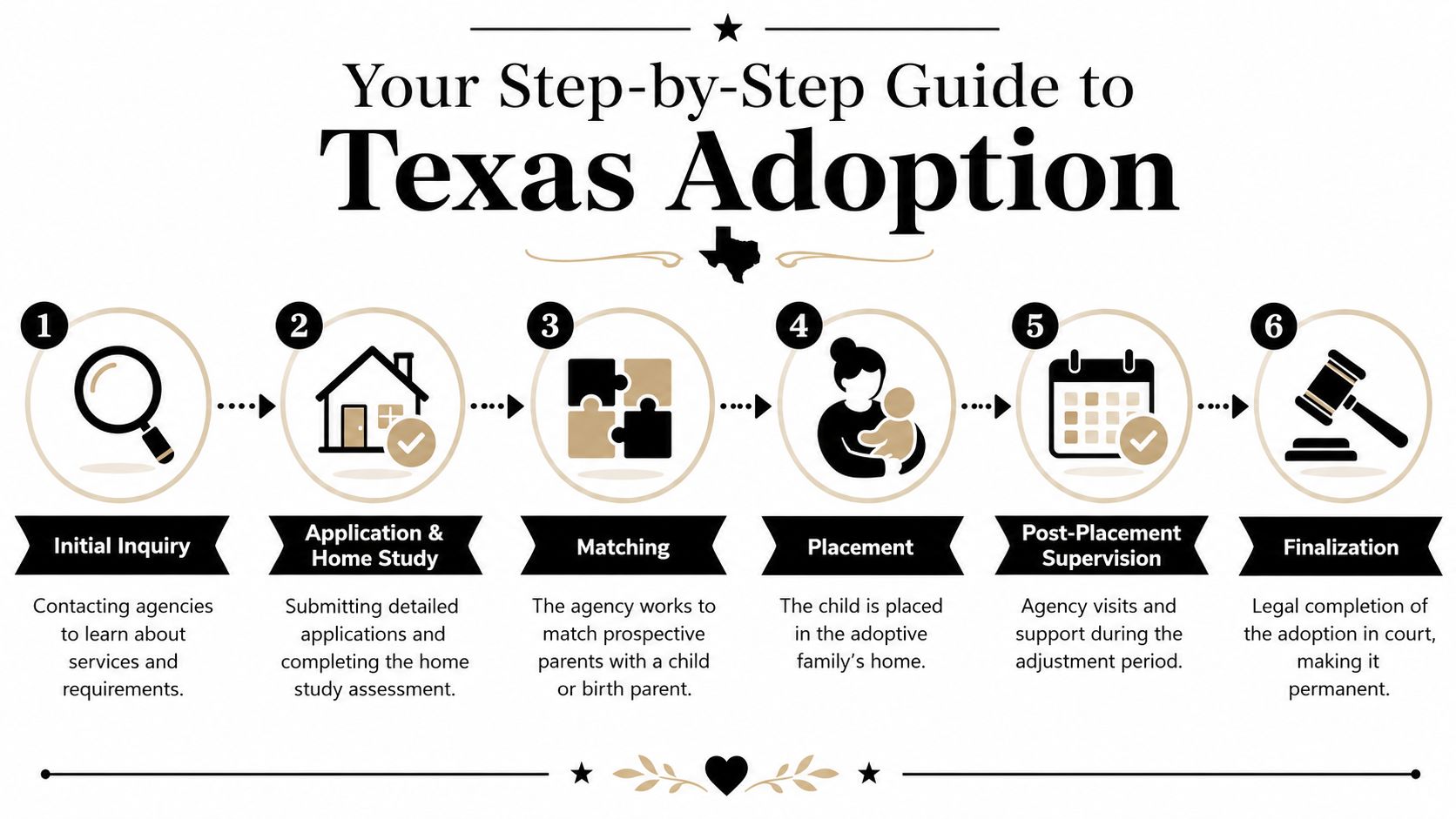
Step one through step three
Initial inquiry
You contact agencies, attend orientation, ask about services, and decide whether the agency fits your values and goals.Application and home study
This stage asks the most of families on paper. Texas requires prospective adoptive parents to be at least 21, financially secure, and able to pass criminal background and child abuse registry checks, according to DFPS adoption options.Matching
Once approved, families may wait to be matched with an expectant parent or with a child, depending on the path they choose.
The home study often causes the most anxiety, but it helps to know what it really is. It isn't a test of perfection. It's an evaluation of safety, readiness, and stability.
The preplacement home study in Texas is exhaustive, mandating individual and joint interviews with all household members, home visits, and interviews with external references like neighbors or school personnel to ensure a safe, nurturing environment.
That means the evaluator may speak with each adoptive parent, children living in the home, and other household members. The evaluator also conducts at least one home visit. The process is detailed because the state wants to be careful about where children are placed.
Later in the process, Texas also requires a broader adoption evaluation framework that can include FBI fingerprinting, a CPS history check, and a Health, Social, Educational, and Genetic History Report maintained for 99 years, as explained by Texas Law Help on adopting a child in Texas.
Step four through step six
The next phase is often the most emotional.
Placement
The child joins your home. This can feel beautiful and tender, but it can also be disorienting. Parents are adjusting. Children are adjusting. Routines take time.Post-placement supervision
Texas requires time in the home before finalization. DFPS explains that postplacement evaluation occurs after the child has lived in the home for at least 5 months, with interviews focused on family adjustment and the child's integration. That waiting period can feel long, but it gives the court a fuller picture of how the placement is going.Finalization in court
A judge signs the order that makes the adoption permanent. If the child is 12 or older, consent is generally required unless the court waives it, as noted earlier in the legal requirements.
A simple example
Consider a married couple adopting through a licensed agency. They complete their application, gather references, prepare for interviews, and answer sensitive personal questions during the home study. Months later, they receive a call about a possible match. After placement, they settle into a new routine while post-placement visits continue. Finalization day comes after months of legal preparation, and the court order gives legal protection to the family they've already started becoming.
That's why many families describe adoption as both a legal process and a relationship process. Both pieces matter.
Understanding Timelines and Costs with a Texas Agency
Two questions show up in almost every consultation. How long will this take, and how much should we plan for? Those are fair questions, but the honest answer is that adoption timelines and costs depend on the path you choose and the facts of your case.
What timelines usually look like
For domestic infant adoption through an agency in Texas, the average wait is 12 to 24 months, with some families matching in 6 months and others waiting over 3 years, according to Angel Adoption's discussion of Texas adoption wait times. That same source notes that the initial application process often takes 1 to 2 months, and some agencies report an average wait around 18 months.
The same source also explains a point that catches many families by surprise. Greater flexibility about a child's gender, race, and other adoption factors can help speed matching.
Keep in mind: A faster timeline isn't always something you can control. It often depends on the type of adoption, the agency's process, and how open a family is to different situations.
How to think about costs
Rather than looking for one total number, it helps to separate adoption expenses into categories:
- Agency fees: These may cover program administration, matching services, education, and support.
- Home study costs: A licensed professional conducts the required evaluation.
- Legal fees: An attorney handles filings, consents, court procedure, and finalization.
- Birth parent related expenses where allowed: These need careful legal review.
That breakdown matters because it helps you ask better questions. One agency may bundle services differently than another. One case may involve more legal complexity than another. A stepparent adoption, for example, often has a very different cost structure from an agency newborn adoption.
Questions worth asking early
A clear agency should be able to explain:
- What services are included
- Which costs are paid to outside professionals
- When fees are due
- What happens if a match does not proceed
Families don't need every answer on day one, but they do need transparency. Hidden assumptions create stress. Clear explanations create trust.
Choosing the Right Agency and Asking Smart Questions
You may be sitting at your kitchen table with two agency websites open, a notebook full of questions, and a hopeful feeling mixed with real nerves. That moment is more important than it looks. The agency you choose will often be the steady voice during waiting, paperwork, conversations with expectant parents, and the emotions that come with each step. Your attorney serves a different role. The attorney protects the legal side of the adoption, prepares filings, and helps make sure the process holds up in court.

That distinction matters because families sometimes expect one professional to do everything. An agency often works like a guide and support system. An attorney works more like the person checking that every legal bolt is tightened before the door closes.
Questions that reveal how an agency really works
A practical list of questions to ask an adoption agency can help you compare options, but the goal is bigger than collecting answers. You want to learn how the agency communicates, how it treats birth parents, and whether it explains hard topics with honesty instead of sales language.
These questions usually tell you a lot:
- How do you support birth parents throughout the process: A careful agency should be able to describe counseling, education, and the steps it takes to avoid pressure.
- Who handles the home study and post-placement visits: Some agencies provide those services directly. Others coordinate with outside professionals.
- How often should we expect updates: Waiting is easier when you know what communication will look like.
- What work do you handle, and what should our attorney handle: This helps prevent confusion about legal filings, consent issues, and court requirements.
- How do you prepare families for open adoption conversations: A good answer should sound realistic, respectful, and specific.
Open adoption is one area where clear language matters a great deal. Families should ask what the agency means by "openness," how expectations are discussed before placement, and what support is offered if contact becomes difficult later. In Texas, promises about future contact need careful discussion with your attorney so you understand what is legally protected and what depends on ongoing cooperation.
Red flags deserve a closer look
Some concerns are easy to spot. Others sound comforting at first and become problems later.
Watch for agencies that cannot explain fees in plain language, rush you to sign, brush off questions about birth parent care, or speak as if a match and timeline can be predicted. Adoption has too many human and legal variables for honest professionals to make guarantees.
Pay attention to tone, too. If an agency answers hard questions with patience, that usually tells you something good. If it becomes defensive when you ask who handles legal work or what happens when a match does not proceed, keep looking.
Ask about life after finalization
Placement and finalization are major milestones, but they are not the end of your family's adjustment. Children may need help processing loss, change, or trauma. Parents may need guidance on attachment, identity questions, school issues, or open adoption communication.
Texas families who adopt through foster care can review state post-adoption services through DFPS post-adoption support information. Families using a private agency should ask equally direct questions. Who will you call if you need counseling referrals six months later. Does the agency offer parent education after placement. Can it name local therapists, support groups, or trauma-informed providers.
Research discussed in an academic analysis of post-adoption service access describes gaps in awareness and access that can leave some adoptive families struggling to find the right help. That makes this a smart interview question, not an afterthought.
For legal process support, Agency and Private Adoption in Texas is one available resource for families comparing how agency and attorney roles fit together.
Your Next Steps to Building Your Texas Family
Adoption works best as a team effort. The agency may help with education, matching, coordination, and support. Your attorney handles the legal steps that protect the adoption from start to finish. When both roles are clear, families usually feel more grounded.
That matters whether you're adopting an infant, formalizing a stepparent relationship, caring for a relative, or moving toward permanency after foster care. The path may differ, but the underlying goal stays the same. Give a child stability, safety, and a legally secure family relationship that serves their best interests.
Texas law puts real structure around adoption for a reason. Home studies are detailed. Consent rules matter. Court approval matters. Those steps can feel heavy while you're living through them, but they exist to protect children and families.
If you're early in the process, start by narrowing your path. If you're already working with an agency, make sure you understand which legal tasks still need attorney attention. If you're in a kinship or stepparent situation, ask whether adoption or another legal arrangement fits your family's needs better.
You don't have to solve every piece alone. Clear guidance can turn a confusing process into one that feels manageable, step by step.
If you're ready to talk through your options, Law Office of Bryan Fagan, PLLC offers free consultations for Texas families exploring adoption and guardianship. Whether you're considering agency adoption, private adoption, stepparent adoption, or kinship care, a conversation about your specific situation can help you understand the legal path ahead and take your next step with confidence.
