
When a family faces a crisis and a child's world is turned upside down, the first instinct for a grandparent, aunt, uncle, or even a close family friend is to step in. You want to provide a safe harbor, a place of stability when everything else feels uncertain. Kinship guardianship is the legal process that gives that loving commitment the strength it needs.
This formal arrangement grants you the legal authority to care for a child when their parents cannot. It is a compassionate solution born from difficult situations—a parent's illness, incarceration, substance abuse issues, or involvement with Child Protective Services (CPS). At its heart, kinship guardianship is about keeping families together and ensuring a child can grow up surrounded by those who know and love them best, even when their family is navigating immense challenges.
Understanding the Heart of Kinship Guardianship
Kinship guardianship isn’t a rare legal maneuver; it's a reality for millions of families. In fact, roughly one in ten children worldwide—that's over 180 million kids—live in some form of kinship care. This global truth reflects what we see right here in Texas every day: loving relatives seeking the legal standing they need to provide a stable, nurturing home. You can explore more about these global trends and see how they connect to families like yours.

A Protective Bridge, Not a Final Destination
Think of kinship guardianship as a strong, protective bridge. On one side, you have a child who desperately needs safety and consistency. On the other is the hope that their parents can heal, recover, and one day resume their roles. Guardianship spans that gap, creating immediate stability while leaving the door open for future reunification.
It gives you the legal power to make critical decisions for the child's well-being—from enrolling them in school to authorizing medical care—without permanently terminating the legal ties to their biological parents. This is where it differs fundamentally from adoption. Adoption creates a brand-new, permanent legal parent-child relationship, while guardianship is designed to last only as long as the child needs it, always prioritizing their best interest.
In the eyes of Texas law, specifically outlined in the Texas Family Code, the primary focus is always on the best interests of the child. Kinship guardianship honors this by placing a child with trusted family members who can provide love, cultural continuity, and a true sense of belonging.
To help clarify this important legal path, here’s a quick look at what kinship guardianship means for Texas families.
Kinship Guardianship at a Glance
This table breaks down the essential components of kinship guardianship, so you can quickly understand what this arrangement entails.
| Key Aspect | Simple Explanation |
|---|---|
| Legal Authority | You have the power to make decisions about the child's education, healthcare, and daily life. |
| Parental Rights | The biological parents' rights are typically suspended, not permanently terminated. |
| Duration | It is often temporary and can be modified or ended by the court if the family's circumstances change. |
| Family Connection | It preserves the child’s essential connection to their biological family and heritage. |
At The Law Office of Bryan Fagan, PLLC, we understand that stepping into this role is an act of profound love and a tremendous responsibility. Our mission is to provide clear, compassionate legal guidance to help you protect the child you care for and bring stability back to your family.
Choosing the Right Path: Guardianship vs. Adoption vs. Custody
When you’re trying to protect a child you love, the legal terminology can feel like a maze. Guardianship, adoption, and custody all sound similar, but they create vastly different futures for a child and your family. Understanding these differences is the first step toward making a confident, informed decision that truly serves the child’s best interests.
Let’s break these down with a simple analogy. Think of kinship guardianship like being given the keys to a house. You have the full authority to live in it, make repairs, and keep it safe for the child, but the original owner—the biological parent—still holds the deed. Their rights are suspended, not gone, leaving the door open for them to reclaim their home if they get their life back on track.
Adoption, on the other hand, is like having the deed legally transferred into your name. It's a permanent, irreversible act that makes you the child's legal parent forever. This process creates a brand-new, legally recognized parent-child relationship and permanently terminates the biological parents' rights, offering the child a "forever family."
Finally, a custody order, which in Texas is part of a Suit Affecting the Parent-Child Relationship (SAPCR), is like creating a detailed household rulebook. It doesn’t change who legally owns the house. Instead, it clearly defines who gets to make decisions, where the child lives, and when each parent has time with them. This is most common in divorce cases but can also apply when non-parents, like grandparents, are involved in a child's care.
Key Legal Differences
Each of these paths dramatically impacts parental rights and the long-term structure of your family. Guardianship is a powerful tool for creating stability without making an irreversible change. Adoption is the right choice when a child needs the security of a permanent family, and it’s clear that reunification with their birth parents is no longer possible or in their best interest.
The core principle guiding every Texas family court, as spelled out in the Texas Family Code, is the best interest of the child. Your family’s unique situation—the parents' circumstances, the child's needs, and your ability to provide care—will determine which legal path best upholds that principle.
Understanding these distinctions is vital. For a deeper dive into how these paths compare, you can learn more about legal guardianship vs. adoption in Texas in our detailed guide.
Comparing Your Options in Texas
To make these concepts even clearer, let’s look at them side-by-side. The table below highlights the most important differences between kinship guardianship, adoption, and a custody order in Texas. It’s designed to help you see which route might best align with your family's goals and the child's needs.
Comparing Guardianship, Adoption, and Custody in Texas
| Legal Arrangement | Parental Rights | Duration | Best For… |
|---|---|---|---|
| Kinship Guardianship | Biological parents' rights are suspended. The guardian has decision-making authority, but the legal link to the parents remains. | Often temporary and can be modified or terminated by a court if the parents' situation improves. | Situations where parents are temporarily unable to care for the child due to illness, addiction, or incarceration, and reunification is a possible future goal. |
| Kinship Adoption | Biological parents' rights are permanently terminated. The adoptive parent becomes the child's new legal parent in every way. | Permanent and creates a new, legally binding parent-child relationship that cannot be reversed. | Cases where reunification is not possible or safe, and the child needs the lifelong security of a permanent family. |
| Custody Order (SAPCR) | Biological parents' rights are defined but not changed. The order specifies who makes decisions and has possession of the child. | Can be modified by the court as the child's needs or parents' circumstances change over time. | Co-parenting situations, often after a divorce, or when a non-parent needs defined rights to care for a child while parents remain legally involved. |
Choosing the right path is a monumental decision, one that will shape a child's entire future. At The Law Office of Bryan Fagan, PLLC, we are here to provide the compassionate legal advice you need to navigate this journey with clarity and confidence. We can help you understand every option and choose the one that offers the most stability and love for the child at the center of it all.
Your Step-By-Step Guide to Securing Kinship Guardianship in Texas
The road to becoming a legal guardian for a child you love can feel overwhelming, but when you break it down, the process is a series of clear, logical steps. Every form, every hearing, and every requirement is designed with one goal in mind: ensuring the child is placed in a safe, stable, and loving home.
Across the U.S., kinship care is the quiet safety net for about 2.5 million children. That means roughly 4% of all kids are living with grandparents, aunts, or other relatives outside the formal foster care system. For Texas families, turning that informal care into a legal guardianship gives you the power to enroll a child in school, consent to medical treatment, and provide the long-term stability they desperately need.
Step 1: Confirm You Are Eligible
First, the court needs to know who you are and why you're the right person for this important role. Under the Texas Family Code, a guardian is often a relative, but it doesn't have to be. A close family friend or anyone with a significant, pre-existing relationship with the child can also petition the court.
The most important factor is showing your genuine commitment to the child's well-being and proving you can provide a safe and nurturing home.
Step 2: File the Legal Petition
This is where the formal process begins. You’ll start by filing a "Petition for Guardianship" with the appropriate Texas court, usually in the county where the child lives. Think of this document as your formal request to the judge, explaining the family's story clearly and concisely.
You will need to explain:
- Why a guardian is necessary: What circumstances prevent the child's parents from providing care?
- Your relationship to the child: How do you know them, and why are you the best person to take on this responsibility?
- Information about the child and parents: Names, addresses, and other key details are required.
This petition is the court’s first introduction to your family's situation, so getting it right is crucial.
Step 3: Notify Parents and Interested Family Members
Once your petition is filed, Texas law requires that the child’s biological parents and other close family members be formally notified. This step, called "service," respects everyone's legal rights and gives anyone with a stake in the child’s future a chance to be heard by the court. This process ensures transparency while keeping the focus on the child’s immediate need for safety and care.
This chart gives you a quick visual of how guardianship fits in with other legal options for a child.
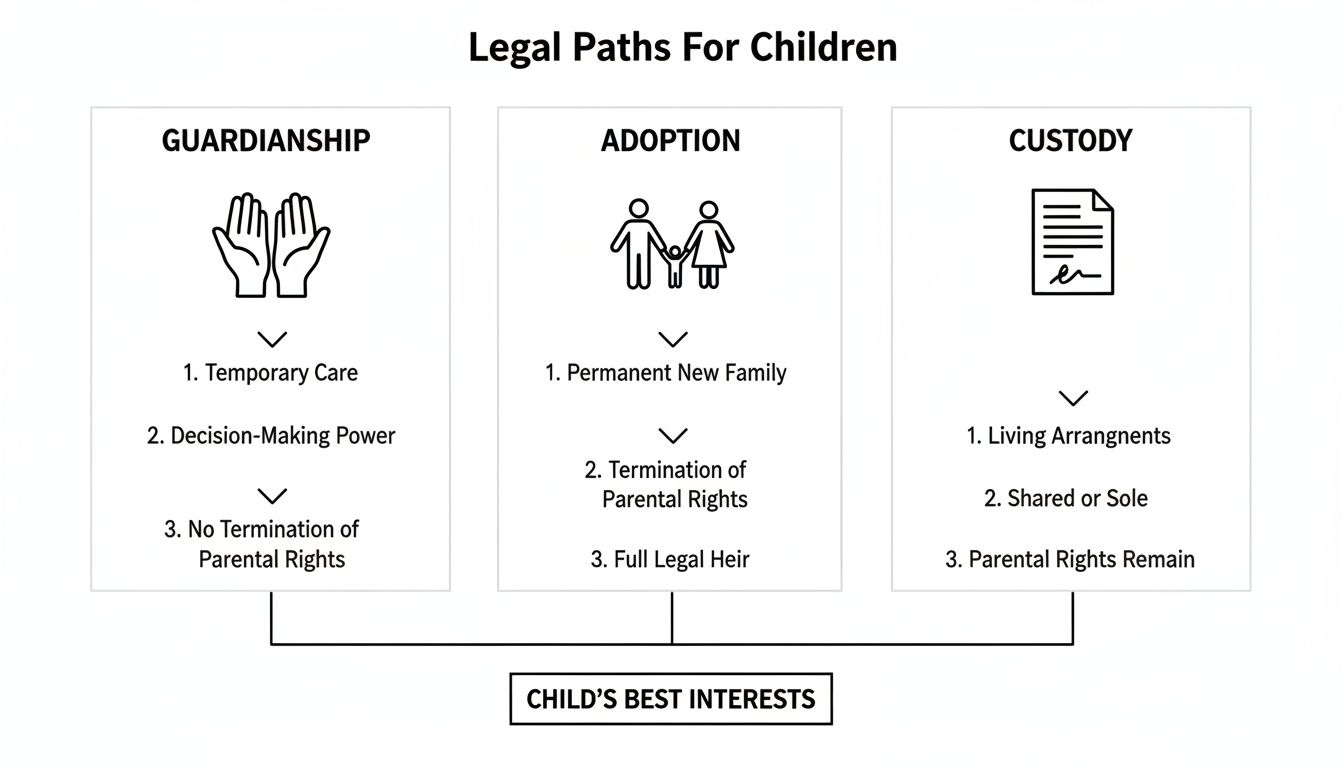
As you can see, guardianship provides essential care while keeping those important family connections intact—a major difference from other legal paths.
Step 4: Prepare for the Home Study
Please don't let the term "home study" intimidate you. It’s not an inspection designed to find faults. Instead, it is a collaborative process to confirm you can offer a safe and supportive home. A social worker will visit your home, talk with you about your life and motivations, and run background checks.
Think of the home study as your opportunity to share your family's story. It's a chance to show the court the love, stability, and support you are ready to offer the child.
You can learn more about what this involves in our guide on how to become a legal guardian in Texas.
Step 5: Attend the Court Hearing
The court hearing is where the judge considers all the information—your petition, the home study results, and any testimony from the parents or other involved parties. You will have a chance to speak directly to the judge and answer any questions. It’s your moment to reinforce why you are the best person to protect this child and nurture their future.
As you prepare for your day in court, knowing how to conduct legal research can empower you with a better understanding of the process.
Step 6: Obtain the Final Guardianship Order
If the judge agrees that appointing you as guardian is in the child’s best interest, they will sign a court order. This final document, often called "Letters of Guardianship," is the legal proof of your authority. It’s the official paper that empowers you to make all decisions necessary for the child’s health, education, and welfare. With that order in hand, your loving commitment is now a legally recognized responsibility. You have successfully created a safe and stable home for the child.
The Rights and Responsibilities of a Kinship Guardian
Once a Texas judge signs that final guardianship order, your commitment is no longer just a promise—it’s a legal reality. That court order is more than a piece of paper; it's the key that unlocks your authority to protect and nurture the child in your care. When you step into this role, you’re officially empowered to make the critical decisions, both big and small, that will shape their future.
This legal authority is incredibly practical. It means you are the one who can enroll the child in a new school that better fits their needs. You can add them to your health insurance plan and consent to medical or dental treatment. You can authorize counseling to help them process difficult family changes or sign them up for the soccer team that will bring them joy. In essence, you step into the shoes of a parent for every major decision affecting the child’s well-being.

Making Decisions in the Child's Best Interest
Imagine the child in your care falls on the playground and needs to go to the emergency room. Without legal guardianship, a hospital might hesitate to provide treatment without a parent's consent, leading to dangerous delays. But with your court order, you have the clear authority to approve any necessary medical procedures, ensuring the child gets the care they need right away.
This legal standing is also crucial for securing support. For example, you can apply for state or federal benefits on the child's behalf, like Social Security or CHIP, which can provide a lifeline of financial and medical support for their upbringing.
As a kinship guardian, your role is guided by one overarching principle in the Texas Family Code: the best interest of the child. Every decision you make—from choosing a doctor to setting screen time rules—should be aimed at creating a stable, secure, and loving environment where the child can heal and flourish.
Core Duties of a Kinship Guardian
With these significant rights come profound responsibilities. Your primary role is to provide for the child’s complete well-being, which goes far beyond just providing a roof over their head and food on the table.
Your core responsibilities include:
- Providing a Safe Home: You must ensure the child lives in a home that is physically and emotionally safe, free from harm or neglect.
- Meeting Daily Needs: This covers everything from proper nutrition and clothing to making sure they get to school on time and have a quiet place to do homework.
- Supporting Emotional and Mental Health: You are responsible for nurturing the child's emotional growth, offering comfort, and seeking professional help like therapy if needed.
- Managing Finances Responsibly: If you receive financial support for the child, you have a duty to use those funds directly for their care and benefit.
Furthermore, becoming a kinship guardian means you have an ongoing relationship with the court. You will be required to file annual reports detailing the child's progress, health, and general well-being. This accountability ensures the guardianship continues to serve the child's best interests as they grow and their needs change. For a closer look at the legal framework, you can find more information on guardianship laws in Texas on our blog.
Preserving Family Connections
One of the most unique and compassionate aspects of kinship guardianship is the responsibility to maintain the child’s connection to their family history. Unless a court has ordered otherwise for safety reasons, a guardian is often expected to facilitate appropriate contact between the child and their biological parents or siblings. This could mean arranging supervised visits, scheduling phone calls, or sending photos and updates.
This duty highlights a key difference between guardianship and adoption. While you have the full authority to parent, your role also involves helping the child navigate their relationship with their birth family in a healthy, supportive way. It's a delicate balance, but it’s central to the spirit of what kinship guardianship is all about—protecting a child while honoring their roots.
When Kinship Guardianship Becomes the Answer
Legal definitions and court processes are one thing, but the real heart of kinship guardianship beats in the stories of Texas families. This legal path often emerges as a lifeline during a family’s most difficult moments, creating immediate stability for a child without severing the family bonds that define who they are.
To truly understand its impact, let's look at a few real-world scenarios where guardianship provided the perfect solution.
Grandparents Providing a Safe Harbor
Consider Maria and David, grandparents in their late sixties. Their daughter began a difficult battle with addiction, making it impossible for her to care for her two young children, ages five and seven. The kids were missing school, and their home life was filled with uncertainty. Without a second thought, Maria and David brought their grandchildren into their own loving home.
However, they faced immediate roadblocks. They couldn't enroll the children in their local school district or authorize routine medical check-ups because they had no legal authority. After a friend mentioned guardianship, they sought legal advice. Securing kinship guardianship gave them the power to make all the necessary decisions for their grandchildren. That single legal step transformed the children's lives from chaos to consistency, providing a safe harbor while their mother focused on her recovery.
An Older Sibling Stepping Up
Here is another powerful example: 22-year-old Alex. After his parents were tragically killed in a car accident, he suddenly became the primary caregiver for his 16-year-old sister, Chloe. They had a strong bond, but Alex had no legal standing to manage her affairs. He couldn't access their parents' insurance to pay for her needs, sign school permission slips, or help her get a driver's permit.
Adoption felt too permanent and would have legally changed their relationship from siblings to parent and child. Kinship guardianship was the ideal fit. It gave Alex the legal authority he needed to care for Chloe until she turned 18, allowing them to navigate their grief together as siblings while keeping her daily life as stable as possible.
When a Close Friend Becomes Family
Kinship guardianship is not just for blood relatives. Consider Sarah, who had been a lifelong friend of a single mother named Emily. When Emily’s mental health struggles led her to abandon her 10-year-old son, Noah, Sarah didn't hesitate to take him in. Noah had known Sarah his entire life and felt safe with her, but in the eyes of the law, she was a stranger. She couldn't consent to a much-needed dental procedure or talk to his teachers about his slipping grades.
By pursuing guardianship, Sarah became Noah's legal guardian. The court recognized their deep, pre-existing bond and determined that this arrangement was in Noah’s best interest. It gave Sarah the power to advocate for him in every part of his life, proving that sometimes, the family a child needs is the one built on years of love and friendship.
Each of these stories shows how kinship guardianship solves specific, urgent problems. It provides the legal framework for a loving caregiver to step in and immediately protect a child's welfare within their trusted family and community network.
Relatives who step up to provide this care are unsung heroes. Kinship carers in England, for instance, save their society an estimated £4.3 billion every year just by keeping children out of the state foster care system. This mirrors the reality here in Texas, where relatives become caregivers out of love and often face incredible financial strain. You can discover more insights about the societal value of kinship care and the challenges these incredible families face.
Your Kinship Guardianship Questions, Answered
When you are considering something as life-changing as kinship guardianship, it's natural to have questions. It means you are taking this responsibility seriously and thinking through what is truly best for the child you love. The legal process can feel complicated, but getting clear answers can bring peace of mind and give you the confidence to move forward.
Here are some of the most common questions we hear from Texas families just like yours.
Can the Child's Parents Still Have Visitation Rights?
This is one of the first—and most emotionally important—questions people ask. In most Texas kinship guardianship cases, the answer is yes. A key goal of guardianship is to keep family bonds intact whenever it is safe and healthy for the child.
Unlike adoption, which permanently terminates parental rights, guardianship simply suspends them. Because of this, judges often include specific visitation schedules in the guardianship order. The court's number one priority is always the child's best interest, so it will carefully set the terms of these visits—such as requiring supervision—to protect the child's physical and emotional well-being. This approach honors the child's connection to their parents while ensuring the stability you provide.
Is Kinship Guardianship a Permanent Arrangement?
While guardianship offers powerful, long-term stability, it is not necessarily permanent. It is a strong, durable solution that is also flexible enough to adapt if family circumstances change. A court can modify or even terminate a guardianship if the original issues that made it necessary have been resolved.
For example, if a parent successfully completes a recovery program and proves they can provide a safe and stable home again, they can petition the court to dissolve the guardianship and restore their parental rights. The court will always hold a formal hearing to determine if ending the arrangement is truly in the child's best interest before making a final decision. This flexibility ensures the guardianship serves the child for exactly as long as it's needed.
Do I Need a Lawyer to Get Guardianship?
Legally, you can file for guardianship on your own in Texas, but it is strongly recommended that you work with an experienced attorney. The process involves strict deadlines, specific legal paperwork, and court hearings that can be incredibly challenging to navigate without professional guidance. Furthermore, the family dynamics in these situations are almost always complex and emotionally delicate.
An experienced family law attorney does more than fill out forms. They become your advocate, ensuring your petition is strong, all legal notices are handled correctly, and that your story is presented clearly in court. They can help you anticipate potential challenges and protect the child's best interests from start to finish.
Having a knowledgeable and compassionate lawyer in your corner can be the difference between a smooth process and one filled with frustrating delays or even heartbreaking outcomes.
Is Financial Support Available for Kinship Guardians?
Stepping up to raise a child is an incredible act of love, but it also comes with significant financial responsibilities. The good news is that you don't have to carry this burden alone; resources are available to help. As a legal guardian, you may be able to:
- Apply for State and Federal Benefits: This could include Temporary Assistance for Needy Families (TANF) or Social Security benefits for the child.
- Get Medical Coverage: You can enroll the child in Medicaid or the Children's Health Insurance Program (CHIP) if they are eligible.
- Receive Child Support: A judge may order the child's parents to pay child support directly to you as the guardian.
- Explore Kinship Caregiver Programs: Texas has specific programs designed to provide financial assistance and other services to relatives caring for children, particularly those who have been involved with Child Protective Services (CPS).
An attorney can help you identify and apply for all the financial support you are entitled to, easing the burden so you can focus on what matters most: giving the child a loving, stable home.
Taking on kinship guardianship is a journey of love, courage, and deep commitment. You don't have to walk it alone. At The Law Office of Bryan Fagan, PLLC, we provide the clear, compassionate, and knowledgeable legal guidance your family deserves. If you are ready to take the next step in protecting a child you love, schedule a free, confidential consultation with us today. Let us help you build a safe and stable future for your family.
