
You may already be doing the daily work of a parent. You pack lunches. You sit through school programs. You calm tears at bedtime. You help with homework, doctor visits, and all the moments in between.
But when the law has not caught up with your real life, that gap can feel unsettling. If something happens at school, a hospital, or in a legal emergency, love alone does not always give you authority. That is why so many families start looking into uncontested stepparent adoption texas. They want the law to reflect the family they have already built.
For many stepparents, this is not about replacing a memory or erasing history. It is about giving a child lasting security. It is about family unity, peace of mind, and the comfort of knowing your role is recognized in every place that matters.
From Stepparent to Parent The Journey to Legal Adoption
A lot of stepparents arrive at this moment.
It often starts after years of showing up. A child gets sick, and you are the one holding the medicine cup. A teacher calls, and you are the one who knows the learning style, the worries, and the strengths. You are already living the role.

That is what makes stepparent adoption so meaningful. It does not create a bond out of thin air. It gives legal protection to a bond that already exists.
What uncontested means in everyday language
In plain English, uncontested usually means there is no fight over the adoption itself. The legal path is smoother because the child’s other biological parent is not opposing the process, or that parent’s rights have already been addressed in a way the court accepts.
That matters for emotional reasons and practical ones.
When adults cooperate, children often feel less caught in the middle. Parents can focus more on stability and less on conflict. The court process also tends to be more manageable.
A strong stepparent adoption case is not only about forms. It is about showing the court that this child already has a stable, loving family relationship worth protecting.
Why families choose this path
Families seek adoption for many reasons:
- Decision-making security so the stepparent can act as a legal parent
- Long-term stability for the child at school, with doctors, and in family planning
- Emotional reassurance because the child knows the family bond is permanent
- Legal clarity if something unexpected happens to the biological parent spouse
This process can feel personal. It can also feel intimidating at first.
That is normal.
Most families do not need more legal jargon. They need a calm explanation of what happens next, what documents matter, and where the emotional pressure points usually show up. Once those pieces come into focus, the path often feels much more doable.
Confirming Your Path to a Smooth Texas Adoption
A lot of hopeful stepparents reach this point with the same question: are we ready to file, or are we about to miss something important?
That question matters because stepparent adoption in Texas is not just a stack of forms. It is the court’s way of confirming a family bond that may already feel settled at home. Before you start paperwork, it helps to make sure the legal pieces line up with the life you are already living together.
The first checkpoint: your marriage and your spouse’s role
Texas stepparent adoption begins with one basic fact. You must be married to the child’s parent.
Your spouse also is not a bystander in the case. The court expects the child’s biological parent spouse to join the adoption petition with you. That can surprise families who assume the stepparent is the only one “doing the adopting,” but the court is really evaluating the family unit you and your spouse are asking it to protect.
A simple way to picture it is this: the marriage creates the legal doorway, and the joint petition is how you walk through it together.
The second checkpoint: whether the case is uncontested
This is often the point where anxiety spikes.
In everyday terms, an uncontested stepparent adoption usually means the other biological parent is not fighting the adoption, or that parent’s rights have already been dealt with in a way the court recognizes. A case often stays on the smoother track when one of these situations applies:
- The other parent agrees and signs the required consent or relinquishment documents
- The other parent has died
- The other parent’s rights were already terminated by a prior court order
If none of those is true, the case may still be possible. It just may not stay simple. For example, if the other parent objects, cannot be located, or has to be formally served after a long search, the process usually takes more time and creates more uncertainty.
That does not mean your adoption is doomed. It means you need a clearer plan before filing.
Why this step matters emotionally, not just legally
Families often focus on the finish line, and that makes sense. You want the final decree. You want the child to have the legal security that matches everyday life.
But confirming your path early can spare your family a lot of avoidable stress.
If consent is in place and the legal posture is clean, the process often feels more like documenting a relationship that already exists. If consent is unclear, the emotional tone changes fast. A hopeful case can start to feel tense, especially when a child senses that adults are worried but does not understand why.
That is why this stage is so important. It helps you identify the pressure points before they turn into delays.
A quick self-check before you file
Many families find it helpful to pause and answer four practical questions:
| Question | Why it matters |
|---|---|
| Are you married to the child’s parent? | Texas stepparent adoption depends on that legal relationship. |
| Will your spouse file with you? | The biological parent spouse is usually part of the petition. |
| Is the other biological parent consenting, deceased, or already legally out of the picture? | That often determines whether the adoption stays uncontested. |
| Are there any missing facts, such as an absent parent whose location is unknown? | Those issues can slow the case and may require extra court steps. |
A real-world example
Maria has helped raise her stepson for years. She handles school pickups, knows the pediatrician, and is the parent he looks for when he is sick. She and her husband assume the adoption will be easy because everyone in the home already sees her as Mom.
Legally, the next question is narrower. Is the child’s other biological parent willing to sign, already out of the legal picture, or likely to contest the case?
If the answer is yes, she will sign, Maria’s path may be straightforward. If the answer is no one knows where she is, that is a different kind of case, even if the family story feels just as strong.
Same love. Different legal path.
If you are unsure whether your case is uncontested, that is often the best issue to clarify before you spend time and money on filing.
Gathering the Story of Your Family for the Court
A lot of hopeful stepparents reach this stage and feel a shift. Until now, the case may have felt personal and emotional. Now it starts to look like forms, records, and signatures.
That can feel discouraging at first.
But there is a better way to see it. Your paperwork is the court’s window into your family. The judge does not live in your home, hear your child call you Mom or Dad, or watch the daily routines that already make you a parent in every practical sense. The file has to tell that story clearly, one document at a time.
What the court is trying to understand
The court usually wants a few basic questions answered without guesswork:
- Who is the child?
- Who are the legal parents right now?
- How is the stepparent connected to the child?
- Has another court already entered orders that matter here?
- Are the legal pieces in place for adoption to go forward?
That is why gathering documents matters so much. Each record fills in one part of the picture, like assembling a family photo album where every page has legal significance.
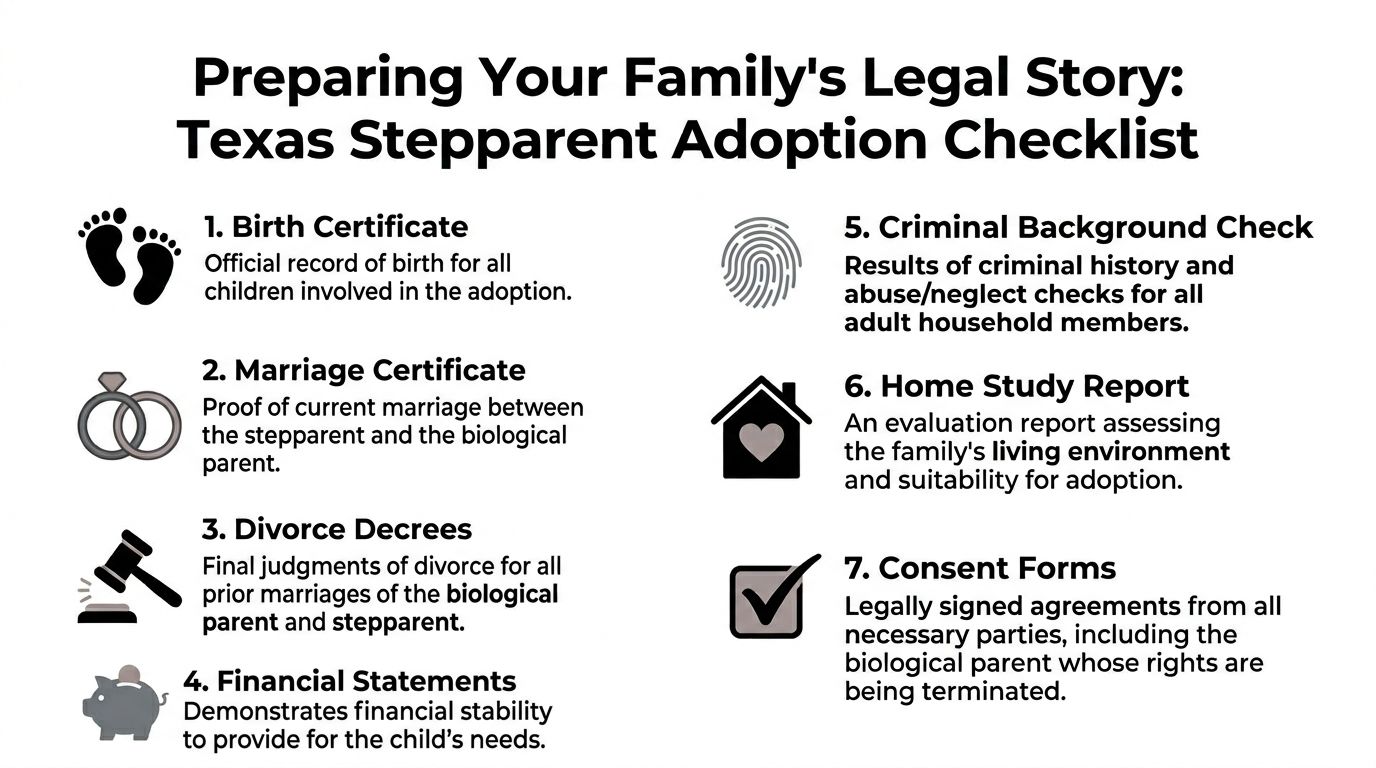
The records many families need
In an uncontested stepparent adoption, families often collect:
- The child’s birth certificate, to confirm identity and current parentage
- The marriage certificate, to show the stepparent is legally married to the child’s parent
- Existing court orders, such as custody, support, or conservatorship orders
- The adoption petition, usually filed by the stepparent and spouse
- Consent, relinquishment, or termination documents, if they apply in your case
- Background check materials, if the court or local practice requires them
- A death certificate, if the other biological parent has died
- Prior divorce decrees or related family court records, if they affect parentage or prior rights
Some counties also have local forms or procedural preferences. That is one reason two families with very similar stories can still end up gathering slightly different paperwork.
Why missing one paper can slow everything down
A court cannot fill in blanks based on common sense.
If your marriage certificate is missing, the court cannot assume the stepparent qualifies to adopt. If there is an old custody order from another county, the judge needs to see it rather than guess what it says. If the file does not clearly show how the other parent’s rights are being addressed, the case can stall while everyone backs up to fix that gap.
That is often the source of anxiety. Families know their story by heart, but the court needs proof arranged in a form it can act on.
A practical example
Suppose James has raised his stepdaughter since kindergarten. He attends school meetings, pays for braces, and signs permission slips. Everyone in the home sees him as Dad.
For court purposes, those facts matter most when they are supported by the right documents. The petition shows what he is asking for. The marriage certificate shows his legal relationship to the child’s mother. Any prior orders show whether another court has already made rulings about custody or support. If the other biological father is signing off, the file should make that easy for the judge to confirm. If you have questions about when a biological father must consent to stepparent adoption in Texas, it helps to sort that out early so your paperwork matches the legal path your case needs.
Filing and recordkeeping after the hearing
Families also get tripped up on where papers go.
A stepparent adoption is filed in the proper Texas court based on the facts of the case and local rules. After the adoption is granted, the signed order is also submitted through the state’s adoption record system so Texas can create the official adoption record. The final hearing is a joyful moment, but there is still an administrative step afterward to make the record complete.
That post-hearing detail is easy to miss, especially when everyone is focused on getting to court day.
A calm way to organize everything
A simple folder system can lower stress more than people expect. Paper or digital both work. What matters is that the documents are easy to find.
Try separating your file into four groups:
Identity documents
Birth certificates, marriage certificate, photo IDs.Existing court records
Divorce decrees, custody orders, child support orders, prior termination paperwork.Adoption documents
Petition, consents, affidavits, county-specific forms, notices.Finalization records
Signed decree, post-decree filing materials, amended birth record paperwork.
If an attorney, clerk, or evaluator asks for one item, you should be able to put your hand on it quickly. That kind of organization does more than save time. It helps the whole process feel manageable.
When the paperwork feels bigger than your confidence
This is the point where many stepparents worry, “What if I leave something out and ruin it?”
That fear is normal. It usually comes from caring, not from being unprepared.
A good checklist helps. So does confirming early whether your county wants particular forms, signatures, or supporting records. The goal is not to produce a perfect scrapbook of your family. The goal is to give the court a clear, complete legal story so the family you have built can be recognized on paper too.
The Heart of the Matter Consent and Termination
The legal center of an uncontested stepparent adoption is not the final hearing.
It is the point where the other biological parent’s rights are legally resolved. This is often the most emotional part of the case because it involves both law and family history.

When a parent agrees
In many uncontested cases, the other biological parent signs an Affidavit of Relinquishment of Parental Rights.
That phrase sounds harsh, so it helps to translate it. It is a legal document saying that the parent is voluntarily ending their legal parent-child relationship so the adoption can proceed.
For some families, this comes after years of distance. A father may have been absent and may believe the child is already being raised in a stable home by the mother and stepfather. A mother may recognize that the stepmother has become the daily parent in every meaningful sense.
These moments can carry grief, relief, guilt, gratitude, or all four at once.
What the court cares about
The court is not looking for a perfect family history. It is looking for a lawful process that serves the child’s best interests.
That means the judge will want confidence that:
- The consent is voluntary
- The paperwork is properly signed
- The legal rights are clearly terminated before adoption
- The child’s stability and welfare are being protected
If you are trying to sort out whether a biological father must agree in your situation, this guide on whether a biological father has to consent to stepparent adoption in Texas can help you understand the issue more clearly.
A family example
Consider a child who has lived with her mother and stepfather for years. Her biological father has had little involvement. He now agrees that the stepfather is the parent doing the day-to-day work and signs the relinquishment affidavit.
Legally, that consent clears a major barrier.
Emotionally, it may still bring up questions for the child. Even when adoption is clearly the right move, children may need gentle reassurance that they are allowed to feel many things at once.
Children do not need every adult detail. They do need honesty, safety, and permission to ask questions.
Other ways rights may already be resolved
Not every uncontested case involves a fresh consent form.
Sometimes the other parent is deceased. In that situation, the court usually needs a death certificate and the rest of the adoption paperwork.
In other families, the other parent’s rights were already terminated in an earlier court proceeding. If so, the adoption focuses on the remaining legal steps rather than redoing that issue.
Those situations can still be emotionally tender. A case can be legally simple and personally complicated at the same time.
A short overview can help bring this part into focus:
| Situation | What the court usually needs |
|---|---|
| Other parent agrees | Properly signed relinquishment paperwork |
| Other parent is deceased | Death certificate and related records |
| Rights already terminated | Prior court order showing termination |
A helpful video can also make this stage feel less abstract:
Talking with your child about this step
Parents often ask, “What do we say?”
Usually, simple is better.
You might say that adoption is the legal way to show that your family belongs together and that the adults are taking steps to make things official. If your child has a relationship with the other biological parent, the conversation may need more care and more support.
You do not need to force a child to feel excited on command. Many children are thrilled. Some are quiet. Some feel happy and sad in the same week.
That does not mean the adoption is wrong. It means your child is human.
Navigating the Home Study and Court Process
A lot of stepparents reach this stage and feel their stomach drop a little. The child already calls you Dad or Mom. Your home already runs like a family. Then the court process shows up and can make a loving, ordinary life feel like it is being placed under a microscope.
That reaction is normal.
In an uncontested stepparent adoption texas case, this part is often more orderly and less intimidating than families expect. It helps to view it as the court’s way of checking two things. Is this home safe, and is this adoption in the child’s best interest? The court is not asking whether your family is perfect. It is asking whether your family should be legally recognized for what it already is.
The adoption evaluation and possible waiver
Texas courts often require an adoption evaluation, which many families call a home study. In some uncontested stepparent cases, the court may waive that requirement if the background checks are satisfactory, as explained in this Texas Law Help overview of stepparent adoption questions.
For anxious parents, that possible waiver matters a lot. It can reduce cost, save time, and remove the stress of preparing for a formal evaluation. Still, it is not automatic. Some counties are more likely to waive it than others, and some judges want the extra layer of review even in a low-conflict case.
If you want to get ready either way, our adoption home study checklist gives a practical picture of the documents, household details, and safety items families are often asked about.

What a home study usually feels like
If the court does require an evaluation, the process is usually much more like a conversation than an interrogation.
The evaluator is looking for stability, safety, and a healthy day-to-day environment for the child. Expect questions about routines, discipline, medical care, school, and how the family functions together. A clean enough and safe home matters. Designer furniture does not.
That distinction helps many families breathe easier. Laundry in a basket, toys in the corner, and a real family schedule do not usually raise concern. Serious safety issues, untreated instability, or troubling background information are what draw attention.
Some stepparents also worry about the emotional side. Will anyone ask whether the child feels comfortable? Sometimes, yes. That is not meant to threaten the adoption. It reflects the court’s larger goal of protecting the child while giving legal shape to an existing bond. Building step parenting confidence at home can make this part feel less unsettling because the legal process often mirrors the same questions families have already been working through privately.
Filing and fees
Once the paperwork is complete, the case is filed in the correct court and placed on that court’s schedule.
Costs vary by county and by the facts of the case. An uncontested stepparent adoption is often less expensive than many other adoption paths, but fees can still rise if documents need correction, if the court orders additional evaluations, or if a case that looked simple turns out to need more work.
This is one reason preparation matters so much. Good paperwork at the front end often prevents delays later.
Where legal guidance can help
Families can be confident parents and still feel unsure about court rules. That is common. Family life and legal procedure are two different skill sets.
Some stepparents use self-help resources and handle the filing themselves. Others hire a lawyer to manage deadlines, confirm county-specific requirements, prepare the petition, and make sure the final hearing packet is complete. The Law Office of Bryan Fagan, PLLC handles stepparent adoption matters in Texas, including petition preparation and guidance through court requirements.
The final hearing is usually a milestone
Many people hear the word “hearing” and picture conflict. In an uncontested case, the final court appearance is often brief, respectful, and emotional in a good way.
The judge usually reviews the file, confirms that the legal requirements have been satisfied, and may ask a few straightforward questions. The purpose is to create a clear legal record before signing the decree. For many families, it feels less like a contest and more like the formal moment the law catches up with everyday life.
A simple way to picture it is this. The paperwork builds the frame, the evaluation answers safety questions if one is required, and the hearing puts the roof on the house. At that point, the legal structure of the family is complete.
What to expect at a glance
Before the hearing
The file should be complete, including the petition, supporting records, and any required evaluation or waiver-related documents.At the hearing
The judge may ask a few simple questions about the child, the household, and why the adoption serves the child’s best interest.After approval
You receive the signed decree and then complete the remaining record-updating steps.
Anxiety often rises at this stage because hope starts to feel real. That is part of the journey too. The court process can feel formal, but for many stepparents, it is also the moment their commitment to the child receives full legal recognition.
Your New Family Life After the Final Decree
When the judge signs the decree, many families feel a wave of relief.
That moment matters. It is the legal confirmation that the parent-child bond now has full recognition under Texas law. But there are still practical next steps, and a few long-term effects that families should understand clearly.
The records that change after adoption
After the adoption is approved, the state record needs to match the new legal reality.
Texas requires the adoption order to be submitted through CARIGGS for the official state record. From there, vital records can be updated, including the child’s birth certificate. If you want a clearer picture of that process, our guide to the adoption birth certificate process explains what families often need after finalization.
Benefits and inheritance questions
This is one area families often overlook.
Post-adoption, an adopted stepchild can qualify for the stepparent’s Social Security survivor benefits if the marriage lasted at least 9 months before the adoption. At the same time, the adoption typically severs the child’s inheritance rights from the terminated parent’s estate under Texas intestacy laws, as noted in this discussion of Texas stepparent adoption effects.
That is why updated estate planning matters.
A new will, beneficiary review, and family planning check-in can help make sure your legal documents match your new family structure.
The emotional adjustment after the decree
Finalization brings joy, but it can also bring transition.
Some children want to celebrate right away. Some need time. Some families find that a little outside support helps everyone settle into the new chapter. If your family is blending roles and routines along with the legal adoption, this resource on step parenting confidence offers thoughtful support for the emotional side of family bonding.
A few common questions
Does the child get a new birth certificate
Usually, yes. The vital records process updates the child’s legal parent information after the adoption is finalized.
Does the stepparent become a full legal parent
Yes. Adoption gives the stepparent full legal parental rights and responsibilities.
What happens to the terminated parent’s legal rights
Those rights end. That is one reason the consent and termination stage is handled with such care.
How long does the whole process take
The answer depends on your county, paperwork, and whether the court requires an evaluation or waiver. Uncontested cases are generally much smoother than contested ones, but exact timing can vary by local procedure and the facts of the case.
The deeper meaning of finalization
At the end of this process, many stepparents say the same thing in different words.
They feel like they can breathe.
No more wondering whether school paperwork will be questioned. No more uncertainty about legal standing in an emergency. No more gap between who you are in a child’s life and who you are in the eyes of the law.
That peace matters.
It matters for you, for your spouse, and most of all for the child who gets the security of legal permanence inside the family they already know as home.
If you are considering uncontested stepparent adoption and want guidance specific to your family, Law Office of Bryan Fagan, PLLC offers free consultations for Texas families. A compassionate legal review can help you understand your options, prepare the right documents, and move toward finalization with confidence.
