
Deciding to adopt is a huge step—one filled with excitement, a ton of questions, and a whole lot of heart. In Texas, this journey is not just an emotional one; it's a legal process guided by the Texas Family Code. A Texas adoption lawyer isn't just a legal necessity; they're your compassionate guide through a process that can feel complicated but is ultimately one of the most rewarding things you'll ever do. They ensure every detail is handled with care so you can focus on what matters most: preparing to welcome a child into your home.
Starting Your Texas Adoption Journey with Confidence

Choosing to grow your family through adoption is one of the most profound commitments you can make. It’s a journey built on love and a powerful desire to give a child a stable, nurturing home. Here at The Law Office of Bryan Fagan, PLLC, we understand this deeply. We know that the excitement about the future often comes with anxiety about the legal maze ahead.
That's why we created this guide. Think of it as your personal roadmap, designed to make Texas adoption law clear and understandable. We want to turn what seems like an intimidating mountain of paperwork and court dates into a series of manageable, heart-centered steps. Our goal is to give you the knowledge and support you need, whether you are:
- A hopeful couple or individual excited to become parents.
- A stepparent wanting to make your bond with your stepchild official and permanent.
- A grandparent, aunt, or uncle stepping up to give a child in your family a forever home.
- A birth parent courageously considering adoption as a loving plan for your child.
Your Journey Is Unique, and We Honor That
No two families are the same, which means no two adoptions are either. The legal path for a stepparent adoption, for instance, looks very different from the one for adopting a child out of the foster care system. A private infant adoption brings its own set of legal and emotional dynamics for both the adoptive family and the birth parents.
At the end of the day, every adoption in Texas boils down to one powerful principle: the best interests of the child. This is the standard a judge will use and the compass that should guide every single decision made along the way.
A compassionate Texas adoption lawyer does a lot more than just file documents. They are your strategist, your advocate, and your counselor, helping you navigate challenges and celebrate every milestone. They ensure every requirement in the Texas Family Code (Chapters 162-166) is met perfectly, from the first home study visit to that incredible day in court when your family is legally finalized.
As you get closer to finalizing, the practical to-do list becomes a happy part of the journey. You'll be getting your home ready and gathering all the essentials for your new arrival, like choosing the right infant car seat.
Our job is to handle the legal framework so your family’s love can take center stage. We’re here to answer your questions, calm your nerves, and walk beside you on the incredible path to building your family.
Understanding the Different Paths to Adoption in Texas

When it comes to building a family, there’s no single, one-size-fits-all map. The journey to adoption in Texas isn't just one road; it's a network of different routes, each leading to the same incredible destination: giving a child a permanent, loving home. The right path for you will depend on your unique story, your circumstances, and your hopes for the future.
This is exactly where an experienced Texas adoption lawyer becomes your most trusted guide. We help you look at all the options and choose the journey that feels right for your family. Let's walk through some of the most common paths together, using real-life scenarios to show you how they work.
Stepparent Adoption: Making Your Blended Family Official
Imagine this: you married the love of your life, who has a child from a previous relationship. For years, you’ve been there for everything—school plays, scraped knees, and bedtime stories. In your heart, that child is already yours. Stepparent adoption is the legal process that makes that love official and permanent.
It’s designed to formalize the deep, loving bond you've already built. Once the adoption is finalized, you have the same legal rights and responsibilities as a biological parent. You can make medical decisions, handle school enrollment, and give your stepchild the lifelong security of knowing you are legally their parent.
But there's a critical step: addressing the parental rights of the other biological parent. For the adoption to proceed, that parent must either voluntarily give up their rights or have a court terminate them due to specific reasons like abandonment. This is a delicate legal maneuver where a skilled adoption attorney is absolutely essential to ensure every detail is handled with care and respect for all involved.
Kinship Adoption: Keeping Family Together
Picture a grandparent stepping in to raise their grandchild when the parents can’t. Or an aunt opening her home to her sister’s kids to give them a stable place to land during a crisis. These acts of love are the very foundation of kinship and relative adoptions.
Texas law recognizes how important it is to keep children within their existing family circles whenever possible. In fact, more than 4% of all children in Texas—that’s around 259,000 kids—are being raised by relatives, many outside the formal foster system.
Kinship adoption takes an informal caregiving role and transforms it into a permanent, legal parent-child relationship. It gives a child who is already being cared for by family the legal stability and security they deserve for the long haul.
This path sometimes involves the Texas Department of Family and Protective Services (DFPS), but not always. An attorney can help you figure out the specific requirements for your situation, whether it’s a private family arrangement or navigating the system as a formal kinship placement.
To help you see how these common paths stack up, here’s a quick comparison.
Comparing Common Adoption Paths in Texas
This table offers a simple look at the key differences between the most frequent types of adoptions we handle in Texas. It's a starting point to help you see which route might align best with your family's situation.
| Adoption Type | Typical Relationship | Key Legal Step | Best For |
|---|---|---|---|
| Stepparent | Stepparent to stepchild | Terminating the other biological parent's rights | Blended families wanting to create a legal parent-child bond. |
| Kinship/Relative | Grandparent, aunt, uncle, or other relative to child | Terminating biological parents' rights; may involve CPS | Relatives who are already caring for a child and want to provide legal permanence. |
| Private Infant | Hopeful adoptive parents to an infant | Matching with expectant parents; voluntary termination of rights | Families who want to adopt a newborn and are prepared for the agency/attorney-led process. |
| Foster Care (CPS) | Hopeful adoptive parents to a child in state care | Termination of parental rights is often already complete | Families open to adopting older children, sibling groups, or kids with special needs, often at little to no cost. |
Each of these journeys is unique, with its own set of legal requirements and emotional considerations. The goal is always to find the one that leads to the strongest, most stable outcome for the child.
Other Meaningful Paths to Building Your Family
While stepparent and kinship adoptions are quite common, Texas law fully supports several other avenues for loving adults to become parents.
- Private Infant Adoption: This is what many people first imagine when they think of adoption. You work with an adoption agency or an attorney to connect with expectant birth parents who are making a courageous adoption plan for their baby.
- Adoption from Foster Care (CPS): Thousands of incredible kids in the Texas foster care system are waiting for a forever family. Adopting through DFPS is often the most affordable path and gives you the chance to provide a waiting child with the safe, permanent home they need.
- LGBTQ+ and Single Parent Adoptions: In Texas, what matters is your ability to provide a safe, stable, and loving home—not your marital status or sexual orientation. Single adults and LGBTQ+ couples are absolutely welcome to adopt, and a good attorney will make sure your rights are protected every step of the way.
To explore these options in more detail, you can learn more about the different types of adoption in Texas and see which one speaks to your family's story. No matter which route you take, the destination is always the same: a family built on love and commitment.
Navigating the Texas Adoption Process Step-By-Step
The journey to adoption can feel like you've been handed a map to a hidden treasure, but with all the landmarks written in a foreign language. It's exciting but overwhelming. The truth is, the Texas adoption process isn't a mystery—it's a series of well-defined steps, each one bringing you closer to building your family. This guide is here to be your translator and your compass.
From the very beginning, having a Texas adoption lawyer by your side is like having an experienced local guide. They know the terrain, anticipate the challenges, and keep you on the right path. Let's walk through the key milestones together, so you can move forward with clarity and confidence.
Step 1: The Initial Consultation and Getting Organized
Your journey starts with a simple conversation. Think of the initial consultation with your adoption attorney not as a test, but as a strategy session. It’s your chance to share your hopes, ask every single question you have, and get a real sense of the road ahead. We’ll sit down and map out a plan tailored to your family's unique story.
To get the most out of our first meeting, it helps to pull together some basic documents. We’ll need to get a clear picture of your background, home life, and financial stability—not to judge, but to build the strongest, most compelling case for the court.
You can get a head start by gathering items like:
- Proof of your identity and marriage certificate (if you're married).
- Recent pay stubs or tax returns to show financial stability.
- Basic information about your home and who lives there.
This first step is all about building a solid foundation. It marks the start of our partnership and gets all the essential pieces in place for a smooth and successful adoption.
Step 2: The Home Study – More of a Conversation Than an Inspection
The term "home study" sounds clinical and intimidating, but we promise, its purpose is to support you, not to critique you. Mandated by Texas Family Code Chapter 162, the home study has one simple goal: to confirm that a child will be joining a safe, stable, and loving family. It’s always conducted by a licensed social worker or a child-placing agency.
Try to think of it less like a white-glove inspection and more like a series of helpful conversations. The home study provider will visit your home, chat with everyone in the household, and help prepare you for the beautiful reality of bringing a child home.
The home study is your chance to show the court the heart behind your decision to adopt. It’s not about having a flawless house or a six-figure income. It's about demonstrating your readiness to provide a safe, nurturing home built on love and stability.
As a standard safety measure in every Texas adoption, the process includes background checks for all adults living in the home. Your attorney can connect you with trusted home study providers and help you prepare, so you feel confident and comfortable from start to finish.
Step 3: Filing the Legal Paperwork That Starts It All
Once your home study is complete or in progress, your attorney will shift focus to drafting and filing the crucial legal documents that formally kick off the adoption with the court. This is where a lawyer's expertise becomes absolutely essential, protecting your adoption from future legal challenges.
The two cornerstone filings are:
- Petition to Adopt: This is the formal document telling the court you intend to adopt a specific child. It lays out the facts about you, the child, and why this adoption is in the child’s best interest.
- Termination of Parental Rights: Before an adoption can happen, the biological parents' rights must be legally ended. This can be done voluntarily, where the birth parents sign relinquishment paperwork, or involuntarily if a court finds a parent has abandoned the child or is proven to be unfit.
This is often the most legally dense part of the process. Your Texas adoption lawyer will manage every fine point, from drafting airtight petitions to ensuring the birth parents' rights are handled ethically and legally.
Step 4: The Amicus Attorney and Post-Placement Visits
In many Texas adoptions, the judge will appoint an amicus attorney. This is a neutral lawyer whose only job is to represent the child’s best interests. Their role is to investigate the situation from the child's perspective and make a recommendation to the judge. They might talk with you, the child (depending on their age), teachers, and others to get a full picture.
After a child is placed in your home, Texas law requires a waiting period of at least six months before the adoption can be finalized. During this post-placement period, your home study provider will make a few visits to see how your family is adjusting. These are supportive check-ins, designed to offer resources and confirm that everyone is thriving. Our detailed guide offers even more insight into the Texas adoption process step-by-step and what to expect during this time.
Step 5: The Finalization Hearing – The Day It Becomes Forever
This is the day you’ve worked so hard for. The finalization hearing is a happy, celebratory court proceeding where the judge reviews all the paperwork, hears brief testimony, and signs the final decree of adoption. It is the exact moment your family officially, legally, and forever becomes one.
You, your child, and your attorney will appear before the judge, often surrounded by family and friends. The hearing is usually short and sweet. The judge might ask you a few simple questions, but the atmosphere is overwhelmingly one of joy. Once the judge’s pen hits the paper, your child is legally yours in every way. A new birth certificate will be issued with your names on it, and a new chapter begins.
Kinship and Foster Care Adoptions in Texas
Some of the most powerful Texas family stories start with kinship and foster care. These aren't just legal processes; they're journeys born from love and resilience, often during a family's toughest times. For a grandparent, aunt, or uncle who has already stepped in to care for a child—or for a family opening their home to a child from foster care—this is about turning that love into lifelong legal security.
Navigating these adoptions means you'll likely be working with the Texas Department of Family and Protective Services (DFPS). That's why having an experienced Texas adoption lawyer in your corner isn't just helpful—it's essential.
The Heart of Kinship Adoption
Kinship adoption is what happens when a relative—a grandparent, aunt, uncle, or even a close family friend—becomes the legal parent to a child they're already raising. It often starts when a child's biological parents can't provide care because of illness, instability, or another personal crisis. It’s the legal system catching up to what your heart already knows: family takes care of family.
Maybe you started out just helping, only to realize the child needs a permanent, stable home with you. Kinship adoption honors the bond you’ve already built, giving both of you the legal protection and peace of mind you deserve.
Adopting from the Texas Foster Care System
Adopting from foster care is another profound way to build a family. These children have been removed from their homes because of abuse or neglect and are waiting for a safe, loving, and permanent family to call their own. As a foster-to-adopt parent, you provide that safe harbor.
The state is deeply committed to finding forever homes for these kids. In fact, since 1998, Texas has earned $83.9 million in federal incentive funds for finalizing adoptions in a timely manner. The pace picked up significantly after a 2014 law change that rewarded states for helping children achieve permanency faster.
Today, relatives adopt more than half of all children from foster care, and 33% of kids in the system live with family members. In 2021 alone, DFPS celebrated 4,586 adoptions from care. You can learn more about how Texas prioritizes these adoptions in this detailed report on state adoption trends.
No matter the path, the legal journey shares a few core milestones.
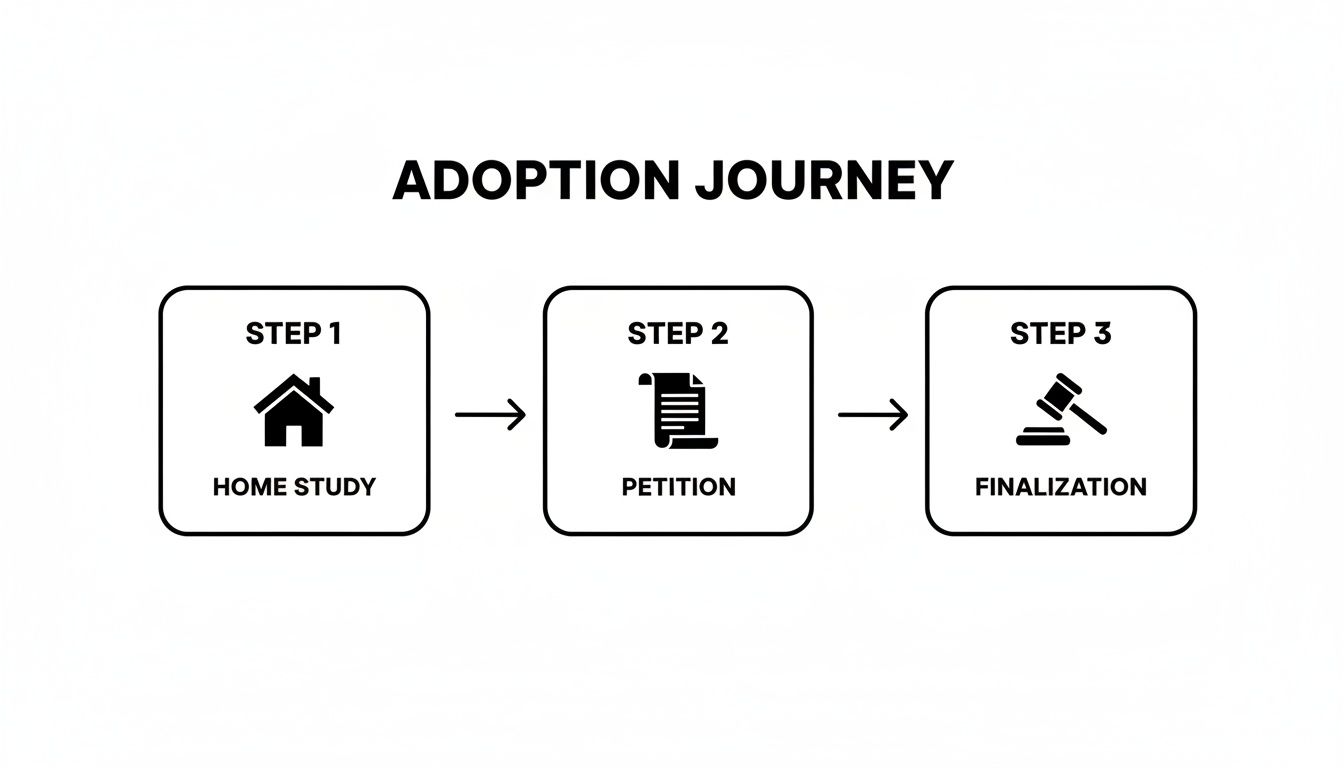
As you can see, the process boils down to three foundational pillars: a home study, filing the legal petition, and the finalization hearing.
Navigating DFPS and the Legal Process
When DFPS is involved, the rules of the game change. This is where a knowledgeable adoption attorney becomes your most important guide. Here’s how these adoptions differ from private ones:
- Termination of Parental Rights: In most foster care cases—and some kinship ones—the biological parents' rights have already been terminated by a court. If not, your attorney will need to guide you through that critical legal step first.
- Home Study and Training: All adoptions require a home study, but DFPS has specific criteria and training designed to prepare parents for the unique needs of children who have experienced trauma.
- Financial Support: A huge benefit of adopting through DFPS is the financial help available. Families who adopt children from state care can often get monthly stipends and Medicaid coverage for the child until they turn 18, which helps ease the financial load.
Adopting a relative or a child from foster care is about providing unwavering stability when it's needed most. Your role transitions from temporary caregiver to permanent parent, a legal and emotional milestone that secures a child’s future.
A good attorney does more than just file papers. They manage communications with DFPS caseworkers, make sure every legal deadline is met, and fight for the support your family is entitled to. The goal is always a smooth, clear path to finalization so you can focus on what truly matters: loving the child who is already a part of your heart.
Understanding Adoption Costs and Timelines
For most families thinking about adoption, two very practical questions pop up right away: "How much will this cost?" and "How long is this going to take?"
These are completely normal—and important—questions. At The Law Office of Bryan Fagan, PLLC, our goal is to trade that uncertainty for a clear, honest plan so you know exactly what to budget for and what to expect on the calendar.
An experienced Texas adoption lawyer is your guide here, helping you manage both the expenses and the schedule. This is how we prevent costly surprises and frustrating delays down the road.
A Transparent Look at Adoption Expenses
The total cost of an adoption in Texas isn't a single number; it really depends on the path you choose. A stepparent adoption, where everyone is on the same page, will naturally cost far less than a contested private adoption.
Here are the main expenses you should be prepared for:
- Legal Fees: This covers the work your adoption attorney does, from drafting and filing the right paperwork to representing you in court. We believe in being upfront about our fees so there are no mysteries.
- Court Filing Costs: Every adoption must be filed with the district court, which charges fees for processing the case.
- Home Study Fees: A licensed professional or agency must conduct your home study. Their fee covers the interviews, home visits, and required background checks.
- Amicus Attorney Fees: In some cases, the court may appoint a separate attorney just to represent the child’s best interests. Their fees are typically shared by the parties involved.
It's worth noting that adopting from the foster care system (DFPS) is often the most affordable route. In many cases, the state subsidizes these costs, and you might even qualify for financial assistance and ongoing medical coverage for your child.
Understanding the financial side of adoption is about empowerment. When you have a clear picture of the investment, you can plan with confidence and focus your energy on preparing to welcome a child into your life.
Mapping Out the Adoption Timeline
Just like costs, the timeline for an adoption hinges on the unique details of your situation. While some steps have legally required timeframes, others can be affected by how quickly paperwork gets done or how busy the court’s schedule is.
Here’s a general look at the sequence of events and how long they typically take:
- The Home Study: This process can take anywhere from a few weeks to a few months. The timeline depends on the agency's availability and how fast you can gather and provide the necessary documents.
- Matching (for Private Adoption): This is often the most unpredictable part of the journey. The wait to be matched with birth parents can range from a few months to a couple of years.
- Post-Placement Waiting Period: Once a child is placed in your home, Texas law mandates a waiting period of at least six months before the adoption can be finalized. This gives everyone time to adjust and allows for post-placement visits to ensure the transition is going smoothly.
- Finalization Hearing: After that six-month period is over, your attorney will get the final hearing on the court's calendar. This can usually be set within a few weeks, depending on the judge’s availability.
An uncontested stepparent or relative adoption might be wrapped up in about seven to nine months. On the other hand, a private infant adoption or any contested case will almost always take longer.
Your Texas adoption lawyer plays a key role in keeping everything on track, managing deadlines, and tackling any issues that pop up so your case keeps moving forward.
Why a Texas Adoption Lawyer Is Your Essential Partner
Throughout this guide, we’ve covered a lot—the different roads to adoption, the critical legal steps, and the realities of costs and timelines. Now, it’s time to talk about the single most important person who will stand by you on this journey: your Texas adoption lawyer.
It’s easy to think of an attorney as just the person who files paperwork. That’s like saying a master architect just draws lines. A skilled adoption lawyer does so much more. They are your family’s strategist, your guide through a legal maze, and your calmest voice during one of the most emotional and significant times of your life.
More Than a Legal Expert—An Advocate for Your Family
Adoption is deeply personal. It’s built on hope, and it can be a rollercoaster of emotions. A great attorney doesn’t just manage documents; they manage your peace of mind. They’re the ones who anticipate roadblocks—from the headache of tracking down a non-responsive biological parent to navigating the intricate rules of the Texas Department of Family and Protective Services (DFPS).
Your lawyer is your champion, both in and out of the courtroom. They translate dense legal language from the Texas Family Code into clear, simple advice and fight to ensure every decision is made with the child's best interests at the very center.
This partnership means you have someone in your corner who has walked this path hundreds of times before. They know the subtle details that can make or break a case, protecting you from expensive delays or devastating legal missteps. For a closer look at everything this role entails, you can learn more about what an adoption attorney does and how they protect your family.
At The Law Office of Bryan Fagan, PLLC, we don't just see ourselves as your legal counsel. We are your partners, committed to helping you cross the finish line with confidence and joy. Your family’s story is unique, and you deserve a legal strategy that honors that.
If you’re ready to take the next, no-pressure step, we invite you to schedule a free consultation with our team. Let's talk about your hopes, answer your questions, and start building your family, together.
Frequently Asked Questions About Texas Adoption
The decision to grow your family through adoption is filled with hope, but it also brings a lot of questions. It's completely natural. We've sat down with countless hopeful parents, birth mothers, and relatives over the years, and these are the questions that come up time and time again. Let’s get you some clear, straightforward answers.
Can I Adopt If I Am Single or Part of the LGBTQ+ Community in Texas?
Absolutely, yes. This is one of the most common myths we help to clarify. Texas law does not discriminate based on marital status or sexual orientation; it focuses on your ability to provide a safe, stable, and nurturing home for a child. Any single adult who meets the state's requirements has the right to adopt.
Likewise, there are no legal roadblocks for LGBTQ+ individuals or couples looking to adopt in Texas. A judge’s only priority is the best interests of the child. A dedicated Texas adoption lawyer is your best advocate to make sure your application is presented fairly and powerfully, focusing on what truly matters: the love and stability you can offer.
What Happens If the Birth Father Is Unknown or Uncooperative?
This is a frequent and very real concern, but it's a situation a skilled attorney handles all the time. If a birth father is truly unknown, your lawyer will conduct what’s called a "diligent search" to try and identify and find him, documenting every step for the court.
If he is known but is uncooperative or unresponsive, your attorney will make sure he is served with legal notice of the adoption plan. If he fails to respond or cannot be located after a diligent search, the court has the power to terminate his parental rights. Getting this step exactly right is crucial—it protects your adoption from being challenged down the road.
An experienced Texas adoption lawyer is absolutely essential when dealing with the termination of parental rights, especially in a complicated case. Handling this process correctly from the start provides the legal and emotional security your family deserves.
How Long Before the Adoption Is Final?
Texas law builds in a waiting period to make sure everyone is adjusting well. After a child is placed in your home, they must live with you for at least six months before you can go to court to finalize the adoption.
During this six-month period, a social worker will conduct post-placement visits. Think of these not as inspections, but as supportive check-ins to see how your new family is bonding. Once this period is successfully completed, your attorney will get you on the court’s docket for the finalization hearing—the day it all becomes official.
The adoption journey is one of the most personal you'll ever take, and having a compassionate legal guide by your side can make all the difference. At The Law Office of Bryan Fagan, PLLC, our entire team is committed to helping Texas families like yours move through this process with confidence and clarity.
If you’re ready to learn more about your options, we invite you to schedule a free, no-obligation consultation with us. Let's talk about your hopes, answer your questions, and start building your family. Visit us at https://texasfamilyadoption.com to take that first important step toward building yours.
