
When life presents an unexpected challenge, a temporary guardianship form is a loving and practical tool that allows a trusted friend or family member to step in and care for your child for a specific period. Think of it as a safety net, carefully put in place to ensure your child's world remains stable and secure without permanently changing your parental rights. It’s an act of planning and love, designed to protect your child when you can't be there.
When Your Family Might Need a Temporary Guardianship Form
Life is full of twists and turns. We all have moments where we need to lean on our village for support, and sometimes, that support needs to be legally recognized. A temporary guardianship form isn't about giving up your role as a parent; it's a responsible, proactive step to prepare for situations where you're temporarily unable to provide care yourself.

Real-Life Scenarios Calling for Guardianship
Imagine you're a single parent facing a major surgery that requires a lengthy recovery. Or perhaps you're part of a military family, and both parents are being deployed overseas. In these moments, a loving grandparent, aunt, or close family friend can step in, but they need more than just your blessing—they need the legal authority to act on your child's behalf.
A temporary guardianship gives them the power to:
- Enroll your child in school and communicate with teachers.
- Consent to medical care, from routine check-ups to emergency treatment.
- Manage the day-to-day decisions that keep your child’s life running smoothly and securely.
This simple document provides incredible peace of mind. You can focus on your recovery or service, knowing your child is in capable, loving hands and your chosen caregiver has the legal backing they need to act in your child's best interest. It’s a protective measure, not a surrender of your rights. If you're weighing your options, it's helpful to understand the key differences between custody and guardianship in our detailed guide.
This legal tool is about foresight and love. It’s a parent’s way of ensuring their child’s world remains as steady as possible, even when their own is temporarily shaken.
A Loving Choice for Stability
The need for stable, loving homes is a serious issue. While adoption is one path to giving a child a permanent family, temporary guardianship provides a vital alternative for families facing short-term crises. It can be the very thing that prevents a child from entering the foster care system by keeping them with trusted caregivers they already know and love.
This approach honors the core principle of family law in Texas: acting in the best interest of the child. It preserves family unity when it's needed most and provides a bridge of stability during uncertain times.
Get Your Ducks in a Row Before You Start
Before you download the temporary guardianship form, taking a few moments to get organized will make the entire process feel less daunting and more empowering. Gathering all the necessary details upfront can prevent simple mistakes that could cause complications later.
Think of it this way: a misspelled name or an incorrect date of birth could cause a school administrator or an emergency room doctor to question the document right when your child needs them most. A little preparation now ensures the safety net you're creating is strong and reliable.
Key Details for Everyone Involved
To fill out the form correctly, you'll need specific information for the child, each parent (or current legal guardian), and the person you're appointing as the temporary guardian. We always advise our clients to write these details down in one place before they begin.
You’re going to need the following for each person:
- Full Legal Name: This must match their official ID, like a birth certificate or driver's license. No nicknames.
- Current Home Address: The complete street address, city, state, and zip code.
- Date of Birth: This is essential for legal identification.
Having this information ready turns what could be a frustrating search into a simple, straightforward task.
Essential Documents to Have on Hand
Beyond basic personal information, certain documents serve as the legal backbone of your agreement. It's wise to have copies of these papers ready, as they'll help you answer specific questions on the form and provide necessary proof if needed.
Getting these details organized first builds a strong foundation for the agreement. It’s a clear signal that you’re committed to creating a legally sound document that truly protects the child’s best interests.
You'll want to locate and have easy access to:
- The Child’s Birth Certificate: This is the primary proof of the child's identity and your legal relationship.
- Parental Identification: Have copies of both parents' driver’s licenses or other government-issued IDs.
- Existing Court Orders: If you have any current orders from a Texas court related to custody, visitation, or child support, you must have them in front of you. A temporary guardianship cannot conflict with existing court orders.
Taking this step ensures you can complete the temporary guardianship form with confidence, knowing you've created a reliable and loving plan for your child.
Completing the Temporary Guardianship Form Section by Section
Staring at a legal document can feel overwhelming, with its formal terms and specific fields. Our goal is to break down each part of the temporary guardianship form into plain English so you can fill it out with total confidence, knowing it accurately reflects your wishes and protects your child.
Think of this form as a clear set of instructions for your child's school, their doctor, and the court. Every section tells a critical part of the story: who's involved, what the guardian is allowed to do, and for how long. Getting these details right is the key to a document that works when you need it most.
Identifying the Key Players
The first part of the form is about establishing the basics. This is where you officially name everyone involved: the child, the parents, and the person you're lovingly appointing as the temporary guardian.
- The Child (Minor): You'll need their full legal name, date of birth, and current address.
- The Parents: List both parents who have legal rights, along with their full legal names and addresses.
- The Proposed Guardian: State their full legal name, address, and their relationship to the child (e.g., "maternal grandmother," "close family friend").
Accuracy here is everything. A simple typo can cause serious delays or legal challenges. Double-check every detail against official documents like birth certificates and driver's licenses. This section lays the entire legal foundation for the agreement.
This simple flowchart shows how the authority flows from you (the parents) to the guardian, all centered on the well-being of your child.
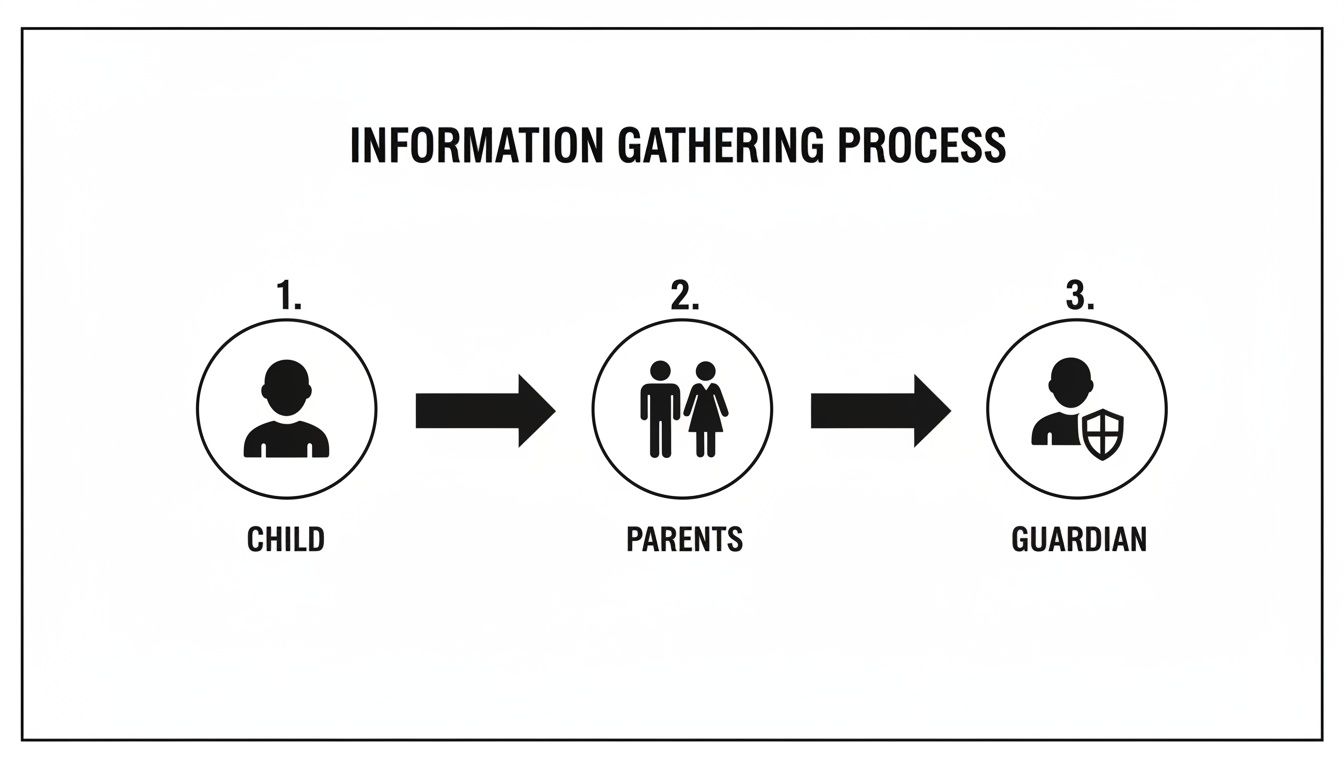
This visual is a great reminder that the power you're granting comes directly from you, for one purpose: to care for your child.
Defining the Guardian's Powers with Clarity
This is arguably the most critical part of the entire form. Here, you must spell out exactly what authority the temporary guardian will have. Vague language is your enemy; precision is your friend. Don't just say the guardian can "handle school stuff." Be specific.
For example, you might grant the authority to:
- "Consent to all necessary medical, dental, and psychological treatment for the child, including routine check-ups and emergency care."
- "Enroll the child in school, access educational records, and make decisions regarding their educational program."
- "Authorize the child's participation in age-appropriate extracurricular, social, and religious activities."
Think through every potential scenario. Does your child have a specific medical need? Are you comfortable with the guardian taking your child on an out-of-state vacation? The more detailed you are now, the fewer questions will arise later.
Granting specific powers is like handing someone a set of keys. You need to be sure you are giving them the right keys for the right doors, ensuring they can access what they need while respecting the areas that remain your responsibility.
To help you get this right, the table below breaks down the key parts of the form and what they're for.
Key Sections of a Temporary Guardianship Form Explained
This table breaks down the critical components of the form, explaining their purpose and what information is required for each.
| Section of the Form | Purpose and Key Information |
|---|---|
| Parties' Information | Clearly identifies the child, parent(s), and the proposed guardian. Requires full legal names, addresses, and dates of birth. Accuracy is crucial. |
| Grant of Powers | This is where you specify exactly what the guardian can do. Be detailed about medical, educational, and personal care decisions. |
| Reason for Guardianship | A brief, honest statement explaining why the guardianship is needed (e.g., parental illness, military deployment). |
| Duration of Guardianship | Specifies the exact start and end dates. A temporary guardianship cannot be indefinite. |
| Signatures & Notarization | The parent(s) must sign the document in front of a notary public to make it legally valid. |
Getting familiar with these sections beforehand makes filling out the actual document much less intimidating.
Stating the Reason and Setting the Duration
The form will ask you to explain why this temporary guardianship is necessary. A clear and honest statement is all that's required. Something as simple as, "The child's parent(s) will be temporarily unable to provide care due to a medical procedure and recovery period," is usually sufficient.
Just as important is defining the timeframe. A temporary guardianship must have a clear start date and end date. This provides a safety net for everyone involved and sets clear expectations for when your parental authority will be fully restored. Most agreements also include a clause allowing you to revoke it in writing before the end date if your situation changes.
Since many legal forms are now PDFs, knowing how to work with them can be helpful. If you're interested, you can learn how to create editable PDF forms to make the process a bit smoother.
Making Your Agreement Legally Binding
You’ve carefully filled out the temporary guardianship form, and now you’re holding a document full of loving intentions. But right now, it’s just paper. It's the final steps—getting it notarized and properly filed—that transform your agreement into a legally enforceable tool that truly protects your child.
This is the stage where your compassionate plan becomes official. It’s what ensures schools, doctors, and other authorities will recognize the caregiver's authority without hesitation, which is exactly what you need in an emergency.
The Critical Role of the Notary Public
To make a temporary guardianship form legally valid in Texas, the parent or parents must sign it in the presence of a notary public. A notary acts as an impartial witness, verifying your identity and confirming that you're signing the document willingly, without any pressure.
This is a non-negotiable step. Without a notary's seal and signature, the form has no legal weight.
Here’s what to remember:
- Don't Sign Ahead of Time: Wait until you are physically in front of the notary to sign the form.
- Bring a Valid ID: Everyone signing must show a government-issued photo ID, like a driver's license or passport.
- Everyone Should Be Present: It is best practice for both parents and the proposed guardian to be present for the signing. This shows everyone is in agreement and understands their roles.
Finding a notary is usually simple. Most banks, shipping stores, and some public libraries offer notary services for a small fee.
Think of notarization as the official stamp of approval that turns your private agreement into a public, legally recognized document. It’s the key that unlocks its power to protect your child.
Filing the Document and Getting Copies
For a court-ordered guardianship, the next step is to file the signed and notarized form with the appropriate Texas county court, usually in the county where the child lives. Filing the document officially enters it into the public record, giving it the strongest possible legal authority.
Whether your agreement is filed with the court or not, you must make several copies. It is wise to get these copies certified by the clerk's office. Certified copies are official duplicates that carry the same legal weight as the original document.
You'll want to give a certified copy to:
- The child’s school
- The child’s pediatrician and dentist
- The temporary guardian
- Your own personal records for safekeeping
Taking these final steps is vital to ensuring your wishes are respected when it matters most. For families who might be looking at a more permanent solution, our firm provides guidance on how to become a legal guardian in Texas, walking you through every step of the court process. As you finalize your documents, it can also be helpful to know the difference between various signature types, and this resource on understanding the nuances of digital versus electronic signatures is a great place to start.
Common Mistakes to Avoid When Creating the Agreement
Even with the best of intentions, a small oversight on a temporary guardianship form can create unexpected hurdles for your family. We’ve seen it happen with Texas families we've helped—a simple mistake prevents a loving caregiver from enrolling a child in school or authorizing needed medical care.
Let's walk through the most common pitfalls so you can ensure your agreement is solid and effective from the very beginning.
One of the most frequent errors is using language that's too vague. Simply writing that a guardian can "handle school matters" isn't enough. Does that include consenting to special education services? Authorizing a field trip? Being specific eliminates confusion and empowers your chosen caregiver to act decisively.
Forgetting Critical Details
Precision is everything when you're filling out this form. Two areas where we see mistakes pop up constantly are forgetting to set an end date and failing to get the document properly notarized.
- No End Date: A temporary guardianship has to be, well, temporary. If you forget to list a specific end date, you could inadvertently invalidate the entire document or create a legal dispute about when your parental authority is fully restored.
- Skipping Notarization: A signature by itself won't do. To make this document legally binding in Texas, the parents' signatures must be witnessed and certified by a notary public. Without that official seal, the form is just a piece of paper with good intentions.
A well-drafted temporary guardianship form is a proactive measure of love. Taking the time to get every detail right is the best way to ensure the child’s world remains stable and secure, no matter what challenges arise.
The current state of child welfare underscores why these stable, family-based solutions are so critical. Foster care adoptions recently hit their lowest level in nearly three decades, with only 46,935 children adopted from foster care in fiscal year 2024. This trend highlights systemic challenges and reinforces why reliable alternatives like well-executed guardianships are vital for keeping children with caregivers they know and trust. You can learn more about these national trends by exploring the latest foster care and adoption statistics.
By avoiding these common errors, you can create a clear, effective agreement that gives everyone true peace of mind.
Is a Temporary Guardianship Your Only Option?
While a temporary guardianship form is an essential tool, it's not always the only path forward. Texas law offers other options that might better suit your family's unique situation. It’s all about finding the right level of legal authority for your specific needs, and understanding the differences is key to making the most informed, loving choice for your child.
One of the most common alternatives is a Power of Attorney for a Minor Child. This document allows a parent to grant specific authorities to another trusted adult, often without needing to go to court.
Key Differences to Consider
A Power of Attorney is often simpler and faster to create than a court-ordered guardianship, but it comes with limitations. While it can empower someone to handle daily decisions like school enrollment and routine medical care, it is not as comprehensive. A guardianship, on the other hand, creates a formal legal relationship overseen by a judge, granting much broader authority and carrying more weight with institutions.
Before you make a decision, it's a good idea to weigh all your options, from these temporary agreements to more permanent solutions like adoption. You can get a clearer picture of how these legal statuses compare by reading our guide on legal guardianship vs. adoption in Texas.
To help you decide between the two most common temporary solutions, here’s a quick breakdown of how they compare.
Temporary Guardianship vs. Power of Attorney for a Minor
| Feature | Temporary Guardianship | Power of Attorney for a Minor |
|---|---|---|
| Court Involvement | Often Required. A judge must approve a formal guardianship. | Not required. A simple, signed document is often sufficient. |
| Legal Authority | Broad. Grants extensive legal rights over the child. | Limited. Grants only the specific powers listed in the document. |
| Duration | Fixed Term. A court-ordered temporary guardianship is for a limited time. | Flexible. Can be set for a specific time or until revoked by the parent. |
| Best For | Situations requiring comprehensive legal authority, often in emergencies. | Planned, short-term needs like travel or a parent's temporary absence. |
| Process | May involve filing a petition, attending a court hearing, and judicial review. | Involves drafting, signing, and notarizing a legal form. |
Ultimately, the right choice depends on your family’s circumstances. A Power of Attorney is excellent for planned, short-term needs, but a temporary guardianship provides the robust legal backing required for more complex or urgent situations.
We Answer Your Top Questions About Texas Guardianship
As you navigate this process, it's natural for questions to arise. We've compiled answers to some of the most common concerns Texas families have, hoping to provide clarity and confidence as you move forward.
How Long Can a Temporary Guardianship Last in Texas?
This depends on the specific type of agreement. An informal Authorization for Temporary Guardianship form often allows you to specify the timeframe, which can be up to six or twelve months and is often renewable.
For a formal, court-ordered temporary guardianship under the Texas Estates Code, the initial term is typically limited to 60 days. The court may grant extensions if necessary, but these are intended as short-term solutions for immediate needs while a more permanent plan is established, always prioritizing the child's stability.
Do Both Parents Need to Sign the Guardianship Form?
Yes, whenever possible. When both parents with legal rights sign the document, it shows a united front to schools, doctors, and the courts. It confirms that everyone is on the same page about the child's care plan and helps prevent future confusion or legal disputes.
If one parent is unavailable, uncooperative, or has had their parental rights terminated, the process becomes more complex. In these situations, it is essential to speak with an experienced family law attorney to understand the specific legal steps required for your circumstances.
Key Takeaway: Consent from both parents makes the temporary guardianship form a rock-solid, undisputed directive for caregivers and officials alike.
Can a Parent Take Back a Temporary Guardianship?
Absolutely. For most informal agreements not ordered by a court, a parent can revoke the temporary guardianship at any time. This is typically done by providing written notice to the temporary guardian.
This flexibility is one of the key benefits of this type of arrangement. It allows parents to resume their caregiving roles as soon as the situation that necessitated the guardianship—like recovering from an illness or returning from deployment—is resolved. Most forms include specific instructions on how to properly end the agreement.
Trying to make sense of a temporary guardianship form and what it means for your family can feel overwhelming, but you don't have to navigate it alone. The compassionate attorneys at The Law Office of Bryan Fagan, PLLC are here to offer clear, step-by-step guidance tailored to your family's unique story. Schedule a free consultation today and let us empower you to protect your child’s best interests with a legally sound and loving plan.
