
Yes, you absolutely can pursue a single-parent adoption in Texas. Your marital status does not define your ability to be a wonderful parent. What the state of Texas—and our team at The Law Office of Bryan Fagan, PLLC—truly cares about is your capacity to provide a safe, stable, and nurturing home for a child.
Your Journey to Building a Family Begins Here

If you're reading this, you are already taking a courageous first step on an incredible path. Exploring adoption on your own is a testament to your commitment, and this guide is here to serve as your roadmap, turning questions into clear, compassionate answers. We believe the heart of a family is love and dedication, not a marriage certificate.
This article is designed to walk you through the entire process, cutting through the legal jargon and giving you a clear picture of what to expect. Our goal is to replace any uncertainty you might feel with the confidence you need to move forward.
What You Will Learn
We’re going to cover everything you need to know about adopting solo in Texas, so you feel prepared for the journey ahead. You'll get a solid handle on:
- Texas Eligibility Rules: We’ll break down exactly what the Texas Family Code says about who can adopt as a single parent. No legalese, just straight answers.
- The Step-by-Step Process: We will map out each phase for you, from the first application and the home study all the way to your final day in court.
- Unique Joys and Challenges: We'll have an honest conversation about the real-world highs and lows of adopting as a single parent.
At its core, the entire Texas adoption process is driven by a single, powerful principle: acting in the best interest of the child. A stable, loving home provided by a committed single parent is every bit as valuable as one provided by a couple.
As you get ready for this life-changing journey, you might also find practical tips for new parents helpful, like this guide to First Time Mum Essentials. Now, let’s get started, arming you with the information you need to succeed.
Understanding Your Eligibility to Adopt Solo in Texas
Let's clear up the biggest myth right away: Texas law absolutely and unequivocally supports single-parent adoption. The state’s primary focus, outlined in the Texas Family Code, is always on the “best interest of the child,” not your marital status. What truly matters is your ability to provide a loving, stable, and secure home.
Think of the legal standards not as barriers, but as guideposts. They're designed to ensure every child is placed in a nurturing environment, and they're practical, common-sense requirements that any responsible adult can meet.
The Core Requirements for Single Adopters
The Texas Family Code (specifically Chapters 162-166) sets the foundation for who is eligible to adopt. For a single person, these rules are refreshingly straightforward and focus on your readiness to be a parent. While every case has its own unique details, the state will look at a few key areas to confirm your ability to care for a child.
These requirements include:
- Being an Adult: You must be at least 21 years old.
- Financial Stability: This doesn't mean you have to be wealthy. It means you can show a consistent ability to manage your finances and provide for a child’s basic needs—things like food, housing, and healthcare.
- A Safe Home Environment: Your home has to be a safe and suitable place for a child to grow and thrive.
- Passing Background Checks: To ensure child safety, you must complete criminal history and child abuse background checks.
A common misconception is that single parents are at a disadvantage. In reality, your life experience, stability, and a loving home are exactly what the state and adoption agencies are looking for. Your commitment is the most powerful asset you have.
Key Eligibility Factors for Single Adopters in Texas
To give you a clearer picture, here’s a breakdown of what the state is looking for and how you can prepare to meet those standards.
| Requirement | What It Means for a Single Applicant | How to Prepare |
|---|---|---|
| At Least 21 Years Old | This is a non-negotiable legal minimum age to adopt in Texas. | Ensure your government-issued ID is current and ready for verification. |
| Financial Stability | You must prove you can support a child on your own. This includes stable income, responsible budgeting, and a plan for unexpected costs. | Gather pay stubs, bank statements, and tax returns. Create a detailed household budget that includes future child-related expenses. |
| Safe Home Environment | Your home will be evaluated for safety, cleanliness, and having adequate space for a child. This is assessed during the home study. | Childproof your home, ensure smoke detectors work, and make any necessary repairs. Think about where the child will sleep and play. |
| Clean Background Check | A thorough criminal history and child abuse registry check is mandatory. A history of certain offenses can be a disqualifier. | Be transparent about your past. If you have a minor offense from long ago, be prepared to discuss it openly and honestly. |
This table isn't meant to be intimidating; it's a roadmap. By understanding what's required, you can take proactive steps to build a strong case for your readiness to parent.
A Real-Life Scenario: Sarah's Journey
To see how these rules apply in real life, let’s consider a relatable example. Meet Sarah, a 35-year-old teacher in Houston. She has always dreamed of being a mother and, after years of building her career and a stable life, she decides to pursue single-parent adoption.
Initially, Sarah worried that her single income might be an issue. But during her home study, she demonstrated her financial readiness by presenting a clear budget, proof of savings, and a steady employment history. She showed that while she wasn't rich, she was responsible and had a solid plan.
Even better, Sarah highlighted her incredible support system—her parents who live nearby, a close-knit group of friends excited to be "aunts" and "uncles," and a flexible work schedule. This network proved her ability to provide emotional and practical support for a child, showing that "single" doesn't mean "alone." Sarah's story shows that eligibility is about the complete picture of your life and dedication.
You Are Not Alone in This Journey
The path Sarah is on is one taken by thousands of hopeful parents every year. In fact, single-parent adoption is a growing and celebrated way to build a family. In 2021, single women adopted approximately 13,000 children in the United States, representing a significant portion of domestic adoptions. This statistic highlights the vital role single parents play in providing forever homes. To see the bigger picture, you can discover more adoption statistics and insights that show how families are formed today.
Ultimately, Texas law is designed to find dedicated parents, regardless of their relationship status. For a deeper dive into the specific legal criteria, you can learn more about who can adopt in Texas in our detailed guide. Understanding these requirements is the first step toward turning your dream of parenthood into a beautiful reality.
Navigating the Texas Adoption Process Step by Step
Knowing what to expect is the secret to a less stressful adoption journey. When you’re a hopeful single parent, having a clear roadmap can turn what feels like an overwhelming mountain of tasks into a series of exciting, manageable steps. This guide will break down the critical stages of a single parent adoption in Texas, taking you from that first big decision all the way to the day your family is legally finalized.
Think of the process less like one long, winding road and more like a path with specific checkpoints. Each one you pass gets you closer to welcoming a child into your life. It absolutely requires patience and a good bit of paperwork, but every single form and interview is there for a reason: to make sure the child’s best interests always come first.
Stage One: Your Initial Steps and Choosing Your Path
The first real move you’ll make is deciding how you want to adopt. This is a huge decision that shapes your entire experience. In Texas, single parents have a couple of solid options, but the most common paths are working with a private adoption agency or partnering directly with an experienced adoption attorney.
- Adoption Agencies: These organizations are often a one-stop shop. They can provide a full range of services, from matching you with birth parents to handling the home study and offering counseling along the way.
- Adoption Attorneys: An attorney is your legal quarterback. They manage every legal detail, like terminating the biological parents' rights and filing all the court documents needed to finalize your adoption. At The Law Office of Bryan Fagan, we specialize in guiding single parents through every one of these legal hurdles.
Your other key decision is the type of adoption. Are you hoping for a private infant adoption, or are you open to adopting a child from the foster care system (CPS)? Both are incredible ways to build a family, but they come with different timelines, costs, and emotional journeys.
This diagram lays out the main checkpoints in the Texas eligibility process, touching on age, stability, and the necessary background screenings.
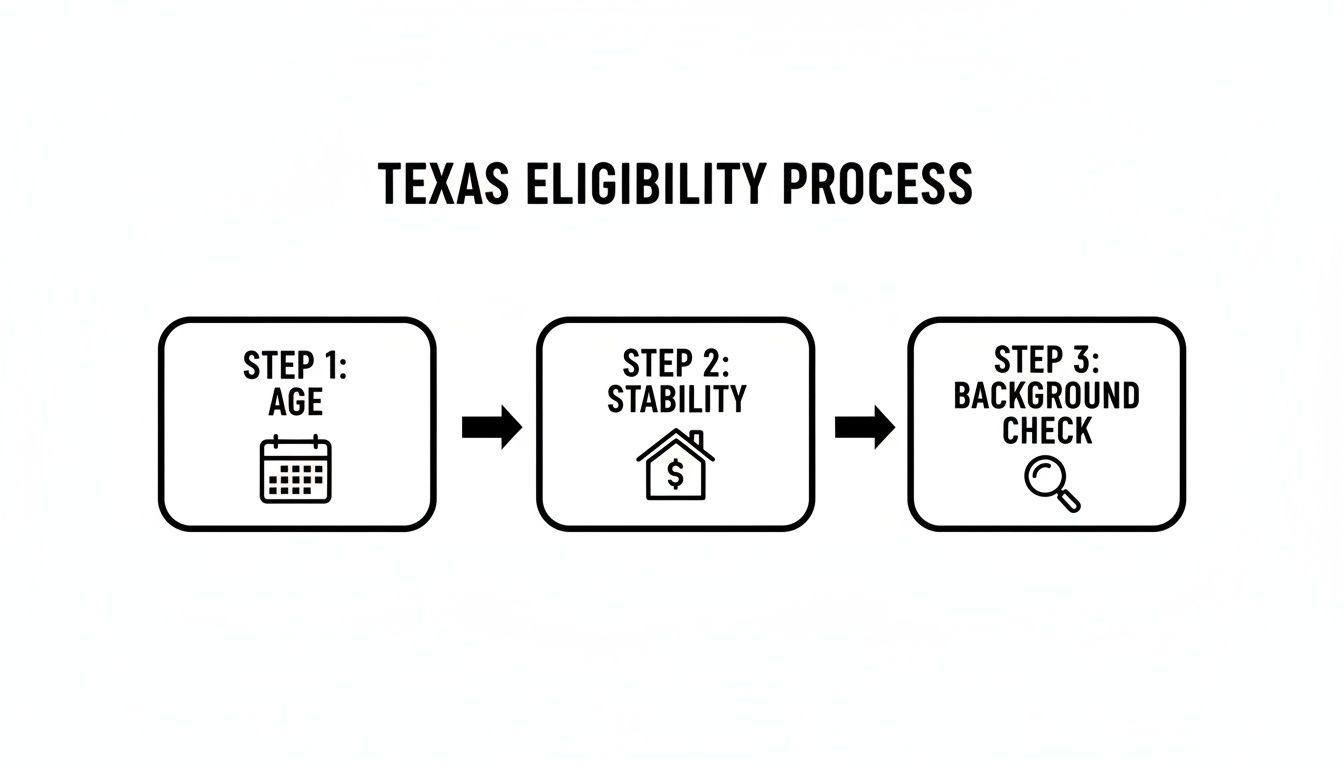
As you can see, eligibility isn’t about your marital status. It's about your ability to provide a safe, secure, and responsible home for a child.
Stage Two: The Application and Home Study
Once you’ve picked your path, it’s time to start the formal application. This means gathering a significant amount of paperwork that paints a detailed picture of your life. It’s your chance to show on paper that you are more than ready to be an amazing parent.
This phase flows right into the home study, which we’ll cover in more depth later. For a single applicant, this is your moment to really highlight your strengths.
The home study isn't an inspection—it's more of a conversation. Think of it as a collaborative process where you and a social worker talk about your motivations for adopting, your parenting style, and the incredible support system you have ready to help you raise a child.
As a single prospective parent, putting a spotlight on your support network is non-negotiable. This network—your family, your friends, your community—shows that while you may be a single parent, you will not be raising this child alone.
Stage Three: Matching and Placement
After your home study gets the green light, the waiting period begins. Honestly, this is often the most emotionally challenging part of the whole process. If you’re going the private adoption route, your profile will be shown to expectant birth parents. If you're adopting from foster care, your social worker will be looking for a child whose needs are a good match for what you can provide.
The matching process is different for everyone. Some single parents are matched in a matter of months, while for others, it takes longer. The most important thing you can do during this time is practice self-care and lean hard on that support system you’ve built.
Once a match is made, the next step is placement—that incredible moment when a child finally comes to live in your home. This kicks off a post-placement supervision period, which in Texas typically lasts for about six months. A social worker will visit your home every so often during this time to see how you and the child are adjusting to your new life together.
Stage Four: Finalizing Your Adoption in Court
The last stop on your single parent adoption journey is the finalization hearing. After you’ve successfully completed the post-placement period, your attorney will schedule a hearing in a Texas family court.
Don’t let the word “court” scare you; this is a happy, celebratory occasion. A judge will review your case file, make sure every legal requirement under the Texas Family Code has been met, and then sign the final decree of adoption. In that moment, the child is legally and forever yours. You'll even be issued a new birth certificate with your name proudly listed as the parent.
This entire journey, from that first decision to the final celebration in the courtroom, is a powerful testament to your commitment. At The Law Office of Bryan Fagan, we are truly honored to help Texas families navigate these steps with clarity and compassion. We invite you to learn more about how we can support your adoption goals.
Preparing for Your Home Study as a Single Applicant

Let’s be honest: the home study can feel like the most nerve-wracking part of the whole adoption journey. It’s easy for single applicants to worry they’ll be judged more critically or that their life will be put under a microscope.
But it's time to shift that perspective. The home study isn't an interrogation—it's a conversation. Its whole purpose is to make sure a child will land in a safe, loving, and supportive home. This is your chance to show the social worker the incredible life you’re ready to provide. It’s an opportunity to highlight your stability, your commitment, and the unique strengths you bring to the table as a solo parent.
A little preparation can turn that anxiety into pure confidence.
Proving Stability on a Single Income
One of the most common worries for anyone pursuing a single parent adoption is proving you’re financially ready. The social worker isn't looking for a six-figure salary; they're looking for responsibility. Your job is to show them you have a solid financial plan and can comfortably meet a child's needs.
Start by getting your financial paperwork organized. They'll typically want to see:
- Proof of Income: Recent pay stubs, W-2s, or tax returns are perfect for showing steady employment.
- Monthly Budget: A simple, clear budget showing your income and expenses, with a little room carved out for child-related costs.
- Bank Statements: These back up your claims of savings and responsible money habits.
- Proof of Insurance: You'll need to show you have a health insurance plan that will cover the child.
When you present this information clearly, you’re not just showing numbers on a page. You're proving you’ve thought ahead and are serious about the financial side of parenting.
Highlighting Your Essential Support System
As a single applicant, your support network isn't just a bonus—it's one of your superpowers. The social worker needs to see that you aren’t planning to do this completely alone. "Single parent" does not mean "isolated parent," and this is the time to prove it.
Think about who is in your corner. We’re talking about family, close friends, neighbors—anyone who will be there for you and your child. You’ll want to document this network:
- Create a List: Write down the names and contact info of the key people in your village.
- Detail Their Roles: Get specific. For example, "My mom, Susan, lives 15 minutes away and has offered to be my go-to for weekend childcare," or "My best friend, David, is our emergency contact and a great male role model."
- Gather Reference Letters: Ask a few people from your support system to write a letter of reference. Hearing from the people who know you best can be incredibly persuasive.
Taking these steps shows the social worker you have a whole team ready to welcome a child with open arms.
Preparing for the Interview and Home Visit
The interview part of the home study is really just a conversation about you—your life, why you want to adopt, and how you see yourself as a parent. Be ready to talk openly and honestly. They want to get to know the real person who will be raising this child.
The home visit itself is all about safety and readiness. The social worker will do a basic check for things like working smoke detectors, a clean environment, and secure windows. They just want to see that you have a safe, designated space for a child to live and grow.
Remember, the goal of the home study is not to find a perfect person or a perfect house. It is to find a prepared, stable, and loving parent who is ready to provide a permanent home for a child in need.
This phase is a huge step toward making your dream of building a family a reality. For a complete rundown of what to gather, check out our Texas adoption home study checklist to make sure you feel ready for every part of the process.
Exploring Your Adoption Options in Texas

If you're a single person dreaming of parenthood, you’re not alone—and in Texas, you have several ways to build your family. Understanding your options is the first step. Think of it like mapping out a journey; each route has different terrain, timelines, and costs, but they all lead to the incredible destination of becoming a parent.
For single-parent adoption, the three main paths are private infant adoption, adopting from foster care, and kinship adoption. Let's break down what each of these really looks like.
Private Infant Adoption
This is the route that often comes to mind first. In a private adoption, you'll work with an agency or an attorney to connect with an expectant mother who chooses you to raise her child. It's a deeply personal journey that can be incredibly rewarding.
But it’s also important to be realistic. This path usually comes with higher costs and can involve a long, unpredictable wait. You might also build a close relationship with the birth mother through an open adoption, which requires emotional readiness and clear communication.
Adopting from Foster Care (CPS)
Choosing to adopt from the Texas foster care system, also known as Child Protective Services (CPS), is a powerful way to give a child a loving, permanent home. This is often the most affordable route for single parents. The state frequently covers most, if not all, of the legal fees, and you may even receive a monthly subsidy to help with the child’s expenses.
The children available through CPS vary in age and background, and many have experienced trauma. They need a parent with patience, a strong support system, and a big heart. Single parents have become a vital part of this system. In 2021, single women adopted about 13,000 children nationwide, making up a huge portion of the 54,200 total adoptions from foster care that year. Your role here isn't just wanted—it's needed.
Kinship and Relative Adoptions
Sometimes, the child you’re meant to parent is already in your life. A kinship adoption happens when you adopt a relative—like a grandchild, niece, or nephew—whose biological parents can no longer care for them. This path is all about keeping family together, giving a child stability with someone they already know and trust.
While the emotional connection is already there, a kinship adoption is still a formal legal process. It requires terminating the biological parents' rights and finalizing the adoption in court to give you full legal authority. It's a profound way to protect a child while honoring family bonds.
Choosing which path to take is a deeply personal decision. It's about weighing the costs, timelines, and emotional demands against your own life and resources. Our team can help you explore all the different types of adoption available in Texas to find the one that feels right for you.
Overcoming Common Challenges on Your Adoption Journey
While the path to single-parent adoption is filled with incredible joy, let's be real—it also comes with its own unique set of hurdles. Thinking about potential challenges isn't a sign of weakness; it's a mark of a smart, prepared parent-to-be. By looking ahead, you can turn these obstacles into opportunities to build your resilience for the realities of parenthood.
This journey demands a ton of emotional stamina, especially during that long waiting period. It also requires a practical game plan for managing finances on a single income and, sometimes, navigating outdated social biases. The key is to be proactive, not reactive.
Building Your Support Network
The single most important asset you have is your support system. A strong network of family and friends is your emotional and practical safety net, proving that “single parent” definitely doesn't mean you’re parenting alone.
- Identify Your Core Team: Who can you call for last-minute childcare, a shoulder to lean on after a tough day, or just some simple advice? Make an actual list of these key people.
- Be Specific About Your Needs: Don't be afraid to ask for exactly what you need. Let your network know if you'll need help with meals after placement or just someone to talk to while you wait.
- Seek Out Other Single Parents: Connect with online groups or local communities of single adoptive parents. Their shared experiences and encouragement can be an absolute lifeline.
Creating a Proactive Financial Plan
Financial stability is all about smart planning, not being massively wealthy. Creating a detailed, realistic budget will give you confidence and show everyone involved you're ready to provide for a child. Take a hard look at your income, expenses, and savings, then map out future costs like childcare, healthcare, and education.
As you think about the practical side of welcoming a child, remember that services for newborn care can seriously ease the transition. If you're in the Houston area, you might want to find a night nanny in Houston to help you get some much-needed rest.
Remember, the goal is to show you are a responsible planner who can provide a secure and stable life for a child. Your commitment and foresight are far more important than the size of your paycheck.
Prioritizing Your Own Well-Being
The adoption process is a marathon, not a sprint. Taking care of your own mental and emotional health is absolutely essential to staying strong for the journey—and for your future child.
Make self-care a non-negotiable part of your routine. This could be scheduling time for hobbies, getting regular exercise, or practicing mindfulness. Doing this ensures you stay centered and resilient, ready to embrace all the joys of parenthood when the time comes.
You’re not walking this path alone. Amid fluctuating adoption landscapes, single parents adopted around 13,000 to 15,000 children annually in recent years, a trend that's been bolstered by a rising acceptance of diverse families. This shift highlights the vital role you play. For more on this, you can discover more insights on adoption trends on obermayerfamilymatters.com.
Questions We Hear All the Time About Adopting Alone in Texas
If you’re thinking about adopting on your own, you’ve probably got a million questions running through your mind. It's completely normal. Below are some of the most common questions we get from single Texans, with clear, straight-to-the-point answers to help you feel more confident about the road ahead.
Can a Single Man Adopt a Child in Texas?
Yes, absolutely. Texas law doesn't care about your gender when it comes to single parent adoption. Any single adult who meets the state's requirements can give a child a home.
When it comes down to it, the court has one single focus: finding a stable, loving home that is in the child’s best interest. A safe, nurturing home provided by a single man is just as valuable as one provided by any other qualified person.
Will I Be at a Disadvantage Compared to Married Couples?
Legally speaking, no. The Texas Family Code puts you on the same level playing field as any other applicant. While it’s true that some private agencies or birth parents might have a preference for a two-parent household, the state’s foster care system is actively looking for great single parents.
The real key is showing your strengths. You'll want to build a strong profile that highlights your stability, your network of friends and family who have your back, and your absolute commitment to being a parent. Those are the things that truly matter.
How Do I Prove Financial Stability on a Single Income?
This isn't about being wealthy; it's about being responsible. You can show financial stability with things like a steady job, a realistic household budget, proof of savings, and having a plan for the child’s health insurance.
Your social worker isn't there to judge how much money you make. They just need to see that you've thought things through and have a responsible plan to provide for a child's needs.
Your dream of building a family is absolutely within reach, and you don’t have to figure it all out on your own. At The Law Office of Bryan Fagan, PLLC, our attorneys are here to guide you through every single step of the single parent adoption process with clarity and genuine support. Schedule your free, confidential consultation today to get started on the next chapter of your life.
