 Skip to content
If you're starting to think about adoption, one of the first questions that comes to mind is almost always about the cost. It’s a practical, necessary question, and the answer can feel a little overwhelming at first. In Texas, the price of adoption can swing from nearly zero for a foster care adoption all the way up to $65,000 or more for a private infant adoption.
That's a huge range, and it all comes down to the path you choose to grow your family. Understanding the key costs for each type of adoption is the first step in creating a financial plan that feels manageable, allowing you to focus on the joy of preparing to welcome a child into your life.
Your Guide to Understanding Texas Adoption Costs
Deciding to adopt is a decision made from the heart, but the financial side can feel like a cold splash of water. The numbers may seem intimidating, but our goal is to pull back the curtain and replace that anxiety with clarity and confidence.
Whether you're leaning toward a private agency, foster care, or adopting a relative, each journey has its own financial landscape. We'll break down where the money goes—from the legal fees that secure your parental rights under the Texas Family Code to the agency costs that provide crucial support for birth parents.
The most important thing to remember is that you are not just paying fees; you are investing in a secure, legal, and ethical process that honors everyone involved, with the child’s best interest at the heart of every step.
Of course, the costs don't stop with the legal process. You also have a home to prepare and a nursery to stock! Our guide on essential baby items can help you budget for everything your new little one will need when they arrive.
To give you a clear view right from the start, we've put together a quick comparison of the most common adoption paths in Texas and what you can generally expect to invest.
Estimated Adoption Costs in Texas at a Glance
This table offers a straightforward summary of the typical cost ranges for the most common types of adoption in Texas. Think of it as a starting point to help you see the big picture as you explore which path feels right for your family.
| Adoption Type | Estimated Cost Range | Key Cost Factors |
|---|---|---|
| Private Infant Adoption | $40,000 – $65,000+ | Agency fees, birth mother expenses, legal fees for both parties, marketing, and home study. |
| Foster Care Adoption | $0 – $5,000 | Minimal legal fees, potential home study costs. Often offset by state subsidies and reimbursements. |
| Stepparent/Kinship | $2,500 – $7,500 | Primarily legal fees for petition filing, termination of parental rights, and court finalization. |
As you can see, the financial commitment varies dramatically. The key is understanding what drives those costs so you can plan with confidence and focus on what truly matters: preparing to welcome a child into your heart and home.
Breaking Down Private Infant Adoption Expenses
Choosing private infant adoption is a deeply personal and beautiful way to build your family. It's a path fueled by hope and connection, but it's also the most significant financial investment in the adoption world. Understanding the price of adoption in Texas for a newborn isn't just about looking at a final number; it’s about seeing how each cost is a crucial piece of an ethical, safe, and compassionate process that honors everyone involved—especially the birth mother and the child.
The financial journey of private adoption is made up of several important parts, not just a single agency fee. Think of it like building a house: you have costs for the foundation (legal work), the structure (agency support), and the essential utilities (birth mother care). Each piece is critical to creating a safe and lasting home for your family.
Core Components of Private Adoption Costs
The total cost is a sum of several distinct but interconnected expenses. Every single one plays a vital role in ensuring the adoption is legally sound and emotionally supported from start to finish.
Here’s a look at the key expenses you can expect:
- Agency Fees: This is often the largest portion of the cost. It covers the agency’s operational expenses, the salaries of professional staff who guide you, counseling for birth parents, matching services, and post-placement support.
- Legal Fees: You'll need an experienced adoption attorney to guide you through the complexities of the Texas Family Code, specifically Chapter 162. Just as importantly, you are also responsible for ensuring the birth mother has her own independent legal representation to protect her rights.
- Home Study Costs: This is a mandatory step in every adoption. The home study is a thorough review of your readiness to parent, conducted by a licensed professional to ensure a safe and loving environment for a child.
- Birth Mother Expenses: Texas law allows adoptive parents to cover reasonable and necessary living and medical expenses for the birth mother during her pregnancy and recovery. This can include things like housing, food, transportation, and any medical bills not covered by her insurance. This support ensures she is cared for during this vulnerable time.
These aren't just line items on a spreadsheet. They represent the network of care built around a child and their birth family, ensuring a healthy start and a legally secure future for your family.
The infographic below gives you a clear visual of how different adoption paths, like private adoption, compare financially.
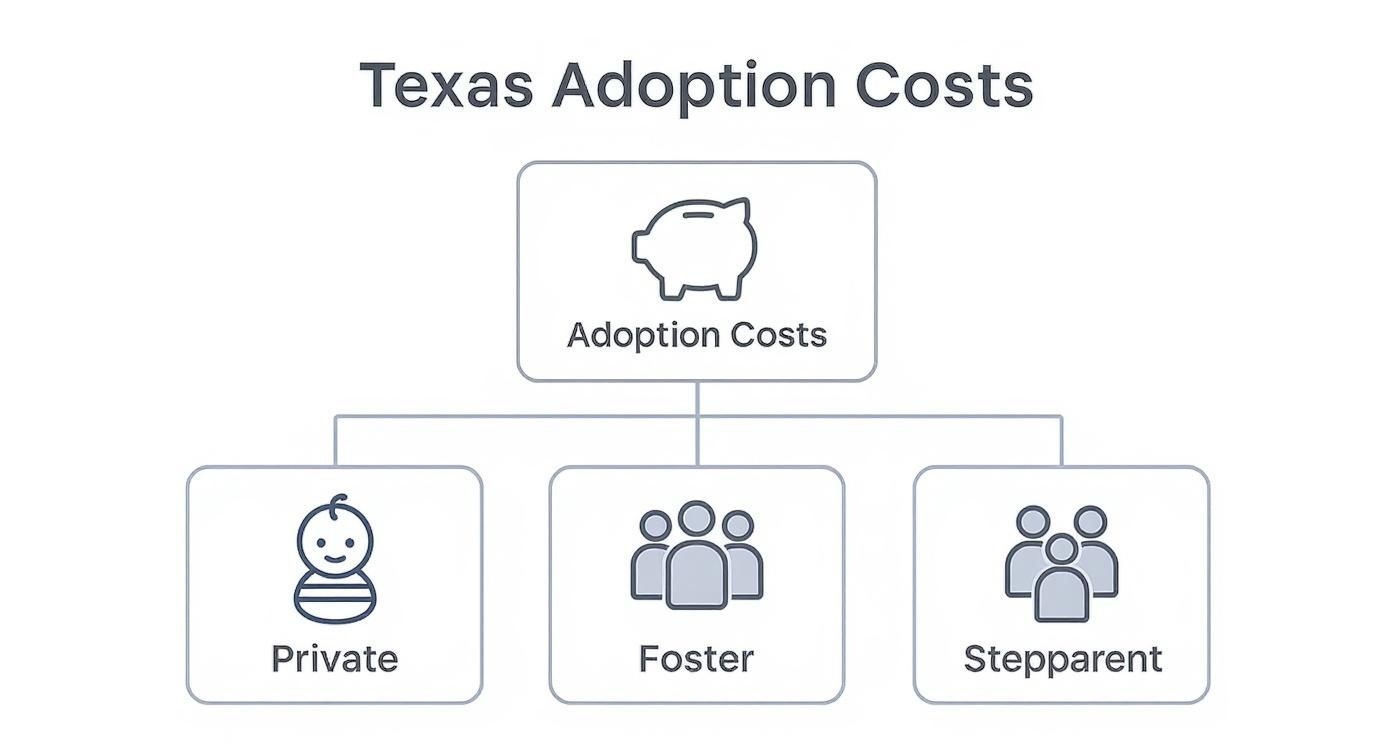
This visual really highlights why the investment in private infant adoption is so much higher than other paths—it’s all about the extensive professional services required to make it happen safely and ethically.
Understanding the Financial Range
So, what does this all add up to? The average cost for a private infant adoption in Texas, where a family works directly with an agency, typically falls between $60,000 and $65,000. That figure makes Texas one of the more expensive states for this type of adoption.
This number covers agency fees, legal counsel for both you and the birth mother, the home study, pregnancy and birth-related expenses, and potential travel. Of course, every family's journey is unique. The final cost will depend on the specific circumstances of the adoption, like the birth mother's individual needs or any unforeseen medical or legal complexities that might arise.
Adopting from Foster Care: An Affordable Path to Family
When hopeful parents in Texas start looking into adoption, the price tag for private adoptions can feel like a huge barrier. It’s easy to get discouraged. But there's another path—an incredibly rewarding one where the biggest investment isn't financial, but one of love, patience, and commitment.
Adopting a child from the Texas foster care system is a beautiful way to give a permanent, loving home to a child who desperately needs one. And by a long shot, it is the most affordable way to grow your family.
This isn't because the process is "cheaper" in quality; it's because the state's primary goal is the child's well-being. The focus is on finding a permanent, loving family for a child. This means the state actively works to remove financial hurdles for families willing to open their hearts and homes.

Why is Foster Care Adoption So Affordable?
The price of adoption in Texas through foster care is dramatically lower because the state steps in with significant financial support. Most families find their total costs range from just $1,000 to $5,000, and in many cases, the process is virtually free.
How is that possible? The state often covers the home study costs and offers subsidies specifically for adopting children out of foster care. This can include monthly financial assistance, Medicaid benefits, and even reimbursement for certain adoption-related expenses.
This entire financial structure is designed to make sure a family's income doesn't stand in the way of a child finding their forever home. The support system is comprehensive:
- State-Covered Fees: Texas frequently pays for many of the legal and administrative fees, like attorney costs and court filing fees.
- Monthly Adoption Assistance: Many children adopted from foster care—especially older kids, sibling groups, or those with unique needs—qualify for a monthly subsidy to help with their care until they turn 18.
- Medicaid Coverage: Children adopted from the foster system usually get Medicaid health insurance, which covers their medical, dental, and mental health needs.
- Reimbursement for Expenses: Families can often get reimbursed for one-time adoption costs, like travel or certain legal fees, up to a specific limit.
Choosing to adopt from foster care is more than a financial decision; it's an opportunity to provide stability, love, and a permanent family to a child, sibling group, or teenager who has experienced uncertainty and deserves a safe place to land.
A Journey of Heart and Home
While the low cost is a huge relief for many families, it's the emotional journey that truly defines this path. Adopting from foster care often means you're welcoming an older child, a group of siblings, or a child with unique needs into your family. This takes a special kind of understanding, patience, and a deep commitment to helping a child heal and thrive.
The rewards, though, are immeasurable. You aren't just growing your family; you are fundamentally changing the course of a child's life, giving them the security and love they deserve. The legal process, guided by the Texas Family Code, is set up to support this goal every step of the way.
If this path feels right for you, you can learn more about how to adopt from foster care in Texas in our detailed guide. It's a journey that builds families and strengthens communities, one loving home at a time.
The Cost of Stepparent and Kinship Adoptions
When a family is already bound by love—like when a stepparent, aunt, uncle, or grandparent is raising a child—the legal adoption process is less about finding a match and more about formalizing a relationship that already exists. This makes the price of adoption in Texas for stepparents and relatives much more affordable and straightforward.
The journey here isn't about finding a child; it's about legally securing a child who is already a huge part of your heart and home. Because of that, the financial side of things is far less complex than with private or agency adoptions.
So, What Am I Actually Paying For?
For stepparent and kinship adoptions, the costs are almost entirely made up of legal fees. Think of it as investing in the legal paperwork required to navigate the Texas Family Code and make sure the adoption is permanent and legally recognized.
Your investment will typically cover these key steps:
- Filing the Petition for Adoption: This is the official document that kicks off the legal process with the court.
- Terminating Parental Rights: This is a crucial step. For an adoption to proceed, the parental rights of the other biological parent must be legally terminated. This can be a simple process if they consent, but it can become more complex—and expensive—if they contest it.
- Court Costs and Finalization: This covers the final hearing where a judge officially grants the adoption, making your family legally and officially whole.
An investment in the legal finalization of a stepparent or kinship adoption is an investment in your child’s stability and security. It provides them with legal permanence, inheritance rights, and the peace of mind that comes from knowing their family is officially forever.
A Real-Life Stepparent Adoption Scenario
Let's put this into perspective. Imagine a stepfather who has been raising his wife’s daughter since she was a toddler. He’s the only dad she’s ever known. He wants to adopt her to give her the legal security of his name and inheritance rights.
Their main expense is hiring an experienced family law attorney to handle the legal side. The attorney files the adoption petition and, assuming the biological father agrees, also handles the voluntary termination of his parental rights. After the paperwork is squared away and they attend a brief, joyful court hearing, the adoption is finalized. The total cost, which is mostly legal fees, is just a fraction of what a private adoption would have been. You can read more about the specific costs of stepparent adoption in our guide.
Stepparent adoptions are a beautiful way to strengthen a blended family. As you navigate this new chapter, you might find it helpful to explore resources for blended families. Legally formalizing your bond is a profound step toward cementing your family's unity for the long haul.
Financial Assistance to Help You Adopt
When you see the numbers associated with adoption, it’s easy to feel like you’ve hit a wall. But those figures don't have to be the end of the road. The price of adoption in Texas is a real concern, but it shouldn't be the final barrier to building your family. Thankfully, there’s a whole network of financial resources designed specifically to help hopeful parents bridge that gap.

Many families find success by piecing together a few different avenues of support. It takes research and planning, but knowing these options exist can turn a seemingly impossible cost into a manageable goal. It's all about finding the right combination of resources that fit your unique situation.
The Federal Adoption Tax Credit
One of the most powerful tools available is the Federal Adoption Tax Credit. This isn't a check you get in the mail. It's a nonrefundable credit that directly reduces your federal income tax bill, dollar for dollar. For 2024, the credit is worth up to $16,810 per child.
So, what does that mean in practice? If you owe, say, $10,000 in federal taxes, this credit could wipe that bill out completely. Because it's nonrefundable, it won’t pay you back more than you owe, but any leftover amount can be carried forward for up to five years. It’s a game-changer that can effectively return thousands of dollars you spent on qualified adoption expenses.
Exploring Grants and Employer Benefits
Beyond the tax credit, there are plenty of other places to look for financial support. These resources exist to make adoption more accessible, ensuring that cost isn’t the only thing guiding your decisions.
- Adoption Grants: A number of non-profits offer grants to help families with adoption costs. The best part? They don’t have to be repaid. These grants can range from a few thousand dollars to much more. Organizations like Help Us Adopt and the National Adoption Foundation are great places to start your search.
- Employer-Provided Benefits: More and more companies are starting to recognize adoption as a way for their employees to grow their families. It’s worth a conversation with your HR department to see if they offer any adoption assistance, which might include direct financial reimbursement or paid leave.
- Low-Interest Loans: Some financial institutions have loans designed specifically for adoption. While you do have to pay this back, it can provide the upfront cash you need to cover agency and legal fees, letting you spread the cost out over time.
Building your family through adoption is a journey of the heart, and these financial tools are here to support that journey. They exist because communities, employers, and the government recognize the profound value of creating loving, permanent homes for children.
By exploring these options, you can start to piece together a financial strategy that puts adoption within your reach. It’s about being resourceful and remembering you don’t have to figure out the financial side all on your own. The support you need to build your family is out there.
Begin Your Adoption Journey with Confidence
Deciding to adopt is a life-changing moment, and understanding the financial side is a huge piece of that puzzle. The price of adoption in Texas can look intimidating, with costs that swing from nearly zero for foster care all the way up to tens of thousands for a private infant adoption. But it helps to remember that every one of those numbers represents a critical step toward building a secure, ethical, and loving family.
As you move forward, try to shift your focus from the price tag to the priceless value of giving a child a permanent home. Every path—whether you go through an agency, the state, or even adopt within your own family—has its own financial story. The destination, though, is always the same: family.
The goal isn't to let the costs scare you away, but to let knowledge empower you. With careful planning and the right support, the financial part of adoption becomes a manageable step in your journey, not a roadblock to your dream.
Remember, you don’t have to walk this path alone. The complexities of Texas adoption law are best navigated with an experienced guide who can bring both legal clarity and compassionate support to the table.
If you’re ready to take the next step toward building your family, we invite you to Schedule your free consultation today with The Law Office of Bryan Fagan, PLLC. Let us provide the expert guidance you need to start your adoption journey with confidence.
Answering Your Questions About Texas Adoption Costs
The financial side of adoption can feel overwhelming. It brings up a lot of valid questions, and getting clear answers is the first step toward moving forward with peace of mind. Here are some of the most common concerns we hear from hopeful adoptive parents about the price of adoption in Texas.
Why Is Private Infant Adoption So Expensive?
It’s a fair question. The high cost of private infant adoption often comes as a surprise. The difference comes down to one thing: private adoptions are not funded by the state. The fees you pay are direct investments in a healthy, ethical, and legally sound process for everyone involved.
Think of it this way: these costs cover the entire ecosystem of a successful adoption. This includes:
- Agency Operations: This is the nerve center—covering staff salaries, outreach to find and support birth mothers, and all the administrative work that keeps things running smoothly.
- Comprehensive Legal Services: Fees ensure that both you and the birth parents have expert legal representation, protecting everyone’s rights under the Texas Family Code.
- Birth Mother Support: This is a critical piece. These funds cover state-approved medical care, living expenses, and counseling for the birth mother during her pregnancy and recovery.
In stark contrast, the state heavily subsidizes foster care adoption. The government's primary goal is to find permanent, loving homes for children in its care. That’s why the state covers most, if not all, of the legal and home study fees, making it a much more affordable path to building a family.
Does the Adoption Tax Credit Refund All My Expenses?
The Federal Adoption Tax Credit is an incredible resource, but its name can be a little misleading. It's a non-refundable credit, which means it can reduce or even eliminate your federal income tax liability, but it won’t result in a check back from the IRS for any leftover amount.
Here’s how it works in practice. Let's say you have a $5,000 tax liability for the year and you qualify for the full credit (which is around $16,000). The credit will cover your entire $5,000 tax bill. The remaining $11,000 doesn't just disappear—you can carry it forward for up to five years to reduce your taxes in the future.
It's absolutely crucial to sit down with a qualified tax professional. They can look at your specific financial picture and help you understand exactly how to maximize this powerful credit.
Are There Hidden Fees I Should Anticipate?
Reputable agencies and attorneys will always aim for 100% transparency, but the reality is that adoption journeys can have unexpected turns. In private adoptions, unforeseen costs can arise. This could be anything from sudden medical complications for the birth mother or baby, requiring extended hospital stays, to unforeseen legal hurdles that need to be addressed.
The best way to prepare is to plan ahead. Start by asking for a detailed, itemized cost estimate from your agency or attorney. Then, build a contingency fund—a good rule of thumb is 10-15% of your total estimated budget—for those "what if" scenarios. Having that financial cushion provides peace of mind and ensures you're prepared for whatever comes your way on this beautiful journey.
Understanding the financial landscape is a critical step in your adoption journey. The team at The Law Office of Bryan Fagan, PLLC is here to provide the compassionate legal guidance you need to navigate the costs and legal requirements with confidence. Schedule your free consultation today to get your questions answered and start building your family.

