
When you hear the term legal guardian documents, it's easy to feel overwhelmed by legal jargon. At their core, these are the official, court-filed papers that give a caring adult the authority to look after a minor or an incapacitated adult here in Texas. Think of documents like an Application for Appointment of Guardian and the final Order Appointing Guardian. Together, they create the legal foundation for protecting someone who can't protect themselves.
Understanding the Foundation of Guardianship in Texas
If you’re exploring guardianship, you are taking a brave and compassionate step to shield a loved one. We know the legal forms and procedures can feel intimidating at first. But try to see this process less as a legal battle and more as building a strong framework of safety and care around someone who desperately needs it. The legal guardian documents are simply the tools you’ll use to construct that framework.
Getting a handle on what each document does is the first, most empowering step you can take. These aren't just pieces of paper. They are official records that tell a judge exactly why your help is critical and how you plan to act in the best interests of the child or adult in question. They paint a clear picture for the court of your family's situation and your commitment to providing a stable, loving home.
Why These Documents Matter
The legal system has a profound responsibility to protect its most vulnerable citizens, which is why the guardianship process is so thorough. According to the Texas Family Code, every decision must prioritize the "best interest of the child." This principle is the heart of the entire process.
Each form serves a specific purpose in proving that a guardianship is necessary and that you are the right person for the job. These documents work together to establish:
- The Need for a Guardian: This is where you demonstrate that the individual (known as the "ward") is either a minor or is incapacitated and can't manage their own affairs.
- Your Suitability: You’ll need to show the court that you are a responsible, caring, and capable person fit to serve as a guardian.
- The Best Interest of the Ward: Above all, every single document is geared toward convincing the judge that appointing you is the best possible outcome for the person who needs protection.
The path to becoming a guardian involves several key documents, from the initial application to the final court order. While every family’s story is different, understanding these core components can make the journey ahead feel much less mysterious. For more urgent situations, it’s also a good idea to learn about the temporary guardianship form and its specific requirements.
Key Guardianship Documents at a Glance
Navigating the paperwork is often one of the most challenging parts of the process. This table breaks down the most common documents you'll encounter and explains what each one accomplishes for you and your loved one in simple, clear terms.
| Document Name | What This Document Does For You |
|---|---|
| Application for Appointment of Guardian | This is the official starting point. It's the petition you file with the court to formally request guardianship and explain why it's necessary for your loved one's well-being. |
| Physician's Certificate of Medical Examination | For adult guardianships, this is a doctor's sworn statement confirming the proposed ward is incapacitated and unable to make decisions for themselves. |
| Criminal History Report | A required background check to show the court you are a suitable and safe person to be appointed as a guardian, ensuring a secure environment for the ward. |
| Oath of Guardian | A sworn statement you sign after being appointed, promising to faithfully perform your duties with the ward's best interests at heart. |
| Letters of Guardianship | The official document issued by the court clerk that serves as your proof of legal authority to act on behalf of the ward. |
| Annual Report | An ongoing requirement where you report to the court each year on the ward's well-being and financial status, ensuring continued oversight and protection. |
Think of these documents as the building blocks of your case. Each one adds another layer of proof and assurance for the court, making your path to securing guardianship clearer and more direct.
Choosing the Right Type of Guardianship for Your Family
Here in Texas, the law understands that no two families are the same. Just as every person's needs are unique, the kind of legal support they require can vary greatly. That’s why Texas law offers different types of guardianship, each designed for a specific situation.
The goal is to provide a loved one with the right amount of protection without taking away more of their independence than necessary. Deciding which path is right for your family is a crucial first step and will determine which legal guardian documents you'll need to file.
Guardianship of the Person vs. Guardianship of the Estate
Most of the time, the court distinguishes between two key responsibilities: caring for someone's day-to-day well-being and managing their finances. These roles can be handled by one person or split between two, depending on what’s best for the person needing help (the "ward").
Guardianship of the Person: This is about making personal and healthcare decisions. It gives you the authority to decide where they live, what medical treatments they receive, and handle their education. For example, a grandmother who needs the legal power to enroll her grandchild in school and consent to a doctor’s visit is acting as a guardian of the person. Her focus is on the child's welfare, not their finances.
Guardianship of the Estate: This is purely about managing finances. It gives you the authority to manage the ward’s property, bank accounts, and other assets. Imagine an uncle asked to oversee a trust fund his teenage nephew inherited. His responsibility is to protect and grow those assets until the nephew is old enough to manage them himself.
Often, a person needs help in both areas. In those cases, the court will appoint a single Guardian of the Person and Estate, combining both roles into one. This gives one person full responsibility for the ward's personal and financial life.
When a Situation Is Urgent: Temporary Guardianship
Sometimes, a crisis happens unexpectedly. A loved one might have a medical emergency and suddenly be unable to make critical decisions. In those moments, you can't afford to wait weeks or months for the standard guardianship process.
A temporary guardianship is an emergency measure. A Texas court can grant this for up to 60 days if you can show clear evidence that a person or their estate is facing immediate harm.
This is a powerful tool for urgent situations, like when an elderly parent has a sudden stroke and can no longer pay their mortgage or consent to life-saving medical care. The legal guardian documents for a temporary guardianship are fast-tracked to put protections in place immediately while the family works toward a more permanent solution.
Guardianship for Adults with Incapacity
When you're seeking guardianship for an adult, the court’s main focus is on a single legal question: is the person "incapacitated"? In simple terms, this means they can no longer provide their own food, clothing, or shelter, care for their physical health, or manage their own finances.
To prove this, one of the most important legal guardian documents you'll file is the Physician’s Certificate of Medical Examination. This is a specific form completed by a doctor within the last 120 days that details the adult’s medical condition and explains exactly why they can't make decisions for themselves anymore. This medical evidence is the foundation of an adult guardianship case—without it, the court simply can't move forward.
Your Step-by-Step Roadmap to Filing for Guardianship
Deciding to file for guardianship is a profound act of love and protection. It's a commitment to stand in the gap for someone who can no longer do it for themselves. While the legal journey can feel intimidating, breaking it down into a clear roadmap transforms it into a series of thoughtful, manageable actions.
Think of this as your guide, walking you through each stage with care—from the initial decision to the final court order. We understand this journey is deeply personal. Our goal is to give you the knowledge and confidence to move forward, keeping your loved one's best interests at the very heart of every decision.
Let's walk this path together, one step at a time.
Step 1: Gathering Your Essential Information
Before you ever set foot in a courthouse, the real work begins at home. The foundation of a strong guardianship case is built on organized, thorough documentation. You’ll need to pull together the personal, medical, and financial records that paint a clear and honest picture for the court.
This isn’t just about filling out forms; it’s about telling your family's story. These records are the evidence that explains why a guardianship is necessary and proves you're prepared to take on this critical role.
Start by collecting the following:
- Personal Information: The proposed ward’s full legal name, date of birth, current address, and social security number.
- Family Details: A complete list of close relatives (spouse, parents, children, siblings) and their contact information. Every one of them has to be legally notified.
- Financial Records: Gather information about the proposed ward’s assets, income, and debts. This could be bank statements, property deeds, Social Security benefit letters, or pension statements.
- Medical Documentation: For an adult, the Physician's Certificate of Medical Examination is absolutely essential. For a minor, you might need relevant school or medical records.
This flowchart gives you a bird's-eye view of the primary guardianship paths you might consider based on your family's needs.
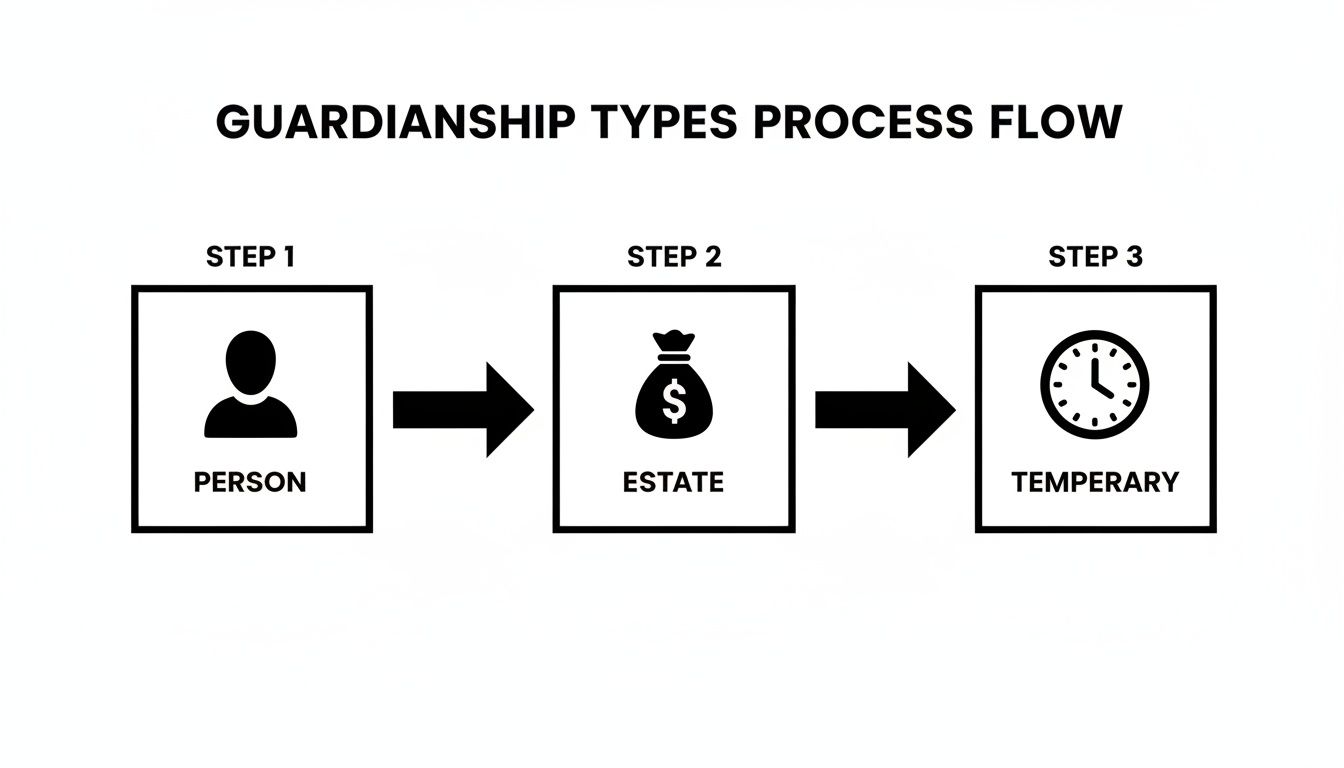
As you can see, the right path—whether it’s for the person, their estate, or a temporary need—is all about matching the legal tool to the specific kind of support your loved one requires.
Step 2: Filing the Application and Notifying Family
With all your information organized, it's time to begin the legal process. The next step is filing the formal Application for Appointment of Guardian with the proper Texas court. This document officially kicks off the legal process, telling the court who you are, who the proposed ward is, and why you believe a guardianship is in their best interest.
Once the application is filed, the court issues a citation. Think of this as a formal legal notice that must be delivered, or "served," to the proposed ward and all their close family members.
Service of citation is a non-negotiable step. The law demands it to make sure everyone with a legal interest in the case knows what's happening and has a chance to be heard. It’s all about protecting the rights of the proposed ward and ensuring fairness.
Failing to properly notify everyone is one of the most common reasons guardianship cases get delayed. This step is about transparency and upholding the legal rights of every person involved.
Step 3: The Court's Investigation and Your Hearing
After you've filed, the court takes an active role in protecting the proposed ward's rights. The judge will appoint two key, independent people to investigate the case:
- Court Investigator: This person visits the proposed ward to see their living situation and circumstances firsthand. They then file a detailed report with the court sharing what they found.
- Attorney Ad Litem: This is an attorney appointed specifically to represent the proposed ward. Their job is to be the voice for the ward's wishes and legal interests throughout the entire case.
Finally, the court will schedule a hearing. This is your day in court, where you’ll present your case to the judge. You need to be ready to answer questions about why the guardianship is needed and explain your plan for caring for the ward.
Being thoroughly prepared with accurate paperwork and a clear grasp of your responsibilities will show the judge you're ready for this role. For a deeper look at what it takes to be appointed, you can learn more about how to become a legal guardian in our detailed guide. It’s a journey of compassion, and having the right legal partner can make all the difference.
The Essential Supporting Paperwork You Cannot Overlook
Beyond the main application form, a strong guardianship case is built on a solid foundation of supporting legal guardian documents. Think of it this way: the application is like the frame of a house, but these supporting papers are the walls, roof, and windows that make it a safe, complete structure.
This paperwork gives the court the full picture. It shows not just why a guardian is needed, but why you are the right person for this critical, loving commitment. Taking the time to gather these documents shows the court you're serious and prepared, helping prevent frustrating delays so your loved one gets the protection they need.

Proving Your Fitness with a Criminal Background Check
One of the very first things you'll need is a comprehensive criminal history report. This is a non-negotiable requirement in Texas, and for good reason. The court's number one job is to protect the proposed ward, and this check is a straightforward way to confirm you have no history that would make you unsuitable for the role.
It might feel a bit invasive, but it’s a standard safeguard that everyone goes through. Submitting it upfront shows you're being transparent and helps build the court's trust right from the start.
Demonstrating Financial Stability for a Bond
In many cases, particularly those involving a "Guardianship of the Estate," the court will require you to secure a bond. A bond is essentially an insurance policy that protects the ward's assets from being mismanaged.
To qualify for this bond, you’ll need to provide financial information showing you're responsible and stable. This usually includes:
- A personal credit report.
- Information about your own assets and liabilities.
- Sometimes, bank statements or proof of income.
This isn’t about judging your wealth. It's simply about making sure you can be trusted to handle someone else’s finances with complete integrity.
Real-Life Scenario: Maria steps in to become the guardian for her 10-year-old nephew, David, after his parents can no longer care for him. David is set to inherit a small life insurance policy. To protect those funds for David’s future, the court requires Maria to secure a bond. By providing her financial documents, she shows the court she is a responsible choice to manage his inheritance until he turns 18.
The Home Study: A Picture of a Loving Environment
While it's more common in adoptions, a home study or a similar court-ordered investigation can be part of a guardianship case, too. This is where a social worker visits your home to make sure it's a safe, stable, and nurturing place for the ward.
The investigator will talk with you and other family members, take a look around your home, and write up a report for the judge. This report gives the court a real-world glimpse into the life you can offer. A positive report is a powerful piece of evidence that speaks directly to the best interests of the child or adult in need of care. With all the sensitive information gathered in these documents, strong cybersecurity for law firms is crucial to protect everyone's data.
These legal documents are the backbone of permanency for thousands of children and vulnerable adults. Providing a stable future through guardianship is a powerful act of love. You can explore more about how families achieve this in our guide, Texas Legal Guardianship.
Common Mistakes on Guardianship Documents and How to Avoid Them
The journey to protect a loved one through guardianship is an act of deep love. But simple mistakes on legal paperwork can cause frustrating delays and add emotional weight to an already stressful time. We get it—this process is new to most families. Our goal here isn't to worry you, but to give you the foresight to avoid common roadblocks.
Think of your legal guardian documents as a direct conversation with the court. If there are gaps or errors in what you submit, that conversation grinds to a halt. Let's walk through the most frequent missteps so you can keep your focus where it belongs: on your loved one, not on fixing paperwork.
Failing to Notify All Required Family Members
This is one of the most common and delay-inducing mistakes we see: failing to properly notify every legally required relative. The Texas Estates Code is crystal clear about who must receive a formal notice—called a "citation"—about the guardianship hearing. This list includes the proposed ward's spouse, parents, siblings, and adult children.
Forgetting even one person can stop the entire process cold. The court has a duty to protect everyone's due process rights, so it simply will not move forward until every required individual has been properly served notice.
How to Avoid This:
- Create a detailed family tree. Before you even think about filing, sit down and map out all living relatives who fall into those legally required categories.
- Track down accurate addresses. Do your homework to find current, correct contact information for everyone on that list.
- Document everything. Keep a log of how and when you tried to notify each person. This demonstrates to the court that you've acted in good faith.
Submitting an Incomplete Application
The Application for Appointment of Guardian is a lengthy document for a good reason—it gives the judge a complete snapshot of the situation. People often leave out key details like current addresses, a full financial picture for the proposed ward, or a complete list of all known relatives.
An incomplete application is like a puzzle with missing pieces. The court can't see the full picture and will almost always send it back, pushing your timeline back by weeks or even months.
An accurate and complete application is your first and best chance to show the court that you are organized, thorough, and ready to take on the responsibilities of guardianship.
Providing Insufficient Medical Evidence
For any adult guardianship, the entire case hinges on proving incapacity. The Physician's Certificate of Medical Examination is the absolute cornerstone of that proof. A frequent error is submitting a form that's too old (it has to be completed within 120 days of filing) or one that’s vague and lacks specific medical details about the person’s condition and limitations.
The doctor's statement must clearly and medically justify why the person can no longer make decisions for themselves. Without that strong, unambiguous evidence, the judge has no legal basis to grant the guardianship. Working with an experienced family law attorney from the start can help you sidestep these issues, ensuring your journey is as smooth as possible.
When You Need a Compassionate Legal Partner
You’ve already taken an incredible first step just by learning about the guardianship process. If the path ahead still feels winding or just plain overwhelming, please know you’re not alone in feeling that way. It’s completely normal. In fact, recognizing when to bring in a legal guide is often the most supportive and loving decision you can make for your family.

An attorney from The Law Office of Bryan Fagan, PLLC, does so much more than just file papers. Our role is to be your compassionate partner through it all. We make sure every one of your legal guardian documents is not just accurate but also tells a compelling story, all while fighting for your family’s best interests in court.
Having an experienced professional by your side brings a peace of mind that's hard to put a price on. Our mission is simple: to lift the legal burden from your shoulders so you can focus entirely on what truly matters—caring for your loved one.
Taking the Next Step with Confidence
Trying to navigate the legal system on your own can add a ton of unnecessary stress to an already emotional time. A dedicated attorney makes sure every detail is handled correctly, from notifying all the required family members to building the strongest possible case to present to the judge. We help you sidestep the common pitfalls that can delay the process, keeping the focus squarely on securing the protections your loved one needs.
At its heart, establishing guardianship is an act of profound love and responsibility. Having a legal advocate ensures that your love is translated into a legally sound plan that protects your loved one’s future and well-being.
As you consider this journey, it’s helpful to understand the different professionals who play a role in legal cases. For a closer look at how various specialists, including medico-legal experts, contribute their expertise, this guide offers some valuable insights.
Your Invitation to a No-Pressure Conversation
Every family's story is unique, and your legal strategy should be, too. We invite you to schedule a free, no-pressure consultation with our team. Let’s just sit down, talk through your situation, and figure out how we can help you take that next step with clarity and confidence.
Frequently Asked Questions About Texas Guardianship
Stepping into the world of guardianship often brings up a flood of questions. It's a path filled with hope, but also a lot of uncertainty—and that's completely normal. We've put together answers to some of the most common questions we hear to help bring some clarity to your journey.
How Long Does the Guardianship Process Take in Texas?
Every family's story is different, so the timeline can shift. But for a straightforward, uncontested guardianship where everyone is on the same page, you can generally expect the process to take about two to four months. This covers the time from filing the initial application all the way to the final court hearing.
If the situation becomes contested or tangled in complex issues, it will almost certainly take longer.
What Is the Main Difference Between Guardianship and Adoption?
This is a really important question, and the answer comes down to one key point: permanence.
Adoption is a permanent, irreversible act that legally terminates the biological parents' rights. It makes the child a full legal member of a new family. Guardianship, on the other hand, doesn't sever those parental rights. It grants a responsible adult the legal power to make crucial decisions for a child or incapacitated adult, but it’s often temporary—lasting until a child turns 18 or the adult no longer needs a guardian.
Think of guardianship as a strong legal shield, not a permanent change to the family tree.
What Are My Legal Duties After I Am Appointed Guardian?
Once a judge appoints you as a guardian, you take on a very serious legal and ethical role known as a fiduciary responsibility. In simple terms, this means you are legally required to always act in the best interests of the person you're caring for (the "ward").
Your specific duties will depend on the type of guardianship, but they usually include:
- Making decisions about their healthcare, education, and where they live.
- Managing their money and property responsibly (if you are the guardian of the estate).
- Filing an annual report with the court, giving an update on their well-being and a detailed accounting of their finances.
Can I Become a Guardian in Texas If I Live in Another State?
Yes, it's possible for an out-of-state resident to be appointed as a guardian in Texas. However, you should expect the court to take a very close look at the arrangement. You’ll need to prove that you have a solid, practical plan for providing consistent care and oversight from a distance and that it’s truly what’s best for the ward.
The need for legal guardianship is growing, not just here in Texas, but around the world. As communities work to protect their most vulnerable, guardianship orders are hitting record levels. In Scotland, for example, more than 20,000 people are now under welfare guardianship orders—a figure that shows the widespread need for protection for everyone from adults with learning disabilities to seniors with dementia. You can discover more insights about these global trends on mwcscot.org.uk.
No matter where you are in this process, you don’t have to figure it all out on your own. The compassionate team at The Law Office of Bryan Fagan, PLLC is here to answer your questions and provide the clear legal guidance you need. We invite you to schedule a free, no-obligation consultation to discuss your family’s situation and take the next step with confidence. Visit us online to get started.
