
You've already done the hardest part. Your child is home, the adoption is real, and the quiet pressure now shifts to paperwork, court records, and the small but important details that make Texas recognize what your family already knows.
In many homes, that's when the questions start. Can school enrollment wait until the birth certificate arrives? Does the name on the foreign decree match the name on the passport? If you came home on the wrong visa type for finalization, do you need to go back to court in Texas? Those questions are normal, and Texas has a legal path for answering them with clarity.
When Texas Families Need to Re-Adopt After an Intercountry Adoption
A family lands in Texas, bags half-unpacked, and the child is finally asleep in the room next door. Then the stack of documents comes out on the kitchen table, and the new worry is not love, it is logistics. School forms ask for a birth certificate. The pediatrician wants proof of parentage. The passport renewal packet needs names to line up exactly.
Re-adoption is the Texas recognition step that can turn an overseas adoption into a Texas-recognized record, which lets the State Registrar register the order and prepare a Texas certificate of birth for the child. For many families, that state-issued record is the document that makes everyday life easier and clearer.
Visa class is the first question
Texas families usually need to look at the child's visa classification first. Children who entered on IH-4 or IR-4 visas generally need finalization in Texas, while children who entered on IH-3 or IR-3 visas are already legally adopted under the home country's standards, though adoption professionals still often recommend re-adoption Texas international adoption overview.
Practical rule: if the visa says IH-4 or IR-4, do not assume the foreign decree is the end of the story for Texas purposes.
A simple way to sort it out is to look at what the visa leaves unfinished. If the child arrived with a visa that leaves final legal completion for a U.S. court, Texas re-adoption is usually part of the road home. If the child arrived with a visa that already reflects a completed adoption under the sending country's law, re-adoption is still often pursued so Texas records match the family's lived reality.
Why families still choose the Texas filing
Even when the foreign adoption was valid, Texas families often want a state birth record, a cleaner paper trail for travel and school, and clearer parent-child documentation for future matters like inheritance and benefits. Texas recognition also matters because it converts the overseas decree into enforceable Texas family law documentation, not just a symbolic file in a drawer. For the state's recognition framework, see Texas recognition of intercountry adoptions finalized abroad.
If you are looking at your packet right now, ask three things. What visa did the child use to enter the United States. Do I already have a Texas-recognized order. And does my family want the certainty of a Texas birth certificate? If the answer to that last question is yes, re-adoption is probably worth serious attention.
For families still in the planning stage, this can also connect to broader Texas adoption questions, including how intercountry adoptions fit into the state process. A helpful starting point is Can You Adopt a Child From Another Country While Living in Texas, especially if you are trying to understand how the international and Texas pieces fit together.
Pre-Filing Preparation for Texas Re-Adoption
Before anyone files a petition, Texas families need to make sure the case is ready for court. That means more than filling out forms. It means checking whether the child's entry status points toward finalization, confirming that the adoptive parents live in the county where the petition will be filed, and making sure the documents are current enough for a judge to rely on.
Start with the Texas basics
Texas adoption practice still turns on the core family-law steps found in Texas Family Code Chapters 162 through 166, even when the adoption began overseas. Families should expect to show that they have the right venue, the right supporting records, and the right proof that the adoption is in the child's best interest. If the case began with a difficult termination issue before the foreign placement, Termination of Parental Rights Before Adoption is the part of the process that explains why that step matters in most adoptions.
The practical pre-filing question is simple. Does this child need Texas finalization, or is the family asking Texas to recognize a completed foreign adoption and issue a Texas birth record? That answer usually turns on the visa class discussed above.
Build the file before you file
Texas families do themselves a favor when they collect the supporting paperwork before walking into court. That usually means a current home study or post-placement report if one is still required, background checks for the adoptive parents, and any pre-adoptive training the child's placement required. A judge does not want to see a family scrambling for basic pieces that should have been ready earlier.
A good readiness check looks like this:
- Residency proof: show the county where the petition belongs.
- Child's entry records: confirm the visa class and arrival documents.
- Home study or update: make sure it reflects the child in the home.
- Background checks: keep them current enough for the court's review.
- Training records: bring proof of required parent education if applicable.
The cleanest cases are the ones where the family checks the immigration piece and the Texas court piece at the same time.
That matters because paperwork can drift out of sync. A parent may have one date on an immigration form and another on a translated decree. An older child may have a name used at home that differs from the name on the foreign record. Sorting those details before filing can save weeks of delay and a lot of stress.
Talk through the emotional part too
Children, especially older children, can feel nervous about going back to court. Some think they are in trouble. Others fear they will lose the family they already have. A short, honest explanation helps. Tell them the court visit is about making the family record match the family itself.
If you're unsure whether the case is ready, a lawyer can review the packet before filing and help you avoid a filing that's likely to bounce back from the clerk or stall later in court.
Gathering the Foreign Decree, Translations, and Apostilles
The document packet is the heart of a Texas re-adoption case. If one paper is missing or one translation is sloppy, the court may not be able to move the case forward. Families often feel discouraged at this stage because the child is already home, yet the legal file still feels unfinished. That feeling is real, and it is usually fixed with careful organization, not panic.
What Texas courts want to see
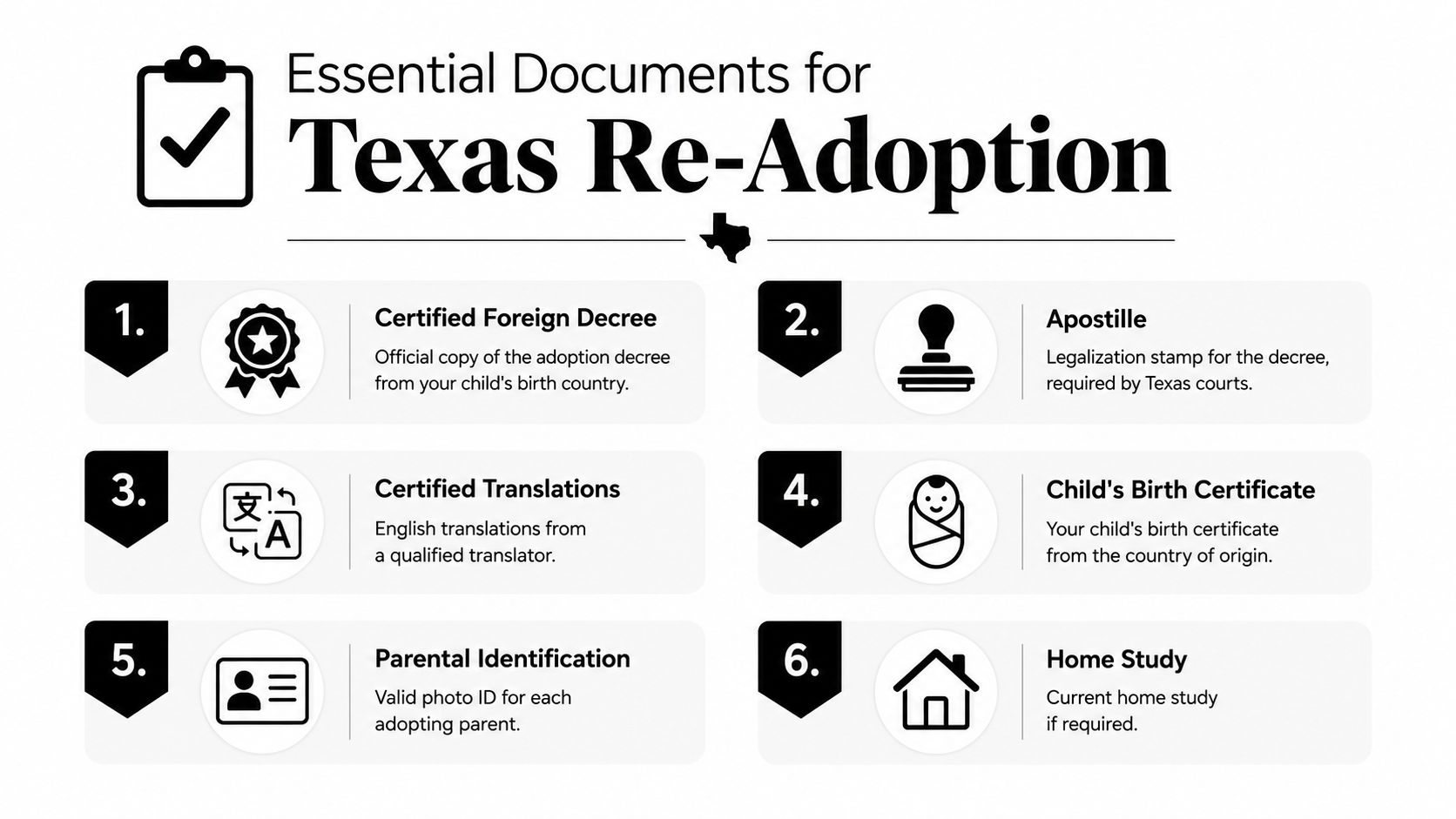
For foreign adoptions validated in Texas, the administrative rule requires a certified copy of the foreign adoption decree and English translations of the adoption materials presented to a Texas court of competent jurisdiction. The applicant is responsible for getting the documents translated, and once the court validates the adoption, an official certificate of adoption must be prepared and sent to the Vital Statistics Unit. In practice, the court needs the certified decree, the translation, and a way to confirm that the translated packet matches the foreign adoption order.
That means the court is looking for a certified decree, a full translation, and a clear paper trail that ties the translation back to the original foreign order.
Apostilles and authentication
Depending on the country, the foreign decree may also need an apostille or other authentication before Texas accepts it. In plain English, an apostille is a formal international authentication stamp that helps a Texas court trust that the foreign public document is genuine. Some families already have this in the dossier from the country process. Others need to request it from the home country or from the appropriate authority that issued the original adoption record.
If the decree is lost, the first move is to ask the foreign court, central authority, or adoption agency that handled the case whether a certified replacement can be issued. If the decree is in another language, do not rely on a friend's translation or an informal summary. The court needs the adoption materials translated accurately and completely.
A simple checklist can help:
- Certified decree: get the official foreign adoption order.
- Translation: obtain a full English translation from a qualified translator.
- Apostille or authentication: confirm whether the sending country requires it.
- Identity records: keep the child's birth certificate and visa records together.
- Updated Texas materials: include any current home study or post-placement paperwork.
- Matching names: verify that spellings are consistent across documents.
For families who want extra help organizing the file, a document-prep service can sometimes reduce the back-and-forth. One general resource families may find useful is approved experiences traveler document prep, especially when the challenge is getting a multi-country paper trail into one clean packet.
A Texas-focused overview of recognition filings is also available through streamlining the process of recognizing a foreign adoption order in Texas, which can help families see how the foreign decree becomes a Texas court matter.
Filing the Petition and Handling Service and Consent
Once the file is ready, the next step is the petition. In most cases, the petition belongs in the Texas county where the adoptive parents live. The filing asks the court to recognize the adoption, or to finalize it if the child entered on a visa that still requires Texas completion.
The document stack has to line up
A clean filing usually includes the foreign decree, certified translations, any apostille or authentication, proof of the child's visa classification, and the Texas petition itself. If a name change is part of the request, it should be included in the same filing when the court allows it, because the recognition process can be paired with a name change request.
The court also wants to know whether all necessary consents are already in place. If the biological parent is not part of the case, the question becomes how Texas law will handle notice and service. That issue can be simple in one case and delicate in the next.
Service can be straightforward, or it can be the hard part
If a parent has signed a waiver or relinquishment, the case moves more smoothly. If the parent lives overseas, cannot be found, or has already had rights addressed in the foreign process, the lawyer may need to review whether service by publication or another court-approved method is appropriate. The exact path depends on the facts, not on guesswork.
Practical rule: don't file first and figure out service later. Texas judges expect the notice problem to be handled with care from the start.
That matters because international cases often have one extra layer of confusion. The foreign decree may say one thing, the immigration packet may say another, and the Texas court still has to decide whether the consent and notice pieces are legally complete. A parent who assumes the foreign papers automatically solve service can end up with a continued hearing and more waiting.
Families also need to keep the visa route in view. An IH-3 or IR-3 child often arrives with a foreign adoption that Texas may recognize, while an IH-4 or IR-4 child may still need a Texas court order to finish the legal step that matches the immigration file. That difference matters because the paperwork has to tell the same story in both systems.
A courthouse habit that saves time
Families should stay in close contact with the district clerk's office and confirm filing requirements before they submit the petition. Clerk staff can tell you whether a document needs a copy, whether the county wants a particular cover sheet, and whether the fee payment method is acceptable. Those small details matter because a complete packet is easier to docket, and a docketed case is easier to move toward hearing.
The goal is to keep the court from stopping at a missing page or a notice problem that could have been solved before the filing went in.

A short video can also help families understand the rhythm of the filing process and what attorneys watch for before hearing day.
The Finalization Hearing and What Happens in Court
The courtroom part usually moves faster than families expect, yet it still carries a lot of feeling. After months of waiting, reviewing, translating, and checking names again and again, the judge finally decides whether the adoption should be recognized or completed in Texas. For many parents, that moment feels less like a legal step and more like the formal welcome home they have been hoping for.
What the judge will review
The judge will review the petition, the foreign decree, any consents or terminations, and the child's status in the United States. The court also looks at whether the adoption serves the best interest of the child, the standard that runs through Texas adoption law. A judge may ask why the family is seeking re-adoption, whether the child is doing well in the home, and whether the parents understand the order they are asking the court to sign.
If the child is older, the judge may ask simple questions directly to the child, especially if the child can understand the proceedings. The tone is calm and conversational, designed to help the child feel seen and heard rather than intimidated.
What to bring
Families should bring photo identification, the original or certified foreign decree, the child's visa information, and any home study or updated report the court asks to see. If the child's name will change, every spelling should line up on the petition and supporting papers. A mismatch in a middle name or surname can slow things down in ways that are easy to avoid.
The hearing itself may end with a few quiet signatures and a few relieved smiles. Once the judge signs, Texas issues the formal decree, and the official certificate of adoption goes to the Vital Statistics Unit so the birth record process can continue. Families often use a resource like this Texas adoption birth certificate guide to understand what that state record does after the court order is entered.
Families often remember the hearing not for the questions, but for the moment the court finally says the legal words that match the life they already live.
That moment matters because it turns a foreign adoption into a Texas court-recognized family record. From there, the paperwork can continue toward the Texas birth certificate and the practical tasks that follow.
Obtaining a Texas Birth Certificate and Understanding the Timeline and Cost
For many Texas families, this is the point where the court order starts to turn into a state record. After the decree is signed, the paper trail shifts from the courtroom to the Vital Statistics process, and the State Registrar prepares a new Texas certificate of birth only after receiving the resident adoptive parents' request, the official certificate of adoption, and the required fees. The official certificate of adoption is the court document that allows the state record to be created, which is why parents often treat it like the key that opens the next file in the stack.
What usually happens next
A parent submits the request for the new birth certificate, includes the court's official certificate of adoption, and pays the required vital records fee. Once those pieces are in place, the Registrar can prepare the new certificate of birth. Families often use that record for school enrollment, passport updates, and other everyday identity tasks that feel much easier when the paper trail is Texas-based.
A helpful overview of the certificate process is available through this Texas birth certificate guide for adoptive families, especially for parents who want to understand what the state record does and why it matters after the court order is entered.
A realistic timeline snapshot
The timeline depends on how complete the file is. Some service providers say the Texas re-adoption process can be finished in a short period once the required information is provided. Cases that need foreign document corrections, translations, or authentication can take longer, especially when a foreign authority has to reissue a record.
| Step | Typical Timeframe | Typical Cost Range |
|---|---|---|
| File and court review | Varies by county and document readiness | Court filing fee, if required |
| Translation and authentication | Depends on foreign document source | Translation and apostille-related costs |
| Hearing and decree entry | Often a single hearing once the file is complete | Attorney fee, if retained |
| Birth certificate request | After the official certificate of adoption is sent | Vital records fee |
The chart above is a planning tool, not a quote. Families should expect the biggest variables to be foreign paperwork, not the Texas hearing itself.
Cost comes from a few moving parts
The main cost categories are court filing fees, translation charges, authentication or apostille expenses, certified copies, and legal counsel if the family hires a lawyer. A clean file usually costs less in time and stress than a file that has to be fixed after filing. That is why many parents choose to slow down for a week and get the packet right the first time.
Some families also want support for the emotional side of the process, especially when the child has already lived through a major change in country, language, or caregivers. Resources such as therapy options for childhood trauma can be helpful while the legal paperwork is being finished, because the court file and the family's adjustment do not always move at the same pace.
Common Complications and How Texas Families Handle Them
Even careful families hit snags. Foreign adoptions are cross-border by nature, so the problems are often about paper, not parenting. A missing apostille, a translation that leaves out a key sentence, or a mismatch between the child's birth name and the name used later in the process can slow everything down. None of that means the adoption is failing, it just means the file needs repair.
The most common tripwires
One issue is a decree that is certified but not properly authenticated for Texas use. Another is a translation that looks readable but is not complete enough for court. Some families also discover that the home country's records and the U.S. immigration packet do not match exactly, which can happen when names were shortened, reordered, or translated differently.
The fix is usually document work, not litigation. Families may need to request a corrected record, obtain a new certified translation, or go back to the foreign authority for an apostille or replacement decree. If the court sees that the family is working in good faith and the problem is fixable, the process can still move forward.
When the case needs extra care
A family should slow down and get legal help if the child's visa classification is unclear, the foreign record conflicts with immigration paperwork, or the location of a biological parent is unknown. Cases involving prior finalization problems abroad also deserve careful review. In those situations, a court wants a coherent story backed by clean documents, not a stack of explanations that don't match.
That kind of review can happen through a consultation with a Texas family lawyer before the file is submitted. The Law Office of Bryan Fagan, PLLC handles adoption matters, including international and Texas court recognition work, so families can have one place to review the decree, the translation, and the petition before hearing day. Other parents want help from a counselor for the child's adjustment too, especially when adoption has layered grief or trauma in the background, and therapy options for childhood trauma can be a useful resource when a family is supporting healing alongside the legal process.
A calmer way to handle the hard parts
The best approach is to solve one mismatch at a time. Check the decree first, then the translation, then the visa record, then the Texas petition. Families often feel better when they stop trying to fix everything at once and instead work through the file in order.
The child's legal status matters, but so does the child's emotional safety. When adults stay calm, explain the process in simple words, and keep the court dates predictable, children usually do better with the transition.
If a document problem shows up, treat it like a paper problem first. Most of the time, that's exactly what it is.
If you're ready to turn a foreign adoption into a Texas-recognized record, the Law Office of Bryan Fagan, PLLC can review your documents, explain the court steps, and help you move toward the Texas birth certificate your family needs. Visit Law Office of Bryan Fagan, PLLC to schedule a free consultation and get guidance that fits your child's visa, your county, and your next step.
