
Thinking about adoption for your newborn is a profound act of love, and the first step is gathering information in a safe, judgment-free space. This is not about making a final decision right now. It's about empowering yourself with knowledge, understanding your options under Texas law, and realizing that you are in control of this process. At The Law Office of Bryan Fagan, PLLC, we believe that every family's journey is unique, and our goal is to provide you with the clarity and support you need.
Your First Steps in Considering Adoption for Your Baby
Making the call to explore adoption is a brave move, and you are not alone. This initial phase isn’t about commitment; it’s about education and self-reflection. The path forward begins with gentle, supportive steps that put your well-being first and help you understand all the choices available to you and your child.
For many birth parents, the simple act of talking to an adoption professional is the most empowering first step. It gives you a confidential space to ask tough questions, voice your fears, and share your hopes without any pressure. This isn't about being "sold" on adoption—it's about having an expert listen and provide real clarity on all your options, including parenting.
Creating a Personal Adoption Plan
A huge part of this early stage is learning what an adoption plan is. Think of it not as a binding contract, but as a roadmap that puts you in the driver’s seat. It’s a document you create that spells out your specific wishes for how the adoption will unfold.
This is your personal guide for the journey ahead. Your adoption plan can detail:
- The kind of adoptive family you imagine for your child. You get to specify preferences about their lifestyle, values, location, and even if they have other children.
- How much future contact you're comfortable with. This is where you can explore the real differences between open, semi-open, and closed adoptions and decide what feels right for you.
- Your wishes for the hospital experience. You decide who is in the delivery room, how much time you want to spend with your baby, and how the adoptive parents are involved.
This plan ensures your voice is heard and respected at every turn. It transforms a process that might feel overwhelming into a series of clear, manageable decisions that you control, always keeping the child's best interests at heart.
The entire purpose of an adoption plan is to honor your wishes and protect your comfort and dignity. It's a testament to your love and the careful thought you're putting into your baby’s future and your own well-being.
Finding the Right Support System
This is a deeply emotional journey, and you absolutely need the right support. Your support system might be a trusted family member, a close friend, a therapist, or an experienced adoption attorney. The key is to surround yourself with people who will support you unconditionally, no matter what you ultimately decide.
At The Law Office of Bryan Fagan, PLLC, our role is to provide that unwavering legal and emotional support. We offer a safe harbor where you can learn about the legal side of adoption in Texas, understand your rights under the Texas Family Code, and explore all your options with empathy. This first step is about finding peace of mind, knowing you have a dedicated advocate on your side from day one.
Understanding Your Adoption Choices in Texas
When you explore adoption for your newborn, you'll see that Texas law offers a few different paths. Each provides a unique level of support, communication, and control, letting you choose the approach that feels right. Getting familiar with these choices is the first real step in creating an adoption plan that honors your wishes and serves the best interests of the child.
The two main routes for placing a newborn for adoption are through a licensed agency or with the help of an attorney in a private adoption. There is no single “best” way—the right choice is personal and depends on the support you need.
Working with an Adoption Agency
Licensed adoption agencies offer a structured, all-in-one experience. They are often a great fit for a birth mother who wants comprehensive support from the beginning to long after the placement is complete.
An agency typically provides:
- Counseling and Emotional Support: You’ll be connected with a dedicated counselor to help you process your feelings and make decisions without pressure.
- Pre-Screened Adoptive Families: Agencies have a pool of hopeful adoptive parents who have already completed extensive background checks and home studies. You can look through their profiles to find a family that matches your vision for your child.
- Financial and Medical Coordination: They handle the logistics of arranging legally allowable financial assistance for pregnancy-related expenses.
- Post-Placement Communication: In an open adoption, the agency often acts as an intermediary, managing the exchange of letters, photos, and updates.
For example, a young woman feeling overwhelmed and without a strong support system might find the comprehensive guidance of an agency incredibly reassuring. It gives her one person to call for legal, emotional, and practical questions.
Attorney-Assisted and Private Adoptions
An attorney-assisted adoption, often called a private or independent adoption, offers a more direct, legally-focused path. This is a common choice when a birth mother has already identified a potential adoptive family—perhaps a trusted friend, a relative (kinship adoption), or someone she connected with personally.
In this situation, an adoption attorney is essential to ensure the process is handled legally and ethically from start to finish. The attorney's main job is to manage all the legal requirements under the Texas Family Code, from filing court documents to finalizing the termination of parental rights. While an attorney provides expert legal counsel, they don't typically offer the same level of emotional counseling or family-matching services you'd find at an agency.
This flowchart lays out the foundational steps you'll encounter, no matter which path you consider.
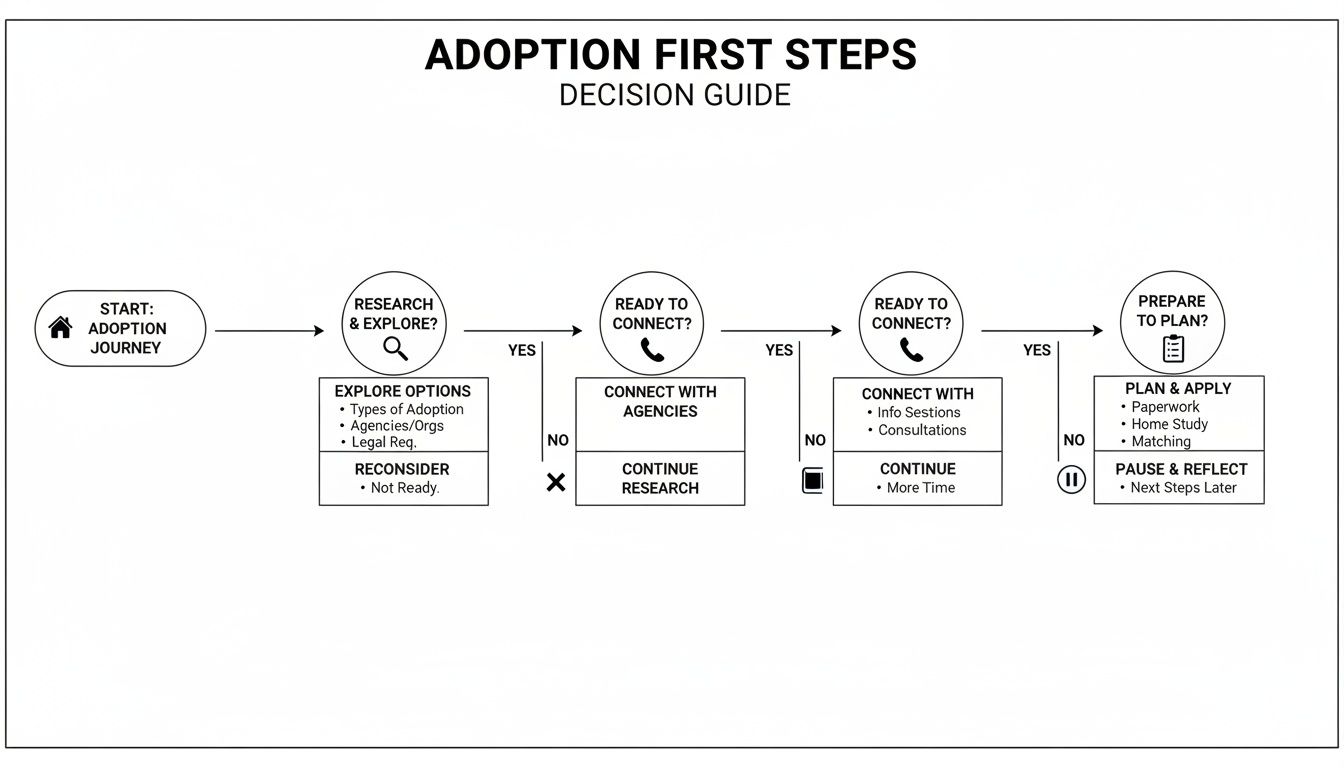
As you can see, every journey begins with learning your options, moves toward connecting with a professional you trust, and leads to creating a plan that feels right for you.
Making a Decision That Feels Right for You
Choosing between an agency and an attorney often boils down to what kind of relationship you want with the adoptive family and how much hands-on support you need. Some women feel more comfortable with the structure of an agency, while others prefer the direct communication possible in a private adoption.
The most important factor is your comfort. Whether you choose an agency or an attorney, you are entitled to compassionate, ethical, and knowledgeable guidance that puts your best interests—and the best interests of your child—first.
No matter which route you take, you will also need to think about the type of relationship you’d like to have after the adoption is finalized. Our guide to understanding the differences between open vs. closed adoption can bring a lot of clarity to what level of future contact feels right. At The Law Office of Bryan Fagan, PLLC, we are here to help you understand every option so you can make an informed and empowered decision.
Creating Your Personal Adoption and Hospital Plan
An adoption plan is much more than a document. It’s your voice, ensuring your wishes are heard and respected every step of the way. This is where you lay out your hopes for your baby’s future and your personal needs during the hospital stay. In a process that can feel overwhelming, this is how you maintain control and find peace of mind.

Putting this plan together is a thoughtful, empowering process. It’s about envisioning the life you want for your child and ensuring your own experience is as comfortable and dignified as possible.
Defining Your Hopes for Your Child
The first part of your adoption plan focuses on the big picture: the family who will raise your child. You have the right to look through profiles of hopeful adoptive families and choose the one that feels right.
This is a deeply personal decision. As you review profiles, you might think about:
- Family Structure: Do you picture your child growing up with a single parent, a same-sex couple, or a heterosexual couple? Would you like them to have siblings waiting for them?
- Lifestyle and Values: Are certain things important to you, like their religious beliefs, where they live, or their approach to education?
- Future Contact: How much openness are you comfortable with? This can range from getting letters and photos to having in-person visits.
Thinking through these details helps you connect with a family whose dreams for a child align with your own. It's a way to proactively build a future you can feel good about.
Many professionals can help you on this journey. As you weigh your options, you might want to learn more about what newborn adoption agencies in Texas can offer. They often specialize in matching birth mothers with pre-screened, loving families ready to welcome a child.
Designing Your Hospital Experience
The birth of your baby is a sacred and personal event. Your hospital plan ensures it happens on your terms. This plan clearly communicates your needs to the hospital staff, your support person, and the adoptive parents, which helps reduce confusion and stress during an emotional time. A great first step is learning how to create a birth plan that clearly outlines your medical and personal preferences.
Think of your hospital plan as your script for your time at the hospital.
A Checklist for Your Hospital Plan
To ensure everyone is on the same page, consider including details like:
- Who is in the delivery room? You decide if you want a friend, a family member, or the adoptive parents there with you.
- Time with your baby: How much time do you want to spend with your baby after birth? It's completely okay to specify that you'd like a few hours alone before the adoptive parents come in.
- Who holds the baby first? You can decide if you want to be the first to hold your baby or if you're okay with a nurse or one of the adoptive parents doing so.
- Naming the baby: Will you be the one to name the baby, or will you leave that to the adoptive family? Sometimes, this is a decision you can make together.
- Hospital interaction: How involved do you want the adoptive parents to be at the hospital? Should they have their own room or stay with you?
- Leaving the hospital: How do you want to handle being discharged? It is perfectly acceptable to say you'd prefer to leave separately from the adoptive family and the baby.
For instance, you might create a plan that says you’d like two hours alone with your baby after delivery before the adoptive parents visit. This is your right, and a clear plan makes it happen smoothly. An experienced adoption attorney can help you formalize this plan and advocate for your wishes, ensuring your hospital experience is as peaceful as possible.
Navigating the Legal Adoption Process in Texas
The legal side of adoption can feel intimidating, but remember that every law exists to protect you, your baby, and the adoptive family. The process in Texas is designed to be thoughtful and deliberate, giving you the time and space you need to feel completely sure of your decision.
The entire framework is laid out in the Texas Family Code, specifically Chapters 162-166, which ensures everything is handled with care and legal precision. The goal is simple: to create a permanent, stable, and loving home for the child. An experienced adoption attorney will be your most valuable guide, translating complex legal terms into plain English so you always feel confident and in control.
The Critical 48-Hour Waiting Period
One of the most important protections for a birth mother in Texas is the mandatory 48-hour waiting period. This is a non-negotiable state law: you cannot legally sign any documents to consent to the adoption until at least 48 hours have passed since your baby was born.
This isn’t just a formality. It’s a crucial safeguard built into the process to give you time to recover physically and emotionally from childbirth. It guarantees that your final decision is made with a clear mind, free from the immediate intensity of labor and delivery. This period is your time to breathe, reflect, and confirm your choice without any pressure.
Understanding Legal Consent and Relinquishment
Once the 48-hour period is over, the main legal step is signing a document known as an Affidavit of Relinquishment of Parental Rights. This is your formal, legal consent to the adoption. It’s a powerful document, and it’s vital to understand exactly what it means.
Once this affidavit is signed and witnessed correctly according to Texas law, it is irrevocable. This finality is intentional—it provides your child with the legal permanence and stability they need to bond with their new family and thrive.
Before you sign anything, your attorney will walk you through every single line of this document. They will make sure you understand that this step legally ends your parental rights, allowing the adoptive parents to become the child’s legal parents. For a deeper dive, you can read our guide on what a release of parental rights form involves and why it's so significant.
The table below breaks down these key legal moments so you can see how the process unfolds.
Key Legal Milestones in a Texas Newborn Adoption
| Milestone | When It Happens | What It Means for You |
|---|---|---|
| Birth of the Baby | At the hospital | This starts the clock on the legally required waiting period. |
| 48-Hour Waiting Period | The first 2 days after birth | You cannot sign any legal adoption paperwork. This time is protected for your physical and emotional recovery. |
| Signing the Affidavit | No sooner than 48 hours post-birth | You sign the legal document to voluntarily relinquish your parental rights, making the adoption legally possible. |
| Finalization Hearing | Typically 6+ months later | A judge reviews the case and issues a final decree of adoption, legally making the adoptive parents the child's parents. |
These steps are handled with care and precision by your legal team to ensure every detail is correct.
Addressing the Rights of the Birth Father
For an adoption to move forward, the birth father's parental rights must also be addressed legally and professionally. This can be a sensitive part of the journey, but your attorney will handle it with the utmost confidentiality and respect for everyone involved.
How this is managed depends entirely on the specific circumstances:
- If he is supportive, he can sign his own legal documents to consent to the adoption plan.
- If his identity or location is unknown, your attorney will take specific legal steps required by law to either notify him or have his rights terminated by the court.
- If he is uncooperative or contests the adoption, the law provides a clear path for the court to terminate his rights, ensuring the adoption can proceed in the child’s best interest.
Handling these legal requirements is the core of what an adoption attorney does. Their expertise ensures that every legal detail is handled correctly, protecting you while creating a secure legal foundation for your child's future.
Financial and Emotional Support for Birth Mothers
Making an adoption plan for your baby is a decision rooted in immense love. It’s a journey that requires strength, and you deserve to feel safe, cared for, and supported every step of the way. That support comes in two forms: financial assistance to lift the burdens of pregnancy, and emotional resources to help you process and heal.
It’s important to know that in Texas, this support is carefully regulated by state law. This ensures your decision is made from a place of love and careful thought, never from financial pressure.
Understanding Allowable Financial Assistance in Texas
The Texas Family Code allows adoptive parents to help with a birth mother's reasonable and necessary living expenses. This isn’t a payment for the adoption; it’s a compassionate way to ensure both you and your baby are healthy and secure during this critical time.
To keep everything ethical and transparent, this support is managed by an attorney or a licensed agency. Funds are paid directly for approved expenses, meaning you can focus on your health without the added stress of financial strain.
Allowable expenses often include:
- Medical Costs: Prenatal care, hospital bills, and other healthcare needs not covered by insurance.
- Housing: Help with rent or mortgage payments to maintain a stable home.
- Utilities: Assistance with essential household bills like electricity and water.
- Maternity Clothing: Ensuring you have comfortable clothing throughout your pregnancy.
- Transportation: Covering the costs of getting to and from doctor’s appointments.
Your Emotional Well-Being Comes First
The emotional side of adoption is profound. You might feel a mix of grief, relief, sadness, and peace all at once—and every single one of those feelings is valid. Access to professional, compassionate support isn’t a luxury; it's a vital part of a healthy adoption process.
Beyond the financial piece, it’s critical to have emotional support, including resources for understanding and managing postpartum depression, which can affect any new mother. Many adoption professionals offer free, confidential counseling for birth mothers—before, during, and long after placement.
Your emotional health is just as important as your physical health. Having a dedicated counselor or support group gives you a safe space to process your feelings and heal in your own time.
Sometimes, the most powerful support comes from connecting with other women who have made this same loving choice. Post-placement support groups, whether in-person or online, create a community of understanding where you can share your story without judgment. You are not alone on this journey.
For birth mothers and hopeful adoptive parents in Houston, Dallas, Austin, and San Antonio, this means there are many loving, pre-screened families and resources available. Your path is your own, but there is a community of support ready to walk it with you.
Your Questions About Newborn Adoption Answered
Thinking about adoption for your newborn brings up many questions, and that's completely normal. You deserve clear, honest answers to help you find your footing. We've gathered some of the most common questions we hear from birth mothers and hopeful families, providing straightforward answers grounded in Texas law to give you the clarity you need.
Can I Change My Mind After Placing My Baby for Adoption in Texas?
This is often the first and most important question a birth mother asks. In Texas, the legal document you sign to give up your parental rights is called an affidavit of relinquishment. Once you sign this paper, the decision is legally considered irrevocable.
The law is designed to protect you. You cannot sign this document until at least 48 hours after your child is born. This waiting period is non-negotiable and gives you crucial time to recover from childbirth and feel absolutely certain about your choice without any rush or pressure.
Once the affidavit is signed, your decision is final. This finality is essential for the child, giving them the permanent, stable foundation they need to bond securely with their new family. It’s vital to use the time before and during that 48-hour window to talk with your counselor and attorney to be completely sure of your choice.
Does the Birth Father Have to Agree to the Adoption?
Yes, the birth father's rights must be legally addressed before an adoption can be finalized. This can feel like a complicated issue, but an experienced adoption attorney knows how to handle this part of the process with confidentiality and care.
How it’s managed depends on your specific situation.
- He's on board: If he supports the adoption, he can sign his own legal documents to consent.
- His location or identity is unknown: Your attorney will take specific legal steps to terminate his parental rights, which might involve a public notice as required by state law.
- He is uncooperative or contests the adoption: Texas law provides a clear path for the court to address his rights and move forward with the child's best interests as the primary focus.
His consent isn't always required for you to start creating an adoption plan, but the law demands his potential rights be legally resolved. It’s a critical step to make sure the adoption is secure for everyone involved.
How Much Contact Can I Have with My Child After Adoption?
You have a real say in what future contact looks like. The amount of communication is worked out in your personal "open adoption" plan—an agreement you create with the adoptive family. The level of openness is a spectrum, and you get to decide what feels right for you.
Your options range from:
- Closed adoption: No identifying information is shared, and there is no contact after the adoption.
- Semi-open adoption: You might share letters, emails, and photos through your agency or attorney without sharing identifying details.
- Fully open adoption: This can include direct contact like phone calls, video chats, and even in-person visits.
Today, most adoptions have some level of openness because it’s widely seen as beneficial for the child’s sense of identity. As you look at profiles of hopeful adoptive families, you can share what you’re hoping for in terms of future contact. This agreement is built on mutual trust and respect, with the child’s best interests always at the heart of it.
Making the decision to explore adoption is a journey of love, courage, and careful thought. You don't have to walk this path alone. The compassionate attorneys at The Law Office of Bryan Fagan, PLLC are here to provide clear, supportive legal guidance every step of the way. If you have more questions or are ready to discuss your options in a confidential, no-pressure environment, we invite you to schedule a free consultation with our team. Let us help you find the best path forward for you and your child.
