
When you step in to raise a grandchild, you’re doing more than just helping out—you’re providing a lifeline of stability and love. You’ve already done the most important part: you showed up. Now, making that role official through adoption is the next critical step to give them the secure future they deserve.
The path forward involves filing a legal petition in a Texas court, addressing the rights of the biological parents, and completing a home study. It all leads to a final court hearing that can create the permanent, loving home your grandchild needs to heal and thrive. At The Law Office of Bryan Fagan, PLLC, we understand the heart behind this decision, and we're here to guide Texas families through the process with empathy and clarity.
Why Adopting Your Grandchild Is a Promise of Permanence
When a grandchild suddenly comes into your care, your first instinct is to create a safe harbor. But while temporary arrangements might solve the immediate crisis, they often don't offer the lasting security your grandchild needs to truly feel at home.
That’s where adoption comes in. It’s not just a piece of paper; it’s a promise of a forever family. It cements your role as the child’s legal parent, giving you the clear, undisputed authority to make every decision for their well-being and future.
The Big Difference: Adoption vs. Guardianship
Many grandparents in Texas find themselves with what's called a managing conservatorship. Think of it as a form of legal guardianship. It gives you the power to handle day-to-day decisions, which is an excellent first step for stabilizing a child's life.
The problem? It’s not permanent. The biological parents often keep some of their rights and could reappear years later to petition the court to regain custody. That lingering uncertainty can be incredibly stressful for both you and the child.
Kinship adoption is different. Governed by the Texas Family Code, it legally and permanently ends the biological parents' rights. It creates an entirely new parent-child relationship between you and your grandchild. This finality is the greatest gift you can offer a child who has already been through so much instability.
To help clarify the options, let's compare the two paths side-by-side.
Comparing Kinship Adoption vs Guardianship in Texas
This table breaks down the key legal differences between adopting your grandchild and becoming their guardian. Understanding these distinctions is crucial for choosing the path that best protects your family’s future.
| Legal Aspect | Kinship Adoption | Guardianship (Managing Conservatorship) |
|---|---|---|
| Permanence | Permanent and final. Creates a new, legal parent-child relationship that cannot be challenged later. | Temporary. The arrangement can be modified or ended if a biological parent petitions the court. |
| Parental Rights | Biological parents' rights are fully and irrevocably terminated. | Biological parents may retain certain rights, such as visitation or the right to regain custody. |
| Decision-Making | You gain sole legal authority for all decisions (medical, educational, etc.). No one else's consent is needed. | Your authority may be shared or limited. You might need court or parental consent for major decisions. |
| Inheritance | Your grandchild gains the same inheritance rights as a biological child. | Inheritance rights are not automatic and must be specified in a will. |
| New Birth Certificate | Yes, a new birth certificate is issued with your name(s) as the parent(s). | No, the original birth certificate remains unchanged. |
Ultimately, while guardianship serves an important purpose, only adoption provides the absolute security of knowing your grandchild is yours, forever.
Choosing adoption brings a sense of peace and closure, solidifying your family in the eyes of the law. You'll have:
- Total Legal Authority: You can enroll them in school, consent to surgery, and make religious decisions without asking anyone for permission.
- Emotional Security: Your grandchild gets the powerful message that they belong. This is a cornerstone for their emotional well-being and sense of family unity.
- Inheritance Rights: They are legally your child and will have the same rights to inherit from you as any biological child would.
- A Fresh Start: Finalizing the adoption means you can get a new birth certificate with your name on it, officially marking a new beginning for your family.
The legal security of adoption creates the foundation your grandchild needs to heal, grow, and develop the essential skills kids need for the future.
A Quick Look at the Journey Ahead
The road to adopting your grandchild might seem complicated, but it’s a structured legal process with one clear goal: protecting the best interest of the child.
It all starts with establishing your legal right—what we call "standing"—to even file the case. Usually, this is because the child has already been living with you for at least six months. From there, the process moves through terminating parental rights, completing a home study to showcase your loving home, and finally, attending the court hearing that makes it all official.
This guide is here to walk you through each phase, one step at a time. You're not just a number in a case file; you're a family. And you don’t have to do this alone. The Law Office of Bryan Fagan, PLLC, is ready to offer the compassionate, experienced legal guidance you need to build that secure future for the child you love.
Starting the Texas Adoption Process
Taking that first legal step to adopt your grandchild can feel like staring up at a mountain. But it’s a climb you don’t have to make alone. The Texas legal system has a specific path for relatives like you, and it’s all centered on one thing: giving your grandchild the stable, loving home they deserve. It all begins with confirming your legal right to file the case and then formally asking the court to get the ball rolling.
Do You Have Standing to File?
Before any Texas court will hear your case, you need to have what the law calls “standing.” It’s a legal term, but the idea is simple: you must have a significant enough connection to the child to have the right to file a lawsuit about them. For most grandparents, this is actually the most straightforward part.
Under the Texas Family Code, you automatically have standing if your grandchild has lived with you for at least the last six months before you file the case. If you've been their primary caregiver for that long, the law recognizes that you have a fundamental stake in their future and gives you the green light to ask a court to make that relationship permanent.
This six-month rule isn't arbitrary. It’s designed to show the judge that you’ve already established a stable, nurturing home for the child—that you’re not just a distant relative, but the one they count on every single day.
Filing the Initial Petition
Once you’ve confirmed you have standing, the next move is to file an Original Petition in a Suit Affecting the Parent-Child Relationship, or SAPCR. It’s a long legal name, but this is the official document that kicks off the adoption process.
This single petition actually accomplishes two critical goals at once:
- It asks the court to formally terminate the biological parents' rights.
- It simultaneously asks the court to grant the adoption, making you the child's legal parent.
Think of the SAPCR as the opening chapter of your family’s story for the court. It explains who you are, your connection to your grandchild, and lays out the powerful reasons why this adoption is in their absolute best interest.
The journey from temporary care to the permanence of adoption is a structured one, as this flowchart shows.
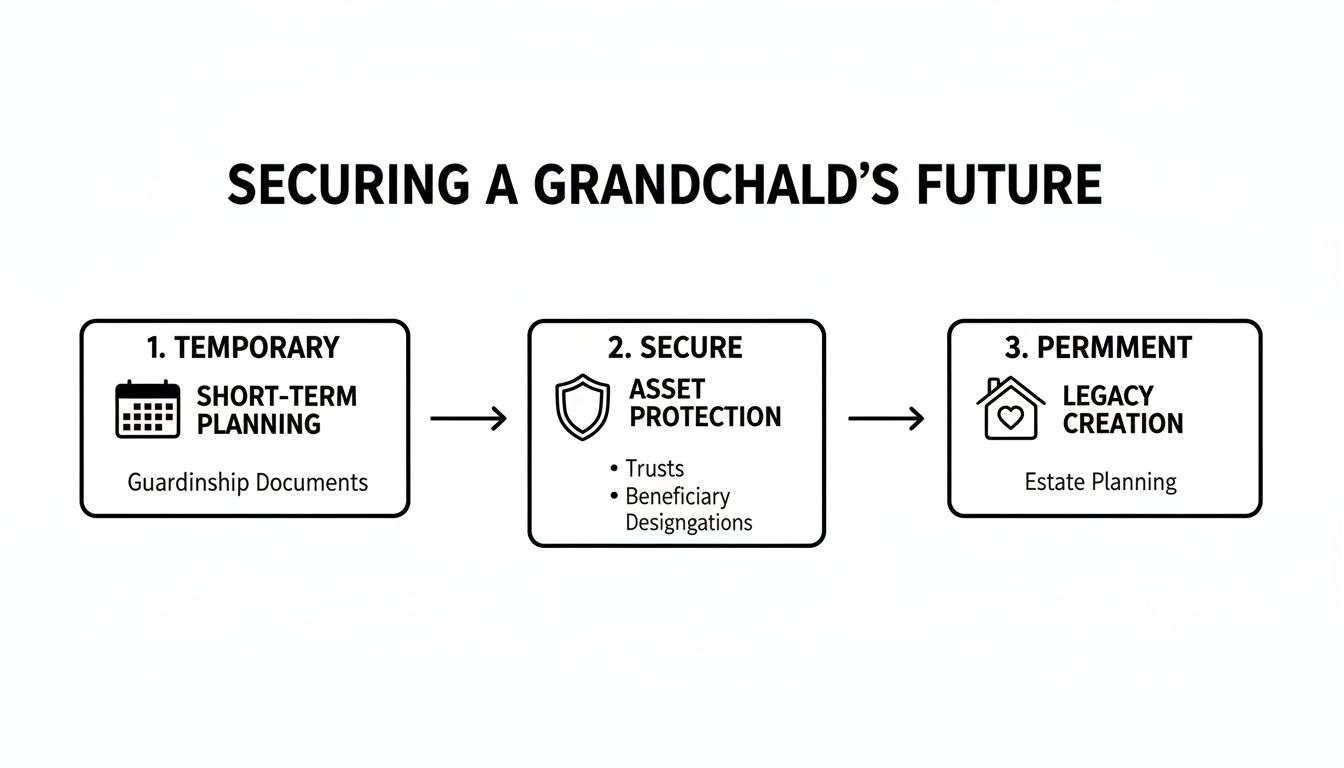
As you can see, the process is designed to move your grandchild from a temporary situation toward a secure, permanent future with you.
Gathering Your Essential Documents
Getting the petition filed correctly from the very start is crucial. A single missing piece of information can cause frustrating delays, adding stress when you need it least. You and your attorney will need to pull together a few key documents to build a strong foundation for your case.
As attorneys, we always tell our clients that gathering your paperwork upfront is one of the most powerful things you can do. It shows the court you’re organized and serious, and it helps your legal team build the strongest case possible right out of the gate.
Having these items ready to go will make the initial filing much smoother:
- Child’s Birth Certificate: The official document that confirms their identity and lists the biological parents.
- Information on Biological Parents: You’ll need their full names and last known addresses. The law requires that they be properly notified of the lawsuit.
- Your Personal Information: This includes your full name, current address, and date of birth.
- Proof of Residence: Any documents showing your grandchild has lived with you—like school records, immunization charts, or letters from doctors—can be incredibly helpful.
When you prepare these documents ahead of time, your attorney can file a complete and accurate petition that sets a professional, positive tone for the entire case. For a deeper dive into the specific requirements and what comes next, be sure to check out our complete guide to kinship adoption in Texas.
Starting the adoption process is more than a legal action; it's a powerful act of love that tells your grandchild they are home for good. With the right support, you can take these first steps with confidence, knowing you’re on the path to giving them the permanent, secure family they deserve.
Handling Parental Rights with Compassion and Clarity
Let's be honest—this is often the hardest part of the journey. Addressing the biological parents' rights is the most emotionally complex step in adopting your grandchild. It requires a delicate touch, combining legal precision with a whole lot of heart, all while keeping your grandchild’s needs front and center.
Texas law lays out two main paths: one where a parent agrees to the adoption, and another where the court has to step in to protect the child.
Navigating this is tough, especially when it involves your own child or their former partner. Just remember, the law has one primary goal: creating a safe, permanent, and loving home for a child who desperately needs one. Your role here is to be their champion.
The Path of Voluntary Relinquishment
In many kinship adoptions, the biological parent knows they aren't in a position to provide the care their child needs. In these moments, they can choose to voluntarily give up their parental rights. This is a profound act of love, allowing the entire family to move forward with a sense of peace and cooperation.
The process involves the parent signing a legal document called an Affidavit of Relinquishment of Parental Rights. This is a sworn statement, signed after the child is born, that formally states their intent to give up their rights so you can proceed with the adoption.
It is absolutely critical that this affidavit is handled with legal precision. A parent's consent must be given freely, without any pressure or coercion. Having an experienced adoption attorney oversee this ensures the document is ironclad, protecting the finality of your adoption for years to come.
Once signed, this affidavit is filed with the court. It serves as powerful evidence to the judge that the parent supports your adoption and believes it's what's best for their child.
When Involuntary Termination Is Necessary
Sometimes, a parent is unwilling to consent, unable to be found, or simply not in a place to make a healthy decision for their child. In these heartbreaking situations, you have to ask the court to intervene and terminate their parental rights. This is called an involuntary termination, and Texas courts do not take this step lightly.
To succeed, you must prove two things to a judge with “clear and convincing evidence”—a very high legal standard.
First, you have to prove the parent committed at least one of the acts listed in the Texas Family Code § 161.001. These grounds are incredibly specific and designed to protect children from harm. In grandparent adoptions, the most common grounds we see are:
- Endangerment: Knowingly placing the child in conditions or allowing them to remain in surroundings that endanger their physical or emotional well-being.
- Abandonment: Leaving the child in your care without providing adequate support and showing an intent not to return.
- Neglect: Failing to give the child the food, clothing, shelter, or medical care they need to thrive.
- Imprisonment: Being incarcerated for a length of time that significantly impacts their ability to be a parent.
Second, you have to prove that terminating the parent's rights is in the child’s best interest. This is the single most important factor for any judge. You will show the court how you provide stability, unconditional love, and a safe home—and, most importantly, how your grandchild is thriving under your care.
The legal fight for involuntary termination can be complex and emotionally draining. You can find a more detailed breakdown in our resources on the termination of parental rights in Texas. Having a compassionate attorney to handle the legal filings, serve the parent with proper notice, and argue your case in court is essential. It frees you up to focus on what really matters: caring for your grandchild.
Preparing for Your Adoption Home Study

The phrase “home study” sounds intimidating, doesn't it? It can conjure up images of a stranger with a clipboard, inspecting every nook and cranny of your house. But here in Texas, the process is officially called a social study, and for grandparents adopting their grandchild, it’s a whole different ballgame.
Think of it less as an inspection and more as your opportunity to shine. This is your chance to show a court-appointed professional what you already know to be true: that you provide a safe, stable, and deeply loving home for your grandchild.
The good news is that for a kinship adoption, the social study is often much more straightforward. The law recognizes the powerful, pre-existing bond you share. The evaluator’s main goal is simply to document the wonderful environment you’ve already created.
What the Evaluator Looks For
The person who conducts the social study isn’t there to find fault. They are a neutral third party—usually a social worker or another qualified professional appointed by the court—tasked with giving the judge a clear picture of your life. They aren't looking for a perfect home, just a suitable and caring one.
Their report will focus on a few key areas:
- Home Safety and Stability: Is the home a safe place for a child? This covers the basics, like having smoke detectors and making sure the space is clean and free of obvious hazards.
- Financial Stability: Can you support the child financially? This doesn't mean you need to be wealthy. The evaluator just wants to see that you have a stable income and a budget to cover your grandchild's needs.
- Physical and Emotional Health: Are you physically and emotionally up to the task of raising a child to adulthood? Be ready to have a frank discussion about your own health and the support system you have in place.
- Understanding of the Child's Needs: The evaluator will want to see that you understand your grandchild's unique history and personality. This includes any special emotional or physical needs they might have because of what they've been through.
Preparing for Your Interviews and Home Visit
The social study usually includes at least one visit to your home and interviews with you, your grandchild (if they’re old enough to talk), and sometimes other people living in the house. Your best tools during this process are honesty and openness. This is the time to speak from the heart about your love for your grandchild and your unwavering commitment to their future.
The most successful home studies happen when grandparents are simply themselves. Be prepared to share your family's story—the challenges and the triumphs. This authenticity demonstrates your strength and your deep connection to the child you’re working so hard to protect.
To make the process as smooth as possible, it really helps to get your documents in order ahead of time. Having your papers organized shows the evaluator that you’re serious and prepared. To help with this, our firm has put together a detailed adoption home study checklist that can walk you through exactly what you’ll need.
Key Documents to Have Ready:
- Financial Records: Things like recent pay stubs, tax returns, and bank statements.
- Personal Identification: Driver's licenses and birth certificates for yourself and any other adults in the home.
- Medical Statements: Simple letters from your doctors confirming you are in good physical and mental health.
- Criminal Background Check Information: You will be required to complete a background check, so be ready to provide any necessary information.
Remember, the evaluator is not there to judge you. They are there to advocate for the best interests of your grandchild. By being open, organized, and honest, you can confidently show them that the best place for your grandchild is right where they are: at home, with you.
Finalizing Your Adoption in Court

You’ve navigated the tough parts—the emotional hurdles of terminating parental rights and the detailed process of the social study. Now you’ve reached the final, and most rewarding, part of the journey. The final hearing isn't another legal battle; it’s a celebration.
This is the day all your love, effort, and commitment are officially recognized by the court. It’s the moment your grandchild legally and forever becomes your child.
For most of the families we work with, this hearing is a genuinely joyous occasion. It’s often filled with supportive family and friends. The judge’s role is simply to confirm that everything is in order and that this adoption is truly in the child's best interest. It’s a day to finally mark the beginning of a secure new chapter.
Understanding the Post-Placement Period
Before you can get that final hearing on the calendar, Texas law requires a specific waiting period. After the social study is done and parental rights are terminated, the law mandates what’s known as a post-placement evaluation period. This period is typically six months.
During these months, the same evaluator who did your social study conducts follow-up visits to see how everyone is adjusting. Their goal is to write a final report for the judge confirming your grandchild is thriving in your home.
But for grandparents, this is often just a formality. Your grandchild has likely been living with you for a long time—often much longer than six months. Because of this, your attorney can petition the court to waive this requirement entirely. In most kinship adoptions, judges agree to waive the post-placement period, which lets you move straight to the final hearing much sooner.
The Day of the Final Hearing
The final hearing itself is usually quite brief and positive. Your attorney will present the final paperwork to the judge, including the thumbs-up from the social study and the order terminating parental rights. The judge will review the file and then likely ask you a few simple questions while you're under oath.
These questions are designed to confirm your intent and that you understand the lifelong commitment you’re making. You can expect to be asked things like:
- Do you understand that this adoption creates a permanent parent-child relationship, just as if the child were born to you?
- Do you promise to provide for this child’s physical, emotional, and financial needs for the rest of their childhood?
- Do you truly believe this adoption is in your grandchild’s best interest?
Your heartfelt “yes” to these questions is the last piece of the legal puzzle.
The moment the judge signs the Final Decree of Adoption is one of the most powerful experiences in our work. It’s the culmination of a family’s fight for stability, and it represents the law officially recognizing the love and commitment that was there all along.
Once you’ve answered the questions, the judge will sign the Final Decree of Adoption. This is the official document that makes you the parent. At this point, many judges will invite you and your family up for a photo to celebrate the special day. It’s a moment of pure joy and relief.
Next Steps After the Decree
With the signed decree in your hands, the legal process is complete. Your attorney will then help you with the final administrative task: getting a new birth certificate for your child.
This new certificate will list you as the parent, officially replacing the original one. It’s a powerful, tangible symbol of your new family structure.
You did it. You’ve given your grandchild the ultimate gift of security and permanence. Now, you can take a deep breath and focus on what really matters—enjoying your life together as a legally recognized family.
Common Questions About Adopting a Grandchild in Texas
As you start thinking about adopting your grandchild, the legal steps are only part of the picture. It's the practical questions—the ones about time, money, and the unique hurdles you might face—that often keep you up at night. We get it. To help you move forward with confidence, we've pulled back the curtain on the most common questions our firm hears from grandparents who are right where you are now.
How Much Does It Really Cost to Adopt a Grandchild?
Let's get right to it: the cost. This is usually the first thing on every grandparent’s mind. The good news is that a kinship adoption is almost always much less expensive than a private infant or international adoption.
You won’t be dealing with hefty agency fees, advertising costs, or covering a birth mother's living and medical expenses. For a grandparent adoption, the costs are much more direct:
- Attorney Fees: This will be your main investment. It covers your legal team’s work in drafting and filing all the necessary court documents, handling the termination of parental rights, and representing you in front of the judge.
- Court Filing Fees: Every Texas county charges a standard fee just to open a new case in court.
- Social Study Fee: The court will appoint a neutral evaluator to conduct the home study. Their fee is typically paid by the person seeking the adoption.
- Service Fees: If a biological parent needs to be formally served with the lawsuit, there’s a small fee paid to a constable or private process server to deliver the papers.
The biggest factor that sways the total cost? Whether or not the adoption is contested. When both biological parents are on board and consent to the adoption, the path is much smoother and more affordable. If one or both parents decide to fight the termination of their rights, the costs will naturally go up to cover the extra legal work, like discovery and a potential trial.
How Long Does a Grandparent Adoption Usually Take?
The timeline for adopting your grandchild can vary quite a bit, but a solid estimate for an uncontested case is somewhere between six to twelve months. Once again, the biggest variable is whether the biological parents are cooperative.
The fastest adoptions are those where a parent voluntarily signs the affidavit of relinquishment early in the process. This single act can dramatically shorten the timeline, allowing your case to move smoothly toward the final hearing.
Here’s a quick look at what can speed things up or slow them down:
- Cooperation is Key: An uncontested adoption where everyone agrees is always faster. A contested case means more legal prep and court dates, which stretches out the timeline.
- Finding the Parents: What if one of the biological parents has vanished? Your attorney will need to perform a diligent search to find them, which can take several months. In some cases, the court may even need to appoint a special attorney (an "ad litem") to represent the missing parent's interests.
- The Court’s Schedule: Sometimes, delays are simply due to a busy court docket in your county.
It’s natural to feel anxious to get it all finalized, but remember that every step is in place to make sure the adoption is legally sound and can never be challenged.
What If I Can’t Find One of the Biological Parents?
This happens more often than you might think. It's not uncommon for one parent to be completely out of the picture, with no known address or phone number. Don't worry—the law has a clear process for this exact situation.
First, your attorney is required to conduct and document a diligent search to locate the missing parent. This isn't just a quick Google search; it involves checking public records, using online databases, and following up on any known leads.
If that search comes up empty, the court will appoint an attorney ad litem. This is a neutral lawyer whose only job is to try and find the missing parent and protect their interests. If the ad litem's independent search is also unsuccessful, they'll report back to the judge. From there, the case can move forward by serving notice through a public posting or newspaper publication. This allows you to proceed with terminating that parent's rights and completing the adoption for your grandchild.
The road to adopting your grandchild is filled with personal questions and unique challenges, but you don’t have to walk it alone. The compassionate attorneys at The Law Office of Bryan Fagan, PLLC are here to give you the clarity and legal guidance your family deserves. We understand the heart behind your decision and are ready to help you build that secure, loving, and permanent home. Schedule a free, confidential consultation with us today to talk about your family’s future and take the first step toward building your family.
