
If you're starting the adoption process, the first question on your mind is probably, "How long is this going to take?" There's no single, simple answer, but in Texas, the journey to build your family can last anywhere from a few months to well over two years. The biggest factor influencing that timeline is the type of adoption you pursue—whether it's a stepparent, private infant, or foster care adoption—along with the unique details of your family and the child you hope to welcome home.
Your Texas Adoption Journey: What to Expect
Starting the adoption process is a huge step, driven by love and hope. While it’s an emotional journey, understanding the practical timeline can bring a welcome sense of clarity. Each type of adoption follows its own legal path, guided by the Texas Family Code (specifically Chapters 162-166), and that legal road map directly shapes how long everything will take.
A stepparent adoption, for example, often moves relatively quickly since a family bond is already in place. Many can be finalized in under a year. On the other hand, adopting a child from foster care usually involves more complex legal hurdles, like the termination of biological parental rights, which can stretch the timeline out considerably.
To give you a clearer picture, here's a quick look at the typical timeframes for the most common types of adoption in Texas.
Estimated Adoption Timelines in Texas by Type
| Type of Adoption | Typical Timeframe | Key Factors |
|---|---|---|
| Stepparent Adoption | 3-12 months | Consent of the other biological parent, court schedules. |
| Kinship/Relative Adoption | 6-18 months | Termination of parental rights, home study completion. |
| Foster/CPS Adoption | 1-2+ years | Termination of parental rights, post-placement supervision. |
| Private Infant Adoption | 1-2+ years | Matching with a birth mother, home study approval. |
| International Adoption | 1-3+ years | Country-specific laws, U.S. immigration processes. |
| Adult Adoption | 2-4 months | Mutual consent, straightforward legal filings. |
This table offers a snapshot, but remember that every family's journey is unique. Factors like legal complexities or waiting for a match can either speed things up or slow them down.
Timelines for Common Texas Adoption Types
The path you choose really sets the pace. For private infant adoptions, the timeline often hinges on the matching process with a birth mother. International adoptions add another layer of complexity, as you'll be navigating the laws of two different countries at once.
The most important thing to remember is that every single step is designed with one goal: to protect the best interests of the child. Patience isn't just a virtue here; it's a critical part of building a stable, loving foundation for your new family.
To help you visualize how these different paths compare, the timeline below gives a general overview of what to expect for some of the most common adoption types.
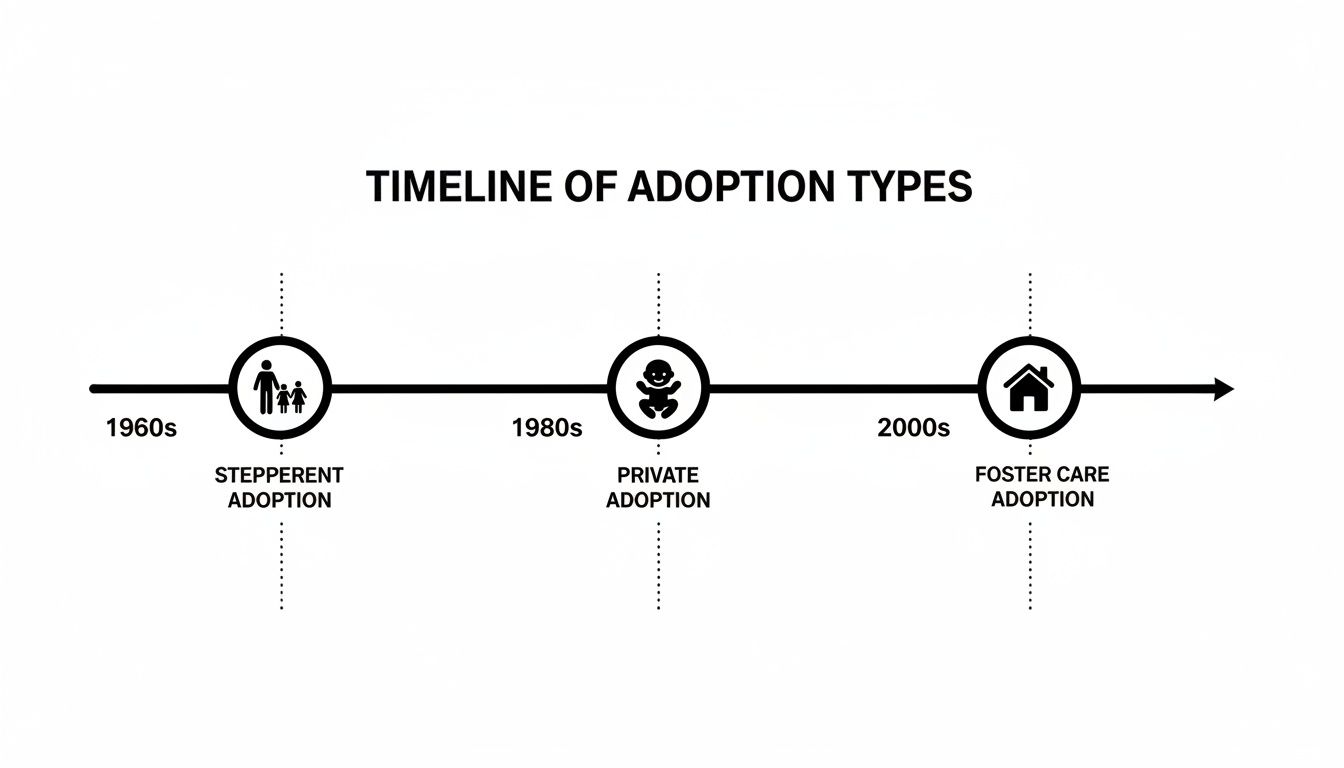
As you can see, stepparent adoptions tend to be the quickest route. Foster care adoptions, due to all the legal safeguards involved, often take the longest. But no matter which path you take, every day that passes is one step closer to growing your family.
The Timeline for Adopting from Foster Care
Choosing to adopt from the foster care system is a truly profound act of love. You're offering a permanent, stable home to a child who desperately needs one. This path, however, often comes with the longest and most winding timeline, typically taking anywhere from 18 to 36 months in Texas.
Why so long? It's simple: every single step is meticulously designed to protect the child's well-being and legal rights for the rest of their life. This isn't just about bringing a child home; it's about making sure that home is forever.
Unlike private adoptions where a birth parent voluntarily consents, foster care adoptions almost always involve a legal process called the termination of parental rights (TPR). This is a court-ordered process that permanently ends the legal relationship between a child and their biological parents. It has to be completed before any adoption can be finalized. This step alone can add months, sometimes years, to the process because it's guided by the strict standards of the Texas Family Code to ensure every decision is truly in the best interest of the child.
Why Foster Care Adoption Takes Longer
The timeline for a foster care adoption is layered with necessary safeguards. Child Protective Services (CPS) oversees the entire process, first working to reunify children with their birth families. Only when that isn't possible does the focus shift to finding them a permanent adoptive home.
Each stage has its own unique timeline, and the clock doesn't start and stop neatly.
- Parent Training and Home Study: Before you can even be considered, you have to complete state-mandated training and a comprehensive home study. This foundational step can take several months right off the bat.
- Matching and Placement: Once you’re licensed, the wait for a match can vary dramatically. It all depends on your family's preferences and, more importantly, the specific needs of children waiting in the system.
- Post-Placement Supervision: After a child is placed in your home, there's a mandatory waiting period of at least six months. During this time, a caseworker will visit regularly to make sure everyone is adjusting well. You can get a closer look at these requirements in our detailed guide on adopting from foster care in Texas.
- Finalization: The final court hearing is the last step that makes the adoption official and legally binding.
This entire journey is shaped by legal hurdles and investigative steps designed to ensure child safety above all else. Nationally, the foster care adoption process spans 18 to 36 months, a timeframe that reflects real-world challenges like court backlogs and strained resources. At the end of the last fiscal year, a staggering 70,418 children in the U.S. were still waiting for their forever families. To see the full picture, you can discover more insights about these statistics from the National Council For Adoption.
Imagine a couple, Sarah and Tom, who decided to adopt a sibling pair from foster care. Their journey began with months of paperwork and training. After their home study was approved, they waited another six months before being matched with two wonderful children. The next year was filled with caseworker visits, court dates for the TPR hearing, and the slow, beautiful process of becoming a family. Their adoption was finalized just over two years after they first called an agency—a long road, but one that led them to their children.
The Private Infant Adoption Timeline
For many hopeful parents, the dream of adopting a newborn is a powerful calling. The path of private domestic infant adoption is a direct way to build your family, but it’s a journey that demands patience, emotional readiness, and solid legal guidance. In Texas, you can typically expect this process to take between 9 and 18 months from start to finish.
Unlike adopting from foster care, this timeline isn't dictated by court schedules for terminating parental rights. Instead, its pace is set by a series of deeply personal and procedural steps. It's all about creating a stable, loving, and legally secure family, which requires a delicate balance of preparation, waiting, and, finally, connection.

Key Stages of the Private Adoption Journey
The timeline for a private infant adoption breaks down into several distinct phases. Each stage comes with its own set of emotional and practical hurdles, and moving through them thoughtfully is the key to a smooth process.
Home Study and Preparation (2-4 months): This is where it all begins. Think of it as the foundation of your adoption. It involves extensive paperwork, background checks, interviews, and a home visit to ensure you can provide a safe and nurturing environment. During this time, you'll also create your family profile book—a beautiful, personal introduction that helps expectant mothers get to know you.
The Matching Process (1-12+ months): Here’s where the timeline can really vary. The "wait" is the time between finishing your home study and being chosen by an expectant birth mother. This period can be short, or it can be long, and it's often the part of the journey that tests your patience and faith the most.
Placement and Legal Consents (Days to Weeks): Once a baby is born and the birth mother is ready, things move quickly. Under the Texas Family Code, a birth mother cannot sign the irrevocable affidavit of relinquishment—the legal document that terminates her parental rights—until at least 48 hours after the birth. This waiting period is a critical protection, ensuring her decision is made with a clear mind and without pressure.
Domestic private adoptions, which accounted for over 31% of all non-stepparent adoptions in the U.S. in 2021, are built on this careful legal framework. The entire process is designed to protect everyone involved—the child, the birth parents, and you, the adoptive family.
The emotional heart of a private adoption is the relationship built on trust and respect between adoptive parents and the birth mother. It's a journey you take together, centered entirely on what is best for the child.
Post-Placement and Finalization
After your baby comes home, the final phase begins. In Texas, there's a mandatory post-placement supervision period that typically lasts about six months. A social worker will visit your home a few times to check on the baby’s well-being and see how your family is adjusting.
Once these visits are successfully completed, your adoption attorney will file a petition to finalize the adoption in court. This final hearing is usually a joyous and brief celebration that officially makes your child a legal and permanent member of your family. If you're considering this path, you can explore more details in our guide to infant adoption in Texas.
Timelines for Stepparent and Kinship Adoptions
When a family bond already exists, the legal side of adoption is really about making it official—formalizing what everyone in the family already feels in their hearts. That's why stepparent and kinship adoptions are often the quickest paths to making a family whole, usually taking about 6 to 12 months here in Texas.
These journeys aren't about finding a child; they're about legally securing a child’s place within a family that already loves and cares for them. The focus is on stability and security, ensuring the child has all the rights and benefits that come with a legal parent-child relationship. Since the "matching" phase is already done, the timeline gets a whole lot shorter.

The Stepparent Adoption Process
For a stepparent, adopting your spouse’s child is a profound act of commitment. The timeline for this process almost always hinges on one major factor: getting consent from the child's other biological parent.
- When Consent is Given: If the non-custodial biological parent agrees to voluntarily terminate their parental rights, things can move forward quite smoothly and quickly.
- When Consent is Contested or the Parent is Absent: The timeline can stretch out if the other parent can't be found or flat-out refuses to consent. This adds extra legal hurdles, as you'll need to prove to a court that terminating their rights is in the child’s best interest, as laid out in the Texas Family Code.
Think about a stepfather who has been "Dad" to his stepdaughter since she was a toddler. Her biological father hasn't been in the picture for years and offers no support. To legally adopt her, the stepfather must first go through the process of terminating the biological father’s rights. This might mean officially serving him with notice or proving abandonment in court. It adds a few months, but it's a vital step to give that little girl the security she deserves. To dig deeper into these steps, you can learn more about the specific requirements for a stepparent adoption in Texas.
The Kinship Adoption Journey
Kinship adoptions, where relatives like grandparents, aunts, or uncles adopt a child, also move faster because of those built-in relationships. Since the child is already living in a safe and loving family environment, some of the typical requirements might be streamlined.
That said, the process is still incredibly thorough. The court's number one job is to protect the child's well-being.
Kinship and stepparent adoptions are not just about paperwork; they are about honoring the family relationships that have already been built through love, care, and daily commitment.
Even in these adoptions, a home study is usually required to confirm the home is stable and supportive. The final step is the court hearing, which is less of a legal battle and more of a celebration—the moment a judge makes it official, recognizing the family bond that was there all along.
Understanding International Adoption Timelines
Bringing a child home from another country is a journey of immense heart and dedication, though it has become a less common path for Texas families in recent years. If you're considering international adoption, it’s critical to go in with a realistic view of the timeline. On average, you should prepare for the entire process to take 2 to 4 years, and sometimes even longer.
This extended timeframe isn't arbitrary; it’s the result of navigating two completely separate and complex legal systems at the same time. You have to satisfy both U.S. federal immigration laws, which are managed by USCIS, as well as the specific adoption laws of the child’s home country. Every single step is layered with legal requirements designed to protect children, demanding incredible patience and a sharp eye for detail.

Navigating the Stages of International Adoption
The international adoption journey is a marathon, not a sprint, and it’s broken down into several crucial stages. Each phase comes with its own timeline, all contributing to the lengthy overall process.
- Home Study and Dossier (6-12 months): The process kicks off with a comprehensive home study, much like in domestic adoptions. At the same time, you'll be compiling a dossier—a massive collection of personal, legal, and financial documents that have to be notarized, authenticated, and translated for the foreign government. This part is incredibly paper-intensive.
- Waiting for a Match (1-3+ years): Once your dossier is submitted to the foreign country, you officially enter the waiting period for a referral. For many families, this is the longest and most unpredictable part of the journey. You are waiting for that country’s authorities to match you with a child who needs a family.
- Travel and Finalization (Weeks to Months): After you accept a referral, you’ll travel to the child’s home country to meet them and finalize the adoption in their courts. This step often requires one or more trips and an in-country stay that can last for several weeks.
This lengthy process is a global trend, not just a Texas one. Due to stringent Hague Convention rules and significant processing delays worldwide, international adoptions to the U.S. have slowed to a trickle. To put it in perspective, U.S. State Department data shows a staggering drop from 22,988 intercountry adoptions in FY 2004 to just 1,275 in FY 2023.
The path of international adoption is a profound commitment, not just to a child, but to navigating cultures, legal systems, and great distances. It is a journey that truly requires a global perspective and a patient heart.
Ready to Take the Next Step in Your Adoption Journey?
Figuring out "how long does it take to adopt?" is a huge piece of the puzzle, but the next step—actually getting started—is what really builds a family. As we’ve talked about, every adoption path moves at its own speed. A stepparent adoption might feel like a sprint, while adopting from foster care can be more of a marathon.
While you can’t control every part of the timeline, you can control how you prepare. Being organized, informed, and emotionally ready for the road ahead is the single best thing you can do to keep the process moving smoothly.
Take a moment to think about your family's goals. Are you hoping to bring home a newborn, or is your heart set on giving an older child a safe and loving home? Every one of these journeys is beautiful, and each comes with its own incredible rewards.
Your dream of building a family is within reach. The path might have its own rhythm, but with the right support, you can move forward with confidence and clarity.
You don't have to turn information into action all on your own. Having an experienced legal guide in your corner can make all the difference, making sure every document is filed correctly and every step is handled with care according to the Texas Family Code.
If you’re ready to explore your options and get personalized advice for your unique situation, we're here to help. We invite you to contact The Law Office of Bryan Fagan, PLLC, for a free consultation. Let's sit down, talk about your hopes, and start building the foundation for your family's future, together.
Common Questions About Texas Adoption Timelines
As you start thinking about which adoption path feels right for your family, a lot of questions about the timeline are bound to pop up. Getting clear answers can help you prepare for the road ahead with a lot more confidence and peace of mind. Here, we'll tackle some of the most common questions we hear from hopeful adoptive parents right here in Texas.
What Is the Longest Part of the Adoption Process in Texas?
For most types of adoption, the waiting period to be matched with a child is easily the longest and most unpredictable part of the entire journey. It's the part that really tests your patience.
In a foster care adoption, the legal process of terminating the biological parents' rights can also create significant delays. This isn't just bureaucratic red tape; it's a careful process that must follow the strict guidelines of the Texas Family Code to protect the child's future.
For a private infant adoption, the wait is for an expectant mother to look through family profiles and choose you. This is exactly why it’s so critical to have your home study done and all your paperwork lined up ahead of time. When that call comes, you want to be ready to say "yes" without any hesitation.
Can We Do Anything to Speed Up Our Adoption Timeline?
It's tough, but many parts of the timeline—like court schedules or a birth mother’s decision-making process—are completely out of your hands. That said, being proactive where you can be is key.
The single best thing you can do to keep things moving smoothly is to partner with an experienced adoption attorney. They know the system inside and out. They'll help you gather every necessary document, prepare you for the home study, and file all the legal paperwork correctly and on time, which helps you sidestep those frustrating and unnecessary delays.
Another thing to consider is being open-minded about the child you hope to adopt. For example, being flexible on the age range, gender, or potential special needs in a foster care adoption can often shorten your wait for a match.
The most important factor in a successful adoption is your ability to provide a safe, stable, and loving home for a child. The legal process is designed to confirm that ability, ensuring the best interests of the child are always the top priority.
Does the Timeline Differ for LGBTQ+ or Single Parents in Texas?
No. In Texas, the legal timeline for adoption is exactly the same for all qualified applicants, regardless of your marital status or sexual orientation. Texas law is clear: adoption is open to both single adults and married couples.
The process doesn't discriminate. It focuses squarely on your ability to meet the necessary requirements to provide a good home. This means passing a criminal background check, completing a positive home study, and showing you can create a nurturing environment. At the end of the day, the law cares about one thing: finding the best possible home for a child who needs one.
The journey to build your family through adoption is a profound one, and you don’t have to walk it alone. At The Law Office of Bryan Fagan, PLLC, our compassionate attorneys are here to provide the clear, knowledgeable guidance you need at every turn. Schedule your free, no-obligation consultation with us today to take the next step with confidence.
Learn more at https://texasfamilyadoption.com.
