
When a child needs a loving adult to step in, the choice between guardianship or custody in Texas often comes down to one question: Are you managing the roles of the child's parents, or are you stepping in because the parents simply can't? Think of it this way: custody (which we call conservatorship in Texas) redefines the rights and duties among parents or gives them to a non-parent, like a grandparent. Guardianship, on the other hand, is a protective measure for when parents are completely unavailable or unfit to care for their child.
Navigating Your Options: Guardianship Vs. Custody
When a child’s well-being is on the line, understanding your legal options is the first step toward giving them a stable, loving home. In Texas, both guardianship and conservatorship are designed to protect children, but they are handled in different courts and are meant for very different family situations. Making the right choice is critical for the child’s future—and for your legal authority to care for them.

This guide is here to offer clarity and compassion as you determine whether guardianship or custody is the right path for your family. We'll explain what each term means under the Texas Family Code and Estates Code in plain English, so you can feel empowered to take the next step.
Guardianship vs. Custody at a Glance
Let's start with a simple comparison to see how these two legal paths differ. This table cuts through the legal jargon and highlights the key distinctions, giving you a quick grasp of the basics.
| Legal Aspect | Guardianship | Custody (Conservatorship) |
|---|---|---|
| Primary Purpose | To protect a child when parents are deceased, incapacitated, or unavailable to provide care. | To define the rights and duties of parents (or a non-parent) in raising a child, often after a separation or when a relative steps in. |
| Court Involved | Probate Court | Family Court |
| Impact on Parental Rights | Parental rights are suspended while the guardianship is active but are not permanently terminated. | Parental rights are maintained but may be modified or limited by the court order. |
| Who Can File | Any concerned adult, often a relative like a grandparent, aunt, or uncle. | Primarily parents, but in certain situations, non-parents with a substantial relationship with the child can file. |
| Common Scenarios | Parents have passed away, are incarcerated, suffer from a severe illness, or have abandoned the child. | Divorce, separation, or situations where a non-parent (like a stepparent or grandparent) is the primary caregiver. |
Looking at the table, you can see the paths diverge significantly based on the family's situation. Both options provide legal authority to care for a child, but they are built for entirely different circumstances with the child's best interest at heart.
The biggest takeaway is this: Guardianship is designed to fill a void left by parents. Custody is about managing the ongoing responsibilities of parents who are still legally in the picture, even if their roles have changed.
What Is a Legal Guardianship for a Child in Texas?
When a child's parents simply are not in the picture—whether due to death, serious illness, incarceration, or abandonment—Texas law provides a powerful legal tool called a legal guardianship. This is not handled in family court. Instead, it’s a formal process that takes place in a probate court, which highlights its serious nature.
The purpose of guardianship is to appoint a responsible adult who can step in and make critical decisions for a child when their parents can't. It is designed to fill a void, offering stability and safety when a child is left vulnerable. The court's number one priority, guided by the Texas Estates Code, is always what is in the child's best interest.

The Two Hats a Guardian Can Wear
In Texas, guardianship is not a one-size-fits-all solution. A probate judge can appoint a guardian to manage different parts of a child's life, and it is common for one person to handle both roles.
-
Guardian of the Person: This is the person responsible for the child’s everyday life. They decide where the child lives, what school they attend, and make crucial calls about medical care. Think of this role as providing the love, guidance, and daily support a parent normally would.
-
Guardian of the Estate: This guardian manages the child’s finances, property, or other assets. This becomes especially important if a child inherits money or receives a settlement. Their job is to protect the child's financial future.
Understanding these two roles is important. While most guardianships combine them, separating these duties can be a smart move if a child has significant assets that need expert management.
A Real-Life Scenario: Guardianship in Action
Let's look at a situation we often see. Imagine grandparents who are suddenly caring for their seven-year-old grandson. His single mother was in a car accident and is now incapacitated, unable to care for him.
The grandparents provide a loving, stable home, but they face immediate roadblocks. They can't enroll him in school, consent to a doctor's visit, or add him to their health insurance. Without legal authority, their hands are tied.
By pursuing guardianship, these grandparents can get the legal standing they need to act as his parents would. A probate court can give them the authority to make every necessary decision, ensuring their grandson gets the care, education, and stability he desperately needs.
This scenario gets to the heart of what guardianship is about: empowering a caring adult to protect a child when their parents can't. It creates a formal, court-ordered framework so there is no confusion about who is in charge of the child's well-being. The process to become a legal guardian in Texas is thorough, but its goal is always to create a safe harbor for a child in crisis.
This legal path provides a profound sense of security for everyone. It turns a loving commitment into a legally recognized one, giving caregivers the power to deal with schools, doctors, and banks on the child's behalf. For many families rocked by tragedy, it is the most effective way to keep a child’s world stable and loving.
What Is Child Conservatorship, or Custody, in Texas?
When Texas families talk about "custody," they are referring to what the Texas Family Code calls conservatorship. It’s the legal framework that family courts use to outline who makes important decisions for a child and when each person has the child in their care. This framework is detailed in a court order from a Suit Affecting the Parent-Child Relationship, or SAPCR.
Think of a SAPCR order as the official rulebook for a child's life after a separation or when a non-parent, like a relative, steps in. It is designed to create stability by clearly defining the rights and responsibilities of every adult involved. While these orders are common in divorce cases, they are also the primary tool used to grant custody rights to a grandparent, aunt, or other relative who is the primary caregiver.
It is crucial to understand that a conservatorship order reallocates or limits parental rights, but it almost never terminates them completely. A biological parent is still the legal parent, even if a court order restricts their decision-making ability or limits their physical time with the child.
Defining the Roles in a Texas Custody Order
When a judge issues a conservatorship order, they assign specific legal titles to the adults. These are not just labels; they define the exact level of authority each person has.
- Managing Conservator: This person has the exclusive right to decide where the child lives. They establish the child's main home and are the parent who receives child support payments.
- Possessory Conservator: This person has the right to have the child with them at scheduled times (visitation). They also have the right to access the child's records and are usually ordered to pay child support.
In many Texas cases, parents are named Joint Managing Conservators. They share big decisions, though one parent is still typically given the exclusive right to determine the child’s residence. But when one parent cannot act in the child's best interest, or when a non-parent is the primary caregiver, the court may name one person as the Sole Managing Conservator. This designation gives a caregiver tremendous authority. It’s essential for anyone seeking this responsibility to understand what being a sole managing conservator in Texas truly entails.
A Real-Life Scenario: How Conservatorship Works for a Relative
Let's walk through another common scenario. An aunt has been raising her nephew for over a year because his parents are battling addiction and cannot provide a stable home. She takes him to school, handles doctor's visits, and provides a loving environment. But legally, she worries the parents could show up and take him, undoing all the stability she has created.
For this aunt, filing a SAPCR to be named the Sole Managing Conservator is the right move.
This court action would not strip the parents of their legal status as parents. Instead, it would give the aunt the clear, court-ordered authority she needs. She could enroll her nephew in school, consent to medical care, and make all other day-to-day decisions. The parents might be named Possessory Conservators, allowing them to have supervised visits and stay connected to their child in a safe, structured way that supports family unity.
This example illustrates how a conservatorship order empowers a relative to provide care while keeping the legal ties between the child and their biological parents intact. It formalizes an existing living arrangement and provides the legal backbone needed to ensure the child’s best interests are protected.
Comparing the Legal Rights and Responsibilities
When weighing guardianship or custody, the most critical factor is the specific legal power each path gives you. These are not just about where a child sleeps; they define your authority to make life-altering decisions for them. A guardian's rights often feel like a parent's, while a conservator's rights are explicitly spelled out and can be shared or limited.
At its core, a guardianship is a comprehensive grant of authority from a probate court. The judge entrusts the guardian with the full scope of parental decision-making because the biological parents cannot. This includes everything from consenting to major surgery to choosing the child's school.
Custody, which we call conservatorship in Texas, works differently. A family court judge carefully allocates specific rights and duties. One person might get the exclusive right to decide where the child lives (the Managing Conservator), while another has visitation rights (the Possessory Conservator). These powers are laid out in the court order, creating a clear but often more restricted set of authorities compared to a guardian.
Decision-Making Authority: A Side-by-Side Look
The amount of control you have over a child’s world varies dramatically between these two legal frameworks. A guardian's authority is broad and all-encompassing, meant to shield the child. A conservator's is specific and divided.
-
Medical Care: A guardian can consent to any medical, dental, or psychological care. In a custody case, the right to consent might be shared with the other parent or limited to routine procedures, depending on the judge's order.
-
Education: Guardians hold the power to make all educational decisions. In a custody arrangement, these rights are often shared between Joint Managing Conservators, which demands effective co-parenting.
-
Financial Matters: The Guardian of the Estate has sole responsibility for managing the child’s money and property. In a custody scenario, financial responsibility is mainly handled through child support, and big financial decisions might still need both parents' approval.
This flowchart gives you a visual for how the roles in a Texas custody order are structured after a judge's decision.
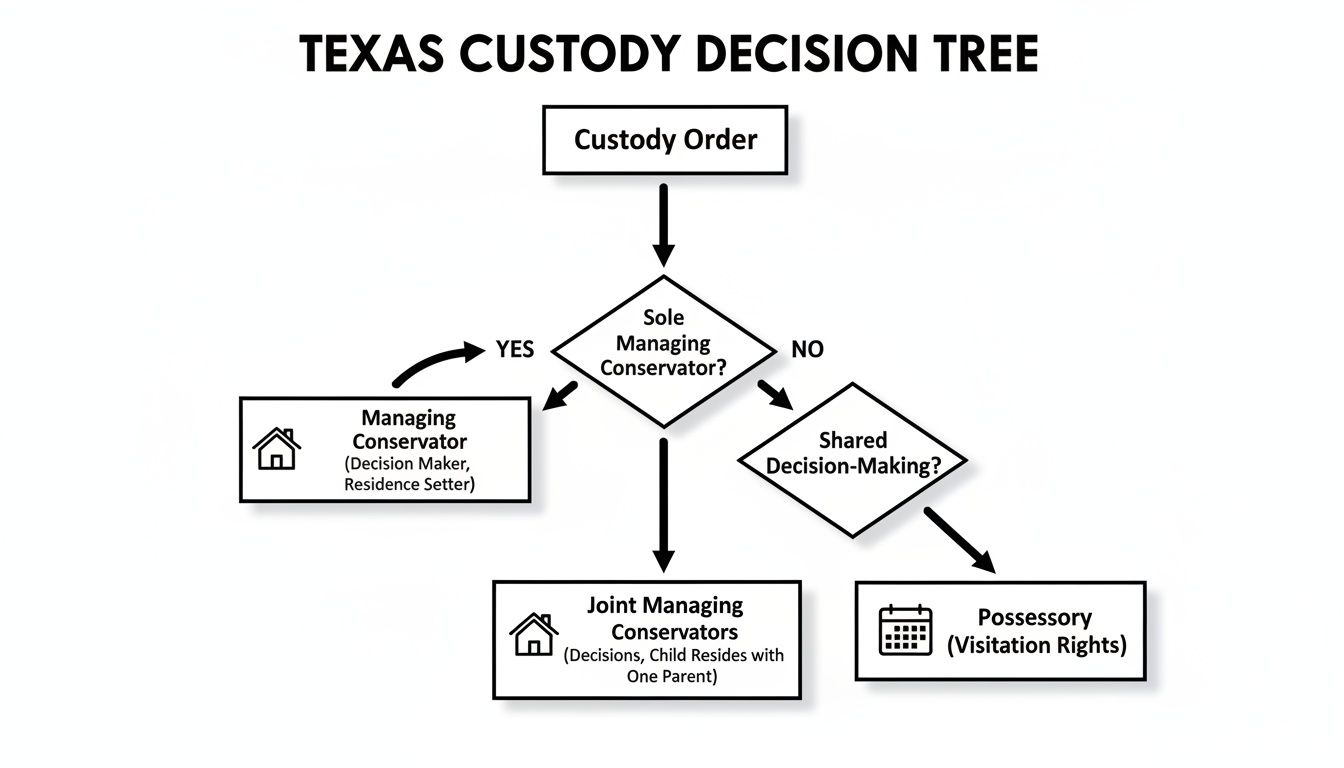
As you can see, a custody order assigns specific roles—Managing or Possessory Conservator—and each comes with a distinct set of rights and responsibilities that prioritize the child's best interests.
The Impact on Parental Rights
This is perhaps the most profound difference. A custody order rearranges parental rights but does not erase them. The parents are still the legal parents, even if their ability to act on those rights is restricted.
Guardianship, on the other hand, is only established because parental rights are effectively unusable—the parents are unavailable, incapacitated, or have passed away. The guardianship suspends the parents' rights to make decisions for their child, transferring that power to the guardian for as long as the order stands.
The critical distinction is this: Custody reallocates rights that parents still legally possess. Guardianship steps in to exercise rights that parents are unable to use themselves, creating a legal shield for the child.
Permanence and Flexibility
Custody orders are built to be adaptable. As life changes—a parent moves, a child's needs evolve—the order can be modified through the family court. This flexibility is essential for co-parenting situations. To help keep communication on track, many co-parents find that exploring different co-parenting schedule apps can be helpful.
Guardianships are generally designed to be more permanent, often lasting until the child turns 18. While they can be terminated if a parent becomes able to resume their duties, it's a significant legal undertaking that requires proving to a probate court that the change is in the child's best interest.
Family courts handle thousands of these cases each year, all aimed at restructuring families to provide stability. Understanding the different rights and responsibilities in guardianship or custody is the first step toward choosing the right legal path for the child in your care.
When Guardianship Is the Best Choice for a Child
Deciding between guardianship or custody usually hinges on one question: can the parents properly care for their child? When the answer is no, guardianship is a necessary step to protect a child whose world has been turned upside down.
This legal path is often the best choice in heartbreaking situations where both parents have passed away, had their rights terminated, are incarcerated, or are incapacitated by illness. In these cases, there is no parent available to make crucial life decisions, and a guardian must step in to fill that role completely, always prioritizing the child's best interests.
Scenarios Where Guardianship Provides Stability
Guardianship gives a caring adult the legal authority they need to provide a stable home when parental care is not possible. Every family’s story is different, but some situations clearly point to guardianship as the most protective path.
-
Parental Incapacitation: A parent may be unable to provide safe care due to addiction or a debilitating mental health crisis. Guardianship allows a relative, like a grandparent, to take over legal responsibility. This ensures the child’s world remains stable, hopefully giving the parents time to work toward recovery.
-
A Child with Special Needs: For a child with special needs who will require lifelong care, a guardianship can continue into adulthood. This ensures a trusted caregiver can keep making critical medical, educational, and financial decisions for them long after they turn 18.
-
Managing a Child's Inheritance: If a child inherits significant money or property, a probate court will appoint a Guardian of the Estate to manage those assets and protect the child’s financial future.
A guardianship grants the legal authority to act as a parent would—enrolling the child in school, consenting to medical treatment, and providing a stable home. It is a powerful tool for ensuring a child’s best interests are met when their parents cannot meet them.
Temporary Needs and Long-Term Security
Sometimes, the need for a guardian is urgent but not permanent. A parent's military deployment or a serious health issue can create a gap in care. In these moments, knowing how to file a temporary guardianship form in Texas can provide the legal authority needed to care for a child right away.
Ultimately, the goal of guardianship is to create a stable, loving environment. For families taking on this new role, focusing on strengthening family relationships is key. These bonds are the foundation of a child’s security.
Courts take their oversight role very seriously. Many states now require annual well-being reports to ensure a child is safe and thriving under a guardian's care.
If you find yourself in a situation where a child needs you to step in, guardianship might be the most loving and legally sound path. It offers the clarity and authority you need to protect them completely.
When a Custody Order Is the Right Path
When you're weighing guardianship or custody, the decision often comes down to whether the child's parents are still in the picture. A custody order, which Texas law calls a conservatorship, is usually the best approach when the parents are still involved but someone else—like a grandparent or stepparent—needs the legal authority to manage the child's daily life. It is a tool designed for flexibility, one that works with the existing parent-child relationship.
Guardianship is meant for situations where parents are absent or incapacitated. Custody, on the other hand, is about formalizing a caregiving arrangement that may already be happening. It is an ideal solution for stepparents, grandparents raising grandkids, or an aunt or uncle providing a stable home while a parent gets back on their feet.
Formalizing Care While Preserving Parental Ties
The power of a custody order is its adaptability. It gives a non-parent the legal authority they need without permanently terminating the biological parents' rights. This is important in families where the goal is to keep everyone connected and support family unity.
With a custody order, a caregiver is empowered to:
- Handle School Enrollment: You’ll have the legal paperwork to register the child for school and make decisions about their education.
- Give Medical Consent: It grants you the authority to approve routine medical, dental, and psychological care.
- Create Daily Stability: It sets up a clear, court-enforced structure for the child's routine, which reduces uncertainty for everyone.
For most Texas families, a custody order is about empowerment, not replacement. It provides the legal authority to care for a child effectively while honoring the biological parents' legal connection and rights, always focusing on the child's best interests.
A Relatable Custody Scenario
Picture this: a grandmother has been caring for her grandchild for months. Her daughter, a single mom, is navigating a personal crisis and needs time to get stable. The grandmother provides a loving home, but every little thing is a battle without legal authority.
By filing a Suit Affecting the Parent-Child Relationship (SAPCR) to be named the Sole Managing Conservator, she gets the power to act. She can sign the child up for school and take them to the pediatrician. Meanwhile, the mother could be named a Possessory Conservator, allowing for a set schedule of safe visits to maintain their precious bond.
This situation is far from unique. These arrangements affect millions of families in the U.S. Often, it’s relatives who step in, making custody orders an essential tool for keeping families together. You can explore more about these family statistics to see just how widespread these situations are.
This path is less permanent and easier to modify than a guardianship, reflecting the reality that family situations can change. For relatives committed to a child's well-being during a tough but temporary chapter, a custody order strikes the perfect balance between authority and flexibility.
Common Questions About Guardianship and Custody
When you're trying to do what's best for a child, the legal system can feel overwhelming. It’s completely normal to have questions when weighing options like guardianship or custody. We've provided clear, plain-English answers to the questions we hear most often from Texas families.
Can a Guardianship Turn into an Adoption?
Yes, this is a possible path, but they are two separate legal actions. A guardian can petition the court to adopt the child. For this to happen, a judge must agree that adoption is in the child's best interest and that the biological parents' rights can be legally terminated under the Texas Family Code.
If the judge approves the adoption, the guardianship is dissolved and replaced by the permanent adoption, creating a new, legal parent-child relationship and a forever family.
Do I Still Need to Pay Child Support if Someone Else Has Custody or Guardianship?
Yes. A court order that grants someone else conservatorship (custody) or guardianship does not erase a parent's financial duty to their child. Biological and adoptive parents are legally required to provide financial support. A judge will nearly always order the non-custodial parent or parents to pay child support to the guardian or managing conservator who is caring for the child.
How Long Does a Guardianship or Custody Order Last?
A Texas custody order, or conservatorship order, typically stays in place until the child turns 18 or graduates from high school, whichever happens last. These orders are designed to be flexible and can be modified if there's a significant change in the family's circumstances, always with the child's best interest in mind.
Guardianships also usually end when the child turns 18. However, a judge can terminate a guardianship earlier if the court finds that a parent is now fit to care for the child again and that ending the arrangement serves the child’s best interests.
The key difference is flexibility. Custody orders are designed to be modified as families evolve, while guardianships are intended for more stable, long-term care situations where parental involvement is not possible.
Can a Child Choose Who They Want to Live With?
In Texas, once a child turns 12 years old, they have the right to file a document with the court expressing their preference for which parent should have the exclusive right to decide where they live.
The judge is required to interview the child, but the child's wishes are not the final word. The judge's decision must always be based on the child's best interests, though the preference of a mature 12-year-old is given very serious consideration.
Choosing between guardianship and custody is a major decision with lasting effects on your family and, most importantly, on the child you love. You do not have to navigate this path alone. The compassionate, knowledgeable attorneys at The Law Office of Bryan Fagan, PLLC are here to help Texas families with empathy and clarity. We can help you understand your options and take the next step toward building your family. Schedule a free, confidential consultation today to discuss your unique situation and determine which legal path offers the best protection for the child in your care.
