
When a child's parents can no longer care for them, whether temporarily or for the long haul, Texas law provides a powerful safety net: guardianship. It's a court-supervised process that puts a responsible adult—a guardian—in charge of a child's care when their parents simply can't.
This isn't about permanently severing a parent's rights. Instead, it’s a solution focused completely on the child’s best interests, ensuring their world remains stable and safe.
Understanding the Heart of Guardianship

The term "guardianship" can sound intimidating, but at The Law Office of Bryan Fagan, we see it as what it truly is: a profound act of love. It’s a way for a grandparent, aunt, or trusted family friend to step up and ensure a child is protected, cared for, and secure.
Think of it like this: a child is on a long road trip, but the driver—the parent—suddenly can’t continue the journey. A guardian is the person who gets in the driver's seat, takes the wheel, and makes sure the child gets where they need to go safely. It’s not about taking the car forever; it’s about making sure the journey continues on course until the parent is able to drive again.
Why Is Guardianship Necessary?
Life happens. Guardianship becomes the go-to legal tool when a parent is unable to fulfill their duties, for all sorts of reasons. The entire point is to create a secure, predictable environment for the child. It gives the guardian the legal authority to make the everyday and critical decisions a parent normally would.
Some of the most common reasons a family might need a guardianship of a minor include:
- A parent is dealing with a serious illness or incapacitation.
- A single parent is deployed for military service or takes an overseas job.
- A parent is incarcerated or struggling with substance abuse.
- Tragically, a child's parents have passed away without naming a guardian in their will.
The guiding principle in every Texas guardianship case is protecting the child. The court isn't focused on punishing parents, but on shielding the child's physical safety and emotional well-being above all else.
This formal court process gives someone the legal power to enroll the child in school, consent to their medical care, and provide the daily stability they need to thrive. While it's a legal proceeding, its purpose is deeply compassionate. You can get a closer look at the statutes and rules by reading more on the guardianship laws in Texas.
Our goal is to pull back the curtain on this legal option and empower you with clear information. When you see guardianship as a protective measure, you realize it’s not a last resort, but a proactive, loving step to secure a child’s future during uncertain times.
The Different Types of Guardianship in Texas
So you know a child needs a guardian. That’s the first big step. But which kind of guardian? Figuring that out is just as important, because Texas law doesn't treat all guardianships the same.
Think of it less like a one-size-fits-all solution and more like a specialized toolkit. You wouldn't use a sledgehammer to hang a picture frame, right? In the same way, the court’s goal is to give a guardian just enough authority to protect the child—nothing more, nothing less. Every decision is measured against the child's best interest.
Let's break down the main types of guardianship you'll find in Texas.
Guardian of the Person
A Guardian of the Person is who most people picture when they think of guardianship. This person is responsible for the child's physical care, safety, and day-to-day well-being. They essentially step into a parental role for all of life's practical decisions.
This guardian's duties include:
- Providing a safe, stable home with food, clothing, and shelter.
- Making all educational decisions, like where the child goes to school.
- Consenting to medical, dental, and psychiatric care.
- Guiding the child's social activities and religious upbringing.
Imagine a grandparent whose daughter is on a year-long military deployment. To legally enroll their grandchild in school or take them to the doctor, the grandparent would need to be appointed Guardian of the Person. It allows them to keep the child’s life running smoothly until mom comes home.
Guardian of the Estate
While the Guardian of the Person focuses on daily life, a Guardian of the Estate is appointed for one reason: to manage a child's money and property. This becomes necessary when a minor inherits or owns significant assets—cash, real estate, stocks—that they can't legally control themselves.
A Guardian of the Estate has a fiduciary duty to the child. This is a powerful legal obligation, meaning they must manage every asset responsibly and only for the child's benefit, accounting to the court for every dollar.
For example, say a teenager inherits her grandfather's house. Her aunt could be named Guardian of the Estate to manage the property—paying taxes, handling repairs, and maybe even renting it out to generate income—until the teen is an adult and can take ownership.
It's common for one person to serve as both Guardian of the Person and of the Estate. However, a court might appoint two different people, especially if the finances are complex. If you're a relative stepping into this role, it helps to understand how it fits within the broader system of family care. You can learn more in our guide to what kinship guardianship is.
Temporary Guardianship
Sometimes, a crisis hits and there’s no time to wait. A temporary guardianship is the court’s emergency solution, designed for urgent situations where a child needs immediate protection.
This type of guardianship is strictly short-term, usually lasting no more than 60 days. It grants someone immediate authority to make decisions for a child while the court evaluates a more permanent plan. It's the legal first aid needed when a child's parents are suddenly incapacitated by an accident or severe illness.
The Step-by-Step Process to Establish Guardianship
The thought of going to court can feel heavy, but the legal path to establishing guardianship in Texas is more like a well-marked trail than an intimidating maze. Think of the court not as an obstacle, but as a safeguard, there to ensure every single decision is made with the child's best interests at heart.
Let's walk through that process together, step by step, so you know exactly what to expect.
Step 1: Filing the Application
It all starts with a formal document called an Application for Appointment of Guardian. This isn't just a simple form—it's a detailed petition to the court that explains exactly why a guardian is needed and why you are the right person for the job. You'll include key information about the child, their parents, and the specific circumstances that led to the need for a guardianship of a minor.
This application gets filed in the probate court of the county where the child resides. Getting this first step right is critical; a clear and thorough application sets the stage for a much smoother process ahead.
Step 2: Providing Legal Notice to Family
Once your application is on file with the court, the law requires that key family members—especially the child's parents—are officially notified. This formal notice is called "service of citation." It’s designed to make sure everyone with a legal stake in the child's future has a chance to be heard.
This step is a fundamental part of a fair legal process in Texas. It prevents crucial decisions from being made behind closed doors and gives parents the opportunity to either consent to the guardianship, object to it, or otherwise participate in the court proceedings. A judge won't move forward until they are satisfied that everyone who needs to be notified has been.
Step 3: The Attorney Ad Litem
In every single minor guardianship case in Texas, the court appoints a special attorney known as an attorney ad litem. This attorney has only one client: the child. Their sole duty is to be the child’s independent voice in the courtroom.
The attorney ad litem will:
- Meet with the child to get a sense of their situation and, if they're old enough, to hear their wishes.
- Interview you, the parents, and other important people in the child’s life.
- Review all the facts and evidence presented in the case.
- Finally, they'll make a recommendation to the judge about what they believe is truly in the child’s best interest.
This independent attorney is one of the most important safeguards in the entire process. It gives the court a neutral, child-focused perspective before making a final decision that will change a child's life.
As you can see in the chart below, a guardian can take on different roles—caring for the child's daily needs as a Guardian of the Person, or managing their finances as a Guardian of the Estate.
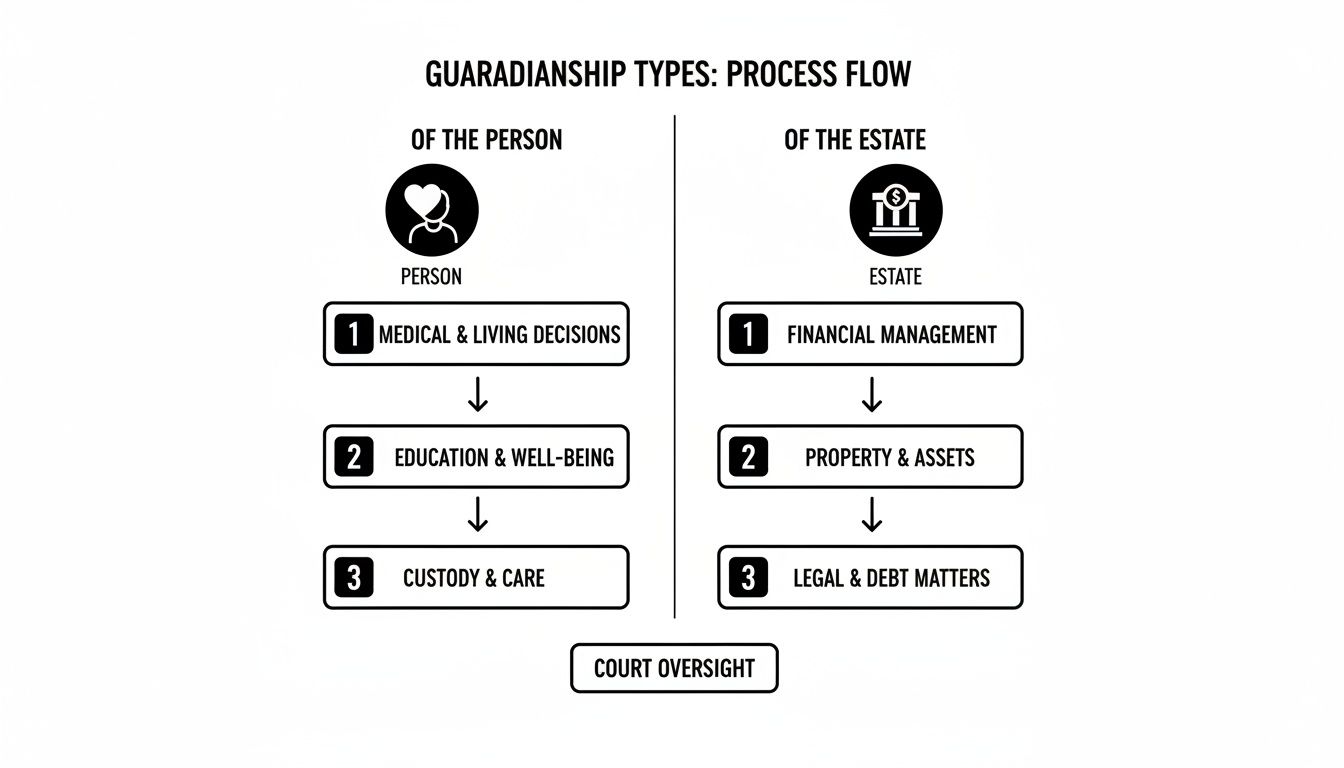
The key is that guardianship can be tailored to fit exactly what a child needs, whether that's day-to-day personal care, financial oversight, or both.
Step 4: The Court Hearing
This is the main event. The court hearing is where the judge pulls all the pieces together to make a final ruling. You, your attorney (if you have one), and the attorney ad litem will all be present.
During the hearing, you will give testimony, which simply means answering the judge's questions under oath. You’ll need to prove that appointing you as guardian is in the child’s best interest—that is the central question the court is there to answer. The judge will listen to you, consider the attorney ad litem's report, and review any other evidence before making a decision.
Step 5: Qualifying as Guardian
Even after the judge approves your application, you aren't quite the guardian just yet. You have to "qualify" by completing a few final administrative steps. These are designed to make your role official and ensure you fully understand the responsibilities you’re taking on.
The final steps typically include:
- Taking an Oath: You will sign a sworn statement, promising to faithfully and dutifully perform your role as guardian.
- Posting a Bond: In many cases, the court requires you to purchase a bond. Think of it as an insurance policy that protects the child’s financial assets from any potential mismanagement.
- Receiving Letters of Guardianship: Once the oath and bond are squared away, the court will issue Letters of Guardianship. This is the official document that gives you the legal authority to make decisions for the child.
While it's a detailed process, it's absolutely manageable with the right guidance. To get a better sense of the legal duties involved, you might want to read our guide on how to become a legal guardian in Texas.
Who Can Be Appointed a Guardian for a Child in Texas

When a Texas court has to appoint a guardian for a child, everything comes down to one simple, powerful question: Who can best provide a safe, stable, and loving home? The court’s entire focus is on the child's well-being, searching for a responsible adult who is truly ready to step into this life-changing role.
Of course, the law sets a baseline for who can serve. A potential guardian must be an adult of sound mind with a clean record. But beyond those basic requirements, the court looks much deeper, carefully examining each person’s character, capabilities, and relationship with the child to find the best possible fit.
The Basic Eligibility Requirements
Before anyone can be considered for a guardianship of a minor in Texas, they have to prove they are suitable for the job. The court process is specifically designed to filter out anyone who isn’t up to the immense responsibility of caring for a child.
Generally, a person is eligible if they:
- Are a responsible and trustworthy adult.
- Have no criminal history involving violence, sexual offenses, or anything that could harm a child.
- Are financially stable enough to provide for the child’s basic needs.
- Have the physical and mental capacity to raise a child.
Think of this as the first layer of protection the court puts in place for the child. It ensures that only qualified and capable individuals even make it to the next step.
Why Texas Courts Prefer Relatives
Whenever possible, Texas courts show a strong preference for appointing a relative—a practice often called kinship care. A grandparent, aunt, uncle, or even an adult sibling is usually seen as the ideal choice. Why? Because they can offer a sense of continuity and family connection that is incredibly important for a child’s emotional health.
This isn't just a legal tradition; it’s rooted in a deep understanding of what helps children thrive. Placing a child with family helps preserve their identity and maintain the bonds of love and trust they've already built, especially during a time of major upheaval.
This approach is mirrored across the country. For children in foster care, guardianship is a key path to a permanent home when returning to their parents isn't an option. The latest data shows that 11% of children exiting the foster care system—that’s about 19,440 kids—were placed into guardianships, often with relatives. You can dig into more of these national trends on the National Council for Adoption's website.
In Texas, the law itself puts family first. Grandparents are given top preference, followed by other close relatives. The court’s goal is always to find the least disruptive, most supportive environment for the child.
People Who Are Generally Disqualified
Just as the court looks for positive qualities, it also has a clear list of red flags. The law is strict: certain individuals are simply not eligible to serve as a guardian because their history or circumstances could put the child at risk.
A person will almost certainly be disqualified if they:
- Have a serious criminal conviction.
- Have a history of substance abuse.
- Owe money to the child’s estate.
- Have a major conflict of interest (like being in a lawsuit against the child).
- Are known for being irresponsible or neglectful.
These rules aren't in place to be punitive. They exist purely to protect the child, making sure their guardian is someone who will act only in their best interest, free from conflicts or a troubling past.
How to Handle Common Guardianship Challenges
The road to becoming a guardian is paved with good intentions, but it’s rarely a straight line. It's completely normal to hit a few bumps along the way, from emotional family disputes to confusing legal requirements. Seeing these hurdles pop up can feel discouraging, but they aren't dead ends—they're just situations that need a clear head and a steady hand to navigate.
At The Law Office of Bryan Fagan, PLLC, we’ve helped countless families work through these exact issues. Knowing what to expect ahead of time is half the battle. It gives you the confidence to face these challenges head-on, always keeping the child’s well-being as your number one priority.
When a Parent or Relative Objects
One of the toughest situations is when a biological parent or another family member officially objects to the guardianship. It can feel like a personal blow, but it’s important to remember that Texas law gives them a right to be heard in court.
An objection doesn't automatically stop the process. The judge’s final decision will always come down to one thing: what is in the best interest of the child. If a parent objects but has a history of neglect, substance abuse, or is otherwise unfit to provide care, the court will almost always prioritize the child’s need for safety and stability. The judge will carefully weigh all the evidence, including the attorney ad litem’s report, to figure out who can offer the most secure and loving home.
Navigating Cases with CPS Involvement
When Child Protective Services (CPS) gets involved, things can get complicated quickly. A CPS case and a private guardianship run on separate legal tracks, but they often overlap. If you’re a relative hoping to become a guardian for a child currently in CPS custody, your involvement can be a game-changer.
Guardianship often means caring for a child who has been through a lot. Using trauma-informed teaching strategies can make a world of difference in helping them feel safe and supported. Your willingness to step up is a huge positive in the court's eyes, as it aligns perfectly with the state's goal of placing children with family members they know and trust.
CPS involvement really highlights the urgent need for a stable home, and guardianship is often the best way to provide it. The numbers from the U.S. foster care system tell a powerful story. As of fiscal year 2024, there were 328,947 children in care. A large number of them—30%—are between the ages of 1 and 5, an ideal age for a relative guardianship that keeps family bonds intact. In states like Texas, where kinship placements are prioritized at over 40%, guardianship is a critical tool for keeping families together. You can dive deeper into these trends in foster care and guardianship.
Managing the Child’s Finances and Estate
If the court appoints you as the Guardian of the Estate, you take on a special legal role known as a fiduciary duty. This is a very high standard that requires you to manage the child's assets with absolute care, honesty, and loyalty. You can't use the child's money for your own needs, and you must keep a meticulous record of every single transaction.
A fiduciary duty means you must act solely in the child's best financial interests. The court takes this responsibility very seriously and requires annual accountings to ensure the child’s assets are protected.
This duty can feel overwhelming, especially if the child inherits complex assets like real estate, stocks, or a business. Your responsibilities will typically include:
- Creating an Inventory: You’ll need to list every single asset the child owns and file it with the court.
- Filing an Annual Accounting: Each year, you must submit a detailed report showing all income and expenses related to the child’s estate.
- Getting Court Approval: You can't make major financial decisions, like selling a house, without getting the judge's permission first.
These challenges are exactly why having an experienced attorney in your corner is so important. A lawyer can help you properly respond to objections, coordinate with CPS, and meet your fiduciary duties, so you can focus on what truly matters—giving the child a safe, stable, and loving home.
Your Next Steps to Protect a Child You Love
The road to guardianship can feel overwhelming, but at its core, it’s about one simple thing: protecting a child you love. Whether you’re a grandparent, aunt, uncle, or close family friend, you’re considering stepping up to provide safety and stability when a child needs it most. Deciding to pursue a guardianship of a minor is a profound step toward securing that child’s future.
You’ve learned what guardianship means in Texas, the different types available, and how the court process works. But reading is one thing. Taking action is what truly matters.
You Don't Have to Do This Alone
Remember, you are not expected to walk this path by yourself. Reaching out for legal help isn't a sign of weakness—it's a sign that you’re taking this responsibility seriously. An experienced family law attorney can bring clarity to a confusing process, making sure every detail is handled correctly so you can focus on what’s important: the child.
The need for this kind of protection isn't just a local issue; it’s a global one. The recent crisis involving unaccompanied minors at the U.S. border highlights how critical guardianship is for vulnerable children. In 2022, when over 300,000 children were apprehended at the U.S.-Mexico border, very few had a guardian to speak for them during life-altering evaluations. As you can learn more about guardianship for unaccompanied minors, it’s clear this legal tool is a lifeline for children in countless situations.
Taking the step to become a guardian is more than a legal process; it is a promise to a child that they will be safe, loved, and cared for, no matter what challenges arise.
Take the First Step Today
If you’re thinking about guardianship for a child in your life, you probably have questions that are specific to your unique family situation. You deserve clear answers and a solid understanding of your options. Our compassionate attorneys at The Law Office of Bryan Fagan, PLLC, are here to listen and help you find the right path forward.
We invite you to schedule a free, confidential consultation with us. Let us help you take the next brave step toward building a secure and loving future for a child who is counting on you.
Frequently Asked Questions About Texas Guardianship
It's only natural to have questions as you think about stepping up for a child you love. Guardianship is a big step, and you deserve clear, straightforward answers. We’ve put together some of the most common questions we hear from families across Texas to give you the clarity you need.
How Long Does It Take to Get Guardianship of a Minor in Texas?
So, how long does this all take? In a perfect world, where everyone agrees and the paperwork is flawless, you're looking at a timeline of about 2 to 4 months from the day you file to the day a judge signs the order.
But life isn't always perfect. If a parent or another relative fights the guardianship, or if other complications pop up, the process will take longer. An experienced attorney can give you a much better estimate based on the specifics of your family’s situation.
Does Guardianship Terminate the Parents' Rights?
No, it doesn't, and this is one of the most important things to understand about guardianship. A guardianship suspends a parent's rights; it doesn't end them permanently like an adoption does. The legal bond between the biological parent and child is still there.
This temporary nature is a core feature of guardianship. It leaves the door open for parents to resume their duties later if their circumstances improve and a judge agrees it’s in the child's best interest.
What Are the Ongoing Responsibilities of a Guardian?
Becoming a guardian means you are legally and morally responsible for a child's entire world. It's a profound commitment, and the court will expect you to always act in the child's best interest.
Your main duties fall into a few key areas:
- Providing Daily Care: This is the big one. It means giving the child a safe home, good food, proper clothing, and the emotional support they need to feel secure.
- Making Key Decisions: You'll be the one making the calls on the child's schooling, doctor and dentist visits, and any mental health care they might need.
- Reporting to the Court: You’re required to file an annual report with the court. This report updates the judge on the child’s health, living situation, and overall well-being, showing that they are safe and thriving in your care.
Can a Child Say Who They Want Their Guardian to Be?
Yes, and Texas courts take a child's opinion very seriously. Once a child is 12 years of age or older, they have the right to sign a legal document naming the person they want as their guardian.
While the judge makes the final decision based on the child's best interest, that written preference is a powerful piece of evidence. It ensures the child's own voice is heard loud and clear in a decision that will shape their entire future.
Navigating the legal path to guardianship requires a compassionate advocate who understands what’s at stake. The team at The Law Office of Bryan Fagan, PLLC is dedicated to helping Texas families protect the children they love. We invite you to schedule a free, confidential consultation to discuss your family’s needs and take the first step with confidence. Visit us at https://texasfamilyadoption.com to learn more.
