
The short answer? Sometimes, but not always. While getting the biological father’s consent is the simplest path to a stepparent adoption in Texas, it’s far from the only one.
If you’re worried that an absent, uncooperative, or even unknown father stands in the way of unifying your family, take a deep breath. Texas law is designed to prioritize a child's need for stability and love, and it provides clear exceptions for when a father's consent isn't required. Your family's legal path forward depends on his legal status and his history of involvement—or lack thereof.
Understanding the Father's Role in Stepparent Adoption
For many hopeful stepparents, the question, "Does the biological father have to consent?" is the single biggest source of stress. You've built a life with your spouse and their child, and you're ready to make your role as a parent official. The thought of needing permission from someone who isn't part of your child's life can feel like an impossible hurdle.
But here’s the key: Texas law doesn’t treat all biological fathers the same. The first and most critical step is figuring out which legal category the father falls into, as defined by the Texas Family Code.
- A Presumed Father is a man who was married to the child's mother during the pregnancy or at the time of birth. His legal rights are the strongest.
- An Acknowledged Father is a man who isn't married to the mother but has signed a legal document called an Acknowledgment of Paternity.
- An Alleged Father is a man who is said to be the father (by himself or the mother) but has never legally established his paternity through a court order or an Acknowledgment of Paternity.
The path forward—and whether you need his signature—depends entirely on which of these descriptions fits your situation.
Determining Your Legal Path
The Texas Family Code draws a bright line between these different types of fathers, and each has distinct consent requirements. This is where many families get stuck, but understanding the difference is your key to moving forward with clarity and confidence.
The table below breaks down what each status means for your adoption journey.
Father's Legal Status and Consent for Texas Stepparent Adoption
| Father's Legal Status | What This Means for You | Is His Consent Typically Required? |
|---|---|---|
| Presumed Father | He was married to the mother at or around the time of the child's birth. His parental rights are automatically recognized by law. | Yes. His consent is almost always needed unless his rights are terminated by a court. |
| Acknowledged Father | He voluntarily signed an Acknowledgment of Paternity, giving him the same legal rights and responsibilities as a presumed father. | Yes. Just like a presumed father, his consent is required unless his rights are terminated. |
| Alleged Father | He has a biological connection but has not taken the legal steps to establish paternity. His rights are limited. | No, not always. His consent may not be required, especially if he hasn't supported the child or registered with the state's putative father registry. |
As you can see, a father who has never established legal paternity has far fewer rights than one who has. If the father in your situation is an Alleged Father, the process can be significantly more straightforward. You can learn more about these critical distinctions in the Texas adoption consent laws to see how they apply to your family's unique circumstances.
This decision tree helps visualize the different paths your adoption case could take based on the father's legal status.
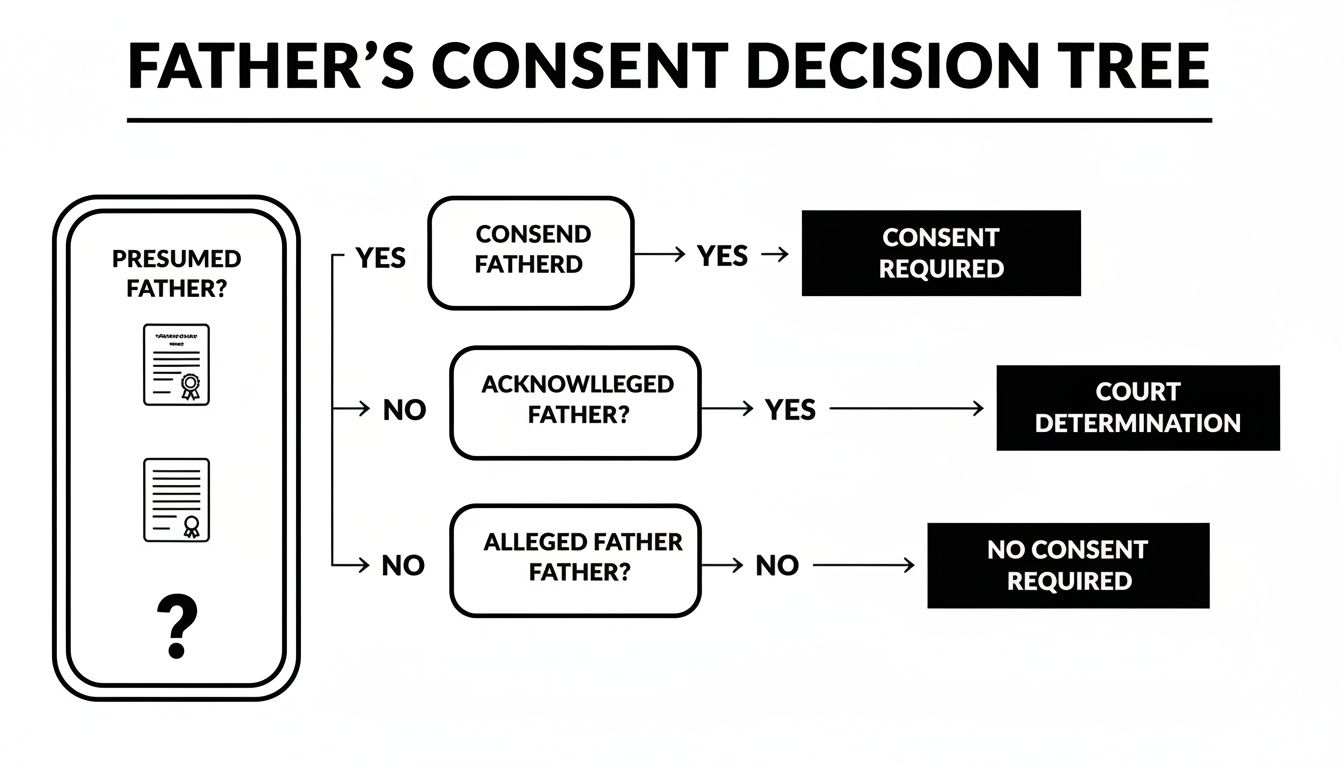
As the flowchart shows, the legal process splits dramatically depending on whether paternity has been formally established. Once you know where you stand on this issue, you can begin planning your next concrete steps toward adoption.
When You Can Proceed Without the Father's Consent
When a biological father is completely absent from a child's life, the question "does a biological father have to consent to stepparent adoption in Texas?" can feel like a massive roadblock. But here’s the good news: Texas law puts a child’s well-being and stability first. It understands that parenthood is so much more than a biological connection—it’s about showing up, providing support, and creating a safe, loving home.
Because of this, Texas law provides a clear path for a stepparent adoption to move forward even if you can't get the father's consent. This is done through a legal process called involuntary termination of parental rights. The name sounds harsh, but its purpose is entirely protective. It allows a court to legally sever the rights of a parent who has failed to act like one, clearing the way for an adoption that is truly in the child's best interest.

What Does Involuntary Termination Mean?
Think of parental rights as a set of keys to a child’s life. These keys unlock the right to make medical decisions, see school records, and decide where the child lives. A father who has these keys but never uses them—or worse, uses them to cause harm—can stop a loving stepparent from fully and legally stepping into their role.
Involuntary termination is the court's way of taking those unused or misused keys from the biological father. It can only be done by a judge, and they have to be convinced of two critical things:
- That specific legal grounds (reasons) exist to terminate the father’s rights.
- That termination is in the best interest of the child.
That second point is the gold standard in all Texas family law cases. The judge’s number one priority will always be what gives the child the most stability, safety, and emotional security.
Common Grounds for Termination Without Consent
To move forward without the father’s agreement, you’ll need to prove one of the legal grounds for termination laid out in the Texas Family Code. While there are quite a few, a handful are most common in stepparent adoptions.
- Abandonment: This is one of the most frequent reasons. In Texas, abandonment can be proven if the father has not visited or communicated with the child for at least six months and also failed to provide any financial support during that same time.
- Failure to Support: This applies if the father has consistently failed to support the child according to his ability for a period of one year, ending within six months of when you file the adoption case. This isn't just about missing court-ordered child support; it's about a general failure to contribute to the child's financial needs.
- Endangerment: This is a very serious ground. It requires proving the father has engaged in conduct that endangers the child's physical or emotional well-being. Examples include drug use, criminal activity, or creating a chaotic and unsafe environment for the child.
Real-Life Scenario: Sarah and her husband, Mark, want Mark to adopt her 8-year-old son, Leo. Leo’s biological father, Tom, hasn't seen or called Leo in over a year. He's also never paid a dime of child support, even though he has a job. In this situation, Sarah and Mark could ask the court to terminate Tom’s parental rights based on both abandonment and failure to support, which would allow the adoption to proceed without Tom's consent.
Proving Your Case to the Court
If you have to seek an involuntary termination, you’ll need to come to court with strong, clear evidence. This isn't about punishing the biological father; it's about showing the judge that the adoption is the best possible outcome for the child. For a deeper look, you can explore who must provide consent to a Texas adoption, but the evidence you’ll need often includes:
- Communication Records: Text messages, emails, and call logs (or the lack thereof) showing no contact.
- Financial Records: Bank statements or official child support payment records that demonstrate a failure to provide support.
- Witness Testimony: Statements from family members, friends, or teachers who can speak to the father's absence and the stepparent's active role in the child's life.
- Public Records: Criminal records or police reports if endangerment is a concern.
Tackling this process takes careful preparation and a solid understanding of what the court needs to see. The goal isn't to start a fight, but to build a secure, legally recognized family for a child who deserves nothing less.
Navigating the Legal Process for Involuntary Termination
Taking that first step toward involuntary termination can feel like staring up at a mountain. It’s a serious legal action, but knowing the path forward makes the climb feel far less intimidating. The entire process is built around one single purpose: giving a child the legal security and permanence they deserve.
The journey starts when your attorney files a Petition for Termination and Adoption with the local court. This is a powerful, two-in-one document. It formally asks the judge to end the biological father’s parental rights while simultaneously requesting approval for the stepparent’s adoption. Combining these actions makes the legal process much more efficient.
The Court's First Priority: The Child's Best Interest
As soon as the petition is filed, the court’s focus narrows to one person: the child. In every termination case, the judge will appoint an ad litem attorney. This is an independent lawyer whose only client is the child and whose only job is to protect their best interests.
Think of the ad litem as the child’s dedicated voice in the courtroom. They will meet with the child, interview you and your spouse, and may talk to teachers, counselors, or other important figures in the child’s life. Their mission is to give the judge an unbiased, professional recommendation on whether terminating the father’s rights and allowing the adoption is truly the best outcome for the child.
Meeting the High Standard of Proof
When you ask a Texas court to terminate someone’s parental rights without their consent, you have to meet a very high legal bar. For a contested case, the law requires "clear and convincing evidence."
This isn't the same standard used in most civil cases. It’s significantly higher. It means the proof you bring must be so solid and persuasive that it leaves the judge with a firm belief that your claims are true.
So, what does this look like in practice? You and your attorney will need to gather concrete proof that establishes the legal grounds for termination, such as:
- A Detailed Timeline of No Contact: Create a logbook of dates showing the last time the father saw, spoke with, or even asked about the child.
- Communication Records: Keep every text, email, or social media message you’ve sent that went unanswered. A pattern of silence can be just as powerful as words.
- Financial Documentation: Collect official child support records (or the lack thereof) and bank statements to prove he has not provided for the child financially.
- Witness Statements: Ask trusted friends, family, or neighbors who have witnessed the father’s absence and the stepparent’s commitment to write sworn statements (affidavits).
Example: Imagine a father claims he wanted to be involved. If you can show the judge a year’s worth of text messages where you consistently offered visitation times and he either ignored you or always had an excuse, you are painting a "clear and convincing" picture of abandonment.
The Final Hearing and Beyond
The process moves toward a final hearing, which is your day in court. This is when your attorney will present all the evidence you’ve gathered to the judge. You, your spouse, and your witnesses might be asked to testify.
The judge will hear all the evidence, carefully review the ad litem attorney's report, and then make a final decision.
If the judge agrees you’ve proven your case with clear and convincing evidence—and that the adoption is in the child’s best interest—they will sign an order that accomplishes both goals. It terminates the biological father's rights and finalizes the stepparent adoption, all in one go. This is the moment your family is finally made whole in the eyes of the law.
To learn more about the specific grounds for termination, you can read our detailed guide on the termination of parental rights in Texas.
Real Stories of Stepparent Adoption in Texas
Reading about the law is one thing. Seeing how it works for families just like yours is another. The legal language around consent and termination can feel cold and intimidating, but these stories show the real-world heart behind the process. They prove that building a secure, legally recognized family is not just a dream—it's an achievable goal.
A Straightforward Case of Abandonment
Think of Sarah, David, and 10-year-old Lily. For years, David has been Lily’s dad in every way that counts. He’s there for homework, coaches her soccer games, and is her go-to for comfort and advice. Lily’s biological father, on the other hand, vanished over three years ago. He moved, stopped calling, sends no birthday cards, and hasn’t contributed a dime to her support.
Sarah and David knew it was time for David to officially adopt Lily, but they were stuck on one big question: does the biological father have to consent to a stepparent adoption in Texas? Their attorney put their minds at ease. Because the father had no contact and provided no support for well over six months, they had a clear-cut case for involuntary termination due to abandonment.
They moved forward by filing a Petition for Termination and Adoption. The father's whereabouts were a mystery, so their lawyer conducted a thorough search. When he still couldn't be found, he was served notice through a public posting, satisfying the court's requirements.
At the final hearing, Sarah showed the judge years-old text messages—her unanswered attempts to encourage a relationship—and bank statements proving the complete lack of financial support. The judge quickly agreed that termination was in Lily's best interest and finalized the adoption on the spot. For Lily, it was the day the law finally caught up with what her heart already knew: David was her dad.
“When the judge called him her father and made it official, it was like the final puzzle piece clicking into place for our family. All the legal worries just melted away.” – A grateful adoptive parent
A More Complex Path Forward
Now, let's look at a tougher situation. Maria, her husband Alex, and her 14-year-old son, Noah, faced a different challenge. Noah’s biological father, Kevin, wasn't completely gone, which complicated things. He’d call once or twice a year and send a little money for Noah’s birthday. But his life was unstable, marked by substance abuse, and his rare calls left Noah feeling more anxious than loved.
Maria and Alex longed to give Noah the stability and legal security of an adoption. Kevin refused to consent, insisting he was still “in the picture.” Their attorney explained that they would need to prove two things: that Kevin’s lifestyle and inconsistent behavior constituted endangerment to Noah’s emotional well-being, and that he had failed to support him according to his means.
This legal battle took more time and effort. Their evidence had to be rock-solid:
- Testimony from a family counselor who spoke to the emotional damage caused by Kevin’s unreliable and disappointing contact.
- Financial records demonstrating that the birthday money was a token gesture, not a real attempt to support a child.
- Most powerfully, Noah—who was over 12—told the judge in a private interview that he wanted Alex to be his legal father.
The judge carefully weighed everything. While Kevin had maintained a thread of contact, the evidence clearly showed his actions endangered Noah’s emotional health and that he had failed his duty to provide for his son. The court ruled that terminating Kevin's rights was in Noah’s best interest. For this family, the final adoption order wasn't a celebration, but a quiet, profound moment of relief—the end of years of uncertainty and the start of a secure future.
What to Do After Your Stepparent Adoption Is Finalized
The moment the judge signs that final order is one you'll never forget. After all the legal hurdles and emotional waiting, your family is finally whole in the eyes of the law. The uncertainty is gone, and you can breathe a huge sigh of relief. It’s time to celebrate.
But after the happy tears and courtroom photos, there are a few practical things you need to do. Taking care of these administrative steps right away ensures your child’s new legal status is recognized everywhere it counts, giving your family the complete security you've worked so hard for.
Your Post-Adoption Checklist
Think of this part as tying up the happy loose ends of your adoption story. The tough questions—like whether a biological father has to consent to a stepparent adoption in Texas—are behind you. These final steps are all about cementing that new reality.
Your attorney will get the official, signed Decree of Adoption from the court. This is the golden ticket, your proof that the adoption is final. Make sure you get several certified copies and keep them somewhere safe.
Once you have the decree, it's time to update your child's records. Here's a simple checklist to follow:
- Apply for a New Birth Certificate: This is a big one. The adoption decree gives you the power to ask the Texas Vital Statistics Unit for a new birth certificate that lists the stepparent as the child’s legal parent.
- Update School and Medical Records: Give a copy of the adoption decree to your child’s school and all their doctors. This makes sure the stepparent is listed as a legal parent with the full authority to make decisions.
- Notify the Social Security Administration: You can update your child’s records with the SSA. If a name change was part of the adoption, you can also ask for a new Social Security card with their new last name.
- Add the Child to Insurance Policies: Call your health, life, and other insurance providers to officially add your child to your policies as your legal dependent.
- Update Your Will and Estate Plan: This is absolutely critical. Updating your will makes sure your child has full inheritance rights as your legal heir.
Tying up these administrative details is about more than just paperwork—it’s about locking in the security your family has worked so hard to achieve. It ensures that your parental rights are recognized in every situation, from a doctor's office to school registration.
Completing these tasks makes the adoption permanent and undeniable. For a more detailed walkthrough, you can learn more about how to get a new adoption birth certificate in Texas and what that process looks like.
With these final items checked off your list, your family can finally move forward with confidence and joy, knowing your bond is legally protected forever.
Let Our Family Law Team Guide Your Next Steps
Taking the final step to make your family whole through stepparent adoption is a profound moment. But when you’re facing questions like whether a biological father’s consent is required in Texas, the path can feel complicated and overwhelming. As we’ve covered, while a father’s willing signature is the most direct route, it’s far from the only one. Texas law always puts the child’s best interests first, providing clear legal avenues to move forward even without that consent.
You don’t have to navigate this alone.

A Compassionate Guide for Your Family
At The Law Office of Bryan Fagan, PLLC, we see ourselves as more than just adoption attorneys. We’re partners who get it—the late-night worries, the hope for the future, and the deep love driving your decision. We believe every child deserves the stability of a permanent, loving home, and every stepparent who steps up to fill that role deserves the legal recognition that makes it official.
Our team is here to manage the legal heavy lifting. We handle everything from the initial petition to building the evidence needed for a termination hearing. This frees you up to focus on what truly matters: being there for your family.
Your family’s story is unlike any other, so your legal strategy shouldn't be a one-size-fits-all template. We start by listening. From there, we build a case that shows the court exactly why this adoption is the best possible outcome for your child.
Take the First Step Today
We know that making the first call can be the hardest part. You’re likely filled with questions and "what-if" scenarios unique to your family. That’s exactly why we offer a free, no-pressure consultation with our team.
This is your chance to get clarity in a confidential setting. In our meeting, we will:
- Listen to your story and understand what you hope to achieve.
- Outline the legal road ahead, whether it involves getting consent or pursuing termination.
- Answer your specific questions about the timeline, costs, and what to expect from the process.
Let us give you the clarity and support you need to move forward with confidence. Your family’s secure and happy future is worth fighting for, and we’re here to help you build it. Contact The Law Office of Bryan Fagan, PLLC, today to schedule your complimentary consultation and start writing the next chapter of your family’s life.
Frequently Asked Questions About Stepparent Adoptions
We get it—the road to adoption is filled with questions. Below, we've answered some of the most common ones we hear from families just like yours, offering clear, straightforward advice to help you move forward with confidence.
What If We Have No Idea Where the Biological Father Is?
This is a surprisingly common hurdle, but it's one you can overcome. When a father's whereabouts are unknown, the court requires you to make a "diligent search" to find him. This isn't just a quick Google search—it’s a formal effort that can include checking public records, searching social media, and contacting his last known relatives or employers.
If that thorough search comes up empty, your attorney can use a legal alternative called "service by posting" or "service by publication." This involves posting a public notice, often in a local newspaper, which legally fulfills your obligation to notify him. The adoption can then proceed, even if he is never found.
How Long Does a Contested Stepparent Adoption Take in Texas?
The timeline really depends on whether the biological father agrees to the adoption. An uncontested adoption, where he willingly signs the necessary paperwork, is the fastest path. These cases are often smooth and predictable, typically wrapping up in just three to six months.
However, if the father contests the termination of his rights, you’re looking at a longer and more complex journey. A contested adoption can easily last from six months to over a year, depending on the court's calendar, how much evidence is needed, and the specific facts of your case.
Can the Biological Father Fight the Termination of His Rights?
Absolutely. A biological father has a constitutional right to appear in court and challenge the termination of his parental rights. If he decides to fight it, your case will be set for a trial where a judge will hear evidence from both sides.
To succeed, you'll have to prove that legal grounds for termination (like abandonment or endangerment) exist using "clear and convincing evidence." This is a high legal standard, which is why having a strong, well-documented case is essential. The judge’s final decision will be based solely on the evidence and what is in the child’s best interest.
Key Takeaway: The child's well-being is the court's ultimate standard. Even if a father contests the termination, a judge's decision will always prioritize the child's need for a safe, stable, and permanent home.
Does the Child Have a Say in the Stepparent Adoption?
Yes, their voice is a crucial part of the process. In Texas, if a child is 12 years of age or older, they must give their own legal consent to the adoption. This is usually done in writing, but the judge will also speak with the child privately in an informal meeting to make sure they understand and truly want the adoption to happen.
For children under 12, formal consent isn't legally required. However, the judge and any appointed attorneys will still carefully consider their feelings and wishes when deciding what is in their best interest.
Navigating the path to stepparent adoption can feel complex, but you don't have to do it alone. The dedicated team at The Law Office of Bryan Fagan, PLLC is here to provide the compassionate guidance and legal expertise your family deserves. Let us answer your questions and help you build the secure, legally recognized family you've been dreaming of. Schedule a free, confidential consultation with us today by visiting https://texasfamilyadoption.com.
