
When your family is at a crossroads over a child's care, the first step toward peace of mind is understanding your legal options. The core difference between legal guardianship and custody boils down to this: custody (which we call 'conservatorship' in Texas) defines the rights and duties of parents, usually after a separation, while guardianship gives a non-parent legal authority to care for a child when the parents simply can't.
Guardianship vs. Custody: An At-A-Glance Comparison
Trying to make sense of Texas family law can feel like learning a new language, especially when terms like "guardianship" and "custody" seem to bleed into one another. While both legal arrangements are designed to protect a child’s best interests, they serve very different purposes and fall under completely separate sections of Texas law.
Choosing the right path is crucial for providing a stable, loving future for the child in your life.

Custody, or conservatorship as it's known in Texas courts, is established under the Texas Family Code. It’s most often part of divorce cases or lawsuits between unmarried parents to map out each parent's rights and responsibilities. The focus is always on the best interests of the child.
Guardianship, on the other hand, is handled under the Texas Estates Code. It's a protective measure for when a child's parents have passed away, are incapacitated, or are otherwise unable to act as parents. A court appoints a responsible adult—often a grandparent, aunt, uncle, or close family friend—to step in and make decisions for the child, ensuring their safety and well-being.
The simplest way to think about it is this: Conservatorship (custody) reallocates parental rights that already exist, while guardianship grants parental-like authority to someone new because the biological parents are unavailable to act.
Grasping this fundamental distinction is the key to figuring out which path fits your family's unique situation. To make the differences even clearer, let's put them side-by-side.
Key Distinctions Between Custody and Guardianship in Texas
This table breaks down the core differences between custody and guardianship, helping you quickly see which legal role applies to your circumstances.
| Attribute | Child Custody (Conservatorship) | Legal Guardianship |
|---|---|---|
| Governing Law | Texas Family Code | Texas Estates Code |
| Primary Parties | Typically biological or adoptive parents | Non-parents (relatives, friends) when parents are unable to care for the child |
| Parental Rights | Defines and allocates existing parental rights; does not terminate them | Suspends parental rights, granting decision-making authority to the guardian |
| Typical Scenario | Divorce, separation, or suits between unmarried parents | Parents are deceased, incarcerated, incapacitated, or have abandoned the child |
| Court Supervision | Primarily court-involved during the initial order and modifications | Requires ongoing court supervision, including annual reports from the guardian |
| Permanence | Intended to be a long-term order, lasting until the child is 18 | Can be temporary or permanent, ending when the child turns 18 or if a parent becomes fit again |
As you can see, the court system, the people involved, and the impact on parental rights are starkly different. While a conservatorship order manages the relationship between parents, a guardianship essentially puts a responsible adult in the parents' shoes when they can't be there, always with the child's best interest at the forefront.
Understanding the Legal Roles in Detail
When you're trying to figure out the best way to care for a child in Texas, it’s easy to get tangled up in legal jargon. Words like "custody" and "guardianship" get thrown around, but in the eyes of the court, they represent two completely different legal universes. Getting a handle on these terms is the first step in choosing the right path for your family.

Unpacking Custody as Texas Conservatorship
First things first: in Texas, what most people call "custody" is legally known as conservatorship. This entire framework lives within the Texas Family Code and is almost always about the child's parents. The court's main job here is to lay out each parent's rights and responsibilities to create a stable, healthy environment for the child.
This is the legal structure used in divorce cases or for unmarried parents who need a formal court order to define their roles. This order is often called a Suit Affecting the Parent-Child Relationship, or SAPCR for short.
Under Texas law, there are two key roles:
- Managing Conservator: This is the parent who has the primary right to make big decisions for the child. Think things like deciding where the child lives, making choices about their schooling, and handling non-emergency medical care.
- Possessory Conservator: This parent typically has visitation rights (laid out in a "possession schedule") and is responsible for paying child support. Their power to make major decisions is much more limited.
More often than not, Texas judges will name parents as Joint Managing Conservators. This means they share the rights and duties of raising their child, even if one parent gets the exclusive right to say where the child's primary home will be, always prioritizing family unity where possible.
Defining Guardianship Under the Texas Estates Code
Guardianship is a whole different ballgame. It's a separate legal process governed by the Texas Estates Code, not the Family Code. A court establishes a guardianship as a protective measure when a child’s parents are simply unable to care for them. This could be due to death, incapacitation, incarceration, or other serious situations that make them unfit.
The person appointed by the court, known as the guardian, is a non-parent—usually a grandparent, aunt, uncle, or even a close family friend—who steps in to fill the parental role.
Guardianship isn’t about parents sharing or dividing rights. It’s about a responsible adult stepping up because the parents can’t. This shifts the entire focus from a dispute between parents to the child’s immediate need for a safe and stable caregiver.
A court might appoint a guardian for different aspects of the child's life:
- Guardian of the Person: This individual handles the child's day-to-day physical care. They provide a home, food, and clothing, and make the big decisions about education and healthcare.
- Guardian of the Estate: This person is put in charge of managing the child's finances, property, or any inheritance they might have until they legally become an adult.
It’s crucial to see the distinction: guardianship grants much broader authority over a person's life and finances compared to conservatorship, which is really about parenting time and decision-making for children of separated parents. Guardianship is reserved for specific situations where a child needs protection because their parents are unavailable.
Comparing the Rights and Responsibilities of Each Role
Knowing the legal title is one thing, but understanding what it means for your day-to-day life—and the child's—is what really matters. The rights and responsibilities that come with either custody or guardianship are designed for completely different family situations. They dictate who makes the big decisions, who pays for what, and ultimately, who is in charge of a child's well-being.

This isn't just legal jargon; it's the very foundation of the child's daily life and future.
The Duties of a Conservator in Texas
When a Texas court issues a custody order, it allocates specific rights and duties between the parents, who are legally called conservators. These responsibilities are laid out clearly in the Texas Family Code to make sure both parents stay involved, even if they're no longer together, always with the child’s best interests in mind.
The Managing Conservator, whether sole or joint, usually holds the power to make the most important decisions. This authority is key to giving the child a stable home base.
These decision-making rights typically include:
- Deciding Where the Child Lives: The right to establish the child's residence, often within a specific geographic area.
- Making Educational Choices: The authority to enroll the child in school and handle other education-related decisions.
- Consenting to Medical Care: The power to approve non-emergency medical, dental, and psychological treatment.
- Managing Financial Support: The right to receive child support payments for the child's benefit and the duty to provide financial support.
On the other hand, a Possessory Conservator has the right to possession and access (visitation) and the fundamental duty to care for the child during that time. They also share in the financial responsibility for the child. The whole idea is that both parents continue to be parents, just within the new framework of the court order.
The Responsibilities of a Legal Guardian
A legal guardian's role is much broader. It's granted because a child's parents are simply unable to do their job due to death, incapacitation, or other serious issues. Instead of sharing rights with a parent, the guardian essentially steps into the parent's shoes, taking on a huge set of responsibilities under the supervision of a probate court.
This is a critical point in the guardianship vs. custody discussion.
A guardian's authority isn't about dividing up parental duties; it's about assuming them completely because the parents can't. This creates a protective legal shield for the child.
A guardian of the person has duties that look a lot like a parent's, including:
- Providing the child with a safe home, food, and clothing.
- Making sure the child gets necessary medical and dental care.
- Making all decisions about the child's education and upbringing.
- Looking after the child's personal well-being and emotional health.
If someone is also appointed as a guardian of the estate, they take on major financial duties. They are responsible for managing the child's property, investments, or income, always with the child’s best financial interests at heart. For a deeper dive into this powerful role, you can explore our guide on what Texas legal guardianship entails and the duties involved.
Ultimately, the choice boils down to the family's specific situation. Custody reshuffles existing parental rights between two parents, while guardianship grants new, all-encompassing authority to a non-parent to make sure a child is protected and cared for.
How Each Path Impacts Parental Rights
One of the biggest questions families ask is how a court order will change a parent’s fundamental connection to their child. The difference between legal guardianship and custody becomes crystal clear when we look at how they affect parental rights. This is a critical distinction for any grandparent, aunt, uncle, or stepparent thinking about stepping in to provide care.
Getting a handle on this difference brings clarity to your options and helps protect what matters most—the child's well-being and their sense of family.
Custody Orders Define Parental Roles
When a Texas court issues a custody order (what we call a "conservatorship order" here), it is not taking away anyone's parental rights. Instead, the order works like a detailed roadmap, clearly outlining the rights and responsibilities each parent will have moving forward. Both parents remain the child’s legal parents in every sense of the word.
For example, a divorce decree will specify which parent makes educational decisions or where the child will live, but it affirms that both individuals are still parents with legal rights and responsibilities. A custody order functions to ensure that even after a separation, both parents are still legally recognized with a defined role in their child's life.
This means both parents typically keep the right to:
- Inherit from and through their child.
- Get information about the child's health and schooling.
- Make specific decisions, as laid out in the court order.
The legal bond between the parent and child remains completely intact.
Guardianship Suspends Parental Rights
Guardianship comes from a totally different angle. It’s a protective measure, put in place specifically because a parent is either unavailable or unable to do their job. While guardianship does not automatically terminate parental rights, it does suspend them.
This is a crucial point. A parent whose child has a guardian still has parental rights on paper, but they can't actually use them. The court has legally handed over the authority to make decisions for the child to the guardian.
The core idea behind guardianship is to create a temporary bridge of care. It allows a responsible adult to act in a parent's place, ensuring the child’s needs are met, while leaving the door open for the parent to potentially resume their role in the future if their circumstances change.
For instance, if a single mom gets into a serious car accident and is incapacitated, a grandparent might be appointed guardian. The mother's rights aren't gone forever; they are simply paused while the grandparent has the legal authority to enroll the child in school, consent to medical care, and provide a stable home. The court recognizes the immediate need for a capable decision-maker, and the guardian fills that role.
The Permanent Path: Adoption
This brings us to the most permanent solution of all: adoption. While guardianship can offer stability, it's not a forever legal relationship. Only adoption forges a brand new, legally binding parent-child relationship that is identical to a biological one, as outlined in Chapter 162 of the Texas Family Code.
Adoption is the only process that legally severs the biological parents' rights for good. It is a profound and final step, giving a child the ultimate security and permanency. For relatives weighing their long-term options, this is a vital piece of the puzzle. A guardianship might be the right step for now, but if the goal is to become the child's legal parent forever, adoption is the only path.
Ultimately, custody redefines parental roles, guardianship temporarily suspends them out of necessity, and adoption permanently creates a new family bond.
Deciding Between Guardianship and Custody
Knowing the legal definitions is one thing, but seeing how these concepts play out for real Texas families is what really makes it click. The path you should take depends entirely on your family's specific situation, your relationship with the child, and what your long-term goals are for their care. Every family’s story is unique, and the right legal tool must fit that reality.
Let’s walk through a few common scenarios. Looking at these examples makes the difference between legal guardianship and custody much clearer and can help you see which situation feels closest to your own.
Scenario 1: Divorcing Parents in Dallas
Picture a couple in Dallas with two young kids. They've decided to divorce. Their main goal isn't to question each other's fitness as parents; it's to create a clear, legally binding plan for co-parenting now that they'll be living apart. They both love their children and want to remain active in their lives.
In a situation like this, they would file a Suit Affecting the Parent-Child Relationship (SAPCR) as part of their divorce proceedings. The family court would then issue a custody order, likely naming them Joint Managing Conservators. This order would spell everything out:
- A possession schedule detailing when the children are with each parent.
- Which parent has the exclusive right to decide where the children live.
- How they will share decisions about the kids' schooling and medical care.
- Who pays child support and how much.
Here, custody (or conservatorship) is the right path. It’s designed specifically to divide and manage existing parental rights between two fit parents, with the child's best interest as the guiding principle.
Scenario 2: A Grandparent in Fort Worth
Now, think about a grandmother in Fort Worth. Her daughter is battling a severe, long-term illness that requires her to be hospitalized for an extended period. The child's father isn't in the picture. The grandmother has her grandson living with her, but she's hitting roadblocks—she has no legal authority to enroll him in school or give consent for a doctor's visit.
She needs the legal power to care for him, but nobody wants to terminate her daughter's parental rights, especially with the hope that she will eventually recover.
For this Fort Worth family, guardianship is the ideal solution. It grants the grandmother the legal power she needs to act as a parent temporarily without permanently severing her daughter's rights, ensuring family unity is preserved.
A probate court can appoint her as the child's legal guardian. This gives her the authority to provide a stable home, make school and medical decisions, and handle all the day-to-day responsibilities. If her daughter recovers and is able to be a parent again, the guardianship can be dissolved by the court. It’s a perfect example of how guardianship acts as a protective, temporary bridge.
Scenario 3: A Stepparent in San Antonio
Finally, let's look at a stepfather in San Antonio. He has been raising his wife's daughter since she was a toddler, and for all intents and purposes, he is her dad. The child’s biological father has been completely absent for years, offering zero financial or emotional support. The stepfather wants to make his relationship with the child he loves legally secure and permanent.
For this family, the most secure and lasting solution is almost certainly a stepparent adoption. This legal process, guided by the Texas Family Code, would formally terminate the absent biological father's parental rights and establish the stepfather as the child's legal father in every sense of the word. Adoption creates a brand-new, permanent parent-child relationship, giving the child the ultimate stability and emotional security. It solidifies the family unit that already exists in their hearts.
This decision tree helps visualize the direct impact each legal path has on a biological parent's rights.
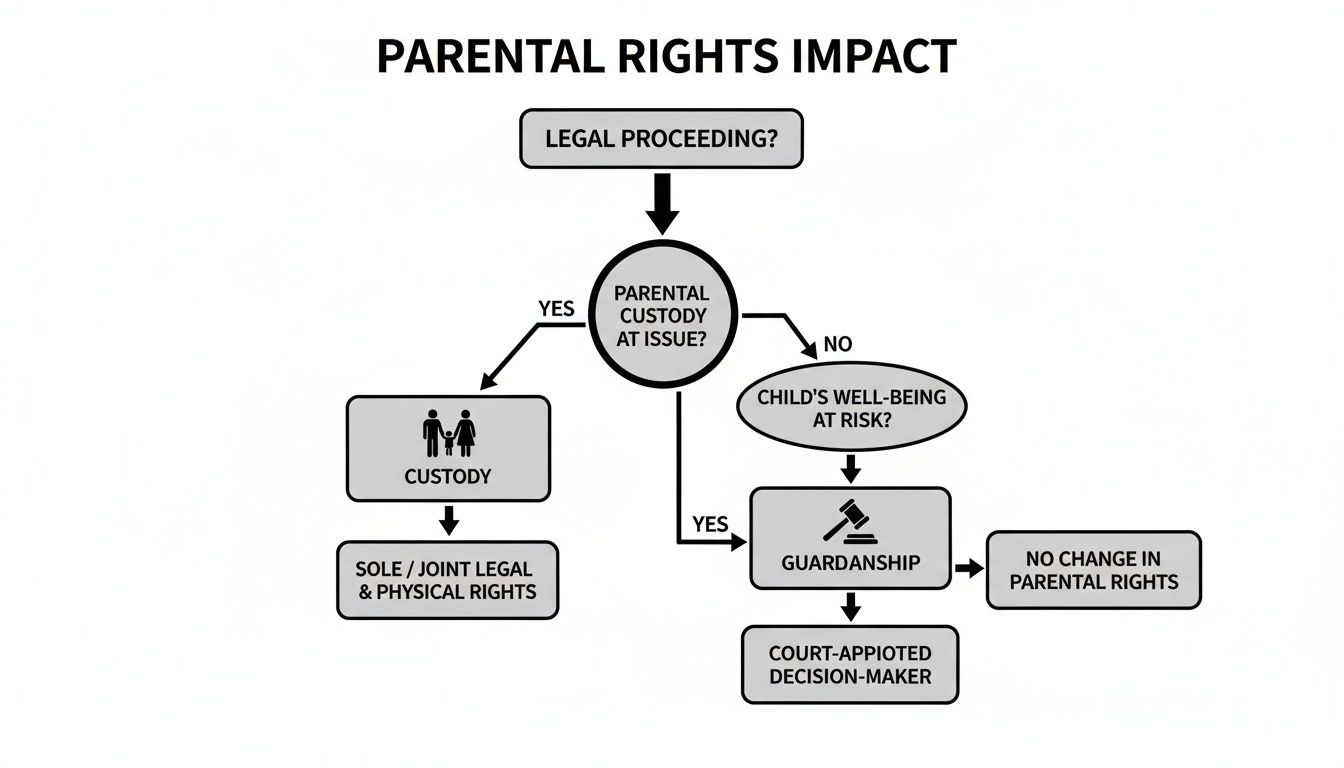
The flowchart makes it crystal clear: custody redefines parental roles, guardianship temporarily suspends them, and only adoption creates a permanent, lifelong change.
Helping Your Family Find the Right Path
Sorting through the maze of family law can feel overwhelming, but you don't have to carry that weight alone. Understanding the real-world difference between legal guardianship and custody is the first, most powerful step you can take to protect a child's future. As we've covered, custody (conservatorship) is about redefining the roles of parents, while guardianship provides a legal shield when parents simply can't be there.
Each of these avenues—conservatorship, guardianship, and adoption—is built for a specific family need. Your family's unique story and your hopes for the child will ultimately point you toward the right legal solution. The one constant is this: every decision must be guided by what is truly in the child's best interest.
Your Next Step Toward Clarity
Here at The Law Office of Bryan Fagan, PLLC, we are dedicated to helping Texas families find not just answers, but peace of mind. Our attorneys have spent years untangling these exact kinds of sensitive family matters, and we pride ourselves on offering clear, compassionate advice that fits your situation. Whether you're a grandparent needing to step in for a grandchild, a stepparent hoping to make your family official through adoption, or parents navigating co-parenting, we're here to support you with experience and genuine empathy.
We believe that every family deserves a clear path forward. Our job is to illuminate that path, giving you the confidence to make informed decisions that protect the ones you love and build a stable, loving home.
You've already taken an important step by learning about your options. Now, let us help you with the next one. We invite you to schedule a free, no-pressure consultation with one of our dedicated family law attorneys. We will listen to your story with compassion, answer your questions in plain English, and help you map out the best possible outcome for your family.
Take that next step to secure your family's future. Contact The Law Office of Bryan Fagan, PLLC today to schedule your complimentary consultation.
Frequently Asked Questions About Texas Family Law
When you're trying to figure out the best way to protect a child in your family, it's natural to have a lot of questions. Below are some straightforward answers to the questions we hear most often from Texas families trying to decide between guardianship and custody.
Can a Grandparent Get Custody Instead of Guardianship in Texas?
Yes, it's possible for a grandparent to get custody, but the legal standard is high. In Texas, a grandparent can file a Suit Affecting the Parent-Child Relationship (SAPCR) to ask the court for conservatorship. To succeed, you must prove to the judge that the child's current home life with a parent would seriously harm their physical health or emotional well-being.
Typically, you also need to show that you've had actual care, control, and possession of the child for at least six months. This standard is often tougher to meet than the one for guardianship, which makes it critical to discuss your specific situation with an attorney to determine which path offers the best chance of success for protecting the child.
How Long Does a Legal Guardianship Last in Texas?
For a minor, a guardianship in Texas generally lasts until one of three things happens: the child turns 18, the child is adopted, or a judge decides the guardianship is no longer needed. A common example of the last one is if a parent who was previously unable to care for the child recovers and proves they are fit to parent again. In that case, the court can dissolve the order and restore the parent's rights.
When the guardianship is for an incapacitated adult, it continues for as long as that person remains incapacitated. Courts keep a close eye on these situations and require guardians to file annual reports to make sure they are always acting in the person’s best interest.
Is Guardianship an Easier Process Than Adoption?
In most cases, setting up a guardianship is a less complicated and less expensive legal process than adoption. The biggest reason for this is that guardianship doesn't require the termination of parental rights—a step that is often the most time-consuming and emotionally charged part of any adoption case.
But it’s important to remember that these two legal actions serve very different purposes.
Adoption creates a permanent, lifelong legal relationship that guardianship does not. The right choice depends entirely on the long-term goals for the child and family, balancing the need for stability with the finality of the decision.
As you navigate these complex decisions, understanding the kind of legal support out there is a crucial next step. You can find helpful information on family law firms to guide you. An experienced attorney can help you weigh all the legal, financial, and emotional factors of both guardianship and adoption to find the right fit.
Every family's story is different. To get clear guidance that’s tailored to your unique circumstances, the compassionate team at The Law Office of Bryan Fagan, PLLC is here to help. Contact us today to schedule a free, confidential consultation and take the next step toward securing your family's future. https://texasfamilyadoption.com
