
When you begin to explore adoption, one of the first questions that comes to mind is often about the financial commitment. The cost for adoption in Texas isn’t a single number; it's a spectrum that can range from nearly zero to $65,000 or more. The final amount depends entirely on the unique path you choose to grow your family.
For many hopeful parents, this is the most daunting part of the journey. Private agency adoptions, for example, typically represent the higher end of that range, while adoptions from the foster care system often come with minimal to no expense for the adoptive family. Understanding what drives these costs is the first step toward creating a confident, achievable plan.
Your Guide to Understanding Texas Adoption Costs
Beginning the adoption journey is an incredibly exciting and emotional time, but it’s natural for financial questions to feel overwhelming. "How much will this cost?" is a practical and important question, and the answer is more of a spectrum than a set price.
This guide offers a clear-eyed, compassionate look at the financial side of adoption in Texas. We’ll break down the three main paths—private agency, foster care, and stepparent adoptions—to demystify why the costs vary so much. Our goal is to empower you with knowledge, helping you move from financial anxiety to confident, informed planning as you take the next step toward building your family.
A Visual Look at Adoption Costs
This chart gives you a quick snapshot of the typical financial commitment for each of the primary adoption paths here in Texas.
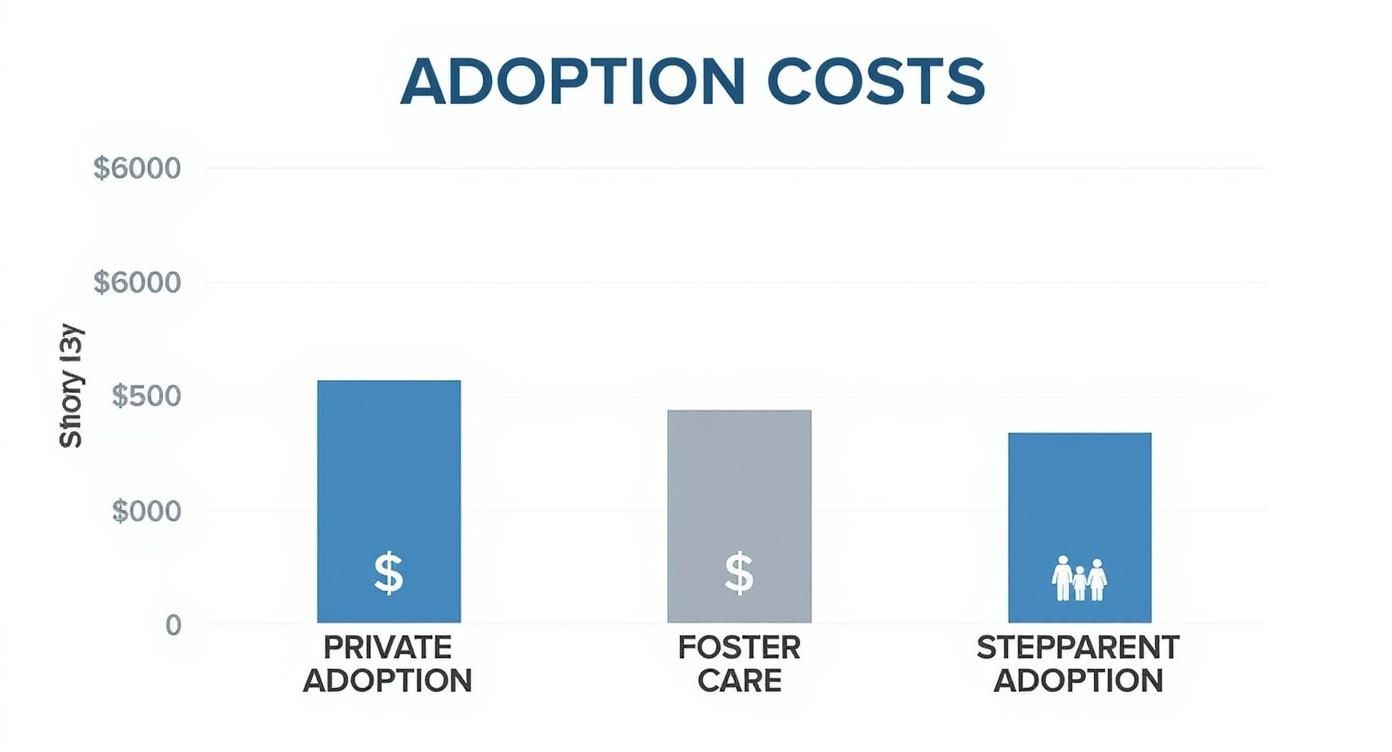
As you can see, the financial investment is dramatically different from one path to the next. This is proof that building a family through adoption is absolutely achievable, no matter your budget. Private adoptions involve significant agency and legal fees, foster care adoptions are supported by the state, and stepparent adoptions mainly consist of legal costs to formalize an existing, loving family bond.
Building a family is a journey of the heart, and understanding the financial road ahead is the first step toward a confident beginning. Every family's situation is unique, and so is their path to adoption.
To give you an even clearer picture, let's compare the typical cost ranges and what those expenses cover.
Estimated Adoption Costs in Texas by Type
| Adoption Type | Estimated Cost Range | Primary Expenses |
|---|---|---|
| Private Agency Adoption | $40,000 – $65,000+ | Agency fees, home study, legal fees, advertising, birth mother expenses, travel. |
| Foster Care Adoption | $0 – $2,500 | Often reimbursed by the state. May include minor fees for fingerprinting or court costs. |
| Stepparent Adoption | $1,500 – $5,000 | Primarily legal fees for terminating the other parent's rights and finalizing the adoption. |
This table highlights the major financial differences, helping you see where your resources might best align with your adoption goals.
Why Do Adoption Costs Vary So Much?
So, what’s behind these wide-ranging numbers? Several key factors influence the final expense of an adoption. Understanding these variables is the best way to prepare for the financial side of your journey and make the right choice for your family.
Here are the main drivers of cost:
- Type of Adoption: As the chart and table show, a private agency adoption has a completely different cost structure than an adoption from the Texas Department of Family and Protective Services (DFPS).
- Legal Fees: Every single adoption must be finalized in court to be legally recognized. These costs cover everything from filing petitions and making court appearances to ensuring every detail complies with the Texas Family Code, protecting the child and your family.
- Agency Fees: With private adoptions, these fees are the engine that runs the process. They cover a huge range of services, like matching you with a birth mother, providing counseling, and offering support throughout the journey.
- Birth Mother Expenses: In some private adoptions, adoptive parents may help cover reasonable living and medical expenses for the birth mother. This support, permitted under Texas law, ensures she and the baby are healthy and safe.
We know this can seem like a lot to take in. Our firm is here to offer reassurance and clarity. Building your family is possible, and we're committed to helping you understand every single step.
Decoding Private Adoption Agency Fees
Choosing a private adoption agency is a rewarding path for many hopeful parents, but it's also the route that typically involves the most significant financial commitment. Seeing a figure between $40,000 and $65,000 can feel daunting, but understanding exactly what those fees cover can turn sticker shock into a clear, actionable plan.
Think of it less as a single price tag and more as a collection of essential services. Each one is designed to support you, the birth mother, and ultimately, the child at the center of this incredible journey. These costs fund the comprehensive support system that makes a private adoption possible, from the first piece of paperwork to the final celebration in a courtroom.

Breaking Down the Core Agency Expenses
When you partner with a private agency, your investment is distributed across several critical areas. Each component plays a vital role in ensuring the adoption is handled ethically, legally, and with the utmost care for everyone involved.
A huge part of the cost for adoption in Texas through a private agency covers the immense effort of connecting hopeful parents with expectant mothers who are considering adoption. This includes:
- Application and Home Study Fees: This is your starting point. It involves an application fee and the cost of the home study—a process required by Chapter 162 of the Texas Family Code to ensure your home is a safe and nurturing place for a child. This is a foundational piece of every single adoption.
- Agency Administrative and Matching Fees: This is often the largest portion of the cost. It covers the agency’s day-to-day operations, staff salaries, outreach to find expectant mothers, and the complex, delicate work of creating a successful match between you and a birth mother.
- Legal Representation: Both you and the birth mother need separate legal counsel to make sure everyone's rights are protected. Agency fees typically include the costs for attorneys who will handle the termination of parental rights and the finalization of the adoption.
These fees essentially build the professional framework needed for a secure and smooth adoption process.
Understanding Birth Mother Support
A crucial and compassionate part of private adoption is providing support for the birth mother. Under the Texas Family Code, adoptive parents can help cover her reasonable and necessary living expenses during her pregnancy and for a short time after birth.
Supporting a birth mother isn’t about "paying for a baby." It’s about providing a stable, healthy environment for her and her unborn child during one of the most vulnerable times of her life. This support ensures she can focus on her well-being without crushing financial stress.
These expenses are always managed by the agency and can include things like:
- Medical and Counseling Costs: This helps cover prenatal care, hospital delivery bills not covered by insurance, and access to independent counseling.
- Living Expenses: This provides assistance with essentials like rent, utilities, groceries, and transportation.
A Real-Life Scenario
Imagine a couple, Sarah and Tom, who begin their journey with a Texas adoption agency. Their total estimated cost is $50,000. Here’s a possible breakdown: $25,000 goes toward agency matching and administrative services, $4,000 is for their home study and legal fees, and $21,000 is set aside in a dedicated fund for the birth mother’s medical care and living expenses. This budget gives them a clear financial roadmap.
The total cost for adoption in Texas can vary, with the average for private domestic adoptions landing between $40,000 and $50,000. That said, some agencies might quote totals as high as $65,000 for their services, which often include more extensive support like post-placement supervision and counseling.
Navigating agency contracts and fee structures can be complex. At The Law Office of Bryan Fagan, PLLC, we can review these agreements to ensure they are fair, transparent, and protect your financial interests. We’re here to turn a complex process into a manageable one, letting you focus on what really matters—preparing to welcome a new child into your life. For a deeper dive into these expenses, you might be interested in our guide on how much private adoption costs in Texas.
The Heartfelt Path of Adopting from Foster Care
For many hopeful parents in Texas, the dream of building a family can feel out of reach because of financial concerns. This is where adopting from the foster care system opens up a beautiful and accessible path forward—one built on love, not large budgets. This journey is centered on finding permanent, loving homes for children in state care, and the state’s support system is designed to make that happen.
When people hear “adoption costs,” their minds often jump to the steep fees of private agencies. But adopting a child from foster care in Texas is a completely different story. It’s a path where your biggest investment is your heart, your time, and your commitment to a child who needs a family.
You won’t see invoices for tens of thousands of dollars. Instead, the focus is on removing financial barriers. This approach, driven by the Texas Department of Family and Protective Services (DFPS), lets you put your energy where it matters most: preparing your home and heart for a new addition, always with the best interests of the child at the forefront.
An Encouraging Story of Family
Take Maria and David, a couple from the Houston area who always dreamed of being parents. They attended an informational meeting about foster care adoption and were deeply moved by the stories of children waiting for a family. Like many, they worried about the cost, but they quickly learned their biggest investment would be emotional, not financial.
Their home study was completely covered. The legal fees to finalize the adoption of their son, Leo, were reimbursed by the state. In the end, their only real out-of-pocket expenses were for minor court filing fees and fingerprinting—adding up to less than a few hundred dollars. Today, their home is filled with Leo’s laughter, a constant reminder that the most valuable things in life have nothing to do with money.
This is a common experience for families who choose this path. The state is so committed to placing these children in permanent homes that it intentionally removes financial hurdles, making this a wonderful and realistic option for so many loving people.
Why Is Foster Care Adoption So Affordable?
The minimal expense is intentional. The state of Texas actively works to remove financial roadblocks so that capable, loving parents can provide a stable home for a child. Most families find they pay very little, if anything, out of pocket.
The typical cost for adopting from foster care in Texas ranges from $0 to $2,500. Even then, these minimal expenses are often reimbursed or subsidized. The Texas Department of Family and Protective Services covers the big-ticket items like the home study and legal representation, making this the most accessible route to adoption.
This powerful support system includes:
- Reimbursement for Non-Recurring Costs: The state will often pay families back for one-time expenses like court fees and attorney costs, up to a certain limit.
- Monthly Financial Subsidies: Many children adopted from foster care, especially those with special needs, are eligible for ongoing monthly financial support to help with their care.
- Medicaid Coverage: Children adopted from foster care typically keep their Medicaid coverage until they turn 18, which takes care of their medical and dental needs.
This web of support is a testament to the state’s dedication to keeping families together and ensuring every child has a chance to thrive. For those who want to dive deeper, we offer a complete overview in our article about adopting from foster care in Texas.
Budgeting for Stepparent and Kinship Adoptions
Adopting a stepchild or another relative—what’s often called a kinship adoption—is a powerful way to make the family bonds you already feel in your heart official in the eyes of the law. These adoptions are unique. You are not bringing someone new into your home; you're formalizing the love and commitment that’s already there. While the journey is deeply personal, it still involves specific legal steps and associated costs.
The good news is that the cost for adoption in Texas for stepparents and relatives is much lower than other routes, typically landing somewhere between $1,500 and $5,000. The expenses are almost entirely legal, focused on navigating the court system to make your relationship with the child permanent and secure.

Key Costs in Relative and Stepparent Adoptions
The financial map for these adoptions is much more straightforward. You can forget about agency matching fees or birth mother expenses. Instead, your budget will center on the legal necessities required by the Texas Family Code.
Here are the main costs you can expect to see:
- Attorney Fees: This is the largest part of the expense. An experienced adoption attorney is your guide through every step, from filing the first petition to representing you at the final court hearing that makes it all official.
- Termination of Parental Rights: For an adoption to proceed, the parental rights of the other biological parent must be legally terminated. This can be done voluntarily, or if the parent is absent or contests the adoption, it may require a more involved legal process.
- Court Filing Fees: Every legal case comes with administrative fees for filing documents with the county court. These are standard procedural costs.
- Social Study or Home Screening: While the court may sometimes waive a full, intensive home study in kinship cases, it often requires a simpler social study to confirm that the adoption is truly in the child's best interest.
A Common Stepparent Adoption Scenario
Let's walk through a common situation. Mark wants to adopt his stepdaughter, Emily. Her biological father has been absent for years and has not provided any financial support.
In this case, Mark's legal team would likely file a single lawsuit that combines the petition to terminate the biological father's rights with the petition for adoption. This is the most efficient and budget-friendly way to handle it. The legal fees would cover drafting and filing all the paperwork, attempting to locate and serve the father, and preparing for the final hearing where the judge officially recognizes Mark as Emily's legal dad. We offer a more detailed look into this journey in our guide to the cost of stepparent adoption.
In a stepparent or kinship adoption, the legal process is the final step in recognizing a family that already exists. It provides the child with the security and legal permanence they deserve.
Budgeting well also means finding ways to free up the necessary funds. To see how you can make steady progress toward your adoption goals, it’s worth checking out some practical monthly savings tips. A little financial planning can make the whole process feel much less stressful, letting you focus on what really matters—your family.
Finding Financial Assistance for Your Adoption
Let’s be honest: the cost of adoption can feel overwhelming. When you see the numbers laid out, it’s easy to feel discouraged, but that price tag should never be the final barrier to giving a child a loving, permanent home.
The good news is you are not alone on this financial journey. Think of it less like a mountain to climb and more like a path with many helping hands along the way. From federal tax credits to state support and private grants, a whole network of resources exists specifically to help families like yours bridge the financial gap. Knowing where to look is the first step.
The Federal Adoption Tax Credit
One of the biggest financial tools available to adoptive families is the federal Adoption Tax Credit. For 2024, the maximum credit is a significant $16,810 per child. This isn’t a small amount—it’s designed to directly offset the real costs of bringing a child into your family.
This credit can be applied to what the IRS calls "qualified adoption expenses," which includes most of the major costs you'll encounter:
- Agency and attorney fees
- Court costs
- Travel expenses, including your meals and lodging
- Other fees directly tied to the legal adoption
One crucial thing to understand is that this is a credit, not a refund. It directly reduces your federal income tax bill, potentially down to zero, but you won’t get a check back for any amount beyond what you owe in taxes. Because everyone's financial picture is different, it’s always a smart move to chat with a tax professional to see exactly how this credit will work for you.
State Support and Subsidies
Here in Texas, the state is deeply committed to finding permanent homes for children in the foster care system. Because of that commitment, adopting from foster care is the most affordable path—often with little to no cost to the family—and comes with substantial financial support.
"The goal of the state is to unite children with loving families, not to create financial burdens. The support systems in place for foster care adoptions reflect a deep commitment to the child's best interest."
If you adopt from foster care, you may be eligible for several layers of assistance:
- Reimbursement of Non-Recurring Expenses: The state will often pay you back for one-time costs like legal fees and court filing fees, up to a certain limit.
- Monthly Adoption Assistance Payments: Many children adopted from foster care, especially those with special needs, qualify for a monthly subsidy. This payment helps with their ongoing care until they turn 18.
- Medicaid Coverage: The vast majority of children adopted from DFPS keep their Medicaid benefits, which is a huge relief for families, ensuring medical and dental needs are covered.
Employer and Private Grant Programs
Beyond government programs, don’t overlook the support that might be available right in your own workplace or through private organizations. These programs can provide thousands of dollars in aid, taking a huge bite out of your total adoption costs.
- Employer Assistance: More and more companies are offering adoption benefits as part of their standard employee packages. This could be anything from a few thousand dollars to over $25,000 in direct reimbursement for your expenses. It’s absolutely worth a conversation with your HR department to see what your company offers.
- Adoption Grants: This is a big one. Dozens of non-profit organizations and foundations offer grants specifically to help families with adoption costs. The best part? Grants don't have to be repaid. Groups like HelpUsAdopt.org, the National Adoption Foundation, and the Gift of Adoption Fund are incredible places to begin your research. Getting these grants can be competitive, but for many families, they are the key that makes adoption possible.
The road to adoption is a journey of the heart. By exploring these financial avenues, you can put your focus back where it belongs: on preparing your home and your life for a new child.
Navigating all these options can feel like a lot, but you don't have to do it alone. Below is a table summarizing the key resources to help you get started.
Financial Resources for Texas Adoptive Families
This table breaks down the primary sources of financial aid available to you, what they cover, and where you can begin your search.
| Resource Type | What It Typically Covers | Where to Find Information |
|---|---|---|
| Federal Tax Credit | Agency fees, legal costs, travel, and other qualified expenses up to the annual maximum. | IRS Topic No. 607, Adoption Credit and consult a tax professional. |
| State Subsidies (Foster Care) | Monthly payments for child's care, reimbursement for legal fees, and ongoing Medicaid coverage. | The Texas Department of Family and Protective Services (DFPS). |
| Employer Benefits | Direct financial reimbursement for adoption expenses, paid leave. | Your company’s Human Resources (HR) department. |
| Private Grants | Varies by organization; can cover a wide range of costs from home studies to travel. | Websites like HelpUsAdopt.org, the National Adoption Foundation, and others. |
Remember, each of these resources is a potential piece of your financial puzzle. Taking the time to research and apply for them can make all the difference. The team at The Law Office of Bryan Fagan, PLLC is here to provide the legal guidance you need, ensuring you can build your family with confidence and peace of mind.
How an Attorney Can Help Manage Adoption Costs
Navigating the financial side of adoption can feel like you're trying to solve a puzzle with a thousand moving pieces. Hiring an experienced adoption attorney is like bringing in an expert to be your guide, making sure every piece fits together correctly and cost-effectively. Their role goes far beyond just filing paperwork; they are your advocate, your strategist, and your most trusted advisor.
An attorney provides that critical oversight, helping you see around corners to anticipate expenses and avoid the kind of costly surprises that can derail your journey. This legal guidance is invaluable when you're reviewing contracts from private adoption agencies. A lawyer can scrutinize the fine print, spot potential hidden fees, and ensure the financial terms are transparent and fair, protecting your family’s investment from day one.
When you bring legal counsel on board, it's also helpful to understand the protections offered by attorney-client privilege rules. This confidentiality is key, as it means you can be completely open about your financial situation, which allows your attorney to give you the most effective advice.
Providing Financial Clarity and Efficiency
A knowledgeable attorney helps keep the cost for adoption in Texas under control by making the legal process as efficient as possible. They have a deep understanding of the Texas Family Code and know how to navigate the court system to prevent unnecessary delays or procedural mistakes that can quickly drive up legal fees.
An attorney's goal is to provide a clear, predictable path to finalization. By managing the legal complexities with expertise, they empower you to focus on preparing your heart and home for your new child, rather than worrying about unexpected legal bills.
For instance, in a stepparent adoption, an attorney can streamline the process of terminating the other biological parent's rights and finalizing the adoption. They'll often handle this within the same legal action to save both time and money, a procedure outlined in Chapter 162 of the Texas Family Code.
Your Compassionate Legal Partner
At The Law Office of Bryan Fagan, PLLC, we see ourselves as more than just legal representatives. We are your partners in this incredible journey of building your family. Our compassionate, educational approach means we take the time to explain every single step, making sure you feel confident and in control of the financial side of your adoption. The best interests of your future family will always be our top priority.
We truly believe that with the right guidance, the adoption process can be a joyful and financially manageable experience. If you are considering adoption, we invite you to schedule a free, no-obligation consultation with our team. Let us help you understand the costs and create a clear plan to build your family with confidence.
Common Questions About Texas Adoption Costs
As you begin to seriously consider adoption, it is completely normal for a lot of questions about the financial side of things to come up. Getting clear, straightforward answers is the best way to feel confident and prepared. We've put together some of the most common questions we hear from hopeful adoptive parents about the cost for adoption in Texas.

This process is a journey of the heart, and feeling secure in your budget allows you to focus on what truly matters: preparing to welcome a child into your home and family.
What Is the Single Biggest Expense in a Private Adoption?
In most private agency adoptions, the biggest line item is the agency's administrative and matching fee. This is a comprehensive fee that covers the immense and delicate work of finding and screening potential birth mothers, providing them with critical counseling and support, and managing all the complex legal details to make the placement happen.
While those agency fees are usually the most significant fixed cost, the birth mother's living and medical expenses can also be a major variable. These costs are completely dependent on her individual needs during her pregnancy.
Does the Federal Adoption Tax Credit Cover All My Expenses?
The Adoption Tax Credit is an incredible resource, but it's important to know how it actually works. The credit is non-refundable. This means it can reduce your federal tax liability, even down to zero, but it will not result in a cash refund beyond what you owe in taxes.
It covers a wide range of qualified adoption expenses—things like agency fees, court costs, attorney fees, and travel. However, because there are income limits and everyone's tax situation is different, it is always a smart decision to talk with a financial advisor to see exactly how the credit can benefit your family.
Think of the tax credit as a powerful tool to recover a significant portion of your costs after the fact, rather than an upfront payment that covers everything. Proper planning is key to maximizing its benefit.
Are There Any Hidden Costs I Should Be Aware Of?
Reputable agencies and attorneys will always aim for full transparency, but some costs can arise that you might not have planned for. They aren't so much "hidden" as they are "variable," changing based on the specifics of your adoption journey.
Here are a few potential costs to keep in your budget:
- Post-Placement Supervision Fees: After your child is home, Texas law requires several follow-up visits before finalization. Some agencies charge a fee for these services.
- Travel and Lodging Expenses: If you match with a birth mother in another city or state, you'll need to budget for flights, a place to stay, and meals during the placement and any required waiting periods.
- Home Study Updates: A Texas home study is generally valid for one year. If the matching process takes longer, you will need to pay for an update.
A dedicated adoption attorney can help you spot these potential variables from the very beginning. By carefully reviewing your agency agreement, they can help ensure there are no surprises down the road.
Building your family through adoption is one of life's most profound experiences, and you shouldn't have to navigate the financial questions by yourself. At The Law Office of Bryan Fagan, PLLC, we're here to provide the compassionate legal guidance you need to move forward with clarity and confidence. Schedule a free consultation with our team today to talk about your unique path to adoption.
