
Yes, you can adopt a child in Texas without going through an agency. In many cases, that path is completely lawful, but it shifts more responsibility onto you and your attorney to make sure every legal step is handled correctly.
For many families, this question comes up at a very personal moment. A stepfather has been packing lunches and showing up for school pickups for years. A grandmother has become the steady parent in a grandchild's life. An expectant mother already knows the family she wants to choose and doesn't want a full agency match.
If that sounds like your situation, you're not asking for a shortcut. You're asking whether Texas law allows a more direct path to make a real family bond legally secure. The answer is yes. The important part is understanding what changes when an agency is not involved, what stays the same, and where legal guidance matters most.
Yes You Can Adopt in Texas Without an Agency
A lot of Texas families reach this point after life has already made the relationship clear. The child is already in your home, already calling a stepparent by a parent name, or already connected to an expectant mother who knows exactly whom she wants to choose. The legal question is whether Texas allows you to complete the adoption without hiring an agency to stand in the middle.
It does.

For families considering a direct match, this usually falls under what people call private adoption in Texas. Texas law allows that path in the right circumstances. The court still decides whether the adoption can be approved.
The part that causes confusion is not whether an agency is required. The key change is who carries the work.
An agency often helps with screening, paperwork flow, communication, timing, and making sure each stage happens in the proper order. Without that structure, the adoptive parents and their attorney take on those jobs themselves. Your attorney handles the legal side, such as consents, petitions, termination issues, court filings, and finalization. Your family may still be responsible for gathering records, completing required evaluations, responding quickly to requests, and making careful decisions about contact and timing. In other words, removing the agency does not remove the process. It transfers more responsibility, and more risk, directly onto the family and the lawyer guiding the case.
That shift matters because adoption law is a little like building a house from an approved plan. You may not need a general contractor for every project, but the permits, inspections, and sequence still matter. If one approval is missing or one document is signed too early, too late, or in the wrong form, the court may delay the case or refuse to finalize it until the problem is corrected.
A stepparent adoption shows this clearly. Everyone in the home may feel ready, and emotionally that makes sense. Legally, the court still has separate questions to answer.
- Has the other parent consented, or must their rights be terminated?
- Was the petition prepared and filed correctly?
- Does the child's consent need to be obtained?
- Have the required supporting documents been submitted to the court?
Those are not agency questions. They are case questions, and someone still has to answer them correctly.
Texas also has rules that surprise many families. A married petitioner generally must have a spouse join the petition. A child who is 12 or older generally must consent unless the court waives that requirement in the child's best interest. Some adoptions may proceed after one parent's rights are terminated and the other parent consents, but only if the legal requirements for that situation are met.
That is why legal guidance becomes more important in a non-agency adoption, not less. An agency may no longer be organizing the process, but the stakes stay the same. Your family is asking the court to create a permanent legal parent-child relationship, and the path still has to be handled with care.
Understanding Your Path Types of Non-Agency Adoptions
When people ask, “Can you adopt a child without going through an agency in Texas?” they're often talking about one of three situations. Each has a different emotional starting point, but all can involve a direct, court-based process.
Independent or private adoption
An independent adoption usually means the adoptive parents and birth parent or birth parents connect directly rather than through a full-service agency. Texas permits this kind of path, and the focus stays on whether parental rights are properly handled and court requirements are met, not on whether an agency was involved.
A simple example is an expectant mother who already knows the couple she wants to place her child with. The relationship may come through friendship, family, church, or another personal connection. In that setting, the attorney often becomes the coordinator for consents, filings, and finalization instead of an agency caseworker.
Families comparing this option often start with a closer look at private adoption in Texas.
Stepparent adoption
Stepparent adoption is one of the clearest examples of a non-agency adoption. There usually isn't any need for matching services because the child is already part of the home.
A typical situation might look like this:
| Family situation | What usually needs legal attention |
|---|---|
| A stepparent has raised the child for years | Consent or termination of the other parent's rights |
| The child sees the stepparent as a parent already | Whether the child's consent is required |
| The married couple wants legal unity | Petitioning together and final court approval |
This path can feel emotionally obvious to a family. Legally, though, it still requires careful work. Love in the home does not replace court findings.
Kinship or relative adoption
Kinship adoption often involves grandparents, aunts, uncles, siblings, or other relatives who stepped in when a child needed stability. These cases can feel urgent because the caregiving relationship may already be established long before anyone starts thinking about adoption paperwork.
For example, a grandmother may have been handling school, medical appointments, and bedtime for a long time. Everyone may say, “She's basically the parent.” Adoption is the step that gives that reality legal protection.
In many relative adoptions, the family bond is already there. The legal task is turning day-to-day caregiving into a permanent parent-child relationship recognized by the court.
Which path fits your family
A short way to think about it is this:
- Independent adoption often starts with a direct connection between birth and adoptive parents.
- Stepparent adoption formalizes an existing parent-child bond inside a marriage.
- Kinship adoption gives a relative permanent legal status after stepping in to care for the child.
The path may differ, but the same basic truth remains. If there's no agency, your family and your lawyer must take the lead in organizing the case.
The Required Legal Journey for All Texas Adoptions
The biggest misunderstanding in direct adoption cases is simple. People hear “without an agency” and assume that means “with fewer rules.” It doesn't.
Texas allows private adoption without an agency, but the process becomes more attorney-led. According to Texas Adoption Center's discussion of do-it-yourself adoption in Texas, adoptive parents in this path must still be at least 21, be financially stable, and complete a home study along with criminal and child-abuse background checks. The safeguards stay in place. What changes is who coordinates them.
The core legal steps
Most Texas adoptions, whether agency-based or direct, involve the same basic legal stages:
- Filing the petition with the court.
- Completing a home study or other required screening.
- Running background checks for adults in the home.
- Addressing parental rights, either through consent or termination.
- Attending a court hearing for final approval.
- Completing any post-placement requirements the court or case requires.
If you want to understand one of the most commonly confusing steps, this guide to Texas adoption home study requirements can help.
Termination and consent are often the hardest part
In many cases, the emotional center of the adoption is not the final hearing. It's the question of the birth parents' legal rights.
Some rights are ended through voluntary consent or relinquishment. Other cases require the court to terminate rights when consent is not available or legal grounds exist. Families often feel nervous here because this stage can affect timing, conflict level, and whether the case stays straightforward or becomes contested.
A hopeful stepparent might say, “The other parent hasn't been involved in years, so this should be easy.” Sometimes it is. Sometimes the legal proof is more involved than the family expected. That's where preparation matters.
A direct adoption is often less about doing less paperwork and more about making sure every piece of paperwork is legally sound.
Here's a visual overview of that legal path:
What the attorney takes on when there is no agency
Without an agency, your lawyer often helps manage tasks that a family may not realize are separate jobs:
- Document control: collecting consents, orders, reports, and supporting records
- Sequence management: making sure steps happen in the proper order
- Court preparation: filing the petition and preparing for finalization
- Problem spotting: identifying missing signatures, notice issues, or gaps in the record
The Law Office of Bryan Fagan, PLLC handles matters such as adoption petitions, consent issues, home study preparation, and court finalization for Texas families exploring these routes.
That's why direct adoption isn't “do-it-yourself” in the casual sense. It's more accurate to think of it as family-led, lawyer-guided.
Agency Facilitated vs Direct Adoption Weighing the Pros and Cons
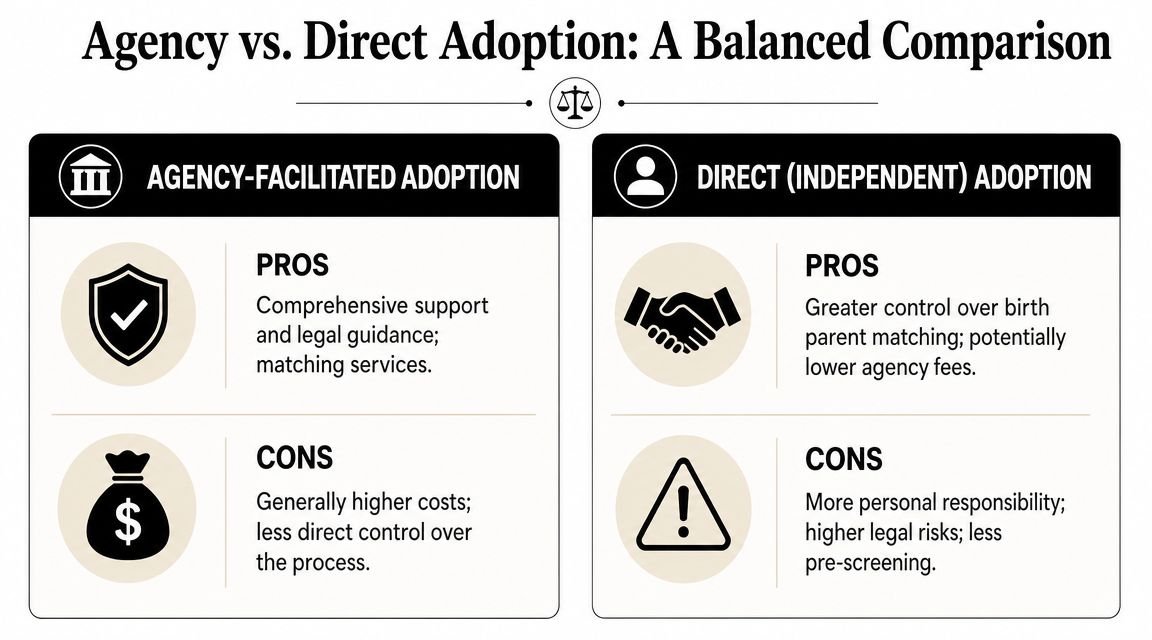
Some families need a full support system. Others already have the connection in place and mainly need legal structure. The difference between agency-facilitated and direct adoption often comes down to who is managing the moving parts.
Think of the agency as a project manager
A full-service agency often helps with screening, matching, education, communication, and process tracking. For some families, that support reduces stress because they don't have to coordinate every task themselves.
A direct adoption is different. The family and attorney take on much more of that project-management role. That can be a very good fit when the relationship already exists, such as in a relative or stepparent case.
Side by side comparison
| Issue | Agency-facilitated adoption | Direct attorney-led adoption |
|---|---|---|
| Matching support | Usually included | Often up to the parties |
| Coordination | Agency usually tracks many moving parts | Family and attorney usually coordinate |
| Communication | Often filtered through agency staff | More direct contact may occur |
| Control | More structure from the agency | More control by the adults involved |
| Risk of missed steps | Agency may help catch process problems | Attorney oversight becomes more important |
When direct adoption can feel simpler
Direct adoption can be more straightforward when:
- The child is already in your life: common in stepparent and kinship cases
- The adults already know each other: there may be less need for matching services
- Everyone agrees on the goal: consent and cooperation often reduce friction
In those situations, families sometimes prefer a more personal process. They may want less distance between the adults involved and more say over how communication happens.
Where the pressure increases
The tradeoff is responsibility.
Without an agency, the family may need to take a more active role in:
- Locating providers: such as home study professionals
- Tracking deadlines: including court and filing requirements
- Managing communication: especially if emotions are high
- Responding to complications: when a consent issue, missing parent, or contested right appears
The direct path can offer more control. It also leaves less room for casual mistakes.
That doesn't mean direct adoption is risky for every family. It means the risk shifts. Instead of paying an agency to organize the process, the family takes on more of the coordination burden and depends more heavily on legal guidance.
The Reality of Timelines and Costs in a Direct Adoption
A family often comes in believing one thing: if no agency is involved, the adoption should move faster and cost less. Sometimes part of that is true. Fewer middle layers can mean fewer moving parts. But in a direct adoption, the work does not disappear. It shifts.
That shift matters.
In an agency case, part of the timeline is managed by the organization coordinating the file, the contacts, and the required steps. In a direct case, much of that coordination falls on the adoptive parents and their attorney. If one item stalls, the whole matter can pause while everyone catches up.
According to Angela Adoption's discussion of Texas adoption wait times, a typical adoption in Texas can take about 9 months to 3 years. That same source notes that domestic infant adoptions commonly take 12 to 24 months, while foster care adoptions often take 9 to 18 months or longer, depending on issues such as termination of parental rights.
Why one direct adoption moves quickly and another does not
The calendar usually turns on the legal condition of the case, not just the label "direct adoption."
A cooperative stepparent adoption may move at a steady pace because the child is already in the home, the adults know the plan, and the remaining legal steps are clear. A private adoption can take much longer if a consent is delayed, a father must be identified or served, or a home study cannot be scheduled promptly. Court calendars matter too. Even a well-prepared case still needs a hearing date.
Adoption timing works a lot like building a house. The visible part is the final result. The actual pace depends on whether the foundation, permits, inspections, and signatures are all in place in the right order.
Common causes of delay include:
- Parental rights questions: whether consent is signed, valid, and complete
- Missing or incomplete records: birth information, prior orders, or required disclosures
- Home study timing: scheduling, corrections, and final approval
- Notice and service issues: especially if a parent is absent or difficult to locate
- Court scheduling: finalization waits on the court's docket, not just the family's readiness
For readers weighing the financial side, this guide on how much private adoption costs in Texas gives a helpful overview of the expense categories families often face.
A direct adoption can still be expensive
Skipping an agency fee does not mean skipping adoption costs. It means the bill is usually spread across separate providers and legal tasks instead of bundled through one organization.
Families are often surprised by that. They expect a shorter invoice because there is no agency in the middle. What they see is a series of smaller charges tied to different parts of the case.
A direct adoption may still involve:
| Common expense area | Why it may apply |
|---|---|
| Attorney fees | Preparing filings, reviewing consents, addressing legal problems, and finalizing in court |
| Court costs | Filing the case and completing required court steps |
| Home study | Often required, even without an agency |
| Background checks | Screening and approval requirements may still apply |
| Case-specific legal work | Service, publication, searches, amended pleadings, or extra hearings |
Some cases stay fairly modest. Others become more expensive because one unresolved issue creates more attorney time, more filings, or more delay.
Where families usually misjudge the risk
Families rarely get into trouble because they do not care. They get into trouble because direct adoption can look simpler from the outside than it feels once the paperwork starts.
One signature may need to be redone. One affidavit may not say enough. One parent may be harder to locate than expected. One hearing may be reset.
Those are not dramatic problems. They are process problems. Yet process problems affect both time and cost, and in a direct adoption, there is no agency stepping in to keep the file moving day by day. That is why legal guidance becomes more important, not less. The attorney is not only filing papers. The attorney is helping the family carry the coordination work that an agency might otherwise handle.
Your Checklist for Starting a Direct Adoption in Texas
A family often reaches this stage with a mix of hope and nerves. They may already know the child, may already feel like a parent in daily life, and may assume the legal part is just paperwork. In a direct adoption, that is the moment to slow down and get organized, because the work an agency might have handled now shifts to you and your attorney.
A good checklist does more than keep papers in one folder. It helps you spot problems early, before a missed consent, an unanswered question about parental rights, or a filing mistake turns a hopeful plan into a delay.
Start by naming the case correctly
The first question is simple, but it matters more than families expect. What kind of adoption is this?
A stepparent adoption, kinship adoption, and independent private adoption can all be called "direct" adoptions in casual conversation. Legally, they do not always follow the same path. The right label affects what consents are needed, whether a termination case must happen first, what screenings may apply, and what the court will want to see.
Start with these questions:
- What type of adoption is this: stepparent, kinship, or independent private adoption
- Whose parental rights must be addressed: consent, relinquishment, or court termination
- Does the child have a legal voice in this case: in some situations, yes
- Are all adults prepared for a formal court process: not just a family understanding
If you are unsure about one of those answers, that is not a sign your case is weak. It usually means the legal map has not been drawn yet.
Build two lists. What you have, and what you do not know.
Families often feel calmer once they can see the case on paper.
First, gather the records your attorney is likely to request. Depending on the situation, that may include identification documents, the child's birth information, marriage or divorce records, prior court orders, and details about where the child has been living.
Then make a second list of open questions. This step is easy to skip, but it is often the most useful one.
Your "unknowns" list might include:
- a parent whose location is unclear
- uncertainty about whether a consent will be signed
- older custody or child support orders
- questions about the proper county for filing
- missing dates or incomplete background information
That second list matters because direct adoption transfers a lot of coordination work away from an agency. Your attorney can solve legal problems more efficiently when the unknowns are identified early instead of surfacing one by one in the middle of the case.
Families often get stuck because one legal step was assumed instead of confirmed.
Prepare for the child-protection steps the court still requires
A direct adoption does not remove the safeguards built into Texas law. It means no agency is managing those steps for you behind the scenes.
Your checklist should include:
- Confirm that the adoptive parent or parents meet the basic requirements.
- Ask whether a home study is required in your case, and schedule it early if it is.
- Complete background checks or other screening steps the court expects.
- Identify whether consent will be voluntary, or whether termination of parental rights must be requested.
- Plan the filing sequence so each step happens in the right order.
That order matters. Adoption cases are a bit like building a staircase. If one lower step is missing, you cannot safely stand on the next one.
Treat legal help as part of the structure of the case
This is often the biggest mental shift for families pursuing a direct adoption. Without an agency, legal counsel is not just helpful at the end when it is time to finalize. Legal counsel helps hold the process together from the beginning.
Your attorney may be the person who:
- checks whether the case is being filed in the right court
- reviews whether a consent or relinquishment meets legal standards
- flags missing parties or notice problems
- coordinates the sequence of filings and hearings
- helps prevent avoidable delays that come from incomplete paperwork
In other words, you are not only hiring someone to file forms. You are assigning the case-management role that an agency often carries in other adoptions.
For many stepparents, relatives, and families with a real existing connection to the child, a direct adoption can be the right fit. The strongest start usually looks the same, though. Clear questions. Clear records. Clear legal guidance. That combination gives the court a more stable picture and gives your family more confidence about each next step.
If you're considering a direct, private, stepparent, or kinship adoption, a conversation with Law Office of Bryan Fagan, PLLC can help you understand your options and the legal steps that apply to your family. A free consultation can give you a clearer path forward, answer your questions about consent, home studies, and finalization, and help you move toward a secure adoption with confidence.
