
A phone call, a text, or a notice from the court can turn an ordinary day upside down. One moment you're worrying about your grandchild, and the next you're hearing that someone may adopt them. For many grandparents, the first reaction is immediate and human: How do I stop this?
That question usually comes from love, fear, and a real desire to protect a child. You may have helped raise your grandchild. You may have watched them after school, taken them to doctor visits, or stepped in when their parents couldn't. So when adoption enters the picture, it can feel like the ground is shifting under your feet.
Texas law, though, doesn't decide these cases based on love alone. It looks at legal rights, court orders, and whether a person has the legal ability to ask the judge for anything in the first place. That's where many grandparents get blindsided.
A Grandparent's Love and a Difficult Question
A grandmother learns that her grandson has been living with another family for months. She has birthday cards saved in a drawer, photos on her phone, and memories of rocking him to sleep when he was a baby. Now she hears that an adoption may be moving forward. Her first thought isn't legal. It's personal. He's my grandchild.
That feeling makes sense. Grandparents often step in during the hardest chapters of a family's life. They fill the gaps, offer stability, and try to keep a child connected to family history. When adoption appears on the horizon, it can feel less like a court process and more like a permanent goodbye.

Why this question is so painful
Grandparents usually aren't asking about paperwork. They're asking whether the law will recognize the role they've played in a child's life.
Some are worried about being cut off completely. Others want to raise the child themselves. Some want the judge to hear their side before anything becomes final.
Here's the hard truth in plain language: Can grandparents stop an adoption in Texas? Sometimes they can raise concerns, but many cannot block the adoption on their own just because they are grandparents. The answer depends on something far more technical than most families expect.
Practical rule: In these cases, the first question usually isn't “What do you want?” It's “Do you have the legal right to ask the court for it?”
Where grandparents often get confused
It's easy to assume that a biological relationship gives you an automatic place in court. Texas law doesn't work that way. A grandparent may have a meaningful bond with a child and still face major legal limits.
That doesn't mean your concerns don't matter. It means the court has a specific gatekeeping system. To understand what a grandparent can do, you have to start with the legal foundation that shapes every adoption case in Texas.
The Legal Foundation The Best Interest of the Child
Texas courts focus on the best interest of the child. In plain English, that means judges look for a safe, stable, and lasting outcome for the child, not merely the outcome that feels fairest to the adults involved.
That principle matters because adoption is about permanence. Courts generally want children to have legal clarity about who their parents are, who can make decisions for them, and where they will grow up. In contested situations, the law tends to protect a child's need for stability.
Why parental rights matter so much
Before most adoptions can be finalized, the legal rights of the child's parents must be addressed. Those rights don't vanish because a relative disagrees with how the family is functioning. A court has to deal with them directly.
Texas Law Help explains that in Texas, grandparents generally can't stop an adoption once the child's legal parent-child ties are being severed through a court-ordered termination of parental rights. It also explains that once the legal relationship ends, an adoption can proceed if the court approves it, and grandparent visitation rights under Texas Family Code Section 153.433 typically require that at least one parent still have legal rights, as discussed in this Texas adoption and Family Code guide for parents and in Texas Law Help's explanation of termination of parental rights.
Think of termination of parental rights like the legal severing of a branch from a family tree. Once that branch is cut by court order, many legal claims connected to that branch disappear too.
What happens in the adoption process
Texas adoption cases often move through a sequence that families don't always see clearly at first:
- Parental rights are addressed: The court must resolve whether each parent's legal rights remain in place.
- The adoption petition is reviewed: The prospective adoptive family asks the court to approve the adoption.
- The court evaluates permanence: The judge looks at whether the adoption serves the child's best interest.
Chapters 162 through 166 of the Texas Family Code govern adoption-related procedures, including the legal framework for adoption itself, required consents, and related court processes. In many cases, families also encounter practical steps such as home studies, background checks, and final hearings before an adoption becomes complete.
A loving grandparent may feel like the obvious safe choice. The court still asks a different question first: who has legal rights, and what result gives this child a permanent, stable home?
That's why emotion alone usually won't stop an adoption. The law starts with legal parentage, then moves to standing, proof, and the child's long-term welfare.
The First Hurdle Gaining Legal Standing to Intervene
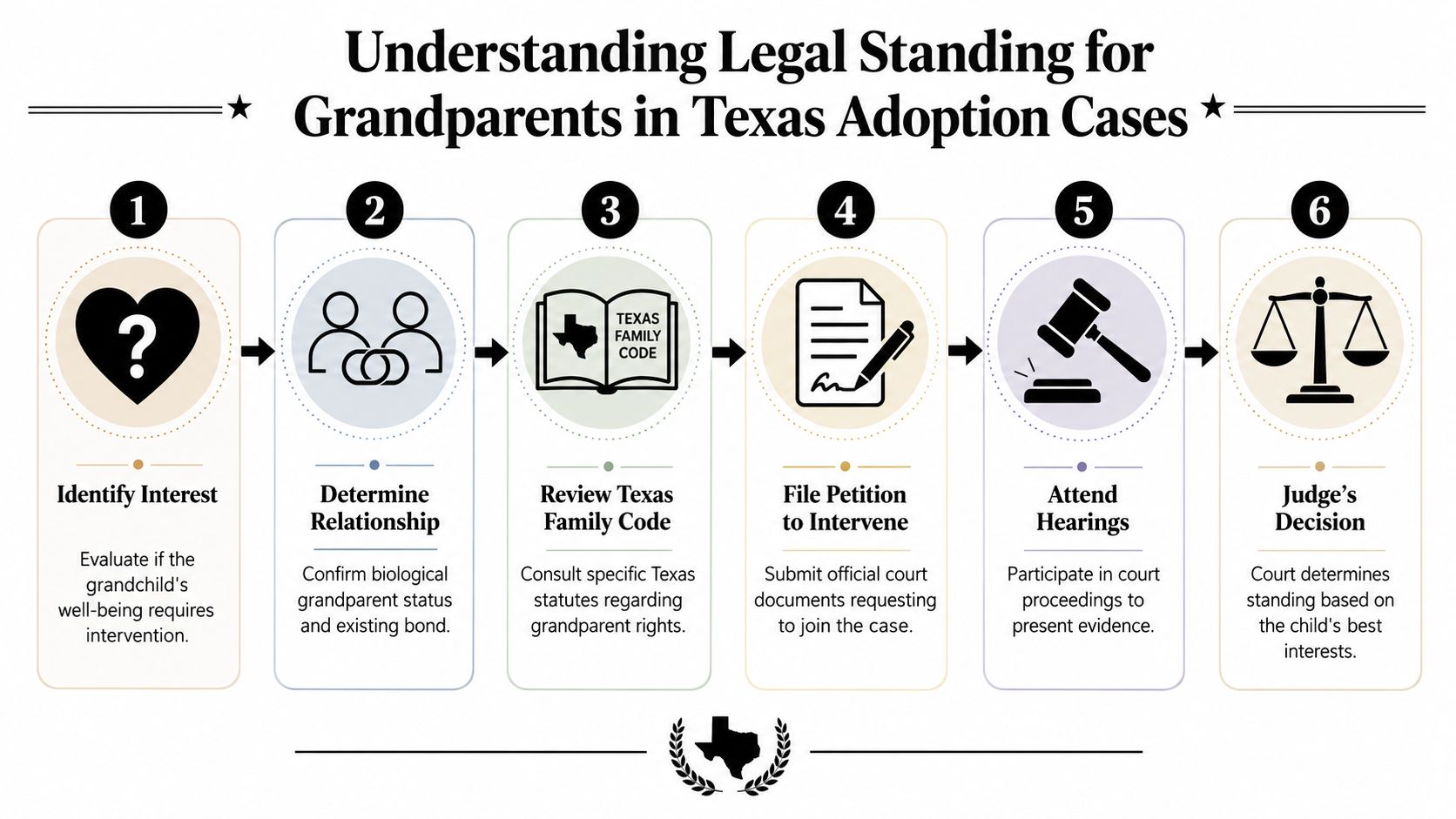
The word standing sounds abstract, but the idea is simple. Standing is your ticket to the courthouse. If you don't have that ticket, the judge may never reach your concerns, no matter how heartfelt or sincere they are.
A lot of grandparents miss this step. They assume the court will hear them because they are family. Texas law is narrower than that.
The Texas State Law Library explains that grandparents may request possession or access only if they meet statutory standing requirements under the Texas Family Code. That means many grandparents can't even get into court to ask for visitation or custody, which is why this overview of legal rights for grandparents is often a useful starting point, along with the State Law Library's guide to grandparent visitation and standing.
Standing is not the same as love
A useful analogy is a concert ticket. You may care a great deal about the performance. You may know the singer personally. But without a ticket, security won't let you in.
Court works much the same way. A grandparent needs a legal basis to file a case or step into an existing one. Blood relation alone usually isn't enough.
What can create standing
Texas statutes set specific rules. One frequently cited rule involves a six-month caregiving threshold within the last 90 days for some custody-related claims. In other words, some grandparents may have standing if they had actual care, control, and possession of the child for that period described by statute.
That doesn't mean every caregiving grandparent automatically wins. It means they may have the right to ask the court to listen.
Here are common situations that may matter:
- You have been acting as a day-to-day caregiver: If the child lived with you and you handled ordinary parenting tasks, that may affect standing.
- A parent still has legal rights: Some grandparent visitation claims depend on at least one parent still having rights.
- You are trying to intervene early: Waiting until the case is nearly over can make your position harder.
What standing does and doesn't do
Standing opens the courthouse door. It does not decide the case for you.
A grandparent with standing still has to prove why the court should grant visitation, possession, or another form of relief. But without standing, the judge may never reach those arguments.
The real first hurdle in many Texas adoption disputes isn't whether a grandparent loves the child enough. It's whether the law recognizes a right to be heard at all.
That's why timing matters. If you believe you've been serving as a real caregiver, or you think you may qualify under the Texas Family Code, it's important to get legal guidance before the adoption moves farther along.
How Your Rights Change in Different Adoption Scenarios
Not every adoption case looks the same. A grandparent's options often depend on how the case began, who currently has legal rights, and whether the grandparent is trying to preserve family placement or stop a nonrelative adoption.
Three common paths
In a CPS or foster care adoption, grandparents may sometimes have a more active role because family placement can be part of the broader conversation about the child's future. If a grandparent is already caring for the child or is being considered as kinship placement, the grandparent may have a practical opportunity to step forward earlier.
In a private adoption, the room for intervention is often much narrower. If the legal parents consent and the court process moves forward, a grandparent may have very little ability to object unless they already have a legally recognized basis to be involved.
A stepparent adoption often feels different emotionally. The child may already be living with one parent and a stepparent who wants to become the child's legal parent. In those cases, grandparents sometimes assume they can object because the child is staying “in the family.” But legal rights still depend on the structure of the case, not family sentiment.
| Adoption Type | Potential for Grandparent Intervention | Key Factor |
|---|---|---|
| CPS or foster care adoption | Sometimes stronger if the grandparent is already a caregiver or seeks kinship placement | Early involvement and legal status in the case |
| Private adoption | Often limited | Whether the grandparent has standing before the case advances |
| Stepparent adoption | Often limited, but fact-specific | Whether parental rights remain intact and whether the grandparent has a legal basis to intervene |
A simple way to think about it
Ask two questions.
First, am I already legally connected to the case in a meaningful way?
Second, is there still a parent whose legal rights keep my claim alive?
Those questions also come up in other child-centered systems. For parents trying to understand rights and school-based protections, this guide on understanding 504 and ADA differences can be a helpful example of how legal categories shape what a family can request.
Practical examples
A grandmother caring for a child during a CPS case may have a real opportunity to ask the court to consider her home. A grandmother who learns of a private adoption after parental rights have already been resolved may find the law gives her little room to act.
A grandfather in a stepparent adoption might hope to preserve visitation. Whether that remains possible can depend heavily on whether at least one legal parent's rights are still in place and whether he can meet standing rules before the adoption is finalized.
Different roads lead to very different answers. That's why a general online answer often feels frustrating. The details of the adoption type often change everything.
What Legal Actions Can a Grandparent Take
If a grandparent does have standing, the next question is practical. What do you file, and what is the court being asked to do?
The answer depends on the case. Some grandparents try to join an existing case. Others need to start their own.

Common legal tools
One option is a petition in intervention. That means asking the court for permission to step into a case that already exists.
Another is filing a Suit Affecting the Parent-Child Relationship, often called a SAPCR. That's the kind of case used to ask for orders about conservatorship, possession, access, or related child issues.
In plain language:
- Intervention: You are trying to join a case already on file.
- SAPCR: You are starting or pursuing a case about the child's legal care and access.
- Request for visitation or possession: You are asking the judge for specific contact or caregiving rights.
What the process may look like
Most grandparents benefit from thinking of this as a sequence instead of one big emergency.
Get the paperwork reviewed quickly
If you received notice of a hearing or petition, a lawyer needs to see exactly what has been filed.Gather proof of your relationship
Save school records, medical contacts, text messages, photos, calendars, and anything else showing your caregiving role.Determine the right filing
Some cases call for intervention. Others call for a separate filing.Give proper notice
Other parties usually must be formally served or notified under court rules.
For families sorting through these choices, the Law Office of Bryan Fagan, PLLC is one Texas firm that handles adoption, termination, and guardianship-related matters, including cases where relatives need help evaluating intervention options.
Here is a short overview that helps many families understand how court procedure feels in real life:
What grandparents should avoid
Some mistakes can make a hard situation harder:
- Waiting too long: Delay can narrow your options.
- Relying on verbal promises: If someone says you'll always be allowed to visit, that may not protect you later.
- Filing the wrong request: The right facts still need the right legal vehicle.
When emotions are high, families often talk as if the case is about fairness between adults. The court is focused on legal procedure and the child's future stability.
That's why organized documents, timely action, and clear legal advice matter so much.
The Uphill Battle Proving Your Case in Court
Even if a grandparent gets into court, there is still a steep climb ahead. Texas law sets a demanding standard for nonparents who want visitation or custody over objection.
A grandparent must do more than show love, close family ties, or even that they might provide a better home. For visitation or custody, a grandparent must not only have standing but also prove that denial of access would significantly impair the child's physical health or emotional well-being. In adoption contexts where parental rights are terminated, the grandparent's legal relationship is often extinguished, removing standing to interfere unless specific circumstances apply, as explained in this discussion of Texas grandparents' rights and in this related resource on how to win a contested adoption case in Texas.
What significant impairment means in real life
This is a high bar. The court usually isn't looking for ordinary disappointment, family conflict, or the sadness that comes from separation.
The judge is looking for evidence of real harm or likely harm to the child's health or emotional well-being. That could include serious safety concerns, ongoing instability, or evidence that the child faces meaningful danger without court intervention.
What evidence may matter
Strong cases usually rely on facts that can be shown, not just strongly felt.
- Records and documents: Messages, school records, medical information, or prior court orders can help tell the story.
- Witness testimony: Teachers, counselors, relatives, or others with first-hand knowledge may matter.
- Specific examples: General claims like “they're bad parents” carry far less weight than concrete facts.
What usually is not enough
A grandparent's case often struggles when it rests on statements like these:
- “The child loves me more.”
- “I disagree with the adoptive family's choices.”
- “I've always been involved.”
Those facts may be emotionally important, but they don't automatically prove significant impairment.
Courts do not compare who loves the child more. Courts ask whether denying the grandparent's request would likely cause serious harm under the legal standard.
That distinction is painful, but it helps families see why these cases are so difficult. A grandparent may be important to a child and still lose if the legal proof doesn't meet the required level.
Navigating Your Next Steps with Compassion and Clarity
If you're asking whether grandparents can stop an adoption in Texas, you're probably carrying more than a legal question. You may be carrying grief, urgency, and a fear that your relationship with your grandchild could disappear.
The law can feel cold in moments like this. But understanding it gives you something useful. It helps you stop guessing and start evaluating your real options.
The clearest takeaway
Most grandparents cannot block an adoption solely because they are grandparents. The legal fight usually turns on two issues:
- Standing: Do you have the legal right to ask the court for relief?
- Proof: Can you show the kind of harm the law requires?
If the case involves a pending adoption, possible termination of parental rights, or a child you have been caring for, quick action matters. Court timelines don't pause because a family is overwhelmed.
A calmer way forward
Start by collecting documents. Write down dates, living arrangements, school involvement, and any caregiving history. Keep copies of every notice you receive. Avoid assumptions, especially if someone tells you not to worry because “it will all work out.”
You don't need to know every statute before you ask for help. You do need a clear review of your facts, the court posture, and whether any path exists to intervene.
Families often feel ashamed for needing guidance in these situations. There's no shame in that. Adoption, termination, visitation, and kinship rights sit at the intersection of law and heartbreak. They're hard because they matter.
If your grandchild's future is being decided in court, clarity is not optional. It's protection.
If you need help understanding your options, Law Office of Bryan Fagan, PLLC offers free consultations for Texas families dealing with adoption, kinship care, guardianship, and termination-related questions. A confidential conversation can help you understand whether you may have standing, what filings may apply, and what steps make sense for your family and the child at the center of the case.
