
In Texas, the answer is almost always no. A stepparent adoption usually can't move forward unless the other biological parent's legal rights are terminated first.
That can feel harsh when you're living a normal family life already. Maybe you've helped with school pickup, bedtime, doctor visits, and hard conversations for years, and now you want the law to recognize what your child already feels at home. Many stepparents come to this question hoping the court can add them as another legal parent without taking anything away from anyone else.
That misunderstanding is common. It's also completely understandable.
Families often use the word "adoption" to mean love, commitment, and permanence. Courts use it more narrowly. In Texas, adoption changes legal parentage, not just paperwork. That's why the process usually requires one legal parent's rights to end before the stepparent becomes a legal parent.
The good news is that termination isn't always a courtroom fight. Sometimes the other parent agrees. Sometimes the law allows the case to proceed because that parent has been absent or uninvolved. And sometimes adoption isn't the right tool at all, but another legal option can still give your family more stability.
The Heart of a Stepparent's Question
A lot of stepparents ask this after a quiet family moment, not a legal one. A child gets sick at school and the nurse won't release information. A parent form comes home and only has space for legal parents. A medical office asks who has authority to sign. Those moments make the gap between emotional parenthood and legal parenthood painfully clear.
If you're asking, Can a stepparent adopt without the other parent losing rights?, you're probably not trying to erase anyone. You're trying to protect a child and bring the legal picture closer to the true one.
Why this question feels so personal
In many blended families, the stepparent has become the dependable adult in everyday life. That role can grow slowly and naturally. By the time adoption comes up, the child may already think of the stepparent as "mom" or "dad," even if the legal system doesn't.
That creates a hard emotional tension:
- You want security: You may want the stepparent to make school, medical, or emergency decisions when needed.
- You want belonging: The child may want the same last name or the same legal connection as siblings in the home.
- You want peace: You may not want a dramatic court fight with the other biological parent.
The law's requirements can feel cold, but they're meant to create a clear and lasting legal family structure for the child.
The Texas answer in plain English
Texas doesn't usually let a stepparent get "added" as a third legal parent through adoption. Instead, adoption creates a new legal parent-child relationship. Because of that, the court usually requires the other biological parent's rights to be ended first.
That doesn't mean every case is hostile. Some families move through this with cooperation and care. Others need the court's help because the other parent has been absent, cannot be located, or hasn't acted like a parent for a long time. The key point is that the legal system needs a proper path, and that path depends on your family's facts.
If you're still early in the process, it helps to think of this less as a yes-or-no question and more as a pathway question. The central issue is not just whether adoption is possible. It's which legal route fits your family and protects the child's best interests.
Why Texas Law Requires Termination of Parental Rights
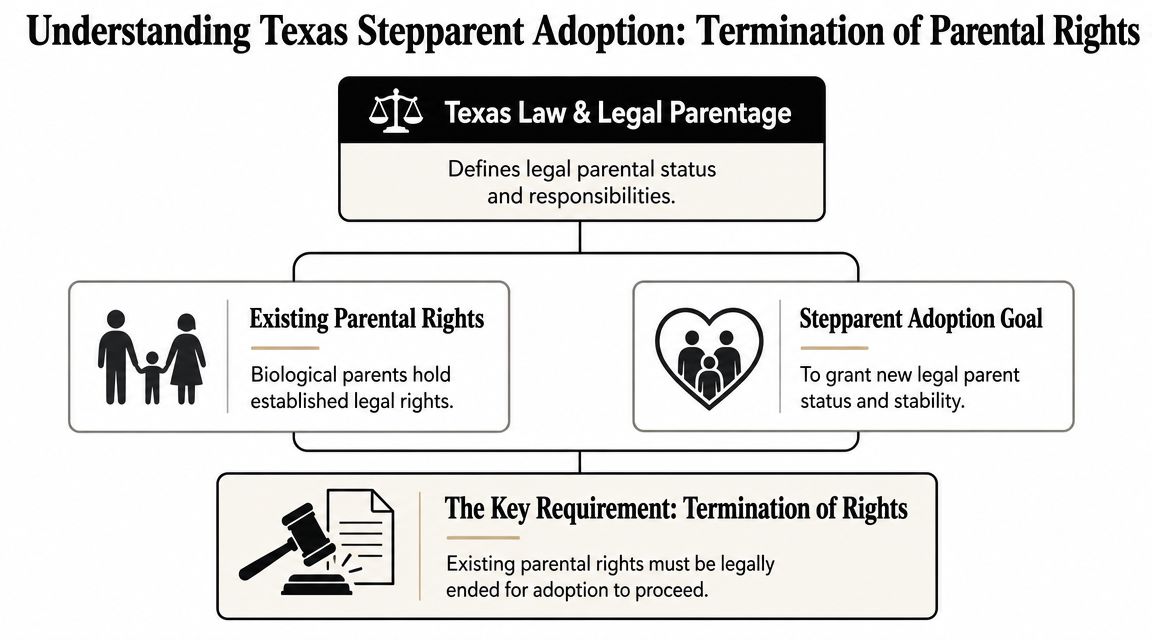
Texas law treats adoption as a permanent legal change, not a simple update to a family chart. That's the reason this issue comes up so often in stepparent cases.
A useful way to understand it is to picture legal parentage as having two legal slots. In a typical stepparent adoption, one slot already belongs to your spouse, who remains the child's legal parent. The other slot belongs to the other biological parent. For the stepparent to become a legal parent through adoption, that second legal relationship usually has to end first.
What Texas requires
Texas Law Help explains that a stepparent adoption can't be finalized unless there is first an order terminating the legal parent-child relationship between the child and the other biological parent, and the stepparent's spouse joins the case without losing parental rights. It also states that if the other parent is alive and no termination order already exists, the case must begin as an Original Petition to Terminate Parent-Child Relationship and for Stepparent Adoption under Texas guidance.
That rule surprises many families because they assume consent alone is enough. In Texas, it isn't enough just for someone to say, "I agree." The court has to enter the proper order.
Why the court is strict about this
This rule exists because adoption creates a full legal parent, not a partial one. After adoption, the stepparent isn't just a helpful adult in the household. The law treats that person as a parent in the strongest legal sense.
That means the court has to think about:
- Parental authority: Who can make major decisions for the child.
- Legal responsibility: Who owes the duties that come with parenthood.
- Long-term stability: Who will remain legally tied to the child going forward.
A judge doesn't treat this as a casual family preference. The court treats it as a permanent transfer of legal status.
Practical rule: In Texas, stepparent adoption is usually a replacement of one legal parent relationship, not an addition of a third one.
A short overview can help make this clearer:
| Legal question | Texas approach |
|---|---|
| Can a stepparent adopt and simply be added on? | Usually no |
| Does the spouse who is already the parent lose rights? | No |
| Must the other parent's rights be terminated first? | Yes, by court order |
Later in the process, families also encounter related steps under Texas adoption procedure, such as court filings, notice, possible social study requirements, and finalization under the Texas Family Code chapters that govern adoption matters. But this termination requirement is the foundation. Without it, the adoption case usually can't cross the finish line.
A short video can also help if you're trying to visualize how the process works in practice.
Adoption Without Consent When a Parent Is Absent
Some families get stuck on one painful thought: "What if the other parent won't sign?" That's a real concern, but it isn't always the end of the road.
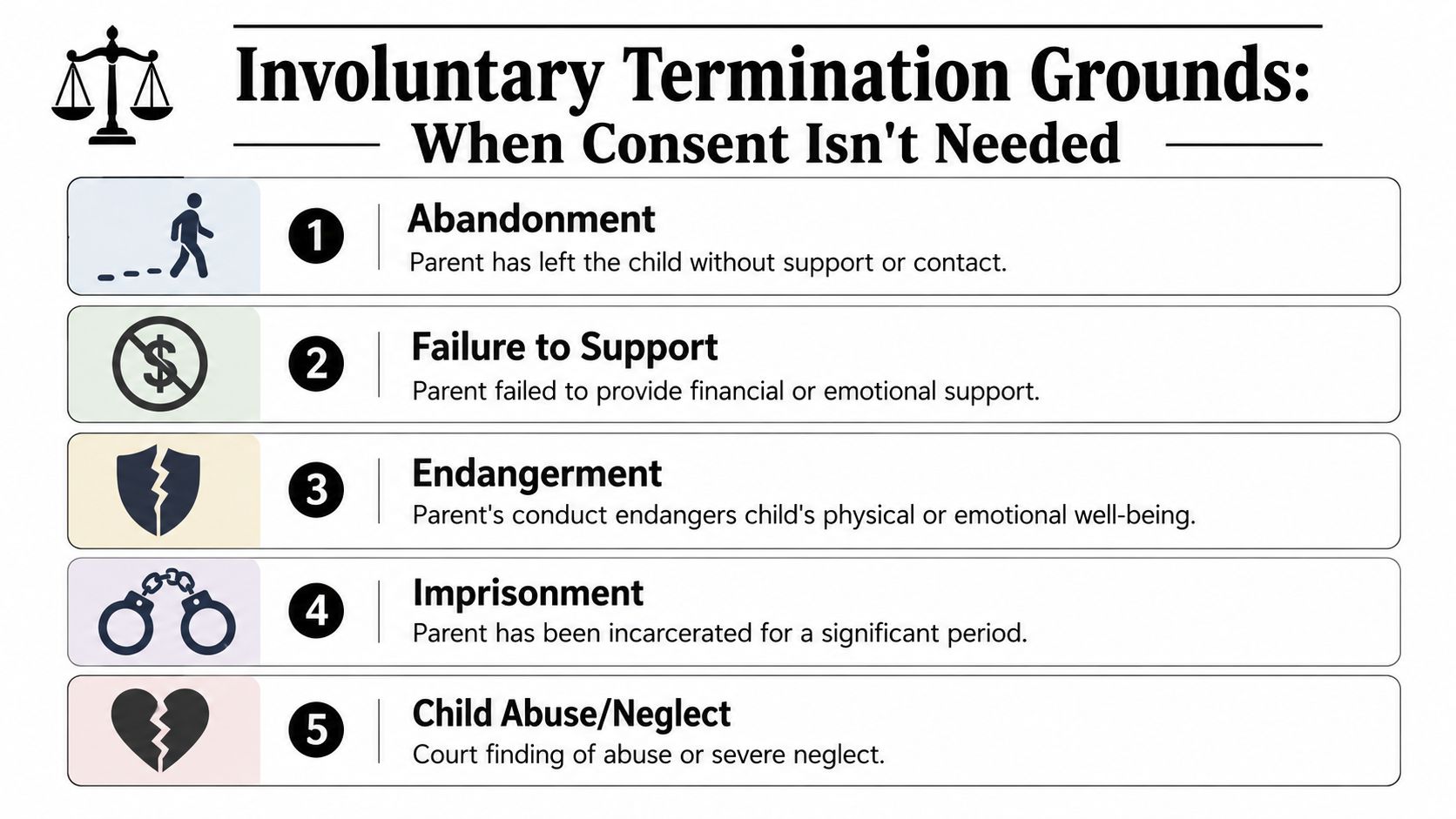
When a parent has been absent, unreachable, or uninvolved for a long time, courts may consider whether there is a legal basis to terminate that parent's rights without consent. The court won't do that just because the stepparent has done a wonderful job. The judge needs legal grounds and evidence.
What absence can look like legally
People often say "abandonment" casually, but courts look for specific conduct. The question is usually whether the parent has failed to act like a parent over time, despite having the chance to do so.
One state example helps show how these cases are often structured. Michigan Legal Help states that a judge may terminate a non-stepparent parent's rights if the custodial parent has sole or joint legal custody and the other parent has substantially failed to support the child for two or more years and substantially failed to visit or contact the child for two or more years, as long as that parent had the ability and opportunity to do so, as described in Michigan's overview of stepparent adoption standards.
Texas law has its own rules and pleadings, but this example shows an important theme across stepparent adoption cases. Courts focus on provable behavior, not hurt feelings alone.
Common fact patterns families bring to court
These situations are easier to understand with real-life style examples:
- Long silence: A father hasn't called, visited, or checked on the child in a very long time, even though he knows where the child lives.
- No support despite ability: A mother has the means to help but hasn't contributed financially or emotionally and hasn't tried to rebuild contact.
- Danger to the child: A parent has engaged in conduct that puts the child's physical or emotional well-being at risk.
- Cannot be found: The family has made serious efforts to locate the parent for notice and service, but the parent remains missing.
Not every difficult co-parenting relationship qualifies. If the other parent occasionally sends a message, sporadically visits, or disputes your version of events, the case may be more contested. Courts look carefully at records, communication history, payment history, prior orders, and service efforts.
Keep your proof organized. Judges often care less about broad accusations and more about calendars, messages, payment records, and documented attempts to contact the other parent.
What to do if this may fit your case
Start by gathering facts, not conclusions.
- Collect records such as child support history, messages, returned mail, and prior court orders.
- Write a timeline of visits, missed visits, support, and major events.
- Document search efforts if the parent can't be located.
- Get legal guidance early so the petition matches the facts and the required procedure.
Families who are unsure whether consent is required often find it helpful to review whether a biological father has to consent to stepparent adoption in Texas. That kind of issue can change how the case starts and what evidence matters most.
The Cooperative Path Through Voluntary Relinquishment
When cooperation is possible, it usually gives the child the calmest path forward. This is the version of stepparent adoption many families hope for. The adults may not be close, but they agree that the stepparent has become the stable parent in the child's daily life and that formalizing that relationship serves the child well.

Agreement helps, but paperwork still matters
Families sometimes make a dangerous assumption. They think a text message, a spoken agreement, or even a signed informal note means the issue is settled. It doesn't.
In a stepparent adoption, voluntary agreement still has to be turned into proper legal documents and court orders. The parent who is relinquishing rights usually needs to complete formal paperwork, and the judge still has to approve the termination and the adoption.
Why this path is often healthier for the child
A cooperative case can reduce conflict in ways that matter significantly to children. It may spare the child from hearing adults argue about old wounds. It can also make the process feel less like a rejection and more like a carefully considered legal transition.
Here are some practical benefits:
- Less emotional strain: Fewer hostile hearings often means less stress for the household.
- Clear expectations: Everyone knows what legal change is being requested.
- Stronger final record: Proper consent and careful filings make the adoption order more secure.
When adults can approach stepparent adoption with honesty and care, the child usually benefits from the lower level of conflict, even if the legal change is still significant.
What this often looks like in practice
A common example is a biological parent who hasn't been active for years and recognizes that the stepparent has become the day-to-day parent. Instead of forcing a contested fight, that parent chooses to cooperate with the legal process. The family still has to file the right case, provide notice, and attend the final hearing, but the tone is different.
Another example is a parent who wants clarity. They may understand that remaining a legal parent on paper, while someone else is doing the parenting in reality, creates confusion for schools, doctors, and the child.
If your family may be able to proceed this way, a lawyer can help make sure the documents are prepared correctly and the court receives what it needs under Texas adoption procedure. The Law Office of Bryan Fagan, PLLC handles Texas adoption and guardianship matters, including stepparent adoptions that involve voluntary relinquishment and finalization issues.
Alternatives If Termination Is Not an Option
Sometimes adoption isn't available right now. The other parent may still be involved enough that termination isn't likely. Or the family may want more legal stability without pursuing a case that feels too divisive.
That doesn't mean you're out of options. It means you may need a different legal tool.
Why the three-parent idea causes confusion
Some families have heard that another state allowed a child to have three legal parents and wonder if Texas can do the same. In limited situations, California says stepparent adoption may proceed without the other parent's written consent if that parent is deceased, can't be found after diligent search, or signs a waiver. California also notes a separate path where the other parent may consent to adoption without surrendering parental rights, creating a three-legal-parent scenario in some cases, according to California court guidance on stepparent adoption exceptions.
That is not the standard Texas path. In Texas, a judge must sign a court order ending parental rights before the adoption can proceed. So if what you really need is authority and stability, not necessarily full adoption today, it makes sense to consider alternatives.
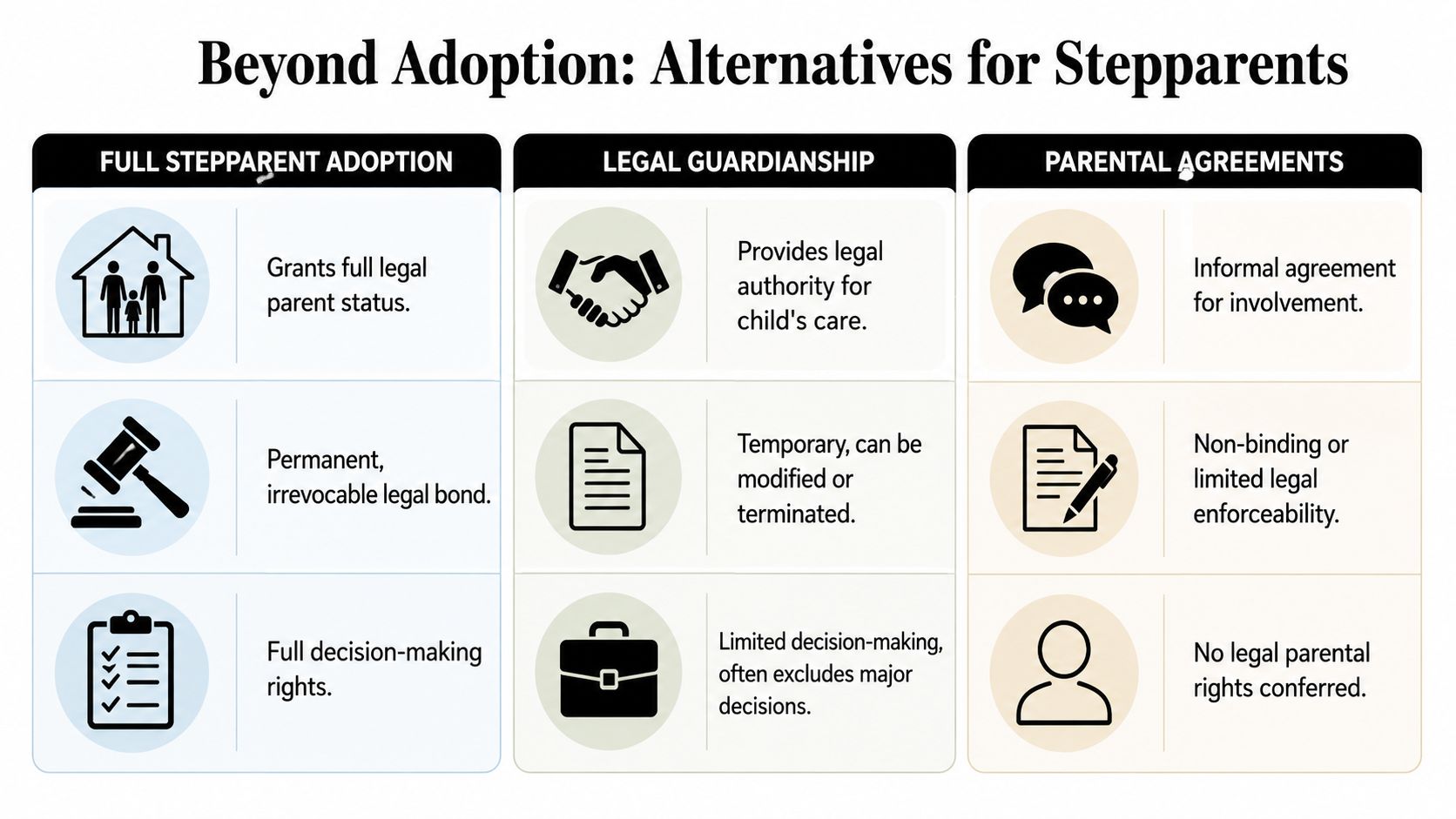
Comparing your options
| Option | What it can do | Limits to understand |
|---|---|---|
| Full stepparent adoption | Creates full legal parent status | Usually requires termination first |
| Guardianship or similar authority | Can help with care and some decisions | May be narrower and may not create permanent parent status |
| Family agreements and paperwork | Can improve day-to-day logistics | Usually doesn't create legal parent rights |
Options that may still help your family
Guardianship or related court authority
If the goal is practical authority, this may be worth discussing. In some situations, a court-based arrangement can help a stepparent care for the child, handle certain needs, or support stability when adoption isn't possible yet. If you're exploring that route, review Texas minor guardianship information to understand how guardianship differs from adoption.
School and medical planning
Sometimes families need immediate function, not a permanent change in legal parentage. Depending on the circumstances, parents may be able to sign documents or coordinate with schools and providers so the stepparent can participate more effectively in day-to-day care. These tools are limited, but they can make life smoother.
Waiting for the facts to develop
There are cases where adoption may become more realistic later. If the other parent remains absent, fails to maintain contact, or becomes impossible to locate, the legal picture may change. Families often do better when they prepare carefully instead of rushing into a weak case.
A delayed adoption plan isn't a failed plan. Sometimes the strongest move is to secure temporary stability now and pursue adoption when the facts support it more clearly.
Choosing the right tool
Ask yourself what problem you're trying to solve.
- If you want permanent parent status, adoption may still be the goal.
- If you need authority during emergencies, another court order may help sooner.
- If you want less daily friction, targeted paperwork may improve school and medical access.
The right answer depends on your family structure, the other parent's involvement, and what level of legal protection the child needs right now.
Taking the Next Step to Build Your Family
Families usually come to this issue with one simple hope. They want the law to reflect the care, consistency, and love that already exist in the home.
The hard part is that Texas doesn't usually allow a stepparent to adopt without the other parent's rights ending first. But once you understand that rule, the path often becomes clearer. Some cases move forward through consent. Others depend on proof that the absent parent hasn't acted like a parent for a meaningful period. And some families are better served, at least for now, by an alternative legal arrangement instead of adoption.
What matters most moving forward
The best path is the one that protects the child and fits the facts.
That usually means:
- Being honest about the other parent's role: Courts look closely at reality, not just labels.
- Preparing documents carefully: Adoption cases under the Texas Family Code can involve multiple steps, including filings, notice, possible evaluation requirements, and final hearing preparation.
- Keeping the child's best interests at the center: Judges want stability, clarity, and long-term protection for the child.
A lot of families also ask about related paths, especially when they are trying to understand how Texas handles nontraditional parentage questions. If that's part of your concern, you may want to read about second-parent adoption issues in Texas.
The right legal plan doesn't always look exactly the way a family first imagined it. What matters is building the strongest and safest structure available for the child.
If you're weighing adoption, voluntary relinquishment, involuntary termination, or another option, don't let uncertainty stop you from getting answers. The process is manageable when you know what the court needs and what facts matter.
If you'd like guidance suited to your family's situation, schedule a free consultation with Law Office of Bryan Fagan, PLLC. A confidential conversation can help you understand whether stepparent adoption is possible now, what alternatives may fit if it isn't, and how to move toward a more secure future for your child.
