
Thinking about building your family through adoption in Texas is an exciting and hopeful step. It's a journey filled with love, but it’s natural for it to come with many questions. When you hear the term "Texas adoption laws," it might sound a bit formal or even intimidating. But these laws are all built around one simple, powerful idea: doing what's best for the child.
Your Adoption Journey Starts with Understanding Texas Law
Think of the Texas Family Code not as a rigid rulebook, but as a compassionate roadmap designed to make sure every child finds a safe, permanent, and loving home. In this guide, we'll break down every step—from figuring out if you're eligible to that joyful day in court when it's all final—into clear, manageable pieces. Our goal is to empower you with the confidence that comes from knowing what to expect, turning legal language into the strong foundation of your family's future.

Building Your Family on a Strong Legal Foundation
The adoption process isn’t something you do alone. It's a partnership between your family, the state, and caring legal professionals, all working toward the same goal. The law provides the structure that makes this life-changing event possible and, most importantly, permanent. It answers the critical questions needed to protect everyone involved, especially the child.
For example, a prospective parent must be at least 21 years old to adopt in Texas. Once you file an adoption petition with the court, a series of hearings are scheduled to ensure every detail is handled with care, always focusing on the child's well-being.
The legal framework for adoption isn't just about paperwork; it’s about providing certainty and security. It’s the state’s way of ensuring that when you welcome a child into your home, that precious bond is protected forever.
Key Milestones in the Texas Adoption Process
Knowing the path ahead can make the whole journey feel much less overwhelming. While every adoption has its own unique story, most follow a similar set of stages guided by state law.
To help you get a clearer picture, here's a quick look at the major milestones you can expect.
Key Stages of the Texas Adoption Process at a Glance
| Adoption Stage | What It Involves | Primary Goal |
|---|---|---|
| Eligibility & Home Study | You show that you're prepared to provide a safe, stable, and nurturing home. This includes background checks and interviews. | To ensure a child is placed in a suitable and loving environment. |
| Termination of Parental Rights (TPR) | A necessary court process that legally frees a child to be adopted by another family. This can be voluntary or involuntary. | To make adoption legally possible and provide permanency for the child. |
| Post-Placement Supervision | A social worker visits your home for a period after the child is placed with you, offering support and ensuring a smooth transition. | To support the new family unit and confirm the placement is successful. |
| Finalization Hearing | The celebratory court hearing where a judge reviews everything and signs the final decree, making the adoption legally official. | To legally create the parent-child relationship and celebrate the new family. |
These steps are thoughtfully designed to move you from preparation to finalization, with checkpoints along the way to support your growing family. For a closer look at the statutes that shape this process, you can explore our firm's guide on the Texas Family Code and what it means for parents.
Who Can Adopt a Child in Texas
When you first start thinking about adoption, one of the biggest questions that comes to mind is, "Can I do this?" It's a natural starting point, and the answer in Texas is probably more welcoming than you think. The law isn't looking for a perfect person; it's focused on your ability to give a child a safe, stable, and loving home.
At its core, the main requirement is straightforward: you must be an adult, at least 21 years old, and financially stable. This doesn't mean you have to be wealthy. It's about showing you can responsibly provide for a child.
The Home Study: A Supportive Partnership
The phrase "home study" can sound intimidating. It might bring up images of a stranger judging your home with a white glove. But that couldn't be further from the truth.
Think of it less as an inspection and more as a partnership. It’s a series of conversations with a social worker who is there to help prepare you for this incredible new chapter. It's a collaborative process, not a test.
During the home study, a licensed professional will:
- Talk with you about your background, life experiences, and your hopes for becoming a parent.
- Walk through your home simply to make sure it’s a safe space for a child to live and play.
- Help you gather documents like financial statements and references from people who know you well.
- Run background checks on all adults living in the home to ensure child safety.
The purpose is to ensure every child is placed in a secure, nurturing environment. But it's also a fantastic opportunity for you to ask questions and feel more prepared to become a parent.
Background Checks and Your Fitness to Parent
A critical part of this process is the criminal history and child abuse registry check. This step is non-negotiable and exists for one reason: to protect children. A minor offense from long ago doesn't automatically disqualify you. The most important thing is to be honest and transparent from the beginning.
The court and your agency are trying to get a sense of your character and confirm that you are fit to be a parent. They want to see that you have the emotional maturity and stability needed to raise a child in a healthy home.
In Texas, the legal standard is always focused on the best interests of the child. The state isn't searching for "perfect" parents—they don't exist. It’s looking for loving, capable, and committed people who can provide a forever home.
Many people worry that being single or part of the LGBTQ+ community will be a roadblock. In Texas, these are not legal barriers to adoption. Your application is judged on your ability to be a great parent. For a deeper dive into the specific qualifications, our firm offers more detailed information on who is eligible to adopt in Texas.
Ultimately, if you feel called to adopt, know that the law is structured to help you succeed, uniting children with families who will love and cherish them.
Exploring the Different Paths to Adoption in Texas
Every family’s story is unique, and so is the path they take to grow. When it comes to adoption in Texas, there isn’t a one-size-fits-all approach. Instead, there are several different avenues, each designed to fit specific family situations, all sharing the same beautiful goal: creating a permanent, loving home for a child.
Think of these paths not as complicated legal routes, but as different doorways into parenthood. Whether you are cementing an existing family bond or welcoming a new child into your life, Texas adoption laws provide a clear framework for each journey. Let's explore the most common ways families are built through adoption in Texas.
Before we dive in, this flowchart breaks down the basic eligibility requirements that apply to nearly every adoption path in Texas.
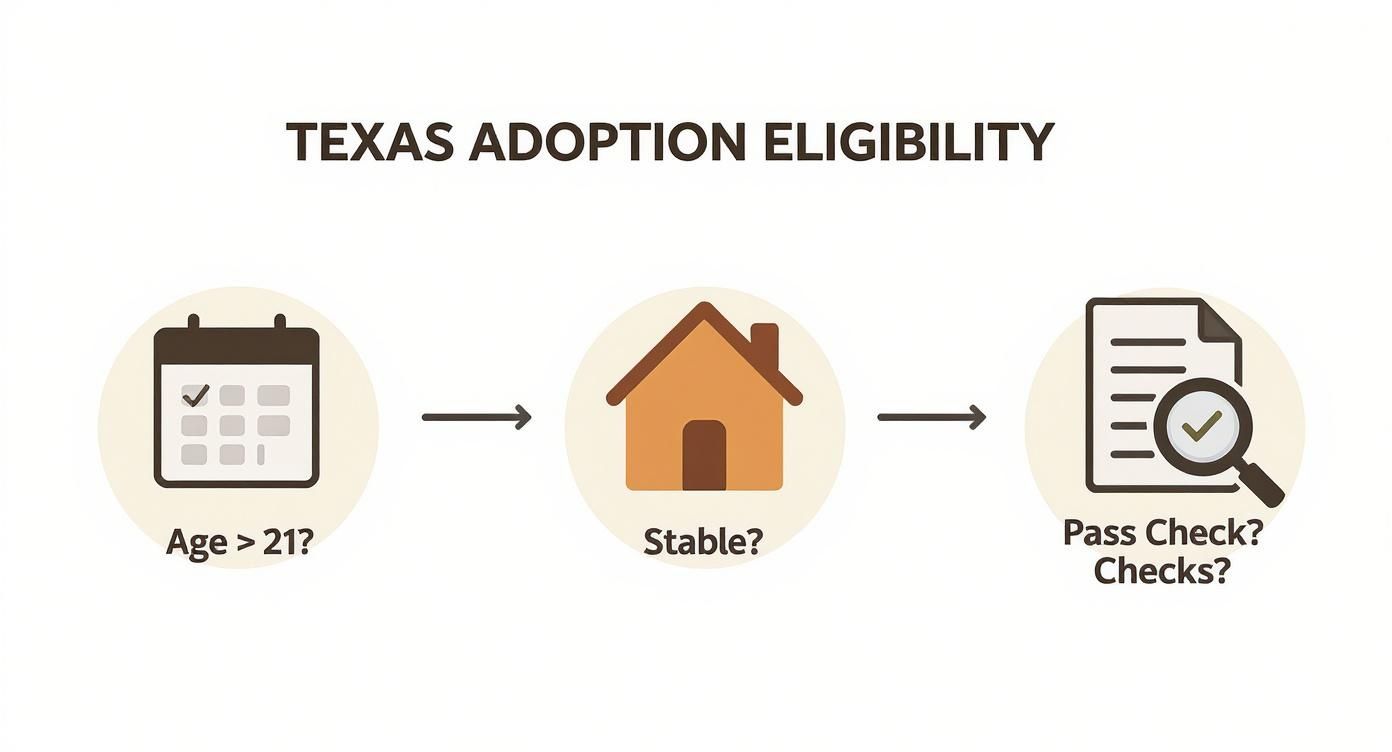
As you can see, the core qualifications boil down to being a responsible adult who can provide a safe and stable home. This underscores the state's unwavering commitment to the child's well-being above all else.
Stepparent Adoption: Solidifying Family Bonds
One of the most heartfelt types of adoption is when a stepparent legally becomes a child's parent, making a bond that has long existed in the heart official. Imagine a stepfather who has raised his stepdaughter since she was a toddler. He’s been there for scraped knees, homework help, and bedtime stories. A stepparent adoption legally recognizes him as her father, providing not just emotional security but crucial legal rights, like the authority to make medical decisions.
This process is often more straightforward than other adoptions, especially if the other biological parent consents. It’s a beautiful way to ensure your family’s legal status finally reflects its emotional reality.
Kinship and Relative Adoption: Keeping Family Together
Sometimes, the best and most loving home for a child is with a family member who is ready to step up. This is known as kinship or relative adoption. A common scenario is when grandparents adopt their grandchild to provide stability when the biological parents are unable to do so. This path honors existing family ties and can make a difficult transition much smoother for the child.
Kinship adoption is a testament to the strength of family. It ensures a child can grow up surrounded by familiar faces and a shared history, which is immensely beneficial for their sense of identity and security.
The legal steps are often streamlined because the child is already with trusted relatives, but the process is just as meaningful. It’s about formally recognizing the loving care that family members were already providing.
Private Domestic Adoption: Creating New Connections
For many hopeful parents, private domestic adoption is the path they choose to start or grow their family. This process involves working with an adoption agency or attorney to connect with an expectant birth mother who is lovingly making an adoption plan for her child.
This journey is built on trust, respect, and open communication. It allows for a deeply personal connection between the birth mother and the adoptive family, often leading to an open adoption where the child grows up knowing the immense love that went into this decision from all sides. The legal process ensures everyone is supported and that the child's best interests remain the central focus.
Adoption from Foster Care (CPS): Providing a Forever Home
There are thousands of children in the Texas foster care system waiting for a permanent family. Adopting from Child Protective Services (CPS) is a profound way to give a child who has faced uncertainty the stability and love of a forever home. This path also comes with minimal costs, as the state provides financial support and resources to families who open their hearts and homes.
This journey may involve fostering the child first, allowing you to build a bond before the adoption is finalized. It’s a powerful commitment to a child who needs it most, offering them the incredible gift of a family and a bright future.
No matter which path you are considering, we are here to provide the compassionate legal guidance you need. To discuss your unique situation and find the right route for your family, schedule a free, confidential consultation with us today.
The Legal Heart of an Adoption
At the center of every adoption story is a profound legal step called the termination of parental rights, often shortened to TPR. We approach this topic with the utmost compassion because it represents a moment of immense significance for the child, the birth parents, and the hopeful adoptive family.
This legal process is what makes a new beginning possible. It’s the formal action that legally frees a child to be adopted, allowing them to gain the stability of a forever family. Understanding it is key to appreciating how Texas adoption laws are designed to put a child’s best interests above all else.
Voluntary Relinquishment: A Courageous Choice
In many private adoptions, the journey starts with a loving and voluntary decision made by a birth parent. This is called voluntary relinquishment—a courageous, selfless plan made by a birth mother who chooses adoption as the best path for her child's future.
Texas law puts important safeguards in place to ensure this decision is made with careful thought and without pressure.
- Mandatory Waiting Period: A birth mother cannot legally sign the affidavit to relinquish her parental rights until at least 48 hours after the child is born. This waiting period is critical, giving her time to recover and be absolutely certain of her decision.
- Irrevocable Decision: Once the affidavit is signed correctly and the waiting period has passed, the decision is generally final and cannot be reversed. This provides the certainty needed for the child’s future.
This process honors the gravity of the birth parent's choice while paving the way for the child to be welcomed into their adoptive family.
Involuntary Termination: Protecting a Child's Future
There are other situations, especially in cases from the foster care system, where parental rights are terminated by a court order. This is known as involuntary termination. It’s a step that’s only taken when a court determines, based on clear evidence, that it's not safe for a child to remain with their biological parent and that termination is truly in the child's best interest.
This is a serious legal action that courts do not take lightly. It is reserved for circumstances where a child's safety is at risk due to factors like abuse, neglect, or abandonment. The legal standard is incredibly high, ensuring that a family is only separated when absolutely necessary to protect the child.
The termination of parental rights, whether voluntary or involuntary, is the legal turning point that allows a child's story to move forward. It is the moment that legally clears the path for an adoptive family to provide the permanent, loving home every child deserves.
Understanding this critical component can feel complex, and the emotional weight is significant. For a more detailed breakdown, you can learn more about how to terminate parental rights and the legal process in Texas in our dedicated guide.
From Filing the Petition to Finalizing Your Family
After the immense emotional and legal journey of terminating parental rights, you are finally on the home stretch. This is where all the patience and preparation come together in the final courthouse steps. Let's walk through this last phase, making the legal process feel manageable as you prepare to officially welcome your child home forever.
This structured legal process has deep roots. While the first Texas adoption law was enacted in 1850 to address inheritance rights, it wasn't until 1931 that the state required court approval for adoptions. This change ensured a formal legal process with judicial oversight—a tradition that continues today to protect children and families. You can discover more insights about the history of adoption laws in Texas.
Filing the Petition for Adoption
The first formal step in this final stage is filing the Petition for Adoption. Think of it as the official start of the final lap. This legal document is your formal request to the court, asking a judge to recognize you as the child's legal parent.
The petition contains all the essential information about your family and the child, demonstrating that all legal requirements under the Texas Family Code have been met. Once filed, it sets the stage for the supportive supervision period and, ultimately, the finalization hearing.
The Supportive Post-Placement Period
After your child is placed in your home, Texas law requires a post-placement supervision period, which typically lasts for at least six months. This may sound like a test, but it’s truly meant to be a supportive and encouraging time.
During this period, a social worker will visit your home a few times to see how everyone is adjusting. These visits serve two key purposes:
- To Offer Support: The social worker is a resource for your family, answering questions and helping you navigate the transition of bringing a new child home.
- To Document Success: They will prepare a positive report for the court, detailing how well your family is bonding and thriving together.
This period provides the court with real-world proof that the placement is successful and is in the absolute best interest of the child.
The Finalization Hearing: A Day of Celebration
The finalization hearing is the beautiful, celebratory milestone you've been working toward. It’s the moment a judge reviews all the documents, including the positive post-placement reports, and signs the final decree of adoption.
Think of this hearing as a graduation ceremony. It's the culmination of all your hard work, hope, and love, and it marks the official beginning of your new life together as a legally recognized family.
On this day, the judge will likely say a few warm words, you might take pictures, and your family will be legally and forever united. From that moment forward, you have all the rights and responsibilities of a parent, and your child has a permanent, loving home.
Common Questions About Adopting in Texas
The path to adoption is lined with questions. Rest assured, you're not the first person to wonder about the details. Here, we’ve gathered some of the most common questions we hear about Texas adoption laws and answered them with the clarity and compassion you deserve.
What Is the Difference Between Open and Closed Adoptions?
This is a great question because it gets to the heart of how modern families are built—with love, respect, and communication. In Texas, these terms describe how much contact the adoptive family and the birth family will have after the adoption.
- Open Adoption: This is very common today. It allows for direct contact, like visits, phone calls, or emails. It can foster an ongoing relationship where a child knows their birth family, creating a supportive network for everyone.
- Closed Adoption: This was once the standard. It means no identifying information or contact is shared between the families. After the adoption, all records are sealed to maintain privacy.
- Semi-Open Adoption: This is a comfortable middle ground. Communication, like letters or photos, happens through a neutral third party, like an agency. This allows for connection without sharing direct contact information.
The right choice is deeply personal and is often made together by the birth and adoptive parents, with the child’s best interests always guiding the way.
How Much Does It Cost to Adopt a Child in Texas?
The financial side of adoption can look very different depending on which path you take. For many, the most surprising news is that adopting from the foster care system (CPS) often has little to no cost. The state even provides financial assistance and resources to support these families.
Private domestic infant adoptions are on the other end of the spectrum, typically ranging from $25,000 to $50,000 or more. These costs usually cover legal fees, agency services, counseling for the birth mother, and approved living expenses for her during the pregnancy. Stepparent and relative adoptions are generally the most affordable. It’s important to have a frank conversation about the potential costs with your attorney to get a clear picture for your unique situation.
How Long Does the Texas Adoption Process Usually Take?
Patience is a virtue in adoption, as the timeline is as unique as your family’s story. A stepparent or relative adoption can sometimes be completed in as little as six months, especially when everyone is on the same page.
Private infant adoptions often take one to two years, sometimes longer. The biggest variable is the matching process with an expectant birth mother. Once a child is placed in your home, Texas law requires a post-placement supervision period, usually lasting for six months, before the adoption can be finalized in court.
An experienced attorney can't speed up every step, but they can help you set realistic expectations and guide you efficiently through each milestone of your specific journey.
Can LGBTQ+ Couples or Single Individuals Adopt in Texas?
Yes, absolutely. Texas law does not prohibit adoption based on marital status or sexual orientation. The only thing the court cares about is your ability to provide a safe, stable, and loving home for a child.
Single men and women, as well as married and unmarried LGBTQ+ couples, successfully build their families through adoption in Texas every day. The home study process evaluates your fitness to be a parent—making sure you have the emotional and financial capacity to care for a child—and that has nothing to do with your household structure.
As you navigate your adoption journey and prepare for life as new parents, you might also find external resources such as resources for new parents helpful.
At The Law Office of Bryan Fagan, PLLC, we believe every child deserves a loving family, and every hopeful parent deserves compassionate guidance. If you have more questions or are ready to take the next step, we invite you to schedule a free, confidential consultation with our dedicated adoption attorneys today. Let us help you build your family, forever.
