
The termination of parental rights in Texas is a court action that permanently severs the legal ties between a parent and child. It is a profound legal step—one a judge only takes when it is absolutely in the child's best interest. For many Texas families, this difficult process is what clears the path for a child to be adopted into a new, stable, and loving forever home.
Understanding This Life-Changing Legal Step
Deciding to terminate parental rights is one of the most significant and emotionally charged decisions a Texas family court can make. This isn't just a legal formality; it's a permanent change that ripples through the lives of children, birth parents, and adoptive families forever. At its core, this action cuts all legal ties, responsibilities, and rights a parent has over their child.
This means a parent loses the right to make decisions about their child's education, healthcare, or upbringing. It also ends their obligation to provide financial support. For everyone involved—hopeful adoptive parents, relatives stepping up to provide care, or a birth parent facing an impossible choice—this journey is filled with complex emotions and critical legal hurdles. At The Law Office of Bryan Fagan, PLLC, we help families navigate this path with empathy and clarity, always focusing on the best interests of the child.

Two Paths to Termination
In Texas, terminating parental rights happens in one of two ways. Each path is driven by a unique set of circumstances and follows its own legal requirements.
- Voluntary Relinquishment: This happens when a parent makes the conscious, and often heartbreaking, decision to give up their parental rights. This is usually part of a thoughtful adoption plan where a birth parent believes this is the best path forward for their child's future. For example, a young mother may lovingly choose a family to adopt her newborn, knowing they can provide stability she cannot currently offer.
- Involuntary Termination: This is when a court orders the termination of a parent's rights without their consent. A court only takes this drastic action when there is clear and convincing evidence of specific grounds, such as endangerment, neglect, or abandonment, and finds it necessary for the child’s well-being.
The guiding principle in every single case is the best interest of the child. A judge will not terminate a parent's rights unless it is proven that doing so will provide the child with the safety, permanency, and stability they need to thrive.
For children whose parental rights are terminated due to neglect or abuse, this legal finality is often the first step toward creating a new foundation of security and love. The process itself marks the beginning of a long journey toward healing from childhood trauma.
The Legal Grounds for Involuntary Termination in Texas
When a Texas court is asked to make the life-altering decision to involuntarily terminate a parent's rights, the judge cannot act on personal feelings. The ruling must be based on specific, legally defined reasons laid out in the Texas Family Code. This legal framework ensures that the parent-child bond—one of the most sacred relationships in our society—is only broken when absolutely necessary for a child's safety and well-being.

These legal reasons, or "grounds," are the building blocks for the case. The person or agency asking for the termination—whether it’s the other parent, a grandparent, or Child Protective Services (CPS)—must build a solid argument using one or more of these grounds. Simply claiming a parent is "unfit" is not enough; they must prove specific actions (or failures to act) that put the child in danger.
What Constitutes Grounds for Termination
The Texas Family Code provides a detailed list of actions that can lead to involuntarily ending parental rights. These grounds aren’t designed to punish parents. They exist to protect children from harm, and the law is written to be very specific to ensure fairness.
Some of the most common grounds a court will look at involve a parent who has:
- Knowingly placed or allowed the child to remain in conditions that endanger their physical or emotional well-being. This is about the child’s environment. For instance, if a parent knows there's drug activity or domestic violence in the home and does nothing, that could be seen as an endangering environment.
- Engaged in conduct that endangers the child’s physical or emotional well-being. This focuses on the parent's own actions. A history of abuse, neglect, or severe substance abuse that directly hurts the child falls into this category.
- Voluntarily left the child alone or in the possession of another without providing adequate support and remained away. This is what most people think of as abandonment.
The law is looking for more than a single mistake. It’s searching for a pattern of behavior that shows a parent is either unable or unwilling to give their child a safe and stable home.
The High Standard of Proof
Because taking away someone's parental rights is permanent and life-changing, the legal standard of proof is incredibly high. In most civil cases, the standard is a "preponderance of the evidence," which means it's more likely than not that something happened. But for termination cases, Texas demands "clear and convincing evidence."
This higher standard means the proof has to be strong enough to create a firm belief in the judge's mind that the claims are true. It’s a serious hurdle designed to protect parents from having their rights taken away unfairly. The person asking for the termination has the heavy burden of meeting this standard for two separate things:
- Proving at least one of the specific legal grounds for termination exists.
- Proving that termination is in the child's best interest.
Even if one of the legal grounds is proven, a judge won't grant the termination unless it's also clear that it's the best possible outcome for the child’s future. The law provides a detailed framework to ensure these decisions are made with the greatest care. In fact, the Texas Family Code specifies over 20 distinct grounds for termination of parental rights, covering everything from abandonment to failing to complete court-ordered services after a child has been removed from the home.
Understanding Key Grounds with Scenarios
Legal language can be difficult, so let's walk through a couple of hypothetical scenarios to see how these grounds might play out in the real world.
- Constructive Abandonment: Imagine a mother leaves her five-year-old son with his grandmother, saying she'll be back in a few weeks. Months turn into a year. She rarely calls and sends no money for his care, even though she has a job. The grandmother, who has been providing a stable home, could petition for termination based on constructive abandonment because the mother has failed to support or stay involved in her son's life.
- Endangerment: A father struggles with a recurring substance abuse problem and has been arrested multiple times. When he has his daughter, he leaves drug paraphernalia where she can find it and has even overdosed while she was in his care. This pattern of behavior directly endangers the child's physical and emotional well-being, providing clear grounds for termination.
In every case, the court's primary focus remains unshakably on the child. The question is never just "Did the parent do something wrong?" but rather, "What is necessary to ensure this child has a safe, stable, and loving future?"
These examples show just how serious the conduct must be for a court to step in. The goal is always to protect the child, and understanding these legal standards helps everyone involved recognize the gravity of the process.
Understanding Voluntary Relinquishment of Parental Rights
When people talk about the termination of parental rights in Texas, the conversation often centers on court-ordered actions. But there's another path a parent can choose—one that is deeply personal and often comes from a place of profound love.
This is known as voluntary relinquishment. It’s fundamentally different from having rights taken away by a court. Instead, it's a proactive, though often gut-wrenching, decision made by a parent who believes another family is better equipped to give their child the life they deserve. It's an act of empowerment, not a surrender.
The Legal Process for Voluntary Relinquishment
To make this decision legally binding, a parent must sign a specific document: the Affidavit of Relinquishment of Parental Rights. This is a sworn statement, signed in front of a notary, where a parent formally states their intention to give up all legal rights to their child.
But Texas law builds in critical protections to prevent a parent from making this choice under duress or in a moment of vulnerability.
A birth mother cannot legally sign this affidavit until at least 48 hours after the child is born. This mandatory waiting period is a compassionate safeguard, ensuring the decision is made with a clear mind, free from the immediate physical and emotional toll of childbirth.
This 48-hour rule gives a mother crucial time to recover, reflect, and be absolutely certain of her choice without outside pressure.
A Permanent and Irrevocable Decision
Once the affidavit is correctly signed and the waiting period has passed, the decision is almost always permanent. It becomes irrevocable, meaning it cannot be taken back.
This finality is essential for the child’s stability. It allows the adoption process to move forward with confidence, giving the child and their adoptive family the legal security they need to bond and build a future. Because the implications are lifelong, it is absolutely vital for any birth parent considering this path to seek trusted legal counsel.
An experienced attorney can provide gentle guidance, making sure you understand every detail of what you’re signing. They will explain the permanent nature of the affidavit and help you fully grasp what relinquishing your rights means for both you and your child. For a closer look at this critical document, our firm provides a detailed breakdown of the Texas release of parental rights form and its components.
An Act of Love in an Adoption Plan
It’s so important to see voluntary relinquishment not as an ending, but as the start of a new chapter for a child. For birth parents, it can be an incredible act of courage and selflessness.
Think about a young mother who knows she lacks the financial resources and support system to raise her newborn. Through an adoption agency, she selects a loving couple who has waited years to become parents. By signing the affidavit, she isn't "giving up" on her child; she is actively choosing a stable, opportunity-filled future for them.
This deliberate choice empowers her to have a voice in her child's future, often as part of an open adoption plan. It is a powerful decision rooted in love, creating the legal and emotional foundation for a new family to grow.
Navigating the Involuntary Termination Court Process
When someone files a petition to involuntarily terminate a parent's rights, it kicks off a meticulous and often emotionally draining legal journey. This is not a quick or simple matter. The Texas court process is deliberately thorough to protect the fundamental rights of parents and, most importantly, the well-being of the child.
Whether the case is brought by Child Protective Services (CPS), a stepparent, or another relative, the path from filing to final verdict follows a very structured sequence of events. The process demands patience, resilience, and expert legal guidance to understand what's happening at each step.
The First Steps in the Court Journey
The process officially starts when a Petition for Termination of Parental Rights is filed with the court. This legal document spells out who is filing the suit, the parent whose rights are being challenged, and the specific legal grounds for why termination is being requested.
Once it's filed, the parent must be formally notified through a process called "service." This is a critical step that ensures they have a fair chance to respond and defend their rights.
Shortly after, the court will hold an initial hearing. One of the first and most important things a judge does is appoint an attorney ad litem for the child. This is a crucial role.
- What is an ad litem? This is an independent attorney whose only job is to represent the child's best interests. They are the child's voice in the courtroom.
- What do they do? The ad litem investigates the situation by interviewing the child, parents, teachers, and anyone else involved. They then make recommendations to the court based on what they find.
Evidence, Hearings, and the High Burden of Proof
After these initial stages, the case moves into an evidence-gathering phase known as "discovery." During discovery, both sides can request documents, ask written questions (interrogatories), and take formal statements under oath (depositions) to build their respective cases. It's common to have several pre-trial hearings to sort out issues and make sure everyone is ready for the final trial.
It’s vital to remember that a parent has a fundamental right to be represented by a lawyer. If a parent can't afford one, the court must appoint an attorney for them in cases started by a government entity like CPS. This right highlights just how serious these proceedings are. The person or agency filing the petition carries the immense responsibility of meeting a very high legal standard.
To terminate a parent's rights, the petitioner must prove their case with "clear and convincing evidence." This standard is much higher than in most civil cases. It requires proof that creates a firm belief in the judge's mind that the allegations are true.
This high bar is a safeguard, designed to protect the sacred parent-child bond from being broken without just cause.
The following infographic shows the core steps a parent might take in a related voluntary relinquishment, which also highlights the legal finality of the process.
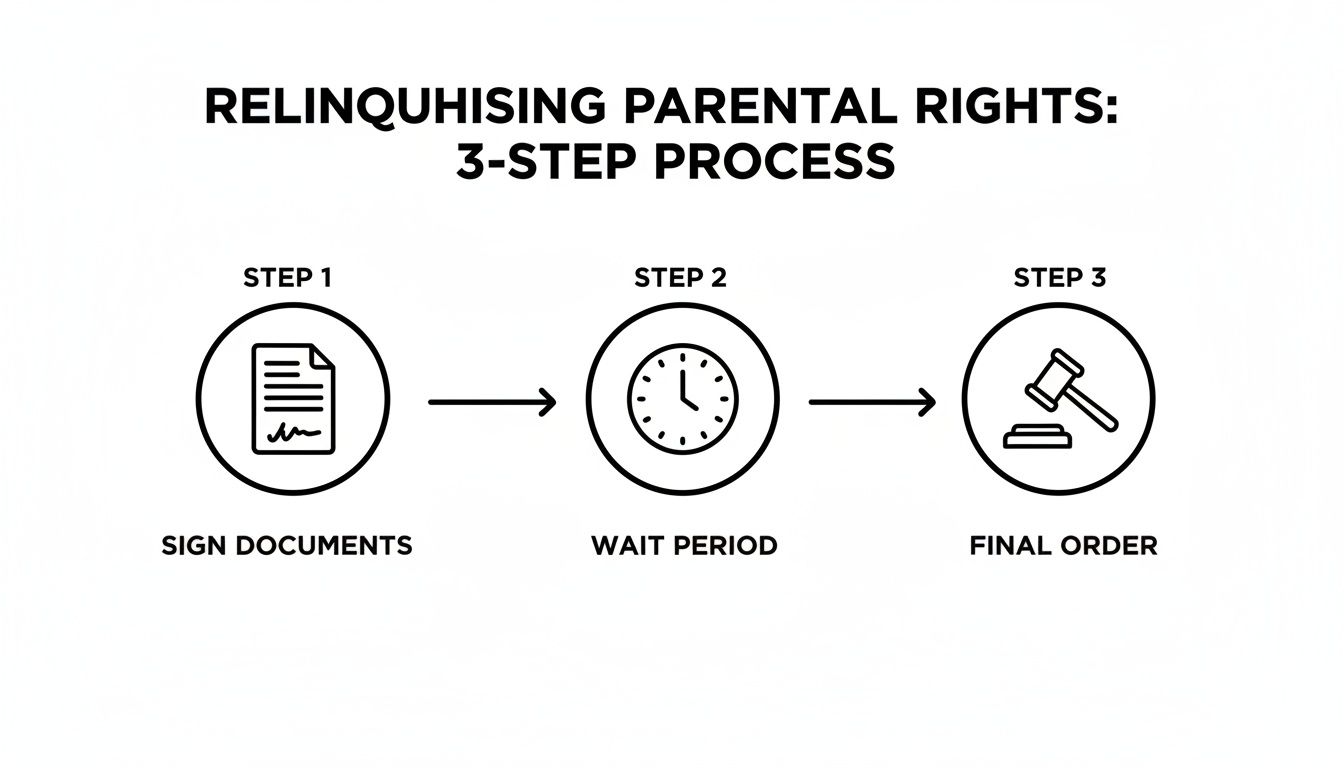
This simple flow shows that each stage—from signing a legal document to a final court action—is a formal step with permanent consequences.
The Sobering Reality of Termination Cases in Texas
The scale of these cases in our state is significant. Statistics show that Texas is a national leader in severing parental rights, having done so for 91,589 children since 2006.
Often, termination happens not because of direct abuse but because a parent fails to complete court-mandated services within a very strict timeline. This reality underscores the urgency and high stakes of every single court date and requirement. To get a better sense of the numbers, you can explore more data on parental rights termination in Texas.
Ultimately, the process ends with a final trial. A judge (or sometimes a jury) will hear all the evidence and testimony. They then make the life-altering decision of whether to grant the termination, based only on the specific grounds presented and what is truly in the best interest of the child.
How Termination Paves the Way for Adoption
The legal process of ending parental rights—whether it happens voluntarily or is ordered by a court—serves a deeply hopeful purpose: it creates a clean slate for a child to find a permanent, loving family through adoption.
Think of it as clearing a path. Until the legal rights of the birth parents are formally brought to a close, no one else can legally adopt the child. This is the bedrock principle of legal permanency. A child simply cannot have two sets of legal parents at the same time. The court must first close one chapter by terminating the existing rights before a new one—the adoption—can officially begin. This ensures the adoptive parents can provide full legal, emotional, and financial support without any confusion or ambiguity.

This vital link between termination and adoption provides the legal foundation needed to build a secure future for a child, no matter the family situation.
Why Termination Is a Necessary First Step
Picture a stepfather who has raised his wife's daughter as his own since she was a toddler. The child's biological father has been completely absent for years, offering zero support or contact. For the stepfather to legally adopt his stepdaughter and give her the security of his name and legal parentage, the biological father's rights must first be terminated.
This scenario shows the real-world need for termination of parental rights in Texas as a prerequisite for adoption. It's a critical step in many family situations:
- Stepparent Adoptions: A stepparent wants to become the legal parent of their spouse's child, which requires terminating the rights of the other, non-custodial biological parent.
- Kinship Adoptions: Grandparents, aunts, or uncles who have been raising a child can provide a permanent home through adoption, but only after the parents' rights are legally severed.
- Adoptions from Foster Care: A child only becomes legally free for adoption after a court has terminated their birth parents' rights, allowing foster parents or another family to step in permanently.
Grasping the full scope of these legal steps is essential, and you can learn more about adoption law in Texas in our detailed guide.
A Statewide Focus on Family Preservation
In recent years, Texas has made a significant shift in its approach to child welfare, now emphasizing family preservation to support families before a crisis spirals to the point of a child’s removal. This proactive focus has had a remarkable impact.
Between 2018 and 2024, the number of children removed from their homes by Child Protective Services (CPS) plummeted by 55%. This dramatic drop from 20,685 to 9,220 annual removals shows that giving families support upfront leads to safer outcomes for everyone.
This shift has also led to a 47% drop in the number of children in foster care and a 43% decrease in those awaiting adoption. By strengthening families, the state is reducing the need for involuntary termination proceedings in the first place. You can read more about this child welfare revolution in Texas and its positive effects. For those families where adoption does become the necessary path, this focus ensures the decision is made only after every other option to preserve the family has been explored.
How a Compassionate Family Law Attorney Can Help
Facing the termination of parental rights is an emotional and legal storm. Whether you are a hopeful adoptive parent seeking to provide a child with stability or a birth parent fighting to protect your family, the stakes couldn't be higher. This isn't a path anyone should have to walk alone.
An experienced family law attorney is more than just a legal representative; they are your guide and your anchor. When emotions are running high, they bring clarity. In moments of uncertainty, they offer a steady hand, ensuring your rights are protected and your voice is heard.
The Role of Your Legal Advocate
A compassionate lawyer does far more than file paperwork. They act as a buffer between you and the intimidating court system, translating confusing legal jargon into plain English. Most importantly, they build a strategy that fits your unique situation.
For a family hoping to adopt, a sharp attorney makes sure the termination process is handled perfectly, creating a rock-solid legal foundation for the new family. For a parent facing an involuntary petition, that same lawyer becomes their most powerful defense, fighting to protect the sacred parent-child bond. The right legal support is invaluable, and finding an attorney who understands these delicate matters is a critical first step. When you're ready to start, it helps to know how to find the best adoption attorneys near you.
How Our Firm Provides Support
At The Law Office of Bryan Fagan, PLLC, our commitment is simple: to provide unwavering support grounded in both legal experience and genuine empathy. We believe this process is about one thing—securing a child's future—and we’re here to help you navigate it with confidence.
Here's how we can help:
- Ensuring Correct Filing: We handle every document with precision, from the initial petition to the final order, preventing costly errors or delays.
- Protecting Your Rights in Court: We will build a strong case, gather the right evidence, and advocate passionately on your behalf before the judge.
- Offering Empathetic Guidance: We understand the emotional weight of these cases is immense. We provide a confidential, supportive space to discuss your fears and goals.
Your family's future is our priority. We are here to be your source of stability, ensuring that every decision made is in the best interest of the child at the center of the case.
With the right legal partner by your side, you can move forward with clarity and peace of mind. We invite you to schedule a free, confidential consultation to discuss your situation and find the support you and your family deserve.
Frequently Asked questions About Parental rights in texas
When you're dealing with the termination of parental rights, the questions come fast and heavy. It's an emotionally charged process, wrapped in complex legal language that can feel impossible to untangle. Our goal here is to give you clear, straightforward answers to some of the questions we hear most often.
Think of this as a starting point. Every family's story is different, but having the right information is the first step toward making decisions you can feel confident about.
Can a Parent Give Up Their Rights to Avoid Paying Child Support?
No. This is one of the most common misconceptions we see. A parent cannot voluntarily sign away their rights just to get out of paying child support. Texas courts simply will not allow it.
The judge’s one and only focus is the child’s best interest, and that includes their right to be financially supported by both parents. A court will only approve a voluntary termination if there’s another person ready to step up and adopt the child—like a stepparent or a grandparent—who will then take on that financial responsibility. The law is designed to protect children, not to give parents a loophole to escape their obligations.
What Happens to My Parental Rights if My Child Is Adopted by a Stepparent?
When a stepparent adopts your child, your parental rights are permanently and completely extinguished. The adoption legally creates a brand-new parent-child relationship between your child and their stepparent. In the eyes of the law, your relationship is legally severed.
This means you lose all legal rights to visitation or to have a say in your child’s upbringing. It also means your legal duty to pay child support ends. For a stepparent adoption to happen, it requires either your willing, voluntary consent to terminate your rights or a court order for involuntary termination based on specific legal grounds.
Can a Father Refuse to Sign Over His Rights in Texas?
Yes, a father absolutely has the right to refuse to sign an Affidavit of Relinquishment. If he refuses, his parental rights cannot be terminated voluntarily.
But that doesn't mean the story ends there. The person seeking to terminate his rights—for instance, the mother’s new husband in a stepparent adoption case—can still move forward by filing a petition for involuntary termination of parental rights in Texas. To win that case, they have to prove two things with "clear and convincing evidence": that legal grounds for termination exist (like abandonment or endangerment) and that cutting ties is truly in the child’s best interest. A father's refusal just means the fight moves into the courtroom, where a judge makes the final call.
Is It Possible to Reinstate Parental Rights After They Are Terminated?
In almost every single case, the answer is no. In Texas, the termination of parental rights is permanent and irreversible. This finality is essential to give children stability and to ensure that a subsequent adoption is secure and unshakeable.
Once a judge issues that final termination order, there is no simple legal path to "undo" it. This is precisely why the courts set such a high bar for evidence and have safeguards in place, like the 48-hour waiting period after birth before a mother can sign a relinquishment. The decision is meant to last a lifetime, cementing the child’s new family structure for good.
For families navigating shared parental responsibilities, understanding effective communication and scheduling tools is crucial. Explore a comprehensive guide to coparenting calendars to see how clear organization can support a child's well-being.
Every family's situation is unique, and these answers only scratch the surface. If you are facing this difficult journey, you don't have to do it alone. The compassionate attorneys at The Law Office of Bryan Fagan, PLLC are here to provide the clear guidance and dedicated support you need. Schedule your free, confidential consultation with us today to take the next step toward building your family's future.
