 Skip to content
Making your stepchild legally and permanently part of your family is a profound and beautiful milestone. For many blended families, stepparent adoption in Texas is the legal path that cements a bond built on love, care, and daily commitment. This process is about more than just paperwork; it’s about gaining full parental rights to make medical decisions, enroll them in school, and give your stepchild the lifelong security of two legally recognized parents.
Your Path to Legally Uniting Your Family
Adopting your stepchild is a powerful act of love that validates the parent-child relationship you've already built. When you marry someone with children, you often step into a parental role naturally. However, without a legal adoption, your rights and responsibilities are limited. Stepparent adoption closes that gap, giving your family the legal recognition and stability it deserves, ensuring that your role as a parent is protected no matter what the future holds.
This journey solidifies your family in the eyes of the law, creating much-needed stability for your child. It's a common path for blended families. In fact, stepparent adoptions make up a significant portion of all adoptions in the U.S. In 2020, they accounted for just over 50% of the 52,536 private domestic adoptions nationwide, as noted in the National Council For Adoption’s report on adoption statistics.
The “Best Interests of the Child” Standard
In every Texas family law case involving a child, the judge’s decision comes down to one core principle: the "best interests of the child." This isn't just a legal phrase; it's the standard that guides every ruling under the Texas Family Code. To make this determination, the court will look at several key factors, including:
- The child’s emotional and physical needs, both now and in the future.
- The stability and safety of the proposed home environment.
- The strength of the existing bond between you and the child.
- Any potential danger to the child, emotionally or physically.
Think of this guide as your roadmap. We’re here to demystify the legal steps with the clear, compassionate guidance your family deserves. We’ll walk you through everything, from understanding your eligibility to the final, celebratory day in court.
At its heart, stepparent adoption is about providing a child with the permanence and security that comes from having two legally recognized and loving parents. It’s a beautiful commitment to their future and well-being.
What This Adoption Means for Your Family
Finalizing a stepparent adoption brings profound changes and a deep sense of peace of mind. You gain the legal authority to make crucial decisions for your child, and they gain the same inheritance rights as a biological child. It’s the law officially catching up to the loving family you’ve already built.
As you begin this journey, remember you're not alone. Our team at The Law Office of Bryan Fagan, PLLC, is here to provide the supportive, knowledgeable guidance you need. We understand both the legal complexities and the emotional weight of this step, and we're dedicated to helping you secure your family’s future with confidence.
First Things First: Are You Eligible for a Stepparent Adoption?
Before diving into the legal paperwork of a stepparent adoption in Texas, it’s important to ensure your family meets the foundational requirements of the Texas Family Code. These aren’t meant to be obstacles; they are safeguards designed to confirm the adoption is stable, secure, and genuinely in your stepchild’s best interest.
Understanding these requirements from the start makes the entire process feel more manageable. They are the building blocks of your legal case, helping the court see what you already know: you are a committed and loving parent to this child. The law simply wants to see proof of an established, solid family unit before making this wonderful change permanent.
The Marriage and Residency Rules
The first and most straightforward requirement is marriage. To be eligible for a stepparent adoption, you must be legally married to one of the child’s parents. The court views this legal union as the cornerstone of the stable home it wants for every child.
Texas law also has a residency rule to ensure the child has had time to bond and settle into the new family dynamic. As outlined in the Texas Family Code, the child must have lived with you (the stepparent) and your spouse for at least six months before you can file the adoption petition. This six-month period gives the court a clear picture of a consistent, nurturing home life. While a judge has the discretion to waive this requirement if it’s in the child's best interest, this is rare and usually only happens in unique situations. It's always best to plan on meeting the six-month residency rule.
When the Child’s Voice Matters: The Consent Requirement
Texas law gives special weight to the wishes of older children, recognizing them as individuals with their own thoughts and feelings about their family. If your stepchild is 12 years of age or older, their formal written consent is a legal requirement for the adoption to proceed.
This isn't just a casual conversation; it's a formal step where the child signs a document expressing their desire for the adoption. It’s a powerful moment that validates their place in this life-changing decision and empowers them to be part of the process.
A child’s consent is more than a legal checkbox. It’s a confirmation from them that they feel secure, loved, and ready to make you their parent in every sense of the word. It reinforces the emotional truth of your family’s bond.
This compassionate part of Texas law ensures the child is an active participant in their own story.
Additional Legal Checks and Balances
Beyond these core rules, the court will take other steps to ensure the child’s safety. You can expect a criminal background check for the adopting stepparent and sometimes for other adults in the home. This is a standard, non-negotiable procedure in all adoptions designed to protect the child.
In some situations, a judge might order a more in-depth adoption evaluation or home study. However, this step is often waived in straightforward stepparent adoptions, especially when the family unit is clearly stable and all other requirements are met. It’s also wise to understand what disqualifies you from adopting in Texas. Meeting these eligibility criteria is your first confident step toward legally cementing the beautiful family you've already built with love.
Navigating Consent From The Other Biological Parent
One of the most delicate parts of a stepparent adoption in Texas is addressing the rights of the other biological parent (often called the "non-custodial parent"). Before your adoption can be finalized, their parental rights must be legally terminated. This is a crucial step because, under Texas law, a child can only have two legal parents at a time. The termination clears the way for the stepparent to become the child's new legal parent.
This part of the process requires a careful, compassionate approach and a solid understanding of the law. The goal is to create a secure and legally sound future for your stepchild, and getting this step right is key to that peace of mind.
The Ideal Path: Uncontested Adoption With Consent
The smoothest path is an uncontested adoption, where the other biological parent agrees that the adoption is in their child's best interest. They make this official by signing a legal document, often called an Affidavit of Relinquishment of Parental Rights.
Once signed and filed with the court, this document serves as a voluntary surrender of their parental rights, allowing the adoption to move forward without conflict. For many families, this cooperative approach helps everyone focus on the child’s happiness. Getting the paperwork right is vital, and you can learn more in our detailed guide on understanding and filing Texas consent to adoption forms.
What Happens When The Other Parent Can't Be Found?
Life is complicated, and sometimes a biological parent has been out of the picture for years, making them impossible to locate. The law understands this. You are not expected to get consent from someone whose whereabouts are a complete mystery.
In these situations, you must prove to the court that you've made a diligent search to find them. This is a formal legal process that involves more than a few phone calls. Steps may include:
- Searching public records and online databases.
- Contacting their known relatives, friends, and past employers.
- Publishing a legal notice in a newspaper, known as citation by publication.
If the judge is satisfied with your thorough search efforts, the court can terminate the absent parent's rights, allowing the adoption to proceed.
When Consent Is Refused: Involuntary Termination
The most challenging scenario is when the other biological parent refuses to give their consent. While this feels like a major obstacle, it does not automatically stop your adoption journey. It is possible to ask the court to involuntarily terminate their parental rights.
This is a very serious legal action, and courts do not take it lightly. You and your attorney must prove that specific grounds for termination exist, as defined in the Texas Family Code (Chapter 161). These grounds are in place to protect children from harmful or neglectful situations and include:
- Abandonment: The parent has left the child without support and has remained away.
- Failure to Support: The parent has failed to support the child for a period of one year.
- Endangerment: The parent's conduct has endangered the child's physical or emotional well-being.
- Criminal Conduct: The parent has been incarcerated for a significant period, preventing them from parenting.
A judge’s primary duty is to protect the child. If a parent has demonstrated through their actions an inability or unwillingness to provide a safe and supportive presence, the court will prioritize the child’s need for a permanent, loving home with you.
Consider a scenario: a stepfather has been the only consistent father figure in a child's life for over a decade. The biological father has not seen the child in eight years and has never paid child support. In that case, a court would likely find that involuntary termination is in the child's best interest, allowing the loving stepfather to legally adopt. When navigating these complexities, especially in challenging co-parenting situations, understanding the emotional support available is crucial. Consider exploring the benefits of co-parent counselling for separated couples as a resource.
No matter which path your family must take—voluntary consent, a diligent search, or involuntary termination—it’s critical to have an experienced legal guide. At The Law Office of Bryan Fagan, PLLC, we handle these sensitive matters with the compassion and legal skill your family deserves.
The Legal Process of Your Adoption Journey
Knowing the legal roadmap for a stepparent adoption in Texas can make a seemingly complex process feel much more manageable. Your journey officially begins when the initial paperwork is filed, but understanding each stage gives you a sense of control and confidence. Let's walk through the process, from the first court filing to the final, joyful hearing.
The entire process is designed to ensure the adoption is in the absolute best interest of your stepchild. While it involves legal documents and court procedures, remember that every step is a building block toward legally cementing the loving family you have already created.
Kicking Off Your Case: Preparing and Filing the Petition
The first formal step is to file an Original Petition for Adoption with the appropriate family court. This critical document introduces your family to the court—it explains who you are, who your spouse and stepchild are, and lays out the legal reasons you are seeking the adoption. It is your official request asking the judge to grant you full parental rights.
Often, the other biological parent's rights have not yet been terminated. In that case, you will likely file a combined petition, such as an "Original Petition to Terminate Parent-Child Relationship and for Stepparent Adoption." This streamlined approach asks the court to handle both the termination and the adoption in a single case, saving time and simplifying the process. Getting this initial filing right is essential, as it sets the legal foundation for everything that follows.
The Court's Due Diligence: Background Checks and Evaluations
Once your petition is filed, the court begins its process to ensure your home is a safe and stable environment for the child. A criminal background check for you, the adopting stepparent, is a mandatory part of every adoption in Texas. There are no exceptions; it is a fundamental step to protect the child's welfare.
While a formal home study is common in many other types of adoptions, it is frequently waived in stepparent adoptions. If your family unit is clearly established and stable, a judge may decide a full evaluation is unnecessary. However, the court always has the discretion to order one, especially if there are unusual circumstances or if the other parent is contesting the adoption.
The path forward at this stage depends on the other parent's position: do they consent, are they unlocatable, or are they refusing? This infographic breaks down the three main scenarios.
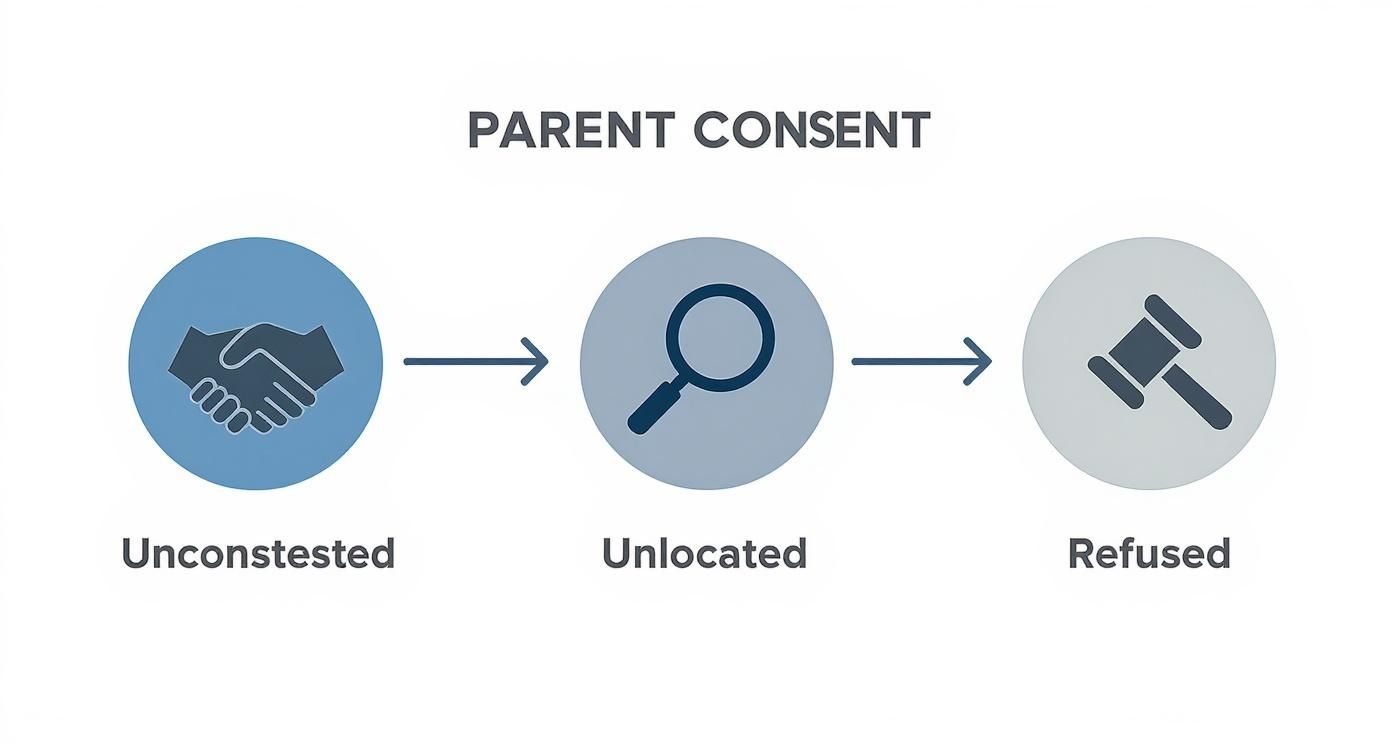
As you can see, an uncontested adoption is the most direct route. A contested case requires the court to become much more involved to resolve the issues.
The Ad Litem Attorney: Your Child’s Advocate
In certain situations, particularly if the adoption is contested, the judge will appoint an attorney ad litem. This is an independent lawyer whose sole job is to represent the child's best interests throughout the case.
The ad litem does not work for you, your spouse, or the other biological parent. They act as the court's eyes and ears, meeting with the child, parents, and perhaps teachers or counselors to get a full picture. From there, they make a formal recommendation to the judge about whether the adoption serves the child's best interests.
Think of the ad litem as your child's legal advocate. Their involvement ensures the child's voice and needs are central to the court's final decision, reinforcing the child-centric focus of the entire process.
The Final Hearing: A Day of Celebration
The finish line of your legal journey is the final adoption hearing. This is a special court appearance where you, your spouse, and your child will go before the judge. This is rarely a dramatic trial; it’s almost always a brief, happy, and celebratory event.
During the hearing, the judge will review the paperwork, listen to brief testimony, and confirm that all legal requirements have been met. The moment the judge signs the final Decree of Adoption is the instant you legally become your child’s parent. This hearing marks the official end of the legal process and the beginning of your new, legally-unified family. It's a day of pure joy and relief—a moment your family will cherish forever.
To help you visualize how things can play out, here’s a look at how timelines can differ depending on whether the adoption is contested.
Stepparent Adoption Timeline: Uncontested vs. Contested
The table below offers a general idea of the timeline for both uncontested and contested stepparent adoptions in Texas. Keep in mind that every case is unique, and these are just estimates based on our experience.
| Milestone | Uncontested Adoption (Typical Timeline) | Contested Adoption (Typical Timeline) |
|---|---|---|
| Initial Filing | Weeks 1-2: Prepare and file the Petition for Adoption and Termination of Parental Rights (if needed). | Weeks 1-4: File the Petition. The other parent is served and has time to respond. |
| Consent/Termination | Weeks 2-4: The other parent signs the consent affidavit. Case moves forward quickly. | Months 2-6: Attempts to locate and serve the other parent. If contested, discovery and legal motions begin. |
| Background Checks | Weeks 3-6: Stepparent completes mandatory criminal background checks. | Months 2-4: Background checks are completed alongside early legal proceedings. |
| Ad Litem Appointment | Rarely needed: An ad litem is typically not appointed in a simple, uncontested case. | Months 3-7: Court often appoints an ad litem to represent the child's best interests. This adds time. |
| Final Hearing | Months 3-4: A brief, final hearing is scheduled to finalize the adoption. | Months 8-18+: Multiple hearings may be required. A final trial is held if no agreement is reached. |
| Final Decree | Immediately at the final hearing. | Immediately after the final trial or hearing. |
As you can see, a contested case introduces significant delays due to the added legal steps required to resolve disputes. An uncontested adoption is always the fastest and most straightforward path.
At The Law Office of Bryan Fagan, PLLC, we are honored to stand beside families on this incredible day. To learn how we can help you reach it, we invite you to schedule a free, compassionate consultation to discuss your family's story.
Planning for the Costs of Stepparent Adoption
Deciding to pursue a stepparent adoption in Texas is a huge emotional step for a family. Alongside the excitement, there are practical, financial questions that need answers. Getting a clear picture of the potential costs from the beginning helps you plan, reduces financial stress, and allows you to focus on what truly matters: making your family legally whole.
The good news is that stepparent adoption is generally one of the most affordable ways to adopt. Think of it as a priceless investment in your child's security, stability, and future. At The Law Office of Bryan Fagan, PLLC, we believe in being transparent about every possible expense, so you can budget with confidence.
Breaking Down the Primary Expenses
The total cost is made up of a few key components. The main investment is typically the attorney's fee, which covers the legal expertise needed to draft and file the petition, navigate the court system, and represent you at the final hearing. Having an experienced attorney ensures every legal requirement is met correctly and efficiently.
Beyond legal fees, you will have standard court filing fees. These are what the county charges to officially open your case and process the required documents. These costs vary slightly from one Texas county to another.
While every family's journey is unique, the financial side of a stepparent adoption is a direct investment in your child's stability and your family's legal permanence. It solidifies your role as a parent in the eyes of the law, which is truly invaluable.
A Realistic Look at the Numbers
Let's talk real numbers. While the complexity of your case can affect the final cost, most families fall within a typical range.
- Attorney's Fees: Generally, you can expect legal fees to range from $1,500 to $4,000.
- Court Filing Fees: These usually add another $300 to $500.
- Other Potential Costs: You might also have smaller expenses for things like background checks ($50 to $100), ordering a new birth certificate ($25 to $50), or a home study if the judge requires one ($500 to $1,000).
In total, most families find the entire process costs somewhere between $1,500 and $5,000. For a more detailed breakdown, you can learn more about the cost of a stepparent adoption in Texas.
Other Potential Costs to Consider
In some situations, a few other expenses might arise. The most common is the fee for an attorney ad litem. If the court appoints an independent lawyer to represent your child's best interests—which often happens in contested cases—you will likely be responsible for their fees.
Another potential cost comes up if the other biological parent cannot be found. You may have to pay for the costs of a diligent search and publishing a legal notice in a newspaper. Our team works hard to manage every part of your case efficiently, helping you keep costs predictable as we move toward your family's goal.
Celebrating Your New Beginning After Finalization
The moment the judge signs the final Decree of Adoption, your legal journey is over. It is a powerful, emotional milestone that marks the true beginning of your life as a legally unified family. While the court proceedings have ended, you can now focus on celebrating and completing a few final administrative steps to make it all official.
This isn't just about a signature; it's the law finally catching up to the reality that has existed in your home for months or even years. It gives your child an incredible sense of security, confirming they have two loving, legally recognized parents who are fully committed to their future.
Making It Official: The Final Paperwork
Once the decree is signed, a few practical tasks remain. These steps ensure every official record reflects your child’s new legal status and family name, completing your stepparent adoption in Texas.
Here are the key things you’ll need to do:
- Applying for an Amended Birth Certificate: This is a major step. You will file an application with the Texas Vital Statistics Unit to issue a new birth certificate that lists you, the stepparent, as a legal parent. This document officially replaces the original.
- Updating Social Security Records: It is crucial to contact the Social Security Administration to update your child's records with their new legal name (if it changed) and new parentage.
- Notifying Schools and Healthcare Providers: Provide a copy of the adoption decree to your child’s school, doctors, and dentist. This gives you the clear legal authority to make all educational and medical decisions without question.
Handling these administrative details promptly creates a clean slate and prevents any future confusion.
The Emotional Impact of Permanence
Beyond the paperwork, finalization brings a wave of emotional security to your entire family. For a child, knowing that their relationship with you is permanent and legally protected is deeply reassuring. It removes any lingering uncertainty and solidifies their place in the family unit.
For you and your spouse, it’s a moment of pure relief and joy. The legal process is complete. You can now move forward with the full rights and responsibilities of a parent, making decisions for your child’s well-being without any legal ambiguity.
This final step isn't just about changing a name on a document; it's about providing your child with the lifelong gift of legal permanence and the unwavering stability that comes from knowing they belong.
After the adoption is finalized, many families find a special way to celebrate their new legal bond. It’s a beautiful way to mark the occasion and honor the journey you've all taken. You could plan a special family trip or even explore heartfelt gifts for step-moms to commemorate the moment. Your journey to this point was built on love, patience, and dedication. Now, you can fully embrace the future as a legally recognized family, secure in the knowledge that your bond is protected forever.
The path to a stepparent adoption is a beautiful and significant one. If you are ready to take the first step or simply wish to learn more about your family's unique situation, the compassionate team at The Law Office of Bryan Fagan, PLLC is here to help. We invite you to schedule a free, confidential consultation to discuss how we can guide you toward legally uniting your family.
Contact The Law Office of Bryan Fagan, PLLC for a Free Consultation

