
Choosing to adopt a child in Texas is a life-changing decision, and it begins with understanding which path is right for your family. The journey to build your family through adoption generally follows one of three main routes: private adoption, foster care adoption, or stepparent adoption. Each path has its own unique set of legal steps, timelines, and emotional considerations—all designed with one guiding principle: protecting the best interests of the child.
Your Texas Adoption Journey: An Overview
Starting the adoption process is an incredible act of love, hope, and commitment. Here at The Law Office of Bryan Fagan, PLLC, we have been honored to guide countless Texas families through this journey, and we know that the first step—understanding your options—is the most critical one. The road ahead can feel overwhelming, but it becomes much clearer once you see the different ways you can get there.
Every adoption in the state is governed by the Texas Family Code, primarily Chapter 162, which ensures that every decision puts the child's well-being and stability first. Whether you're a couple dreaming of welcoming a newborn, a stepparent looking to make your family legally whole, or someone feeling the call to give a permanent home to a child in state care, there is a path forward for you.
The Three Main Paths to Adoption
To give you a better sense of these options, let’s look at the primary routes for building your family through adoption in Texas.
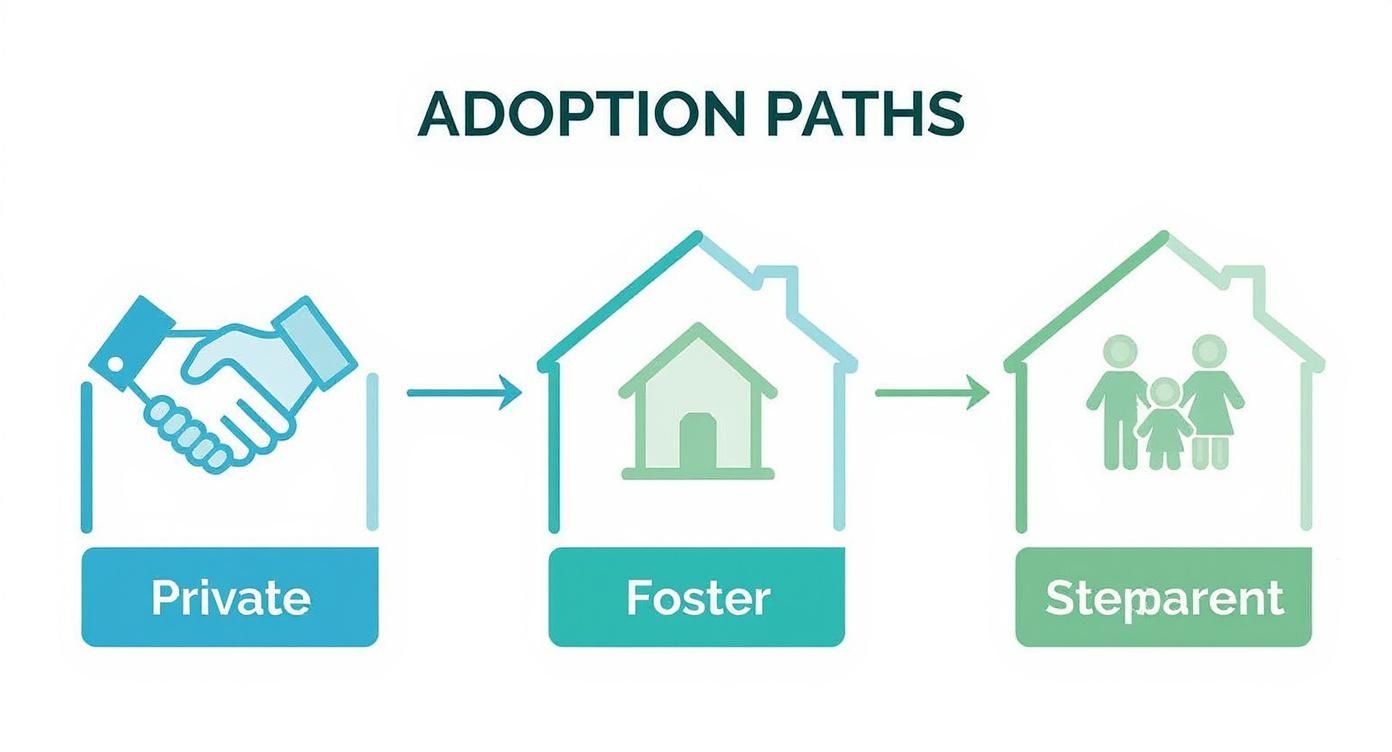
This graphic breaks down the distinct starting points for private, foster, and stepparent adoptions. While each journey leads to the same beautiful destination—family—they involve very different procedures. For example, in a private adoption, you may work directly with an agency and a birth mother. In a stepparent adoption, you will navigate court requirements for terminating one parent's rights to solidify your own.
Choosing the right path comes down to your unique circumstances, goals, and resources. A private adoption often involves a more direct, personal connection with a birth mother. A foster care adoption provides a waiting child with a much-needed permanent home. And a stepparent adoption is all about solidifying a bond that already exists.
To help you compare these options side-by-side, we've put together a simple table that highlights the key differences in eligibility, timelines, and requirements for each type of adoption in Texas.
Comparing Your Adoption Options in Texas
| Adoption Type | Eligibility | Approx Timeline |
|---|---|---|
| Private Adoption | Financially stable adults, 21+, pass home study & background checks. | 6-18 months |
| Foster Care Adoption | Licensed foster parents, 21+, pass training & home study. | 9-18 months after placement |
| Stepparent Adoption | Must be married to the child's legal parent for at least 6 months. | 3-6 months |
Each of these paths presents a unique opportunity to build your family. The key is to find the one that aligns best with your personal situation and what you hope to achieve.
A successful adoption journey isn’t about finding the "easiest" path, but the right path for your family and, most importantly, for the child. It's about preparation, patience, and surrounding yourself with compassionate support.
At our firm, we firmly believe that an informed family is an empowered one. When you understand these core differences from the very beginning, you can move forward with confidence and clarity. As you continue reading, we’ll break down each step of the process in detail, from the initial eligibility checks to that final, joyful day in court.
Meeting the Initial Adoption Requirements
Before you can begin the home study or imagine meeting a child, there is some essential groundwork to cover. Think of this first phase not as a bureaucratic hurdle, but as the first concrete step toward building a secure, loving foundation for a child. Texas law, outlined in the Texas Family Code (Chapter 162), is designed with one goal in mind: ensuring every child is placed in a stable, safe, and supportive home.
The wonderful news is that Texas welcomes all kinds of families. Whether you’re single, married, divorced, or widowed, the door to adoption is open. The law cares far less about your marital status and much more about your ability to provide a nurturing environment where a child can thrive. At a minimum, you must be at least 21 years old and financially stable enough to support a child.
This initial stage is about collecting the paperwork that tells your story and demonstrates your readiness for the incredible responsibility of parenthood.
Gathering Your Essential Documents
Preparing your adoption application is a lot like preparing for any other major life event—a little organization goes a long way. You'll need to gather a handful of documents that paint a clear picture of your life, from your finances to your health. This isn't about being invasive; it's simply how adoption professionals verify that you're prepared to care for a child.
Here are the core documents you’ll want to start collecting:
- Financial Records: This usually includes recent pay stubs, tax returns, and bank statements to show you have a steady income and can manage your finances responsibly.
- Medical Clearances: You and any other adults living in your home will need a note from a doctor confirming you're physically and mentally healthy enough to take on the joys and challenges of parenting.
- Personal References: You’ll be asked for letters of reference from people who know you well—such as friends, colleagues, or community leaders—who can speak to your character, stability, and why you would make a wonderful parent.
- Proof of Identity and Relationship Status: This includes basic documents like birth certificates, a marriage license, or divorce decrees if they apply to your situation.
It can feel like a lot. We worked with a couple, Sarah and Tom, who felt completely overwhelmed by the paperwork. Their solution was simple: they bought a binder, created a checklist, and used dividers for each category. That small organizational step turned their anxiety into a feeling of control, freeing them up to focus on the more emotional parts of the journey.
Understanding Background Checks
A critical piece of this initial phase is the background check. This is a non-negotiable step required by law. Every adult living in the home must undergo a thorough criminal history and child abuse registry check to ensure the child’s safety, which is always the court's number one priority.
It is vital to be completely honest during this process. A minor issue from your past won't necessarily stop you from adopting, especially if you can show how you've grown since then. Transparency is always the best approach.
These initial requirements aren't hurdles to clear; they're the building blocks for the strong, secure family you're about to create. Every document you gather is a testament to your commitment to a child’s future.
Completing this prep work sets the stage for the next big milestone in your journey: the home study. By thoughtfully organizing your paperwork and understanding what Texas law requires, you’re taking a powerful first step.
The path of learning how to adopt in Texas starts right here. If you have questions about your eligibility or need help figuring out where to start, our team is here to help. We invite you to schedule a free consultation to talk through your unique situation with a compassionate legal expert who can guide you with confidence.
Navigating the Home Study Process
The words "home study" can make even the most confident person feel a little nervous. It sounds official, maybe even intrusive, as if someone with a white glove will be checking for dust.
Let’s clear the air: that's not what it's about. The home study is not a test you can pass or fail. Think of it as a collaborative conversation—a way for you and your adoption professional to get to know each other. This process, rooted in Texas Family Code Chapter 162, is designed to do one thing: ensure a child is placed in a safe, stable, and loving home.
You'll work with a licensed social worker whose goal is to support you, not to disqualify you. They are looking for readiness, not perfection. They understand that a real family home is built on love, not immaculate floors or a Pinterest-perfect nursery.
What the Home Study Really Explores
This process is a holistic look at your life—a chance to share your story, your hopes for the future, and what makes you who you are. The social worker will want to talk about your background, your relationships, and how you handle life's challenges. It's a personal journey, and being open and honest is the best way to navigate it.
The conversations and evaluations generally focus on a few key areas:
- Your Background: This covers your childhood, education, career, and the significant moments that have shaped you.
- Your Relationships: They'll want to get a sense of your support system—your partner (if applicable), family, and friends.
- Your Home Environment: This is less about aesthetics and more about safety. Is your home free of hazards? Do you have working smoke detectors? Are cleaning supplies stored safely? Is there enough space for a child?
- Your Parenting Views: You'll have a chance to discuss your thoughts on discipline, education, and how you plan to honor a child's unique story and culture within your family.
- Financial Stability: This isn't about being wealthy. It's about demonstrating that you can manage your finances responsibly and provide for a child's basic needs.
A big part of this stage involves gathering paperwork. To get a head start and feel more prepared, take a look at our guide on the essential required documents for a Texas adoption home study. It breaks down exactly what you'll need.
A Real-Life Scenario: Turning Nerves into Confidence
Take Maria, a single teacher who was full of anxiety about her home study. She worried that her small apartment and single income would be deal-breakers. When her first interview came, she decided to be upfront and shared her fears with the social worker.
What she received wasn't judgment, but a partner. The social worker saw Maria's genuine passion for children and her incredible support system of friends and family. They walked through Maria's budget together, pointing out her financial strengths. The "inspection" of her apartment turned into a helpful chat about simple, inexpensive child-proofing tricks.
By the end of it all, Maria realized the home study was never about evaluating her apartment; it was about understanding her heart and her capacity to provide a nurturing home. The process became an empowering step that affirmed she was more than ready to be a mother.
Your story is just as valid. The home study is your chance to shine a light on the love, stability, and commitment you're ready to offer. It's a foundational piece of your adoption journey, and with the right mindset, it can be a surprisingly positive and affirming experience.
Adopting From The Texas Foster Care System
Choosing to adopt a child from the Texas foster care system is a truly life-changing decision for both you and a child in need. This path is guided by the Texas Department of Family and Protective Services (DFPS) and is filled with both incredible heart and specific legal milestones. At its core, this journey offers a waiting child the one thing they need most: a permanent, loving family.

Many families we work with are drawn to this path because the need in Texas is immense. As of early 2024, there were thousands of children in the Texas foster care system waiting for a permanent home. These are children who are legally free for adoption and are simply waiting for someone to call Mom or Dad. When you look at the statewide foster care statistics, you start to see the profound difference one family can make.
The Role Of DFPS And Reunification
It's important to understand that when a child first enters foster care, the primary goal of DFPS is almost always reunification. The state's first priority is to try and safely return the child to their biological family. DFPS provides resources and creates service plans to help birth parents work through the issues that led to their child's removal. This is a compassionate and critical part of the process, honoring that original family bond.
Adoption only becomes the goal when it’s clear that reunification isn't a safe or viable option. That pivot happens after a court determines that the birth parents' rights must be legally terminated—a decision made solely in the child's best interests. It’s a somber but necessary step that legally frees a child to be adopted into a new forever family.
The journey through foster care adoption is a testament to patience and hope. It requires understanding that the child's past is part of their story, and your role is to provide a future built on unconditional love and stability.
Key Steps In A Foster Care Adoption
While every child's story is unique, the general process of adopting from foster care follows a structured path designed to prepare you fully and protect the child every step of the way.
- Orientation and Training: It all starts with attending an informational orientation. After that, you'll go through required training (often called PRIDE training), which prepares you for the unique needs of children who have experienced trauma and loss.
- The Home Study: Just like in any other adoption, you’ll complete a home study. For a foster care adoption, the focus is on your ability to provide a safe, trauma-informed environment for a child who needs stability more than anything.
- Matching and Placement: Once your home is licensed, the matching process begins. Your caseworker and DFPS will work to find a child whose needs align with what your family can provide. When a match is made, the child is placed in your home for a supervisory period, which usually lasts at least six months.
- Finalization: After that post-placement period goes smoothly, your attorney will file a petition to adopt. A judge reviews the entire case, and you'll have a finalization hearing to make the adoption legally permanent. That's the day you officially become a forever family.
A Story Of Sibling Adoption
Let us share the story of a family we'll call the Garcias. They felt a strong calling to adopt siblings—a 7-year-old boy and his 9-year-old sister who had been in the system for two years. For much of that time, the goal was still reunification with their birth mother. The Garcias knew this and supported it, understanding that the children’s hearts were still very much tied to their first family.
Over the next year, however, it became clear that reunification was not a safe possibility. The court moved to terminate parental rights, which was an emotionally complicated time for everyone. The Garcias worked closely with therapists and their caseworker to help the children process their grief, all while reassuring them of their permanent, unshakable place in their new family.
Their finalization day wasn't just a legal proceeding. It was a celebration of resilience, patience, and the creation of a brand new family legacy, one built on a foundation of honesty and unwavering love.
Understanding Adoption Costs and Timelines
When you're starting the adoption journey in Texas, two questions almost always come up first: "How much will this cost?" and "How long is it going to take?" These aren't just details; they're the practical realities that shape your entire experience. It's one thing to prepare your heart for a new child, but it's another to prepare your finances and mindset for the road ahead.
The answers depend on which adoption path you take, but getting clear, honest information from the start is the key to feeling in control.

Let's break down the typical expenses and waiting periods you can expect. Knowing these factors upfront helps you budget, plan, and keep your focus right where it belongs: on building your family.
Breaking Down the Costs of Adoption
The price tag on adoption can feel overwhelming at first glance, but it becomes much less intimidating when you understand what those numbers represent. These aren't random fees; they fund the critical legal, social, and administrative work needed to ethically unite a child with their forever family.
Here's a look at what expenses typically cover for different adoption types:
- Private Agency Adoption: This route usually involves the highest costs, often ranging from $30,000 to $50,000 or more. These fees support a whole ecosystem of services—from counseling and medical care for the birth mother to agency operations, legal work, and post-placement supervision.
- Foster Care Adoption: Adopting from the Texas foster care system is by far the most affordable path, frequently costing little to nothing. The state often provides a subsidy to help with the child's needs, and most legal fees are reimbursed.
- Stepparent or Kinship Adoption: Because these adoptions don't require agency matching, they are significantly less expensive. The costs are primarily for legal fees to file the petition and handle the termination of the other biological parent's rights, typically falling between $2,500 and $7,500.
For a deeper dive into the numbers, check out our guide on how much it costs to adopt in Texas.
A Real-Life Story: Unexpected Fees Handled with Grace
Let's talk about a family we'll call the Jacksons. They were matched with a birth mother in a private adoption and had meticulously budgeted for every known expense. Shortly before the baby was due, they discovered the birth father, who was previously out of the picture, needed to be legally served to address his parental rights.
This added an unexpected legal bill of several thousand dollars. Instead of panicking, they leaned on their community. They were open about the situation, and a family member stepped up with a no-interest loan to bridge the gap. Their story is a powerful reminder that while surprises can happen, they don't have to derail the dream.
Navigating the Adoption Timeline
The "waiting game" is often the hardest part of the adoption process. It can be an emotional rollercoaster, and having a realistic sense of the timeline can bring peace to the uncertainty. The wait varies dramatically depending on the type of adoption you pursue.
For example, families open to older children, sibling groups, or children with medical needs often see shorter wait times in foster care adoption. In private infant adoption, the timeline is often driven by the birth mother's choices. The typical wait for a domestic infant adoption in Texas is around 12 to 24 months, but this can shift based on your agency, your profile, and many other factors.
The adoption timeline is not just a waiting period—it's a preparation period. Use this time to educate yourself, strengthen your support network, and prepare your heart and home for the child who is meant for you.
To give you a clearer picture of these differences, we've put together a table outlining the general expectations for timelines and costs in Texas.
Typical Adoption Timelines and Costs in Texas
This table provides a snapshot of the average wait times and cost ranges for the three main types of adoption in Texas. Use it as a starting point for your planning and discussions with your chosen agency or attorney.
| Adoption Type | Average Timeline | Estimated Cost |
|---|---|---|
| Private Infant Adoption | 12 – 24 months | $30,000 – $50,000+ |
| Foster Care Adoption | 9 – 18 months (post-placement) | $0 – $2,500 |
| Stepparent Adoption | 3 – 6 months | $2,500 – $7,500 |
Keep in mind that these are just averages. Your personal journey might be shorter or longer, but knowing the landscape helps you prepare for whatever comes your way.
Exploring Different Paths to Building Your Family
Adoption in Texas is as diverse as the families it helps create. There is no one-size-fits-all approach to building a family, and your first step is understanding the different paths available to find the one that feels right.
Each journey has its own unique legal and emotional landscape. It might be a stepparent making a heartfelt bond official, a grandparent stepping in to raise a grandchild, or a couple welcoming a child through an agency. They are all different, but they all start with love.
Here at the Law Office of Bryan Fagan, PLLC, we see families formed in countless ways every day. Our goal is to bring clarity and compassion to your journey as you figure out which route aligns with your heart. Let's walk through some of the most common ways families are built through adoption in Texas.
The Beauty of Stepparent Adoption
One of the most common adoption journeys we guide is stepparent adoption. This is a beautiful process that legally recognizes a bond that has already been thriving in your home for years.
If you’ve been raising your spouse's child as your own, this step makes you their legal parent. It gives you the authority to make critical medical and educational decisions and, just as importantly, secures their inheritance rights. It solidifies your role in their life, permanently and legally.
The process is often more direct than other adoptions, especially if the other biological parent agrees to voluntarily terminate their parental rights. This is a critical legal step under the Texas Family Code, since a child can only have two legal parents. If consent isn't given freely, a court may need to get involved to involuntarily terminate those rights—a step that requires careful legal guidance. It is also important to know that for any child aged 12 or older, their written consent is required, honoring their voice in this life-changing decision.
Keeping Family Together Through Kinship Adoption
Sometimes, the most loving and stable home for a child is with family they already know and trust. Kinship or relative adoption allows grandparents, aunts, uncles, or other relatives to provide a permanent home when a child's parents can no longer care for them.
Texas law strongly favors placing children with relatives. The courts recognize that this approach preserves crucial family connections and gives the child a sense of continuity and belonging during a difficult time.
Imagine a grandmother who has been caring for her grandchild since birth. A kinship adoption gives her the full legal authority she needs to enroll him in school, make medical decisions, and provide him with the security of a forever home. While it still involves legal steps like a home study and terminating parental rights, the entire process is focused on strengthening existing family bonds.
LGBTQ+ Adoption in Texas
Let's be perfectly clear: love makes a family, and in Texas, LGBTQ+ individuals and couples have the same right to adopt as anyone else. You can adopt as a single person or as a couple, and your sexual orientation or gender identity cannot be used to deny your application. Period.
We’ve had the honor of sitting with same-sex couples on their finalization day in court, celebrating the moment they officially became parents after years of dreaming. The legal process is exactly the same for everyone—you’ll complete a home study, background checks, and all the other required steps. The focus remains right where it should be: on your ability to provide a safe, loving, and stable home for a child.
Open vs. Closed Adoptions
Another important decision you'll face is the level of contact, if any, between the adoptive family and the birth parents after the adoption is finalized. This is usually described as either an "open" or "closed" adoption.
- Open Adoption: This involves some form of ongoing communication, which can be anything from sharing letters and photos to arranging occasional visits. Many families find this helps a child understand their own story and can reduce feelings of abandonment.
- Closed Adoption: In this scenario, all identifying information is sealed, and there is no contact between the families. This was once the standard practice but has become much less common over the years.
This decision is deeply personal. It's often made collaboratively between the adoptive parents and birth parents, with the child's best interests always being the guiding principle.
Every adoption story is unique, but they all share a common thread: a profound commitment to a child's future. The legal path you take is simply the framework that makes that commitment official and permanent.
No matter which path you're considering, the journey begins with understanding your options. If you’re ready to learn more about how to adopt in Texas, our compassionate team is here to listen to your story and help you take the next step. We invite you to schedule a free, no-obligation consultation to discuss your family’s future.
Common Texas Adoption Questions Answered
When you decide to adopt, it’s natural to feel a mix of excitement and uncertainty. Questions like “How long will this take?” or “What paperwork do I really need?” can swirl in your mind. We’ve gathered the most common concerns we hear from families, so you can move forward with clarity and confidence.

Having reliable, straightforward answers is the first step to turning uncertainty into action. Below, you’ll find clear explanations and practical tips to help guide your next move.
How Long Does The Texas Adoption Process Take?
The timeline for adoption in Texas varies depending on the path you choose. A stepparent adoption, especially with consent from the other biological parent, can often be finalized in as little as three to six months. Private infant adoptions typically take between 12 to 24 months from application to the final court hearing. If you’re adopting from foster care, the process usually takes about a year after a child has been placed in your home.
What Happens If A Birth Parent Changes Their Mind?
This is one of the most emotional questions for hopeful parents. Under Texas law, a birth mother must wait at least 48 hours after giving birth before she can sign the legal document that voluntarily relinquishes her parental rights. Once she signs that affidavit and it is filed with the court, her decision is irrevocable and permanent, except in very rare cases of proven fraud or duress.
The legal framework in Texas is designed to provide certainty and stability for the child once the adoption is finalized, ensuring their new family structure is permanent and secure.
What Forms Are Needed For A Stepparent Adoption?
A stepparent adoption hinges on a few critical documents. While your attorney will handle the official filings, you will generally need to provide information for:
- The Petition for Adoption, which officially starts the legal process.
- Consent from the other biological parent to voluntarily terminate their rights, or a court order to terminate their rights.
- Written consent from the child if they are 12 years of age or older.
Your family’s future deserves thoughtful care and experienced legal guidance. At The Law Office of Bryan Fagan, PLLC, we are here to support you through every step of the adoption process with clear advice and genuine compassion. Schedule your free consultation today and let an experienced Texas adoption attorney answer your questions and help you take the next step toward building your family.
