
Deciding to grow your family through adoption is a huge, heart-driven decision. It’s completely normal to feel a mix of excitement and a bit of "where do I even start?" The good news is, you're in the right place. We are here to help you understand the legal process in plain English, offering a clear, compassionate roadmap for your journey.
At its heart, the adoption requirements in Texas are all about one thing: ensuring you are ready to provide a safe, stable, and loving home for a child. This guide will walk you through every step, from the first piece of paperwork to the day you finalize your family in court, with the warmth and understanding your family deserves.
Starting Your Texas Adoption Journey With Confidence

The Texas adoption process is built around a single guiding principle: the "best interest of the child." This is a legal framework laid out in the Texas Family Code, but please don't let that intimidate you. Think of these requirements not as hurdles, but as guardrails designed to protect everyone involved—especially the child at the center of it all.
This journey is about building a forever family. We'll break down exactly what you need to know to move forward with confidence, turning a complex process into manageable, step-by-step guidance.
A Path Well-Traveled in the Lone Star State
If you're feeling a bit overwhelmed, please know that you are not alone. Texas is one of the nation's leaders in building families through adoption. In the 2021 fiscal year alone, 4,586 children in the care of the Department of Family and Protective Services (DFPS) found their permanent homes through adoption.
For example, a grandparent who steps in to care for a grandchild might feel daunted by the legal system. But it's encouraging to know that more than half of all adoptions in Texas are by relatives—a figure that has jumped by 31% since 2011. This really shows the strength of kinship adoption and keeping kids connected to their family unit. You can discover more adoption trends on AECF.org to see the bigger picture.
Thousands of families across our state—from hopeful new parents to relatives and stepparents—share this journey every year. The legal steps you're about to take are the very same ones they took to build a secure foundation for their new life together.
Quick Overview of Texas Adoption Requirements
While we’ll dive deep into each topic later, it helps to start with a bird's-eye view. This table summarizes the core requirements you'll encounter on your path to adopting in Texas, as outlined in the Texas Family Code.
| Requirement Category | Key Details |
|---|---|
| Eligibility | You must be at least 21 years old, financially stable, and considered a responsible, mature adult. |
| Home Study | A comprehensive review of your life and home to ensure a safe and nurturing environment for a child. |
| Background Checks | All adults in the household must undergo criminal history and child abuse/neglect registry checks. |
| Termination of Parental Rights | The biological parents' rights must be legally terminated, either voluntarily or by court order, before an adoption can be finalized. |
Seeing it all laid out can feel like a lot, but each piece is a logical step toward the final goal, always focused on the best interests of the child.
The purpose of these requirements is not to find "perfect" parents, but to find prepared, loving, and stable homes where children can thrive.
Now that you have the big picture, let's start by breaking down the very first step: figuring out who is eligible to adopt here in Texas.
Who Is Eligible to Adopt a Child in Texas

When you first start thinking about adoption, one of the biggest questions is often the most personal: "Am I even eligible?" It’s a completely valid concern. But the wonderful news is that in Texas, the answer is more about your heart and stability than a rigid set of checkboxes.
The Texas Family Code is designed to be inclusive, focusing on your ability to provide a loving, safe home—not on finding a "perfect" person. Texas law welcomes hopeful parents from all walks of life.
The foundational requirements are straightforward. You must be at least 21 years old, be financially stable, and be considered a responsible, mature adult. These terms are intentionally broad because Texas law recognizes that good parents can be single, married, LGBTQ+, or part of a blended family. Your marital status is not a barrier; the focus is on the stability and love you can offer a child.
What Does Financial Stability Really Mean?
That term "financially stable" often causes a bit of anxiety, but it doesn't mean you have to be wealthy. It simply means you can consistently manage your household expenses and have the resources to provide for a child's basic needs—food, shelter, clothing, and care.
For instance, a single school teacher with a steady income and a well-managed budget can absolutely demonstrate financial stability. The state is looking for responsibility and planning, not a specific income bracket. It's about showing you are prepared to meet a child's needs.
The Role of Background Checks in Adoption
A critical part of ensuring a child’s safety is the background check. Every single adult living in the prospective adoptive home has to go through a thorough check, which includes:
- Criminal History: This looks for past convictions.
- Child Abuse and Neglect Registries: This checks for any history of substantiated child abuse or neglect.
It is so important to be honest and upfront during this part of the process. A mistake from your past, especially one from many years ago, does not automatically disqualify you. An evaluator will look at the nature of the offense, when it happened, and how you’ve moved forward with your life since then. For a deeper dive, you can learn more about who can adopt in Texas in our comprehensive guide.
The purpose of the background check is not to judge your past but to protect a child's future. It’s a measure of safety and responsibility, offering peace of mind to everyone involved in the adoption process.
Ultimately, showing you're eligible is about painting a picture of your life for the social worker and the court—a picture that highlights your maturity, your ability to provide, and the love you're ready to share. The focus is always on your readiness to meet a child's needs and support them as they grow into the person they’re meant to be.
Understanding the Texas Adoption Home Study
Let’s be honest—the home study often feels like the most intimidating hurdle in the entire Texas adoption process. So many hopeful parents tell us they worry it’s some kind of high-stakes test or a white-glove inspection they have to pass with flying colors.
Let’s get one thing straight: it’s not.
The Texas adoption home study is a process of preparation, not judgment. Think of it as a guided conversation designed to make sure you feel supported, educated, and ready for the incredible journey of raising an adopted child. It’s less like an inspection and more like building a detailed family profile that shows you can offer a safe, stable, and loving home where a child can thrive.
What to Expect During the Home Study Process
The home study has a few moving parts, but your social worker is there to guide you through every one of them. Their job is to answer your questions and help you get ready for this amazing new chapter. The main components are:
- Gathering Paperwork: This is where you’ll collect documents like birth certificates, marriage licenses, financial statements, and letters of reference. It’s all about painting a clear picture of your life and stability.
- Interviews: You’ll meet with your social worker several times, both on your own and as a couple (if you’re adopting with a partner). These talks are a chance to explore your background, your dreams for your family, and how you approach parenting. Being open and honest is what matters most.
- Home Safety Check: A social worker will visit your home to confirm it’s a safe place for a child. They aren’t looking for a perfect house—they’re checking for basic safety measures like working smoke detectors, covered outlets, and properly stored medications.
To help you feel completely prepared, we've created a resource to walk you through it. You can see exactly what to expect by reviewing our detailed adoption home study checklist, which breaks down everything you'll need.
The Heart of the Home Study Interviews
The interviews are where the real connection happens. This is the social worker’s chance to get to know you as a person, not just as an applicant on paper. You’ll likely talk about your own childhood, your relationship, your support system, and how you handle life’s inevitable curveballs.
Remember, the social worker isn't looking for perfect people. They are looking for real, resilient, and loving adults who are ready to make a lifelong commitment to a child. Your unique story—with all its ups and downs—is what makes you a potential parent.
For instance, a social worker might ask how you plan to talk to your child about their adoption story. This isn’t a pop quiz; it’s an invitation to start thinking about these important conversations and an opportunity for the social worker to share helpful resources. The goal is to prepare you, not to catch you off guard, ensuring the best interests of the child are at the forefront.
A Partnership for Your Future Family
At the end of the day, the Texas home study is a partnership. Your social worker becomes a key member of your adoption team, working with you to ensure the "best interest of the child" is front and center. They are an advocate for you and for your future child.
When you walk into the home study with an open heart and a willingness to learn, you’ll do more than just check a box on the list of adoption requirements. You'll finish the process with more confidence and a deeper understanding of what it means to be an adoptive parent. It’s the final step in confirming you’re ready to give all the love and support a child is waiting for.
Exploring Different Paths to Adoption in Texas
Building a family through adoption isn't a one-size-fits-all process. In Texas, the path you take will depend entirely on your unique circumstances, the child's needs, and your family's goals. Each road to adoption has its own map of requirements and legal steps outlined in the Texas Family Code.
Think of it like choosing a route for a life-changing journey. The path for a stepparent formalizing a years-long bond looks very different from that of a family welcoming a newborn from a private agency. Our goal is to give you a clear, step-by-step look at your options so you can choose the right path with confidence.
Stepparent Adoption
For many blended families, a stepparent adoption is the beautiful, final step in making a family whole on paper. It’s about formalizing a bond that has already been built in your hearts and home, giving both the child and the stepparent the legal security and permanence they deserve.
The most critical adoption requirement in Texas for this path is getting consent from the child's other biological parent. If they agree to voluntarily relinquish their parental rights, the process is often smooth and collaborative. But if that parent is uninvolved or contests the adoption, the court will need to terminate their rights, a legal process focused entirely on the child’s best interests.
Kinship and Relative Adoption
When a grandparent, aunt, uncle, or other close relative steps in to adopt, it’s known as kinship adoption. This is an incredibly common and highly encouraged path in Texas because it honors the powerful connection of family and culture. It allows a child to grow up surrounded by people who already know and love them.
Because the child is staying within their family circle, the state often streamlines the process for relatives. A home study is still required to ensure the home is safe and stable, but it's typically approached with the understanding that a loving, established relationship is already in place. It's a powerful way to provide stability and family unity when a child needs it most.
Private Infant Adoption
When many people think of adoption, they often picture bringing a newborn home. This is usually done through a private infant adoption, where expectant parents make the courageous and loving decision to create an adoption plan for their baby.
A key legal step here is the Termination of Parental Rights (TPR). Texas Family Code Chapter 162 is very specific: a birth mother cannot sign the legal papers to relinquish her parental rights until at least 48 hours after giving birth. This crucial waiting period ensures she has time to make this life-altering decision clear-headed and free from the physical and emotional pressures of labor.
The legal framework for private adoption is carefully designed to protect everyone involved—the birth parents, the adoptive parents, and most importantly, the child. It ensures the entire process is ethical, legal, and permanent.
The home study is a foundational part of most adoptions. This flowchart breaks down the three main stages you can expect in Texas: the paperwork phase, the interviews, and the in-home visit.
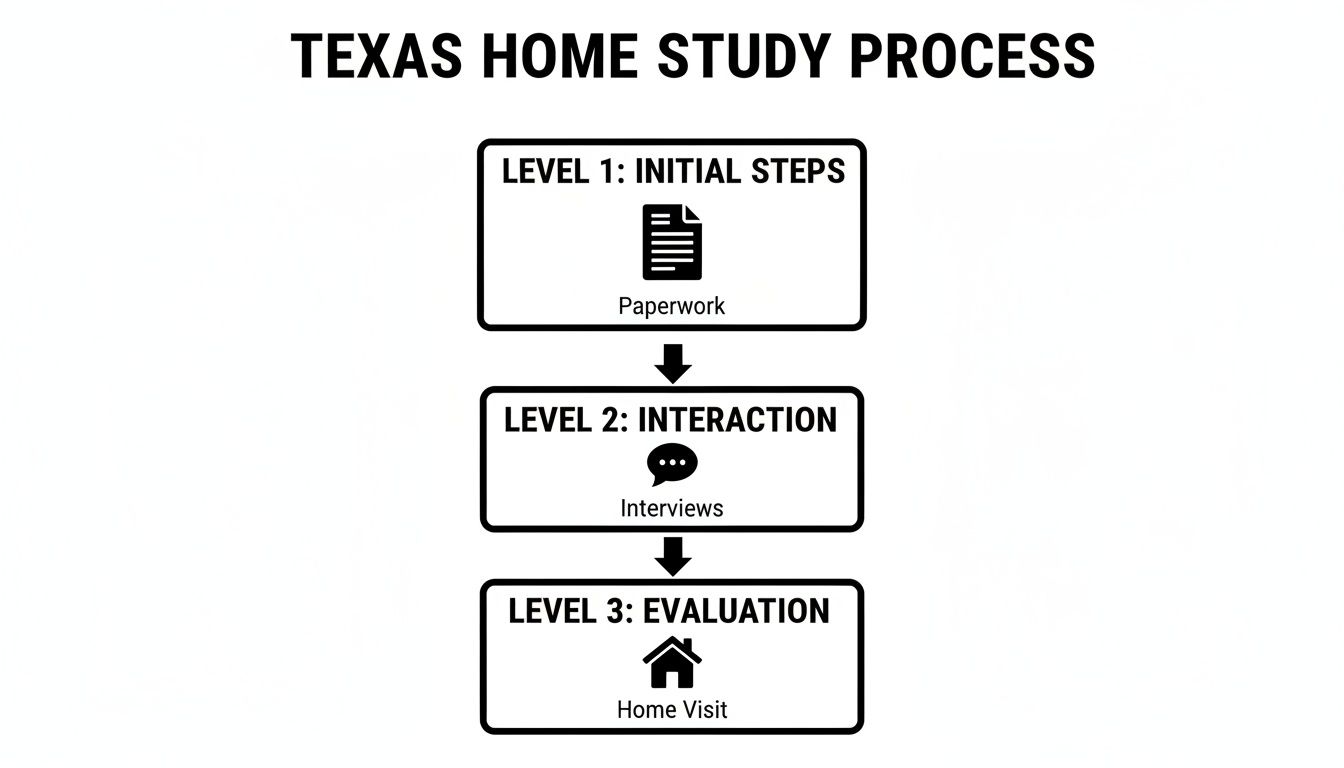
As you can see, it’s a structured process designed to prepare and support you, not to catch you off guard.
Adopting from Foster Care (CPS)
Thousands of incredible children in the Texas foster care system are waiting for a permanent, loving family. Adopting through Child Protective Services (CPS) is often free or low-cost and is a deeply rewarding way to grow your family. Many children in foster care have faced trauma or neglect and need parents who can meet them where they are with immense patience, support, and love.
For example, a family might decide to adopt a sibling group to keep them together. This act of love provides incredible stability for the children. Nationally, about 54% of children adopted from foster care are between 1 and 5 years old, but many older children and teenagers are also hoping for a forever family. You can learn more about the children awaiting adoption in Texas on the DFPS website to get a clearer picture.
No matter which path you’re considering, they all lead to the same beautiful destination: family. Understanding the specific adoption requirements in Texas for each one is your next step.
The Legal Process of Finalizing Your Adoption
Once the home study is behind you and you've been matched with a child, you've reached the final, most beautiful part of the adoption journey. This is where your family is officially born in the eyes of the law. While these last steps are guided by the Texas Family Code, they're about turning your emotional bond into a permanent legal reality.
This part of the process might sound formal, but it’s truly filled with heart. It’s about making sure every legal detail is perfectly in place so your family can start its new life with complete security and peace of mind.
The Critical Step of Terminating Parental Rights
Before any adoption can be finalized, a crucial legal step must happen: the biological parents' legal rights to the child have to be formally ended. This is a non-negotiable process called the Termination of Parental Rights (TPR). Think of it as the legal mechanism that makes a child eligible for adoption, creating a clean slate for your new family to begin.
This can happen in two primary ways:
- Voluntary Relinquishment: This is most common in private infant adoptions, where a birth parent makes the courageous and loving choice to sign legal documents giving up their parental rights. In Texas, a birth mother must wait at least 48 hours after giving birth to sign these papers. This waiting period ensures the decision is made with a clear mind and without pressure.
- Involuntary Termination: In other cases, like many foster care adoptions, a court may step in to terminate a biological parent's rights. This only happens when it's proven to be in the child's best interest due to severe issues like neglect, abuse, or abandonment. It’s a serious court proceeding focused entirely on the child’s safety and future.
This step, while sometimes emotionally heavy, is what provides the permanency and stability every child deserves.
Post-Placement Supervision and The Final Countdown
After a child is placed in your home, a new chapter begins—the post-placement supervision period. This is not a test. It's really a time of support and transition for your new family, and it typically lasts for about six months.
During this time, a social worker will visit your home every so often. These visits are much more relaxed than the initial home study. The social worker is there to see how everyone is adjusting, offer resources, and answer any questions that come up as you navigate the beautiful challenges of bonding. They will then put together a positive report for the court, which is a key piece of evidence for the final hearing. Our team can help you understand more about the role of the Texas Family Code in the adoption process and what to expect.
The final adoption hearing isn't a trial; it's a celebration. It's the moment a judge looks at you, looks at your child, and legally declares you a family forever.
Your Adoption Day: The Joyful Final Hearing
Once the post-placement period is successfully finished, your attorney will file a final petition with the court to schedule the adoption finalization hearing. This is the day you’ve been dreaming about. Far from being a scary courtroom battle, this hearing is a moment of pure joy.
You, your child, and your attorney will appear before a judge. The judge will review your file—including the home study and post-placement reports—and ask you a few simple questions under oath to confirm you’re ready to take on all the rights and responsibilities of a parent.
Then comes the best part. The judge will sign the final decree of adoption. At that exact moment, your child is legally yours in every single way, with the same rights as a biological child, including the right to inherit. Many families bring cameras, balloons, and loved ones to the courthouse to celebrate what is lovingly called "Adoption Day"—the beautiful, official beginning of your forever family.
Your Next Steps Toward Building Your Family
You’ve just navigated a mountain of information on the Texas adoption process, from the legal nuts and bolts to the emotional journey ahead. It’s completely normal to feel a mix of excitement and maybe a little bit of overwhelm. But the good news is you now have a roadmap. You know the key milestones, from confirming you’re eligible to completing the home study and choosing the adoption path that feels right for your family.
Knowledge is one thing, but taking that first concrete step is where your family’s story really begins. Each stage is a thoughtful move toward the incredible goal of giving a child a permanent, loving home.
Your Initial Checklist for Moving Forward
To help turn that big goal into small, manageable actions, here are a few things you can do right now to get the ball rolling:
- Gather Key Documents: Start a dedicated folder—digital or physical—for important papers. Think birth certificates, marriage licenses, recent pay stubs or tax returns, and letters of reference. Having these ready will make your home study application feel a lot less daunting.
- Attend an Information Seminar: Many adoption agencies and organizations offer free, no-pressure seminars. These are fantastic places to hear real stories from adoptive parents, ask questions, and meet other people who are on the exact same path as you.
- Explore Different Adoption Paths: Take some time to reflect. Does a stepparent adoption, a kinship placement with a relative, or a private domestic adoption feel like the best fit for your unique situation?
Every great journey begins with a single, courageous step. Your next step is to seek personalized guidance that honors your unique story and dreams for your family.
Now is the time to take that step. We invite you to schedule a free, confidential consultation with the Law Office of Bryan Fagan, PLLC. This is a real conversation where you can ask your most pressing questions and get compassionate, straightforward legal advice. Let us empower you to take the next confident step in your adoption journey toward building your family.
Frequently Asked Questions About Texas Adoption
When you start thinking about adoption, the questions can feel endless. It's a journey filled with hope, but also a lot of uncertainty. To help clear the path, we’ve put together some straightforward answers to the most common questions we hear from hopeful parents, birth parents, and relatives in Texas.
Can a Single Person Adopt a Child in Texas?
Absolutely. The Texas Family Code does not focus on your marital status—it focuses on your ability to provide a safe, loving, and stable home for a child.
As long as you’re at least 21 years old, financially stable, and can offer a mature and responsible environment, you are fully eligible to adopt. The focus is always on what's in the best interests of the child, not whether you have a spouse.
How Long Does the Adoption Process Typically Take?
There’s no single answer to this, as the timeline really depends on the type of adoption you're pursuing. Think of it as different paths up the same mountain—some are shorter and more direct, while others have more twists and turns.
Here’s a general breakdown:
- Stepparent Adoptions: These can be the fastest, sometimes wrapping up in just a few months, especially if the other biological parent is in agreement.
- Private Infant Adoptions: This path often takes between one and two years from starting your home study to the final court hearing.
- Foster Care Adoptions: The timeline here can be unpredictable. It depends entirely on when a child becomes legally available for adoption, which only happens after their biological parents' rights have been terminated.
No matter which route you take, patience is your most valuable asset.
What Is the Difference Between Open and Closed Adoption?
The biggest difference comes down to one thing: communication. It’s all about the level of contact between the birth family and the adoptive family after the adoption is finalized.
- Open Adoption: This involves some form of ongoing contact. It could be anything from sharing photos and letters to emails or even occasional visits. Open adoptions are becoming more common because they can give a child a stronger sense of their own story and identity.
- Closed Adoption: In this arrangement, no identifying information is shared, and there is no contact between the birth parents and the adoptive family.
Texas law permits both, and it’s a deeply personal decision. The final agreement is made between the birth and adoptive parents, always with the child's well-being at the heart of the choice.
The goal of any adoption agreement, whether open or closed, is to create a sense of security and belonging for the child. It’s about honoring their story while building their future.
Can I Adopt an Adult in Texas?
Yes, you can. Adult adoption is legal in Texas and is often used to formalize a bond that has existed for a lifetime. The most common scenario is a stepparent adopting an adult stepchild, finally making the parent-child relationship official on paper.
It can also be a way to establish legal inheritance rights for a caregiver or another person who has played a significant role in someone's life. The process is much simpler than adopting a minor, as it typically only requires the consent of the adult being adopted and the person adopting them.
The adoption journey is different for every family, and your questions deserve personal, compassionate answers. At the Law Office of Bryan Fagan, PLLC, we are here to provide the legal guidance you need with the empathy you deserve. We are ready to help you take the next step. Schedule a free, confidential consultation with us today to discuss your story and learn how we can help you build your forever family. You can reach us at https://texasfamilyadoption.com.
