
You may be sitting in a Plano kitchen today with a child you already love, wondering whether adoption will make your family legally whole. Or you may be a relative caring for a child, a stepparent ready to take on permanent responsibility, or a hopeful parent trying to understand where a private or foster-care adoption begins. The questions can feel personal and overwhelming, especially when a child's future depends on careful legal decisions.
An adoption lawyer in Plano does more than prepare forms. The right attorney helps identify the legal obstacle that could stop a case before finalization, protects the child's best interests, and explains each step in language your family can use. Texas adoption is built around court oversight, parental-rights decisions, home-study requirements, and a final decree that permanently changes the legal relationship between parent and child.
Finding Your Adoption Attorney in Plano
A Plano couple may begin with a simple hope: they want to give a child a permanent home. After an initial conversation with an agency or relative, they learn that adoption involves more than signing papers. Someone may need to address the other parent's rights, every adult in the home may need clearance, and a court must decide whether the adoption serves the child's best interests.
That's where an adoption lawyer plano families can trust becomes important. Adoption has a long legal history in Texas. Earlier Texas civil laws allowed adoption by deed, and historians note that Texas passed an adoption law in 1850, before Massachusetts enacted the United States' first modern adoption statute in 1851. This history helps explain why adoption remains a highly procedural area of family law, governed mainly by state statutes and courts rather than federal common law. (Texas adoption law history)

Adoption changes legal status permanently
Under Texas Family Code Chapter 162, a final adoption decree creates a legal parent-child relationship. The adopted child is treated as the adoptive parents' child for inheritance and other legal purposes, while certain grandparent access rights remain governed by Chapter 153. (Texas Family Code Chapter 162)
That permanence is a source of joy, but it also calls for careful preparation. A lawyer may need to investigate parental rights, prepare pleadings, coordinate with a home-study provider, communicate with agencies, and appear at the final hearing. The lawyer's job is not to push a family through a form-driven process. It's to help the adults make lawful decisions that protect the child's safety, stability, identity, and long-term family relationships.
A useful starting point: Ask not only, “How do we file an adoption?” Ask, “What must be resolved before this adoption can legally move forward?”
Families looking for counsel can review adoption attorneys near you and compare each firm's experience with the type of case they're considering. A consultation should leave you with a clearer understanding of the next legal step, the information your attorney needs, and the questions that still require answers.
Understanding the Texas Adoption Process
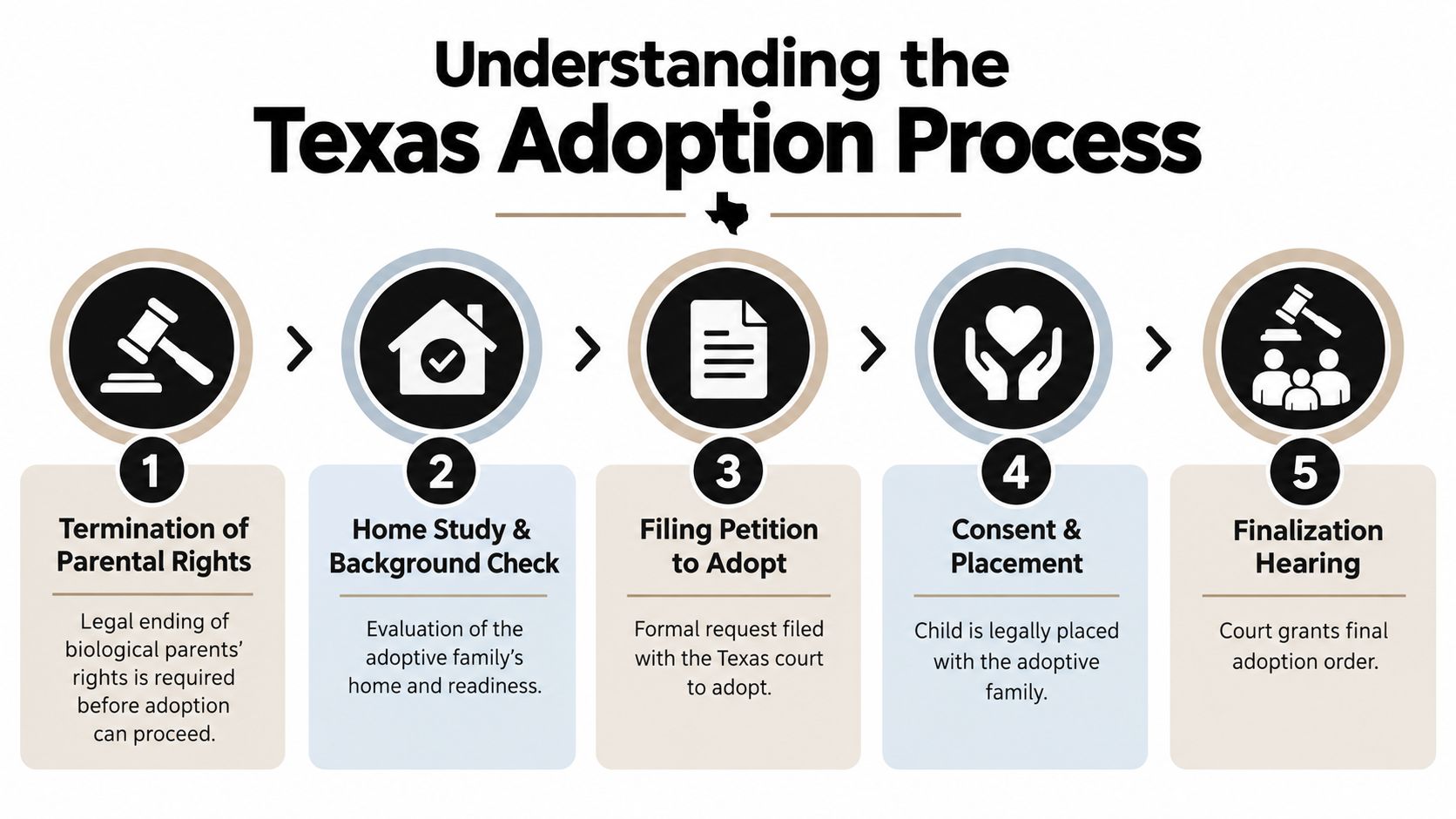
Texas adoption usually follows a legal sequence, although the details vary by case type. The most important point is that adoption and termination of parental rights are separate legal issues. In many cases, the child's other parent must first voluntarily relinquish parental rights or have those rights involuntarily terminated before the court can grant the adoption.
The legal gates before finalization
First, identify the adoption route. A stepparent, kinship, private domestic, foster-care, international, and adult adoption can involve different documents and decision-makers. Chapter 162 supplies the central adoption rules, while Chapters 163 through 166 address related matters such as termination, confidentiality, and other adoption procedures. Your lawyer should identify which provisions apply rather than treating every case alike.
Second, address parental rights. Voluntary relinquishment may be possible in some cases, but an unwilling or absent parent can create a contested termination case. Involuntary termination requires stronger legal proof than showing that adoption would be convenient. A parent's location, history of involvement, consent, and conduct can all affect the strategy.
Third, complete the home study. Texas requires the Department to complete a home study before an applicant is approved for adoption. The evaluation is a safety-and-space assessment, not a ceremonial form. Federal child-welfare guidance for Texas says it includes interviews with each adoptive parent, children age four or older in the home, other household members, outside references, and at least one home visit with all household members present. (Texas home-study guidance)
Every adult resident, nonresident child, and relevant household disclosure matters. Texas law and guidance also include criminal-background and child-abuse clearance elements. Because approval depends on completion of the study, missing information can delay a case even when the child is already living with the family. (Texas Family Code Section 264.207)
Placement, residence, and the final hearing
After the legal prerequisites and placement arrangements are handled, the child generally must live with the petitioner for a required period before finalization. DFPS explains that an adoptive family typically may seek finalization after the child has lived in the home for six months, although the six-month residency requirement can be waived when doing so serves the child's best interest. (DFPS adoption guidance)
For stepparent cases, Texas Law Help explains that the child must generally live with the petitioner for at least six months, and a child age twelve or older must consent in writing or in court. (Stepparent adoption guidance) Families considering that path can read Stepparent Adoption in Texas for a focused explanation.
At the final hearing, the judge reviews the legal record and considers the child's best interests. If the requirements are met, the court enters the final adoption order. You can also watch this Texas adoption process video as a general visual overview, but your attorney should apply the law to your specific facts.
Types of Adoption Our Firm Handles
The best legal strategy depends on how the child is connected to the family and whether parental rights are settled. A stepparent adoption is not handled like an international adoption, and a CPS case is not handled like a private infant placement.
Stepparent and kinship adoption
In a stepparent case, the spouse seeking adoption wants to become a legal parent to the other spouse's child. The other parent generally must consent or have parental rights terminated before the court can grant the adoption. If the child is age twelve or older, the child must provide written or in-court consent, subject to the rules discussed above.
Kinship and relative adoptions involve grandparents, siblings, aunts, uncles, and other relatives who want to provide permanent care. These cases often carry an important emotional goal: preserving the child's connection to family while creating clear legal authority and stability. A lawyer should examine existing custody orders, the parents' rights, the child's living arrangement, and whether adoption or guardianship better fits the family's needs.
Private, foster, and CPS adoption
A private domestic adoption may involve birth parents, an adoption professional, prospective parents, and court filings. Birth parents may explore an open arrangement involving agreed communication, or a more limited arrangement. The adults need clear counseling about what Texas law permits and how written agreements may function.
Foster-care and CPS adoptions involve public agencies and child-welfare requirements. They may include reunification efforts before adoption becomes the permanency goal. A family caring for a child through CPS should ask whether it needs a DFPS-focused adoption lawyer, a termination-first strategy, or advice about another permanency option.
Texas remains a large and active adoption environment. An estimated 7,168 children were adopted in Texas in 2023, compared with 7,265 in 2022. Foster-care adoptions represented 58.33% of the 2023 estimate, private domestic adoptions represented 39.96%, and intercountry adoptions represented 1.72%. (Adoption by the Numbers 2025)
LGBTQIA+, international, and adult adoption
Texas adoption law applies to qualifying parents based on the legal facts of the case, not on a family's stereotype. LGBTQIA+ couples and single parents should receive an individualized review of standing, parentage, consent, and the child's best interests. International adoptions add another layer of agency, immigration, and foreign-country requirements, so families should obtain counsel early.
Adult adoption and adult guardianship serve different purposes. The right choice depends on the adult's capacity, wishes, existing relationships, and legal goals. A consultation can help distinguish these paths before the family spends time and money pursuing the wrong filing.
For an overview of available routes, families can review types of adoption in Texas.
Costs and Financial Assistance Options
Adoption costs depend on the type of case, the professionals involved, the amount of litigation, and the services required. A private adoption may involve attorney fees, filing costs, service or notice expenses, counseling, agency charges, and a home study. A stepparent or relative case may look different from a contested termination and adoption proceeding.
Home-study pricing alone can vary by provider. One Texas provider lists domestic and international home studies at $1,475, repeat-family home studies at $900, and home-study updates at $400. Those figures are provider-specific examples, not a universal Texas fee schedule. (Texas home-study pricing)
Build a case budget before filing
Ask an attorney to separate known expenses from possible expenses. Court filing fees, legal representation, and the home study may be easier to identify at the beginning. Contested parental-rights litigation, difficulty locating a parent, additional evaluations, or a need to correct incomplete paperwork can change the total.
A practical first conversation should address:
- Legal fees: Ask whether the representation covers preparation, filing, communication, hearings, and finalization.
- Court expenses: Confirm which filing or service charges are paid directly to the court or another provider.
- Home-study charges: Ask whether the quoted amount covers the initial evaluation, updates, and any repeat work.
- Case complications: Discuss what happens if a parent contests termination, cannot be located, or raises a new issue.
- Agency involvement: Determine which services are handled by the agency and which require separate counsel or providers.
The goal isn't to reduce a child's future to a price tag. It's to prevent financial surprises from creating stress during an already emotional process.
Assistance may depend on the adoption route
Families adopting through foster care or CPS should ask the agency and attorney about available assistance. Public-agency adoption can involve benefits or support that aren't available in the same way for a private domestic case. Eligibility depends on the child, the program, and the facts of the adoption, so families should confirm current requirements rather than rely on general promises.
Employer adoption assistance and federal tax rules may also affect a family's planning. A lawyer can identify legal and process-related costs, while a tax professional should advise on tax eligibility and filing decisions. Families can also compare Texas adoption subsidy information with federal assistance through Texas adoption subsidy and federal adoption assistance resources.
Budgeting principle: Get a written explanation of what the quoted legal fee includes, what it excludes, and which events could require additional work.
How to Choose the Right Adoption Lawyer
A lawyer may be technically capable and still be a poor fit for your family. Adoption requires legal skill, but it also requires patience, direct communication, and respect for the child's history and the birth family's rights.

Questions that reveal useful experience
Start with the lawyer's practice focus. A general family lawyer may understand custody and divorce but have limited experience with adoption pleadings, termination litigation, home studies, agency coordination, or finalization hearings. Ask how often the attorney handles the type of adoption you're pursuing.
You might ask:
- What adoption types do you handle regularly? Look for an answer that matches your situation, whether it involves a stepparent, relative, CPS placement, private adoption, international process, LGBTQIA+ family, or adult adoption.
- How do you evaluate parental-rights issues? The lawyer should explain the difference between consent, relinquishment, and involuntary termination without promising an outcome.
- How do you prepare families for a home study? You should receive practical guidance about household members, records, disclosures, references, and the home visit.
- How will you communicate? Ask who answers questions, how updates are delivered, and what happens when an urgent issue arises.
- What can delay this case? A thoughtful lawyer will identify risks instead of offering certainty before reviewing the facts.
Local knowledge matters, but empathy matters too
Plano families may interact with local courts, evaluators, agencies, and professionals who understand North Texas practice. Local familiarity can help an attorney prepare filings and scheduling expectations, but it doesn't replace careful legal analysis. The lawyer still must work from the Texas Family Code and the facts of your case.
Pay attention to how the consultation feels. Does the attorney listen without rushing? Do they explain difficult issues plainly? Do they respect birth parents and relatives, or do they speak as if the case is only about the prospective adoptive parents?
The Law Office of Bryan Fagan, PLLC provides adoption and guardianship counsel for Texas families, including stepparent, relative, domestic, international, foster-care, LGBTQIA+, single-parent, CPS-related, and adult matters. The firm also offers virtual consultations statewide, which can help families begin the conversation even when travel or schedules are difficult.
Frequently Asked Questions About Adoption
Can a criminal background issue prevent adoption?
A background issue doesn't answer the question by itself. Texas pre-adoptive evaluations include criminal-background and child-abuse clearance elements, and the home study considers the household as a whole. Tell your lawyer and evaluator about the issue early. Hiding information can create a larger problem than the underlying record.
Is open adoption legally required?
Texas adoption arrangements can differ in the amount and type of contact permitted after adoption. An open arrangement may include communication or updates, while a closed arrangement may involve little or no continuing contact. The adults should discuss expectations carefully, and your attorney should explain what can be documented and how the child's best interests guide the arrangement.
What happens if a birth parent changes their mind?
The answer depends on whether the parent has signed a valid relinquishment, whether a court has addressed parental rights, and the timing of the change. A birth parent's rights deserve careful protection, while prospective parents need honest advice about legal risk. Don't assume that a verbal promise, agency conversation, or informal agreement settles the issue.
Do relatives need an adoption lawyer?
They may benefit from one, especially when a child's parents disagree, a parent is difficult to locate, CPS is involved, or the family is unsure whether adoption or guardianship is appropriate. Kinship care often carries both legal and emotional complications. Clear advice can protect family unity without overlooking the child's need for permanent stability.
Can a child be adopted before six months?
A six-month residence period commonly applies before finalization, but Texas guidance recognizes that the requirement may be waived when doing so serves the child's best interest. The court's authority and the facts of the case matter. Your attorney should explain whether a waiver is legally available and whether requesting one is sensible.
If you're considering adoption in Plano, don't wait until a missing consent, incomplete home study, or contested termination has already stalled the case. The Law Office of Bryan Fagan, PLLC can review your family's circumstances, explain the Texas process, and help you identify the next practical step. Visit Law Office of Bryan Fagan, PLLC to schedule a free consultation about adoption or guardianship guidance.
