
At its heart, Texas adoption law is a legal framework built to create a permanent, loving family for a child. The guiding star for every single step is the child's best interests. The entire process, outlined in the Texas Family Code, revolves around this principle—from the termination of a birth parent's rights to the court-approved home study, everything is designed to place a child in a safe and stable home.
Your Path to Parenthood Starts Here

Starting the adoption journey is a profound act of love. Whether you're dreaming of bringing home a newborn, making your bond with a stepchild official, or providing a safe harbor for a relative, you are taking a beautiful step toward building your family. We understand that the path ahead can feel full of questions and unknowns. This guide is here to offer a reassuring first step, explaining the process with empathy and clarity.
Every rule, form, and court hearing in Texas adoption law is structured around one vital principle: protecting the best interests of the child. Instead of seeing the legal process as a series of hurdles, think of it as a thoughtful system of safeguards built to create strong, permanent families.
Understanding the Emotional and Legal Journey
The decision to adopt is deeply personal. It often marks the end of one chapter and the hopeful beginning of another, blending complex legal procedures with powerful emotions. Acknowledging both sides of this journey is key to feeling prepared and empowered.
For instance, a couple might feel pure joy when they match with a birth mother, only to be followed by waves of anxiety during the mandatory waiting periods. A grandparent stepping up to adopt their grandchild feels a mix of overwhelming love, sudden responsibility, and the need to navigate a completely new family dynamic. These feelings aren't just normal—they're part of the process.
The Texas Family Code, especially Chapters 162-166, provides the legal roadmap for every adoption. It ensures each case is handled with care, fairness, and a laser focus on creating a stable future for the child.
Different Paths to Building Your Family
Texas law recognizes that families are built in many different ways. Your unique situation will point you toward the right path. Here’s a quick look at the most common types of adoption:
- Private Infant Adoption: This is what most people picture—working with an agency or attorney to adopt a newborn, often with direct communication with the birth parents.
- Stepparent Adoption: This legally formalizes the bond between a stepparent and their stepchild, giving them full parental rights and responsibilities.
- Kinship or Relative Adoption: This happens when a family member—like a grandparent, aunt, or uncle—steps in to adopt a child in their own family to ensure they remain with loved ones.
- CPS Adoption: This means adopting a child from the state's foster care system, giving a permanent home to a child who cannot safely return to their birth family.
Each of these avenues has its own procedures, but the destination is always the same: creating a loving, legally recognized family. No matter where you are on your journey, please remember that you aren't walking it alone.
Our team at The Law Office of Bryan Fagan, PLLC, is here to provide the compassionate legal guidance you need. We invite you to schedule a free consultation to talk about your dreams of building a family.
The Legal Heartbeat of Texas Adoption
To really understand why today’s Texas adoption laws are so protective and thoughtful, it helps to look back at where they came from. This isn’t just a dry history lesson; it’s the story of how our state’s approach to building families grew from a system focused on property and inheritance into the compassionate, child-first framework we have today.
The earliest adoption laws in Texas looked nothing like what we have now. In fact, the first statute, passed way back in 1850, was mostly about creating "legal heirs." Its main goal was to establish inheritance rights—not ensuring a child’s welfare or nurturing the emotional bonds of a new family.
That early framework worked for its time, but as society’s understanding of family evolved, so did the need for a more protective legal process.
The Shift Toward Child-Centered Laws
The real turning point came in the early 20th century. Lawmakers and communities started to realize that adoption was about so much more than just continuing a family line. It was about giving a child a safe, loving, and permanent home.
In 1931, Texas took a huge step forward by modernizing its adoption laws. For the first time, every single adoption had to get court approval. This change guaranteed a judge would review each case to decide if the adoption was truly in the child’s best interest—a standard that remains the absolute cornerstone of all family law today.
This landmark legislation marked the official move from adoption as a private deal to a legally supervised process designed to protect the most vulnerable person in the room: the child.
Why This History Matters to Your Journey
Knowing this history helps you understand the "why" behind the steps you're taking today. The home study, the court hearings, and the termination of parental rights aren’t just bureaucratic hoops to jump through. They are safeguards born from decades of learning and experience, all designed to make sure every adoption creates a secure and stable family.
These foundational laws are all laid out in the Texas Family Code, which serves as the official playbook for every adoption case. It’s the legal structure that ensures fairness and consistency, protecting hopeful parents, birth parents, and most importantly, the children at the heart of it all. For a closer look at the specifics, you can explore our essential guide on Texas adoption and the Family Code.
Every form you fill out and every hearing you attend is part of this long legacy of growing compassion. It’s a system built to honor the profound emotional weight of creating a family through adoption, all while upholding the legal standards that make that family permanent and secure.
Finding the Right Adoption Path for Your Family
Every family’s story is beautifully unique, and Texas law recognizes that the path to building that family through adoption will be just as personal. Choosing the right adoption path is less about finding the "best" one and more about discovering the one that aligns with your heart, your circumstances, and your hopes for the future.
Think of it like choosing a home. Some families need a house that’s move-in ready, while others dream of renovating a historic property with deep family roots. The end goal is the same—a loving home—but the journey to get there looks very different. Similarly, adoption law in Texas provides several distinct pathways to create your forever family.
Private Infant Adoption: A Journey of Connection
Private infant adoption is what many people first imagine when they think of adoption. It typically involves a direct connection between a hopeful adoptive family and expectant birth parents, often facilitated by a licensed agency or an experienced attorney. This path is built on a foundation of mutual choice and trust.
For example, a couple who has longed for a newborn may create a profile book sharing their life, values, and dreams for a child. A birth mother reviews these profiles, choosing the family she feels is the right fit for her baby. This process is deeply personal and emotionally charged, requiring patience, empathy, and a strong support system for everyone involved.
Stepparent and Kinship Adoptions: Strengthening Family Bonds
Sometimes, a family is already formed in heart, and the law simply needs to catch up. Stepparent and kinship (or relative) adoptions are powerful legal acts that formalize bonds that already exist. These paths are centered on providing stability and legal permanence to a child within their existing family circle.
- Stepparent Adoption: This legally solidifies the relationship between a stepparent and their stepchild. It grants the stepparent full parental rights and responsibilities, which is crucial for making medical decisions, enrolling in school, and ensuring the child has two legal parents.
- Kinship Adoption: This occurs when a relative, such as a grandparent, aunt, or uncle, adopts a child in their family. Kinship adoption often arises from a crisis, providing a child with a safe, familiar, and loving home while honoring their existing family ties.
Adopting from Child Protective Services (CPS): A Path of Hope
Adopting a child from the state's foster care system is an incredible act of love that provides a permanent home for a child who cannot safely reunite with their birth family. These children, who range from infants to teenagers, are waiting for a family to offer them the stability and love they deserve.
The process of adopting through CPS (often called foster-to-adopt) involves becoming a licensed foster parent first. While this path can have its unique challenges, it is also immensely rewarding. It’s important to understand the key differences between being a temporary caregiver and a permanent parent. You can read more about the distinctions in our guide exploring the difference between foster care and adoption.
At its core, adopting from CPS is about healing and hope. It’s a commitment to showing a child who has experienced trauma that they are worthy of unconditional love and a place to truly belong.
To help you visualize how these paths compare, here is a quick overview of the primary adoption types in Texas.
Comparing Adoption Paths in Texas
| Adoption Type | Primary Candidates | Key Legal Requirement | Typical Level of Openness |
|---|---|---|---|
| Private Infant | Families hoping to adopt a newborn. | Consent from biological parents. | Often open or semi-open. |
| Stepparent | A stepparent married to the child's legal parent. | Termination of the other parent's rights. | Varies based on family dynamics. |
| Kinship (Relative) | Grandparents, aunts, uncles, or other relatives. | Termination of parental rights. | Usually open due to existing ties. |
| CPS (Foster-to-Adopt) | Families open to children of various ages. | Child must be legally free for adoption. | Varies; often semi-open. |
Each of these avenues leads to the same destination: a legally recognized, forever family. The right choice depends entirely on your unique circumstances and the kind of adoption journey you envision.
Understanding Open, Semi-Open, and Closed Adoptions
Another crucial decision is determining the level of communication between the adoptive family and the birth family. Today, most adoptions involve some level of openness, recognizing the benefits for the child's sense of identity.
- Open Adoption: Involves direct contact between the birth and adoptive families, which can include letters, photos, phone calls, or even in-person visits. This is the most common approach today, with research showing that about 95% of modern adoptions are open.
- Semi-Open Adoption: Communication is handled through a third party, like an agency, allowing for privacy while still sharing updates.
- Closed Adoption: No identifying information is shared and there is no contact between the families. This is much less common today.
Identifying the right path for your family is a decision that requires thoughtful consideration and compassionate legal advice. To discuss which adoption path feels right for you, we invite you to schedule a free, confidential consultation with our team.
Navigating the Texas Adoption Process Step-by-Step
The adoption journey can feel like a huge adventure, but it gets much clearer when you have a map. Think of this section as your step-by-step guide, breaking down the entire process into four manageable stages. We'll walk you through each critical milestone, from your initial preparations to the joyful day your adoption is finalized in court.
Instead of seeing this as a series of hurdles, view it as a carefully paved path designed to lead a child to a secure and loving home. Every single step, governed by adoption law in Texas, serves a specific and vital purpose in building your forever family.
This infographic shows the different starting points for an adoption journey, whether it begins through a private agency, with a relative (kinship care), or from the foster system.
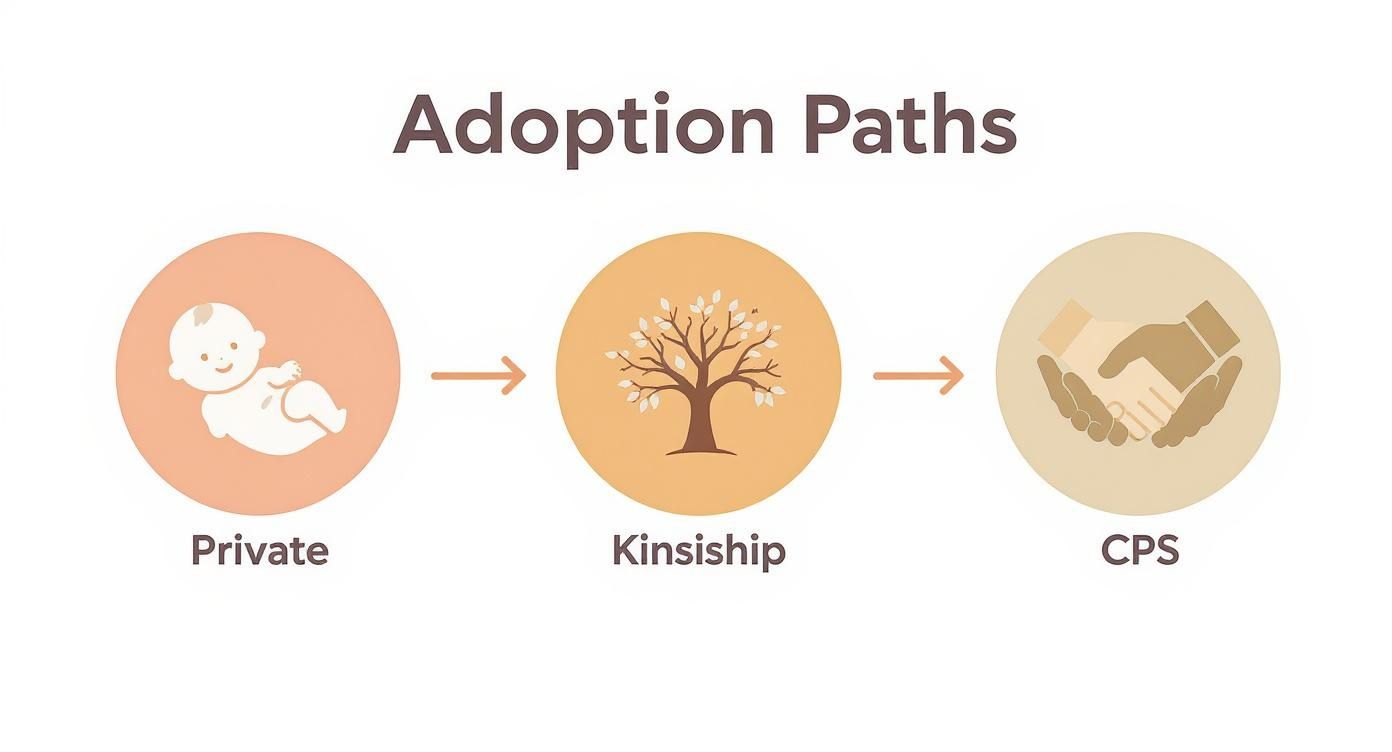
While the initial paths might look different, they all eventually merge and follow the same legal milestones required to create a stable, permanent family for a child.
Step 1: The Home Study
Before a child can be placed in your home, you must complete a home study. This is a thorough review conducted by a licensed social worker. The goal isn’t to judge your lifestyle but simply to ensure you can provide a safe, stable, and nurturing environment for a child.
The home study involves interviews, background checks, a review of your finances, and a visit to your home. It’s a chance for you to learn and prepare for parenthood, and for the state to verify that your home is ready. This step is a cornerstone of the Texas Family Code, highlighting the state's commitment to placing children in secure homes.
Step 2: Terminating Birth Parent Rights
For an adoption to move forward, the legal rights of the birth parents must be terminated. This is a profound and legally critical step that creates the "legal space" for an adoptive parent to step in. Termination can happen in one of two ways:
- Voluntary Relinquishment: A birth parent can choose to sign a legal document, known as an affidavit of relinquishment, to voluntarily give up their parental rights. In Texas, a birth mother cannot sign this document until at least 48 hours after the child’s birth. This waiting period ensures the decision is made without the immediate pressures of labor and delivery.
- Involuntary Termination: In difficult situations involving abuse, neglect, or abandonment, a court may terminate a parent's rights without their consent. This is a serious legal action taken only when it's proven to be in the child's best interest.
This part of the process is handled with immense sensitivity, recognizing the emotional weight for everyone involved while always putting the child’s need for a permanent home first.
Step 3: Placement and Post-Placement Supervision
Once parental rights are terminated, the child can be legally placed in your home. This is the moment you've been waiting for—when you finally bring your child home! But the legal journey isn't quite finished yet.
The post-placement period begins, which usually lasts for about six months. During this time, a social worker will visit your home a few times to see how everyone is adjusting. These visits are meant to be supportive, not intrusive. The social worker is there to offer resources, answer questions, and prepare a report for the court confirming the placement is a success and serves the child's best interests.
Step 4: The Finalization Hearing
The last step is the finalization hearing in court. This is the official, celebratory day when your family becomes legally complete. You, your child, and your attorney will appear before a judge, who will review all the paperwork—including the home study and the post-placement reports.
The judge will ask a few simple questions to confirm your intent and then sign the final decree of adoption. At that moment, the child is legally yours, with all the rights and responsibilities that come with it. It’s often a joyous and emotional day, marking the successful end of your adoption journey and the beautiful beginning of your new life as a family.
Each of these steps is a deliberate part of a process designed to protect children and build strong families. Navigating them requires patience, heart, and the right legal guidance. If you have questions about where you are in the process, we invite you to schedule a free consultation with our compassionate team to discuss your next steps.
Who Is Eligible to Adopt in Texas
One of the first questions we hear from hopeful parents is, "Am I eligible to adopt?" It’s a question that comes from a place of deep hope and, sometimes, a little bit of fear. Let’s clear the air with a reassuring truth: Texas law focuses on your ability to provide a safe, stable, and loving home—not on fitting some perfect, one-size-fits-all mold.
The state’s eligibility requirements are designed to be inclusive, recognizing that loving families come in all shapes and sizes. The core goal of adoption law in Texas is to find the best possible homes for children in need, and that opens the door for many different kinds of wonderful people to become parents.
Core Eligibility Requirements for Adoptive Parents
The Texas Family Code lays out a few key criteria that all prospective adoptive parents must meet. Think of these not as barriers, but as foundational safeguards to protect a child’s well-being.
You can be considered eligible to adopt in Texas if you are:
- An adult. There is no specific upper age limit, but you must be legally recognized as an adult.
- Financially stable. You don't need to be wealthy. You just have to show you can provide for a child's basic needs.
- Able to provide a safe, nurturing home. This is confirmed through the home study process, which is designed to ensure you can offer a secure environment.
Beyond these basics, you'll go through a criminal background check. This is to ensure there’s no history of child abuse or neglect. Every standard is in place for one reason: to make sure every child is placed in a home where they can truly thrive.
Busting Common Myths About Who Can Adopt
Many caring individuals mistakenly count themselves out of the adoption process because of myths that just aren't true. It's time to set the record straight on how welcoming Texas adoption law can be.
Here are a few myths we can put to rest right now:
- Myth: You must be married. This is completely false. Single individuals are absolutely eligible and welcome to adopt in Texas.
- Myth: You must own your own home. Not true at all. Whether you rent or own, what matters is that your home is a safe and stable place for a child.
- Myth: You have to be young to adopt. There is no "perfect" age. Your maturity, stability, and ability to care for a child are what really count.
These myths often create unnecessary anxiety. The reality is that the state is looking for capable, loving parents from all walks of life.
Affirming LGBTQ+ Adoption Rights in Texas
It is essential to state this clearly and with wholehearted support: LGBTQ+ individuals and couples have the same right to adopt in Texas as anyone else. The U.S. Supreme Court has affirmed that marriage equality extends to all related rights, and that absolutely includes adoption.
In Texas, your sexual orientation or gender identity cannot be used as a barrier to adoption. The law focuses on your character, stability, and ability to love and care for a child—qualities that have nothing to do with whom you love.
Whether you are a single person or part of a couple, your application will be evaluated on the exact same criteria as any other prospective parent. A loving, stable home is what matters most, and same-sex couples and LGBTQ+ individuals provide these homes for children across Texas every single day.
The journey to adoption starts with understanding that you are likely more "qualified" than you think. Feeling ready to take the next step or simply want to ask a few more questions in a safe, judgment-free space? Our team at The Law Office of Bryan Fagan, PLLC, is here to provide the compassionate legal guidance you deserve. We invite you to schedule a free consultation to talk through your hopes for building a family.
Finalizing Your Family and Life After Adoption

The finalization hearing isn't just another court date. It's a celebration—the culmination of your long journey and the beautiful, official start of your new life as a legally recognized family. This is the day you’ve been working toward, the moment your forever truly begins.
When you, your child, and your attorney stand before the judge, the atmosphere is almost always warm and joyful. The judge will review all the final documents, including the positive reports from the post-placement supervision period, making sure every requirement under Texas law has been met.
Then, with the stroke of a pen on the final decree of adoption, it’s done. Your child legally becomes a permanent member of your family, with all the rights, privileges, and love that entails.
Life After the Final Decree
Once the excitement of finalization day settles, a new and wonderful chapter opens up. There are a few practical steps that follow the judge's order, and they are just as important for cementing your new family structure.
One of the very first tasks is getting a new birth certificate for your child. Your attorney will help you file the right paperwork with the Texas Bureau of Vital Statistics. The new certificate will list you as the child’s parents and can also reflect any name change you've chosen—a powerful, tangible symbol of your new legal reality.
Nurturing Connections and Finding Support
Life after adoption is an ongoing journey of growth, love, and learning. If you have an open or semi-open adoption agreement, this new phase is about honoring the communication plans you made with the birth family. Maintaining these connections with respect and consistency is so important for your child’s sense of identity and well-being.
It's also crucial to remember that you are not alone. Texas offers a wealth of post-adoption support resources for families, from counseling services and parent support groups to educational workshops. These resources can provide invaluable guidance as you navigate the unique joys and challenges of raising an adopted child.
The goal of adoption law in Texas is not just to create families, but to ensure they have the foundation to thrive for a lifetime. Finalization is the legal beginning, and the support that follows is what helps your family flourish.
Our commitment at The Law Office of Bryan Fagan, PLLC, extends far beyond the courtroom doors. We are here to support you long after the legal process is complete. If you have questions about finalizing your adoption or need guidance on what comes next, we invite you to schedule a free, compassionate consultation with our team.
Common Questions About Texas Adoption Law
The adoption journey is filled with hope, excitement, and—let’s be honest—a lot of questions. As you get closer to building your family, it’s completely normal to wonder about the practical details, like how long it will all take and what the costs look like.
We’ve gathered some of the most common questions we hear from families just like yours. Our goal is to give you clear, straightforward answers to help you turn uncertainty into confident action.
How Much Does It Cost To Adopt a Child in Texas?
Adoption costs in Texas can vary dramatically depending on which path you take. If you choose to adopt a child from the state's foster care system (CPS), the costs are often very low—or even zero. The state frequently provides financial assistance to help support the family, making it an accessible option for many loving parents.
Private domestic infant adoptions, on the other hand, can range anywhere from $25,000 to over $50,000. These costs typically cover a bundle of services, including:
- Legal and agency fees
- Home study expenses
- Support for the birth mother’s living and medical needs
Stepparent and kinship adoptions are generally much less expensive because they don’t require the same level of agency involvement. It’s always a good idea to discuss all potential costs with your attorney upfront to create a realistic financial plan for your family's journey.
How Long Does the Adoption Process Take in Texas?
Just like the costs, the timeline for an adoption depends heavily on your specific circumstances. A stepparent or relative adoption can sometimes be wrapped up in just a few months, especially if everyone is on the same page. Adopting a child from foster care might take anywhere from six months to two years to finalize.
Private infant adoption timelines are often the most unpredictable because they hinge on the matching process. This path typically takes from one to two years, from the day you start your home study to the finalization hearing in court. Legal requirements, like the mandatory waiting periods after a birth parent signs legal paperwork, also play a key role in the overall timeframe.
In Texas, a birth parent’s decision to relinquish their parental rights is a serious, legally binding step. A birth mother must wait at least 48 hours after the child's birth to sign the relinquishment affidavit. Once signed, this decision is generally irrevocable, providing stability for the child and finality for everyone involved.
Your dream of building a family is the most important journey you'll ever take. At The Law Office of Bryan Fagan, PLLC, we are here to provide the compassionate legal guidance you need to navigate every step with confidence. Schedule your free consultation with us today by visiting https://texasfamilyadoption.com.
