 Skip to content
Deciding to grow your family through adoption in Texas is a journey of the heart—a beautiful, courageous choice. But it’s also a complex legal path. An adoption attorney is your most crucial partner on this journey, offering the legal skill and compassionate support you need to build your family securely. They handle the intricate legal work, freeing you up to focus on what truly matters: preparing your home and your heart for a new beginning.
Starting Your Texas Adoption Journey

The moment you decide to adopt, your world fills with hope, excitement, and—let’s be honest—a lot of questions. Whether you are a hopeful parent dreaming of a new addition, a stepparent wanting to make your family legally whole, or a birth parent considering a loving plan for your child, you are not alone. This journey is profound, and having the right guide is everything.
In Texas, adoption isn’t just about paperwork; it's a formal legal process spelled out in the Texas Family Code. This is where an experienced adoption attorney steps in to become your navigator and advocate.
Think of them as a seasoned guide on a deeply personal expedition. They know the terrain, anticipate the challenges, and keep you on the safest, most direct path to your destination: bringing your child home.
Their job is to ensure every step is handled with precision and care, always putting the child’s best interests first. From filing the first petition to that incredible moment in court when your family is made official, their expertise brings peace of mind.
What a Texas Adoption Attorney Does for Your Family
So, what exactly does an adoption attorney do? Understanding their role helps you see just how valuable they are. They aren't just legal advisors; they are the architects of your family's legal foundation.
Here’s a quick look at the key responsibilities your attorney handles to ensure a smooth, secure, and legally sound adoption in Texas.
| Service Area | What It Involves | Why It Matters for You |
|---|---|---|
| Legal Filings & Strategy | Drafting and filing the Petition for Adoption, motions, and the final decree with the correct court. | This ensures all paperwork is accurate and meets strict Texas legal standards, preventing costly delays or rejections. |
| Termination of Parental Rights | Managing the legal process of terminating the biological parents' rights, either voluntarily or through court action. | This is a critical step for a secure adoption. It makes the child legally available to be adopted, protecting your family from future legal challenges. |
| Home Study & Compliance | Guiding you through the mandatory home study requirements and ensuring all state compliance checks are completed properly. | An attorney helps you prepare for and successfully navigate this crucial part of the process, making it less intimidating. |
| Court Representation | Representing you in all required court hearings, including the finalization hearing where your adoption becomes official. | You get a professional advocate to speak on your behalf and present your case to the judge, ensuring your story is heard and your rights are protected. |
Ultimately, a compassionate adoption attorney in Texas does more than just manage legal tasks. They bring clarity when you feel uncertain and celebrate with you when your family is finally whole. At The Law Office of Bryan Fagan, PLLC, we believe this journey is about creating families, and we’re honored to be a part of it.
The Critical Role of an Experienced Adoption Attorney

Think of an adoption like building a house. You can have the perfect design and all the right materials, but without a skilled architect, the foundation could crack. An experienced adoption attorney is that architect, ensuring your family is built on a solid, legally sound foundation.
Their job isn't just about paperwork; it's about navigating the complex maze of Texas adoption law, specifically Chapters 162-166 of the Texas Family Code. They protect you from hidden pitfalls that can turn a joyful journey into a legal nightmare, letting you focus on what really matters—preparing to welcome a child home.
Safeguarding Your Family’s Legal Future
The most critical part of any adoption is making sure it’s permanent. A Texas adoption attorney is your family’s legal shield, protecting the rights of everyone involved, especially the child. A huge piece of this is managing the termination of parental rights, the legal step that makes a child available for adoption.
This can be a difficult and emotional process, whether it's a birth parent voluntarily signing over their rights or a court-ordered termination. Your attorney handles it with both compassion and legal precision, preventing future challenges that could threaten your family’s stability.
For example, what if a birth father wasn't properly notified during a private adoption? He could appear months or even years later, trying to challenge the adoption and creating immense heartbreak. A good attorney foresees these risks and takes proactive steps to ensure every potential claim is permanently settled before the adoption is ever finalized.
Navigating Complexities and Avoiding Pitfalls
No two adoptions are the same, and unexpected issues often arise. This is where your attorney becomes your strategist, calmly guiding you through any bumps in the road.
An attorney is essential for handling challenges like:
- Interstate Compact on the Placement of Children (ICPC): If you're adopting a child from another state, you're facing a web of federal and state laws. Your attorney manages this complex process to ensure your child can legally join you in Texas without a hitch.
- Contested Adoptions: Sometimes, a biological family member objects to the adoption. Your attorney will step in to represent your family in court, fighting for the child's best interests.
- Strict Legal Deadlines: The legal system runs on strict timelines. Missing a single one can set your case back by months. Your attorney is the one keeping the calendar and making sure everything moves forward.
The legal finality of an adoption is not just a detail; it's the bedrock of your family's security. An adoption attorney's expertise is what transforms a hopeful journey into a legally recognized, lifelong family bond.
Your attorney is more than a legal advisor. They are a guide who understands the emotional weight of this journey and provides the professional authority you need. To better understand their specific duties, you might want to read our deep dive into what an adoption attorney does for you. They give you the peace of mind to turn your dream of family into a beautiful, legally secure reality.
Understanding the Different Adoption Paths in Texas
When you decide to grow your family through adoption in Texas, you'll quickly realize it's not a single, straight road. It’s more like a network of trails, each with its own unique scenery, challenges, and timeline. The key is finding the path that aligns with your family’s unique story and goals.
An experienced adoption attorney in Texas can be your guide, explaining each option so you can move forward with confidence. No matter which route you take, the destination is always the same: creating a secure, loving, and permanent home for a child.
Stepparent and Kinship Adoptions
For many Texas families, adoption isn't about meeting a child for the first time—it's about legally recognizing a bond that has already been forged in your heart. Stepparent and kinship adoptions are powerful ways to make those deep family connections official.
Stepparent Adoption: This is when you legally adopt your spouse's child. It’s about more than just paperwork; it’s about solidifying the parent-child relationship you've already built and securing full legal rights and responsibilities. The biggest legal hurdle is usually addressing the parental rights of the other biological parent. If they consent, the process is fairly straightforward. If not, your attorney will need to petition the court to terminate their rights—a step taken only when it is clearly in the child’s best interest.
Kinship or Relative Adoption: This happens when a grandparent, aunt, uncle, or another relative adopts a child within the family. These adoptions often come from a place of necessity, providing stability and love within a familiar family network. Because the relationships are already there, the process can feel more natural, but it still requires a sharp legal eye to ensure the adoption is legally sound and permanent.
These adoptions are about making your family whole in the eyes of the law. It’s the final step that ensures the love and commitment you already provide are protected for a lifetime.
Private Infant Adoption
When people imagine adoption, this is often the path they picture: a hopeful family connects with a birth mother who has made the courageous and loving choice to create an adoption plan for her newborn.
In a private adoption, your attorney wears many hats. They don't just file papers with the court. They often work with licensed agencies to help facilitate a healthy and ethical match, ensuring the birth mother’s rights are honored and she receives the support she deserves, all while protecting your rights as the adopting parents.
The heart of a private adoption is the relationship built on trust and respect between the birth parents and the adoptive family. An experienced attorney makes sure every legal and emotional detail is handled with care, honoring everyone involved in this life-changing decision.
This path demands careful timing. The Texas Family Code is very clear: a birth mother cannot sign the legal documents to relinquish her rights until at least 48 hours after the child’s birth. This waiting period is a critical protection to ensure her decision is made without pressure. Your attorney will manage this sensitive step with the compassion and professionalism it requires.
Adopting from Foster Care
Adopting a child from the Texas foster care system, often called a CPS adoption, is an incredible way to give a permanent, loving family to a child who desperately needs one. Thousands of children in Texas are legally free and waiting for adoption because their biological parents' rights have already been terminated.
This journey usually starts with becoming a licensed foster parent. You’ll go through training and a home study that prepares you for both the joys and challenges of parenting a child who may have experienced trauma or neglect. The costs are typically far lower than private adoptions, and the state often provides financial assistance and other resources.
Your adoption attorney acts as your champion through this process. They'll work with the Texas Department of Family and Protective Services (DFPS), cutting through the red tape to ensure a smooth transition from foster care to the final adoption day. They will stand with you in court and file every petition needed to make your family official. It can be a long road, but the reward of giving a child a forever family is truly priceless.
Comparing Common Texas Adoption Pathways
| Adoption Type | Key Legal Requirement | Typical Parties Involved | Primary Attorney Focus |
|---|---|---|---|
| Stepparent | Termination or consent from the other biological parent. | Stepparent, custodial parent, child, and non-custodial parent. | Managing parental rights termination and filing the adoption petition. |
| Private Infant | Voluntary relinquishment of rights by birth parents. | Adoptive parents, birth parents, and sometimes an agency. | Facilitating the match and ensuring legal consent is properly executed. |
| Kinship/Relative | Consent or termination of parental rights. | Relative, parents, child. | Formalizing an existing family relationship with legal security. |
| Foster Care (CPS) | Previous court-ordered termination of parental rights. | Adoptive parents, child, and the Texas DFPS. | Navigating state agency requirements and finalizing the adoption in court. |
Thinking through these options can feel overwhelming, but you don't have to figure it out on your own. No matter which path feels right for you, an experienced and compassionate adoption attorney in Texas is your partner every step of the way.
Your Step-By-Step Guide to the Texas Adoption Process
Thinking about the legal side of adoption can feel like staring at a mountain of paperwork. It’s natural to wonder, “Where do I even begin?” The good news is that the process, while detailed, follows a clear and logical path.
With a compassionate adoption attorney in Texas as your partner, that mountain becomes a series of manageable steps. Let's walk through the major milestones you’ll encounter on the road to building your family, from that first conversation to the final day in court.
Step 1: The Initial Consultation and Home Study
Your journey officially kicks off with an initial consultation, a meeting where you can share your story, ask questions, and outline your hopes for adoption. From there, the first big task is the home study. This is a mandatory step in Texas where a licensed social worker gets to know you, your lifestyle, and your home to ensure you can provide a safe and loving environment for a child.
Don't let the term "study" intimidate you. It's much less of an inspection and more of a conversation. It involves interviews, a review of your finances and background, and a visit to your home. Your attorney will help you prepare for every part of it, making sure you know what to expect and feel confident presenting your family.
Step 2: Filing the Petition and Managing Legal Rights
Once your home study is approved, your attorney will draft and file the Petition for Adoption with the correct Texas court. This is the official document that tells the court you intend to adopt and formally starts the legal process.
At the same time, your lawyer handles the most critical piece of the legal puzzle: the termination of the biological parents’ parental rights. This can happen voluntarily if a birth parent signs legal paperwork to relinquish their rights (which can't happen until at least 48 hours after the birth). It can also happen involuntarily if a court has to intervene. This step must be handled with incredible care to ensure the adoption is legally secure for life.
As the flowchart below shows, the starting point looks a little different depending on whether you’re a stepparent, adopting privately, or adopting from foster care.
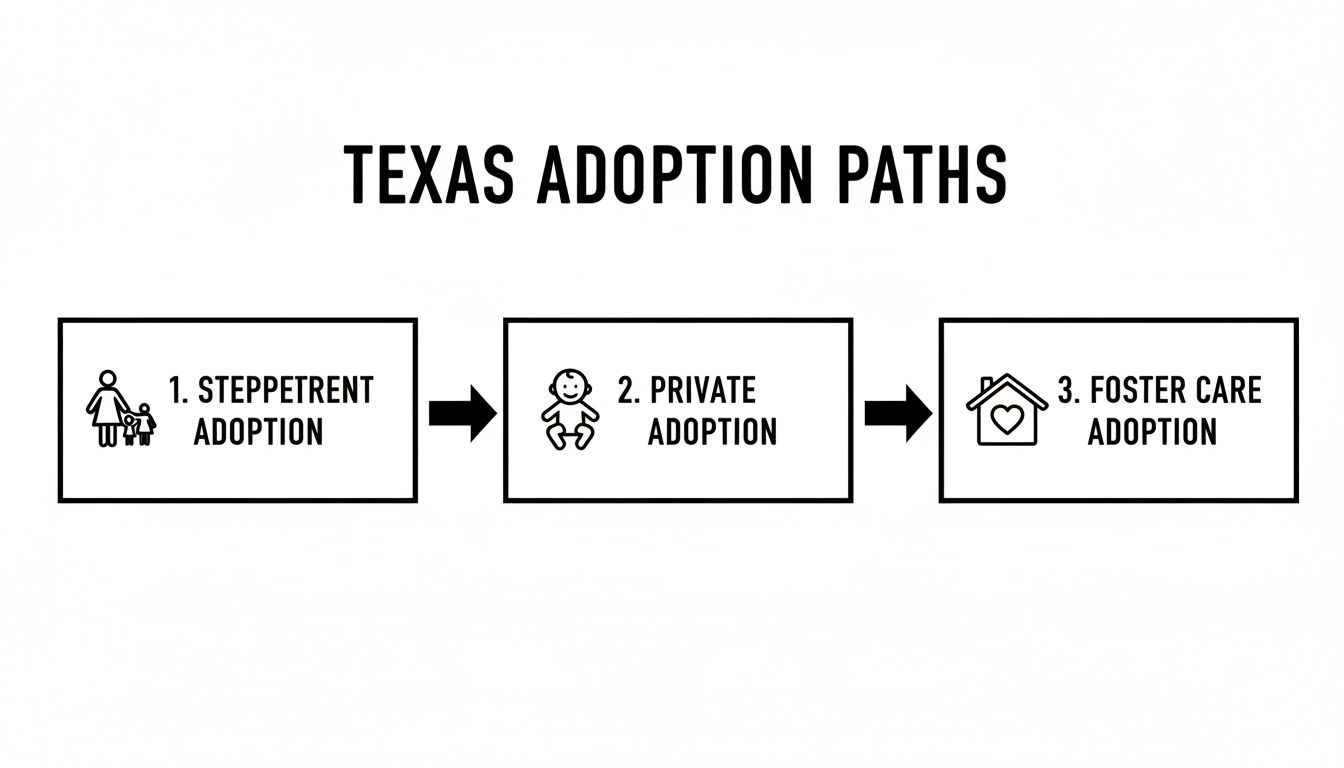
While each path has a unique start, they all converge on the same destination: creating a permanent, legal family. Knowing your specific path helps your attorney build the right strategy from day one.
Step 3: Post-Placement Supervision and Finalization
After your child is placed with you, a period of post-placement supervision begins. This typically lasts about six months. During this time, a social worker will visit your home a few times to see how everyone is adjusting. These visits are supportive, not intrusive—they are there to offer resources and make sure your new family is thriving.
The finalization hearing is the beautiful culmination of your entire journey. It’s the day the court officially declares you a family, transforming love and commitment into a legal reality.
Once the supervision period is successfully completed, your attorney schedules the finalization hearing. This is the moment you've worked so hard for. You, your child, and your attorney will appear before a judge who gives the entire case a final review.
The judge will confirm that every requirement under the Texas Family Code has been met and, most importantly, that the adoption is in the best interest of the child. Then, with the bang of a gavel and a signature on the final decree, your child is legally and forever a part of your family. It’s an emotional, celebratory day that many families call their "Gotcha Day"—the official birthday of their new family.
Getting through these steps is so much easier with an expert partner. To dive deeper, check out the Texas adoption process in our step-by-step guide. It gives you an even closer look at each phase of this incredible journey.
Understanding Adoption Costs and Timelines
When you decide to grow your family through adoption, two big questions immediately come to mind: “How much is this going to cost?” and “How long is this going to take?” These are perfectly normal, practical concerns, and getting clear answers can feel overwhelming.
With a solid understanding of the road ahead, you can turn that uncertainty into a manageable plan. Think of your adoption attorney in Texas as your financial and logistical guide, helping you map out a realistic budget and timeline for your journey.
Breaking Down Adoption Expenses
The cost of an adoption in Texas isn't a single, flat fee—it’s a combination of different expenses that depend entirely on the path you choose. The financial picture for a foster care adoption looks vastly different from a private infant adoption.
While every family's journey is unique, most adoptions will include some combination of the following costs:
- Legal Fees: This covers your attorney's work—from filing all court documents and managing the termination of parental rights to representing you at the final hearing.
- Agency Fees: If you’re working with a private adoption agency, their fees cover crucial services like matching you with a birth mother, providing her with counseling, and handling administrative tasks.
- Home Study Costs: In Texas, a licensed social worker must conduct a home study to ensure your home is a safe and suitable environment. This fee covers their time for the interviews, home visits, and preparing the official report for the court.
- Court Costs: These are the standard filing fees required by the court to process your adoption petition and other legal paperwork.
- Birth Parent Living Expenses: In private adoptions, Texas law allows you to provide reasonable financial support for the birth mother’s living and medical expenses. Your attorney is key here, making sure all payments are handled legally and ethically.
Adopting from the foster care system is almost always the least expensive route, as the state subsidizes many of the costs. On the other end of the spectrum, private infant adoptions typically require the largest financial investment.
Realistic Timelines for Your Adoption
Just like costs, adoption timelines can vary quite a bit. The length of your journey will depend on the type of adoption you're pursuing and whether any legal curveballs come your way.
An adoption can take anywhere from a few months to over a year. The key is patience and having a legal guide who can anticipate and manage potential delays, keeping the process moving forward.
Several factors can stretch out your timeline:
- Contested Actions: If a biological parent decides to fight the termination of their rights, the process will involve more court hearings and naturally take longer to resolve.
- Interstate Compact (ICPC): Adopting a child who lives in another state is more complex. It requires legal approval from both Texas and the other state’s government agencies, which adds an extra layer of bureaucracy and time.
- Waiting for a Match: In private infant adoptions, the time it takes to connect with an expectant mother can range from a few weeks to many months. This is often the most unpredictable part of the process.
This is where an experienced adoption attorney becomes invaluable. They can’t magically speed up a judge’s calendar, but they can provide a dose of predictability. By managing deadlines, navigating bureaucratic hurdles, and giving you a clear financial roadmap, they free you up to focus on what really matters: preparing your heart and home to welcome your child.
Choosing the Right Adoption Attorney for Your Family
Picking the right legal partner is one of the biggest decisions you'll make on your adoption journey. This isn’t just about hiring a lawyer; it’s about finding a guide and an advocate who understands both the legal hoops you need to jump through and the emotional weight of building your family. Your attorney should feel like a true partner—someone you trust completely to protect your family’s future.
Questions to Ask a Potential Attorney
Think of your first meeting as a two-way interview. You're not just there to get information—you’re there to see if they're the right fit. You need to walk away feeling confident in their skills and comfortable with their approach.
Here are a few essential questions to ask any adoption attorney in Texas:
- How much of your practice is dedicated to adoption? You want someone who lives and breathes adoption law, not a general family lawyer who handles a case here and there.
- What is your experience with my specific type of adoption? The needs of a stepparent adoption are worlds away from a private infant or CPS adoption. Find an attorney who already knows the path you're on.
- How do you communicate with clients? Ask about their process for giving updates and how easy it is to reach them with questions. Clear, consistent communication is the key to reducing stress.
- What is your philosophy on the "best interests of the child?" Their answer says a lot about their values. A compassionate attorney will always put the child's well-being at the center of every single decision.
More Than Just Legal Skill
The right attorney brings more to the table than just legal knowledge; they bring empathy. They understand this is a deeply personal journey, not just another case file. This is especially true here in Texas, where the need for dedicated legal professionals is significant.
With approximately 21,691 children in its foster care system according to recent data, Texas is a major hub for adoption services. An effective adoption attorney Texas must stay on top of changing state policies to give you realistic advice on timelines and potential outcomes. You can discover insights on state-by-state foster care statistics to learn more about these trends.
Finding the right attorney is about finding a shared commitment to building a strong, secure, and legally sound family. It’s about trust, shared values, and knowing your guide is just as invested in your family’s future as you are.
At The Law Office of Bryan Fagan, PLLC, our entire practice is built around keeping families strong and united. We believe every child deserves a permanent, loving home, and we pour our hearts and legal expertise into making that a reality for families across Texas. To learn more about what to look for in a legal partner, feel free to read our guide on how to find a good family law attorney.
If you’re looking for a team that combines professional excellence with a genuinely compassionate approach, we invite you to connect with us. Schedule a free consultation today, and let's talk about how we can help you take the next step toward building your family.
Common Questions About Adoption in Texas
It's natural to have a million questions when you're thinking about adoption. The process can feel overwhelming, but getting clear, straightforward answers is the first step toward building your family with confidence. We’ve put together answers to some of the most common questions we hear from Texas families.
Can We Change from a Closed to an Open Adoption Later?
The short answer is yes, it's possible, but it depends entirely on everyone involved being on the same page. A closed adoption can absolutely shift to a more open one down the road, but it requires mutual agreement.
Once an adopted person turns 18, they can petition the court for their original adoption records. If the birth parents have also filed written consent to be contacted, the court can release that identifying information, opening the door for a connection. Texas also has a voluntary reunion registry, which acts as a secure place for adult adoptees and their biological relatives to find one another if both sides have opted in.
What Are the Basic Requirements to Adopt in Texas?
The state’s primary goal is simple: place children in safe, stable, and loving homes. The Texas Department of Family and Protective Services (DFPS) has a list of basic requirements to ensure that happens.
To adopt in Texas, you generally need to be:
- At least 21 years old.
- Financially stable and responsible enough to support a child.
- Willing to share information about your life and background.
- Able to provide positive character references.
- Ready to complete a full home study, which includes background checks for every adult living in the house.
These rules apply whether you’re married, single, or part of an LGBTQ+ couple. An experienced adoption attorney in Texas can help you gather your documents and make sure this initial step is smooth and stress-free.
Do I Have to Appear in Court for the Adoption?
Yes, and this is the best part of the entire journey. The final court hearing is a mandatory—and wonderful—last step for every Texas adoption.
The finalization hearing is the official celebration of your new family. It’s the day the judge reviews your journey, confirms the adoption is in the child’s best interest, and signs the decree that makes your family legally whole, forever.
This is the moment you've been working toward. Your attorney will be right there with you, presenting the final paperwork and ensuring every legal detail is buttoned up. Far from being intimidating, this hearing is usually a happy and emotional event that officially marks the beginning of your new life together.
At The Law Office of Bryan Fagan, PLLC, we know these questions are just the beginning. We're here to provide the personalized, compassionate answers your family deserves. Schedule a free, confidential consultation with our team and let us help you build the family you’ve been dreaming of.

