
You've finally brought the baby home, or you're counting down the days until you do. The car seat is installed, the nursery is ready, and everyone keeps asking for photos, but one thought keeps interrupting the joy. The paperwork isn't finished yet, and in a surrogacy birth outside Texas, that can be the difference between feeling settled and feeling stuck.
That gap catches a lot of families off guard. A birth in another state, or another country, can look complete on the hospital discharge day, yet the legal work may still involve the birth state, federal agencies, and Texas courts or vital records. For Texas parents, the safest path is to treat the homecoming as a family milestone, not the end of the legal process.
When Your Baby Is Born But the Paperwork Is Not Done
A Texas couple can come home with a newborn, a diaper bag, and a stack of forms that do not yet finish the legal story. The baby is here. The paperwork may still be catching up. The question that matters in Texas is still open, who is the legal parent, and what record will Texas recognize?
That gap surprises a lot of families because a birth outside Texas can look finished on the hospital side while the legal work continues elsewhere. A baby born in another state, or another country, may involve the birth state, federal agencies, and later Texas court or vital records steps before the family record is complete. The same is true in many surrogacy cases, where the medical part and the legal part move on different timelines.
Why the birth certificate may not be enough
A birth certificate identifies a child, but it does not always answer every legal question Texas will care about later. If the child was born outside Texas, the birth state may issue one set of papers first, while Texas still requires its own recognition process so school records, doctor records, and other agencies can rely on the correct parentage.
Texas surrogacy law makes that split even clearer. Texas requires a valid gestational agreement and a Texas court validation of that agreement before a pre-birth order may be granted, so cases that cross state lines often depend on more than one jurisdiction's paperwork. For a plain-language explanation of why families sometimes need both paths, surrogacy vs. adoption in Texas helps show how the pieces fit together. Families crossing state lines also need to understand Interstate Adoption and the ICPC in Texas, because a child's movement from one state to another can trigger separate placement rules.
Practical rule: plan before the birth, not after discharge. Bringing the baby home is the family moment. The legal finish line may still be ahead.
Families who want to understand the contract side of these arrangements often benefit from a careful review of insights on contract law, because surrogacy agreements depend on clear terms and careful timing.
The Two-Track Legal Workflow Texas Families Must Follow
A baby can be home in Texas while the legal record is still catching up. That gap is where a lot of families get surprised, because the birth may be complete but Texas recognition may not be. The practical job is to finish the paperwork in the right order so the child's status, parentage, and future records all line up.
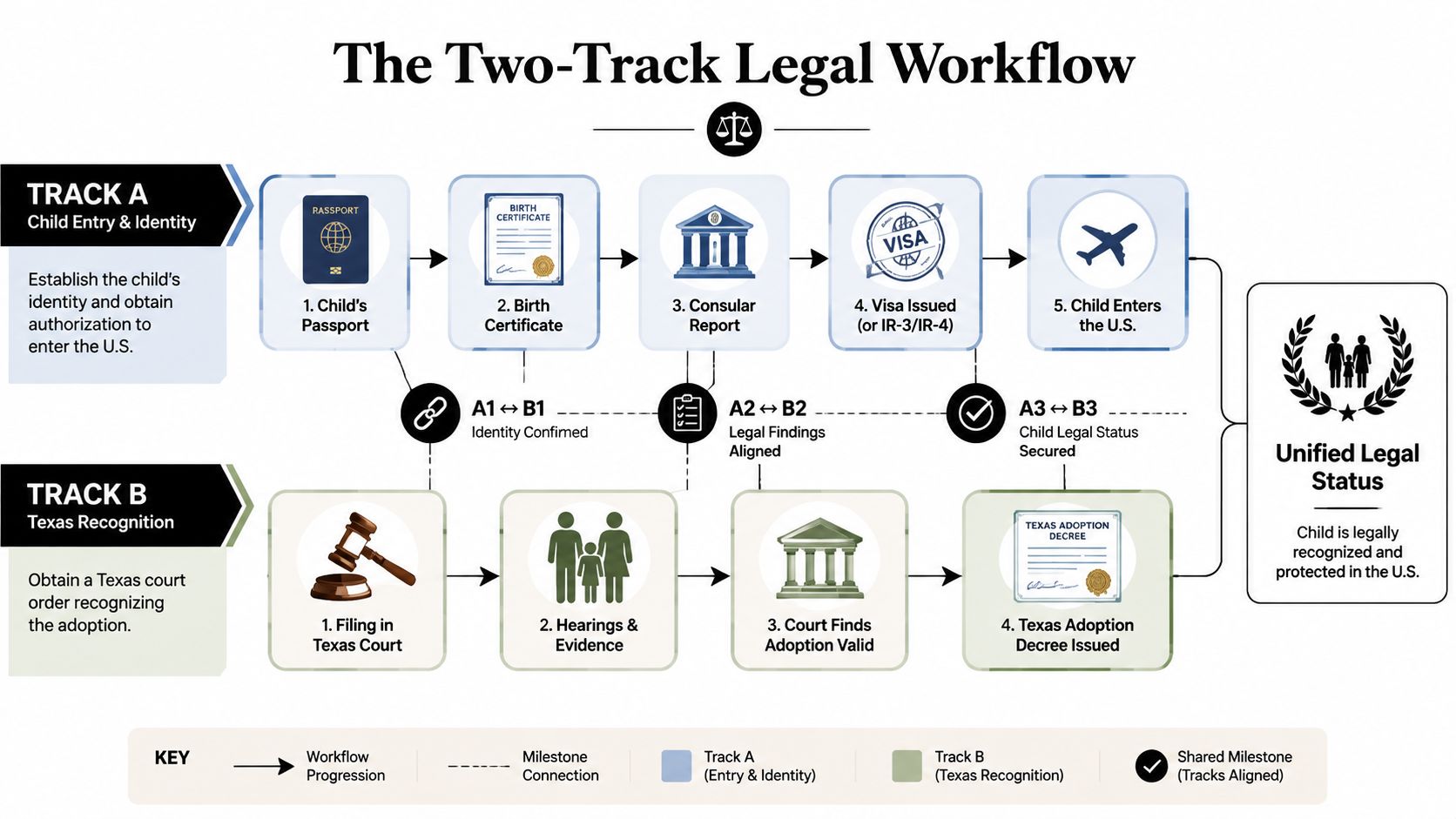
Track one and track two
The first track is the child's legal status as created by the birth state or foreign country. That includes the birth record, hospital discharge documents, and, for children born abroad, the consular or immigration steps that determine how the child is recognized on entry. The second track is Texas recognition, which may involve a parentage order, an adoption proceeding, or validation of a foreign decree so Texas agencies can treat the parents as the legal parents here.
These tracks do not move in lockstep. A family may finish one set of documents and still be waiting on the other, much like having a key that opens the front door but not the filing cabinet. If the second track is ignored, problems can show up later in school records, medical forms, insurance files, or any place that asks who the child's legal parents are.
Texas law treats those steps as separate because they answer different questions. Chapter 162 addresses adoption basics, including who may adopt and how parental rights are handled. Chapter 163 concerns the Interstate Compact on the Placement of Children when placement crosses state lines. Chapter 164 deals with consent and relinquishment. Chapter 165 covers the adoption decree. Chapter 166 addresses medical decision-making and advance directives, which can matter while the child's care plan is being completed. Families often need help sorting out whether they need legal parentage recognition, adoption, or both, and surrogacy and adoption in Texas, when you need both explains why the answer is sometimes a combination of procedures.
A Houston family can run into this exact split. A couple may use a surrogate in another state and receive a parentage order there, yet Texas still has to decide what it needs before the child's legal record is fully aligned here. That can affect the documents used for the child's Texas file, especially when parents want every agency record to match the family's actual situation. For families who also want a clear review of insights on contract law, the agreement side matters too, because the surrogacy contract sets the terms that support the paperwork later.
Domestic Out-of-State Births Versus International Surrogacy
A child born in another U.S. state and a child born abroad can both leave Texas parents with unfinished paperwork, but the legal layers are very different. That difference matters because the documents you gather, the agency you deal with, and the order you file in are not the same.
Domestic placement usually stays inside state systems
When a surrogate gives birth in another U.S. state, the main issues are birth-state parentage, interstate placement rules, and Texas recognition later. The family may already have a court order from the delivery state, but Texas still needs the record to line up with its own procedures before the child's legal identity is fully settled here. In these cases, Termination of Parental Rights Before Adoption is a useful companion resource because, in most adoptions, the court must clear the prior legal parent-child relationship before a new one can be created.
The emotional experience can still feel simple. You bring the baby home, you feed the baby, and life begins. The legal side is what stays complicated.
International surrogacy adds a federal layer
International cases are different because the family has to deal with foreign birth records, U.S. consular review, and federal citizenship or immigration rules before Texas gets a clean file. The U.S. State Department says assisted reproduction and surrogacy abroad raise complex citizenship and documentation issues, which is why families should not assume the foreign process works like a Texas one. The order of steps can affect whether the child can travel, whether the child gets a passport, and which court order Texas will eventually recognize.
This is also where time starts to stretch. A domestic out-of-state case may feel like a legal coordination problem, while an international case can feel like a multi-system handoff. The paperwork burden is usually heavier, and the consulate often becomes the gatekeeper.
Bottom line: if the birth happened outside Texas but inside the United States, think interstate parentage and Texas recognition. If the birth happened abroad, add foreign law, consular review, and federal citizenship rules to the list.
Families who live near the border or travel often already understand how one legal event can trigger another across jurisdictions. That same logic shows up in adoption and surrogacy cases, too.
Home Studies, Background Checks, and the Texas Six-Month Rule
Texas families are often surprised by how much preparation the court expects before finalization. The paperwork may begin with a birth abroad or across state lines, but Texas still wants a full, child-focused picture before it signs off.

What Texas courts look for
In a Texas suit for adoption, an adoption evaluation must be conducted as provided in Chapter 107, and the court may not grant the adoption until the child has lived with the petitioner for at least 6 months, unless an exception applies. That waiting period is not just a formality. It gives the court a chance to see that the placement is stable and that the child is thriving in the home.
Texas also uses a current home study as a key benchmark for interstate coordination. Texas DFPS says Texas can place children with families from other states only if they have a current home study, which shows how seriously the state treats pre-placement review. If you're gathering documents early, Texas home study requirements gives a practical overview of what families usually need to prepare.
Why early preparation helps
A family in Dallas who completes the home study before the birth often has a calmer first week after delivery. Their focus stays on bonding and medical care, not on chasing a social worker's signature while living out of a hotel. A family that waits until after the baby arrives may still get through the process, but the stress level is much higher.
The child's best interests sit at the center of this rule. Texas wants proof that the child is safe, the home is stable, and the placement is likely to last. That is why the law cares about background checks, evaluations, and the passage of time before finalization.
Courts do not want a rushed file. They want a stable child-centered record.
For families exploring private infant adoption, kinship care, stepparent adoption, or foster-care permanency, those same preparation rules still matter. The legal path changes, but the court's focus on safety and stability stays the same.
Birth Certificates, Amended Records, and Proving Genetic Parentage
A family can bring a baby home and still have an unfinished paper trail. The child is in the nursery, the diapers are stacked, and Texas still needs documents that show where the child was born, who has legal parentage, and how the state should build the record that other offices will rely on.
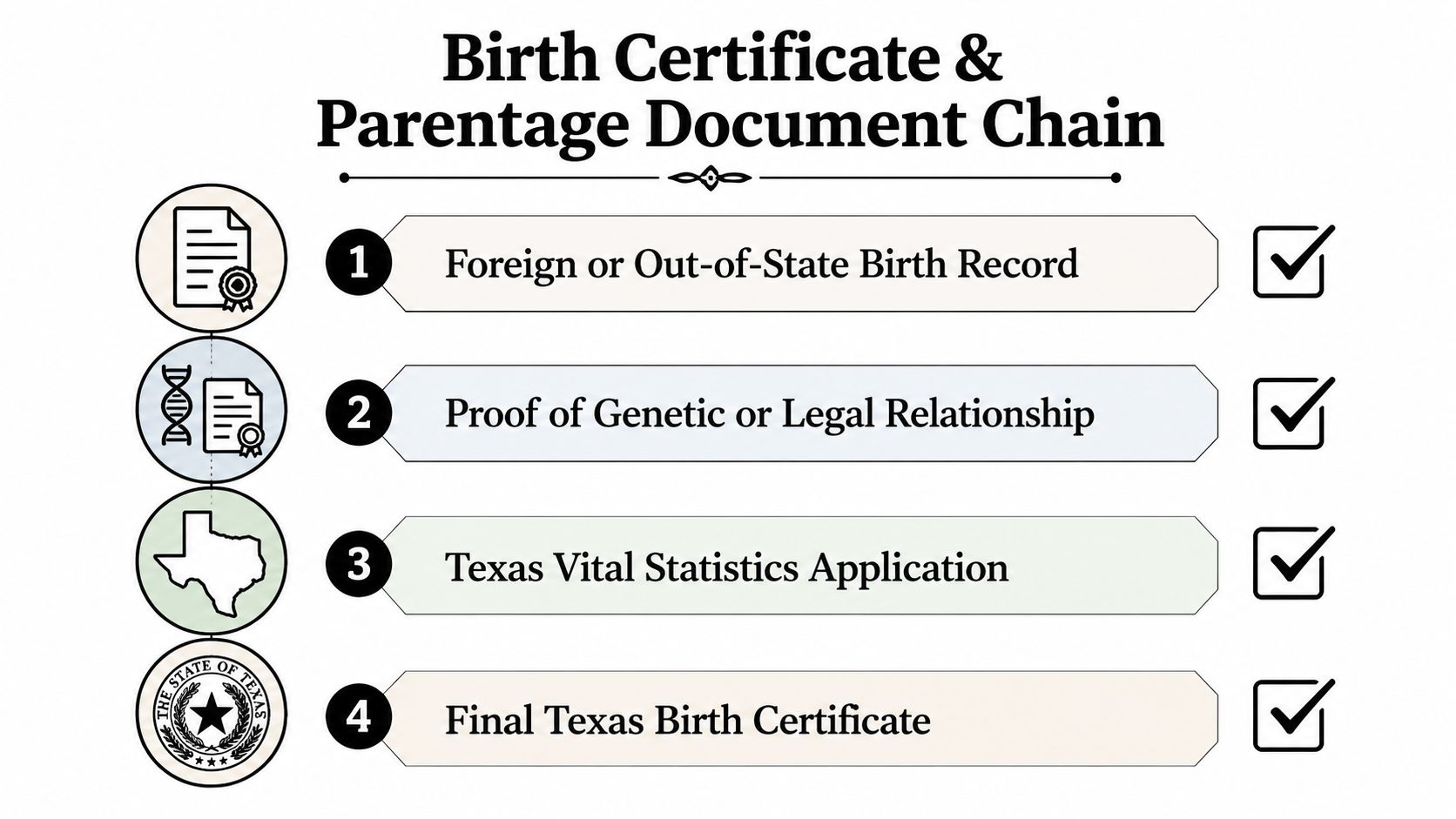
The chain of documents
The first link is the civil birth record from the state or country where the child was born. After that comes proof of genetic or legal relationship, which may include IVF records, parentage documents, or DNA testing in some cases. Texas then needs the filing that matches the child's legal status so the state can create a record schools, doctors, and agencies will read without confusion.
According to the U.S. State Department, assisted reproduction and surrogacy cases often require more than a hospital discharge packet, because the parent-child connection may have to be shown through several records that fit together. A hospital record, a lab record, and a parentage order do different jobs. When one of those pieces is missing, the file stops looking like one continuous story, and the next office in line may refuse to move it forward.
Texas also has a specific pathway for foreign adoptions and amended records. Under 25 Texas Administrative Code § 181.29, residents must submit a certified copy of the foreign adoption decree and English translations to a Texas court for validation, after which the State Registrar may prepare a new Texas certificate of birth. If the child's name also needs to be aligned with the legal record, Texas Family Code § 162.023 allows registration of a foreign adoption decree and may be paired with a name-change petition. Families dealing with an overseas case can also review this guide to adopting from another country while living in Texas for a broader explanation of the Texas side of the process.
Why one missing page can stall everything
A hospital record with the wrong parent name can delay the birth certificate. A missing IVF record can make it harder to show the intended parent-child connection. A decree that is valid in the birth country may still need translation or validation before Texas agencies will accept it.
That is why a clean file matters so much. The child's legal identity needs to match across the birth record, the Texas record, and any travel or identity document the family uses later. If one page says one thing and another page says something different, a clerk or registrar may see a gap where the family sees a finished case.
For families who are also preparing for life in France, that kind of document consistency matters even more because cross-border paperwork often gets checked against multiple records at once. The same problem shows up for Texas families who split time between states or countries. A small mismatch can create a large delay, and the fix usually starts with the paper trail, not with a new court filing.
USCIS, Consular Reports, and Citizenship for Children Born Abroad
When a child is born abroad through surrogacy, the federal layer becomes unavoidable. Texas families often think first about the homecoming, but the embassy or consulate may be the bottleneck.
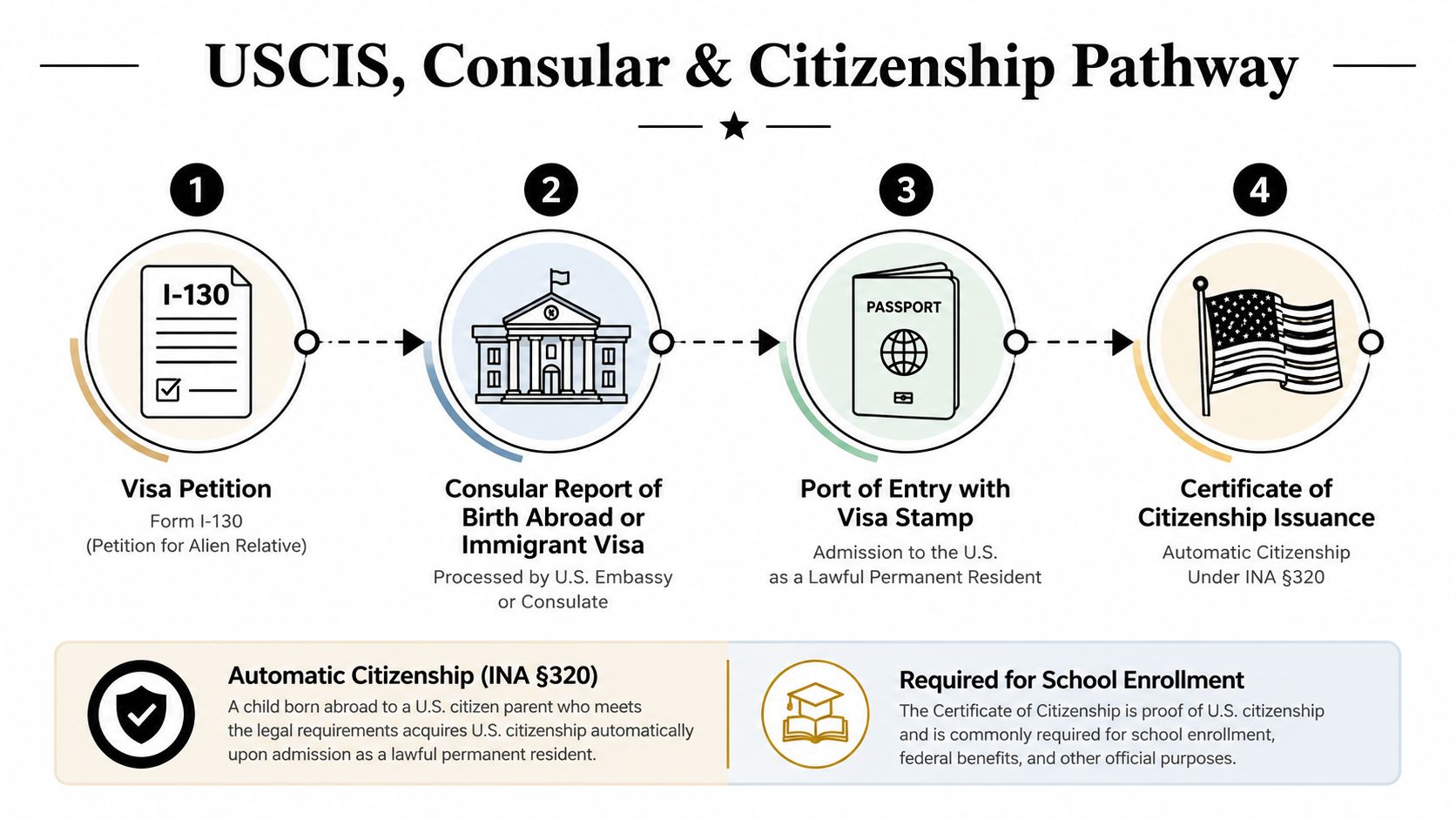
What citizenship depends on
The U.S. State Department says an adopted child born outside the United States automatically becomes a U.S. citizen only if a final adoption is completed, at least one parent is a U.S. citizen, the child is under 18, and the child resides in the United States in the legal and physical custody of the citizen parent as a lawful permanent resident. Those rules matter because citizenship is not assumed just because the child is biologically connected to a U.S. parent.
For international cases, the consular process may involve a Consular Report of Birth Abroad or another citizenship-related filing, depending on the child's facts and the country involved. The State Department also says assisted reproduction and surrogacy abroad create complex documentation issues, so parents should expect the consulate to ask for more than a hospital discharge packet.
If your family is trying to understand how those overseas steps fit with Texas life, adopting a child from another country while living in Texas is a helpful companion guide.
The travel document question
Parents often ask when they can leave the country with the baby. In many international surrogacy cases, the child needs the birth record, the passport or equivalent travel document, and the consular review before travel is safe or lawful. That is why many families wait on the embassy process instead of trying to solve everything after they get home.
If your family also needs to coordinate travel plans, preparing for life in France shows how document planning matters when a family crosses borders, even outside the adoption context.
The consulate often decides the pace, not the parents.
That can feel frustrating, but it is better to know early than to learn it after you're already abroad with a newborn.
A Realistic Timeline and the Hurdles That Catch Families Off Guard
A realistic timeline begins when the baby is born and ends only when Texas recognizes the child's legal status. A family can leave the birth state or foreign country with the baby in their arms and still have unfinished paperwork waiting behind them. That gap between homecoming and legal recognition is where many parents feel the most surprised.
One track handles the birth-state or foreign record. The other track handles Texas recognition, which may mean a parentage order, an adoption filing, or another court step depending on how the child was born and what documents already exist. Families often discover that those tracks do not move at the same pace.
| Sample Timeline After a Surrogacy Birth Outside Texas | Typical Window | Key Deliverable |
|---|---|---|
| Birth-state or foreign birth record | Immediate to short-term | Certified civil record |
| Genetic or legal parentage proof | Early document collection | IVF records, parentage order, or adoption decree |
| Travel or citizenship step | Varies by country or state | Passport, visa, or consular document |
| Texas recognition or adoption filing | After records are complete | Texas court or vital records action |
| Final home placement period | Often months in adoption cases | Court readiness for finalization |
Where cases slow down
The delays are usually documentary, not medical. Families get stuck when the civil birth record is incomplete, when genetic proof is missing, or when the documents do not match from one jurisdiction to the next. A second common problem is assuming one court order will satisfy both the place of birth and Texas, even though each system may ask for different proof.
The timetable can stretch in ways that are hard to predict. DNA testing may take time, travel documents may take longer than expected, and foreign parentage or adoption proceedings can move in separate stages. The consular or embassy review often becomes the point that controls the rest of the trip home. That does not mean every case will move at the same pace, only that one slow office can hold up everything else.
A family using a surrogate abroad may think the hardest part is delivery, but the handoff between agencies often creates a significant delay. A missing translation, a name mismatch, or a late-filed form can stop a process that already feels emotionally full.
Parents also need to think about travel planning before they assume they can leave. A visa checklist for UAE travel is a good reminder that border crossings depend on documents, not just intentions. The same idea applies here, since a newborn's exit from another country may depend on records that are still being assembled.
What to bring to the first meeting
A Texas family law attorney will usually want to see the gestational carrier agreement, the birth-state parentage order or foreign adoption decree, the child's birth record and passport, IVF and genetic records, the home study, and identification for each intended parent. If the child's legal status is still unsettled, the first meeting becomes the place where the roadmap starts.
Law Office of Bryan Fagan, PLLC helps Texas families work through adoption and guardianship questions with a focus on the child's best interests and the documents that have to line up before finalization. Families in Houston, Dallas, Austin, and San Antonio can meet with the firm, and statewide virtual consultations are available if travel is hard during the newborn stage.
If you are standing in that in-between place, baby in your arms and paperwork still open, you do not have to figure it out alone. Ask for help early, gather the records, and let a Texas family law team review the file before one missing document slows down your family's next step.
